



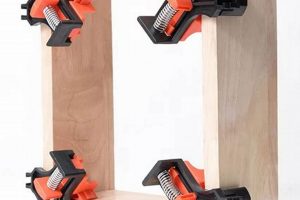
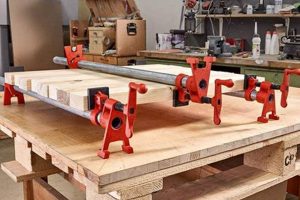
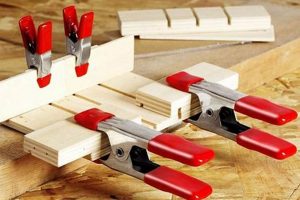
A collection of fastening tools specifically designed to hold workpieces securely together during the assembly, gluing, or finishing stages of carpentry projects constitutes a vital resource for woodworkers. These groupings typically include a variety of styles and sizes, allowing for adaptability to different project requirements. Examples encompass bar clamps for long, straight edges, pipe clamps for wider assemblies, corner clamps for right-angle joints, and spring clamps for quick, light-duty tasks.
The availability of a well-chosen assortment ensures greater efficiency and accuracy in woodworking endeavors. Proper workpiece stabilization prevents slippage, minimizes errors, and contributes to stronger, more durable final products. Historically, simpler clamping methods were employed; however, modern manufactured sets offer improved strength, adjustability, and ease of use, significantly advancing the quality of woodworking craftsmanship.
This article will examine the key types available, factors to consider when selecting an appropriate collection, and maintenance practices to prolong the life and effectiveness of these essential tools.
Essential Guidance
Selecting the correct set and employing best practices are crucial for achieving optimal woodworking results. The following guidelines address key considerations for maximizing the utility and lifespan of these tools.
Tip 1: Assess Project Needs: Prior to purchasing, analyze anticipated projects. Different joinery techniques and workpiece sizes demand specific types. A general-purpose collection may suit initial projects, but expanding the selection becomes necessary as skills and complexity increase.
Tip 2: Prioritize Quality: Invest in sets constructed from durable materials such as hardened steel. Inferior materials are prone to bending or breakage under pressure, compromising the integrity of the workpiece and posing a safety hazard.
Tip 3: Consider Throat Depth: The throat depth, or the distance from the bar to the clamping surface, determines the maximum thickness of material that can be accommodated. Select sets with a range of throat depths to accommodate diverse project requirements.
Tip 4: Apply Even Pressure: Distribute pressure evenly across the workpiece to prevent distortion or damage. Utilize cauls, or sacrificial pieces of wood, to spread the clamping force and protect delicate surfaces.
Tip 5: Avoid Over-Tightening: Excessive force can damage the workpiece or strip the threads of the clamping mechanism. Tighten only until the joint is secure and the glue line is thin and consistent.
Tip 6: Clean and Maintain Regularly: Remove glue residue and debris after each use. Lubricate moving parts with a light oil to prevent corrosion and ensure smooth operation. Store in a dry environment to further inhibit rust formation.
Tip 7: Use Appropriate Clamping Accessories: Accessories such as corner protectors, spreader attachments, and parallel clamping pads can enhance functionality and protect finished surfaces.
Adherence to these recommendations promotes efficiency, accuracy, and longevity, maximizing the value of the investment. The subsequent section will explore specific applications and techniques in greater detail.
1. Versatility

The versatility of a collection directly correlates to its utility across a wide spectrum of woodworking tasks. A set encompassing various types offers solutions for diverse clamping needs, mitigating the necessity for multiple specialized tools. This adaptability is particularly advantageous in projects involving complex joinery, curved components, or unusual shapes. For instance, a collection containing both parallel-jaw and spring variations allows a craftsman to secure large panels during glue-up and quickly affix smaller pieces for detail work. The absence of this variety would necessitate investing in a greater number of dedicated tools or compromising the effectiveness of the clamping process. This also allows for different angles and shapes of wood.
The effect of increased versatility extends beyond mere convenience. The capacity to adapt to different situations enhances productivity and reduces the risk of project delays due to inadequate tooling. The application of appropriate types, such as using band clamps for circular assemblies or edge types for securing trim, improves the quality of the final product by ensuring consistent pressure and precise alignment. The range of motion is one of the more essential elements. The number of woodworking and wood projects can be improved as well.
In summary, versatility is a crucial attribute, providing enhanced efficiency, improved project outcomes, and greater overall value. A well-rounded assembly allows the woodworker to tackle a broader range of challenges with confidence. This adaptability is critical for efficient handling and completion of different projects, enabling a craftsman to use specific types that serve different purposes in the wood handling.
2. Strength
The strength of fastening devices is a fundamental characteristic that directly impacts the success and safety of woodworking operations. The ability to withstand significant forces without deformation or failure is paramount when securing workpieces for gluing, assembly, or machining.
- Material Composition
The type of materials used dictates the overall strength. High-carbon steel or hardened alloys are common choices due to their tensile strength and resistance to bending. Cast iron is a heavier alternative. The specific alloy and heat treatment processes employed during manufacturing significantly influence the ultimate load-bearing capacity.
- Clamping Force Capacity
Each model is designed to exert a specific amount of pressure, measured in pounds or kilograms. Exceeding this rated force can result in damage to the tool, the workpiece, or both. Selecting based on the anticipated forces involved in a particular project is essential. The clamping force affects the way wood is handled, whether creating cabinets or small art pieces.
- Structural Design
The design of the frame, jaws, and screw mechanism contributes to its overall strength. Robust construction, reinforced stress points, and precisely machined threads are critical for ensuring consistent and reliable performance. Weaknesses in any of these areas can compromise the clamping force and lead to premature failure.
- Resistance to Deformation
A strong tool should resist bending or twisting under load. Deformation can lead to misalignment of the workpiece and compromise the integrity of the joint. High-quality models are designed to maintain their shape even under considerable pressure, ensuring accurate and consistent results. Even small amounts of pressure can add up when creating large pieces of furniture.
In conclusion, material composition, clamping force capacity, structural design, and resistance to deformation collectively determine the strength. Prioritizing these factors when selecting an set will ensure reliable performance and contribute to the production of high-quality, durable woodworking projects. These also help in the production and construction of larger projects or multiple of the same project.
3. Precision
In woodworking, precision is paramount, and the capacity to achieve accurate and repeatable results is heavily reliant on effective workpiece stabilization. The ability to hold components firmly in the correct position during assembly and finishing is directly related to the types utilized and their correct application. Without precise clamping, even the most meticulously crafted joinery can result in misaligned and structurally unsound projects.
- Joint Alignment
The primary function in facilitating precision is ensuring accurate joint alignment. When joining two pieces, proper application maintains the desired angle and prevents shifting during the gluing or fastening process. The use of corner or miter types is specifically designed to maintain right angles or precise bevels, respectively. Failure to achieve accurate joint alignment can lead to racking, instability, and aesthetically unappealing results.
- Consistent Pressure Distribution
Equally important is the provision of consistent pressure distribution across the joint surface. Uneven force can cause warping, distortion, or glue starvation, weakening the bond and compromising structural integrity. Parallel-jaw models are engineered to apply even pressure across a wide surface, minimizing the risk of these issues. Consistent pressure ensures uniform glue distribution and optimal bond strength.
- Repeatability and Accuracy
Precision clamping also contributes to repeatability and accuracy in batch production. By consistently securing workpieces in the same position, operators can ensure that each component is dimensionally accurate and conforms to the design specifications. This is particularly crucial in cabinetmaking or furniture construction, where multiple identical parts must be produced with minimal variance. Quality sets can perform the same work for a long period of time.
- Minimized Material Waste
Finally, precision contributes to minimized material waste. Misaligned or distorted workpieces often require rework or outright rejection, resulting in increased material consumption and production costs. Proper clamping minimizes these errors, ensuring that materials are used efficiently and effectively. The selection of appropriate styles, coupled with careful application, is essential for maximizing material yield and minimizing waste.
The aforementioned facetsjoint alignment, consistent pressure distribution, repeatability, and minimized material wastecollectively illustrate the inextricable link between precision and the effective utilization in woodworking. A commitment to selecting appropriate models and employing proper techniques translates directly into improved project quality, reduced waste, and enhanced overall efficiency. The result is better woodworking that yields positive results.
4. Durability
Durability, in the context of woodworking fastening devices, denotes the capacity to withstand repeated use, environmental exposure, and the inherent stresses associated with securing workpieces. The relationship between durability and these tools is a direct determinant of long-term value and performance. Inadequate durability translates to premature failure, requiring frequent replacement and increasing operational costs. Conversely, instruments constructed from robust materials and exhibiting sound design provide years of reliable service, representing a worthwhile investment for both professional and amateur woodworkers.
The material composition and construction methods directly influence the operational lifespan. Instruments fabricated from hardened steel or other high-strength alloys demonstrate superior resistance to bending, cracking, and corrosion compared to those constructed from inferior materials. For example, a pipe composed of malleable iron will exhibit a shorter service life and a greater susceptibility to damage than one forged from high-carbon steel, especially when subjected to high torque or repetitive clamping cycles. Regular maintenance, including cleaning and lubrication, further contributes to the longevity of these essential woodworking aids, mitigating the effects of wear and environmental factors.
In summary, durability constitutes a critical factor in evaluating and selecting collections for woodworking applications. The selection of sets characterized by robust materials, sound construction, and appropriate maintenance practices ensures a sustained operational lifespan, minimizes replacement costs, and contributes to consistently high-quality woodworking outcomes. The practical significance lies in the reduced downtime, increased efficiency, and overall cost savings associated with using reliable and long-lasting equipment.
5. Adaptability

Adaptability is a key attribute that defines the utility and long-term value of fastening tool collections within the woodworking domain. The capacity to accommodate diverse workpiece shapes, sizes, and orientations is fundamental to successful completion across a wide range of projects. A collection lacking adaptability will limit the craftsman’s ability to tackle unconventional tasks, potentially leading to project delays, compromised quality, or the necessity of acquiring additional, specialized tools. For example, when constructing furniture with curved elements, traditional parallel-jaw instruments are often inadequate. In such cases, band or flexible types become essential for applying uniform pressure along the curved surface. Without these adaptable options, achieving a secure and aesthetically pleasing bond is significantly more challenging.
Furthermore, adaptability extends beyond accommodating different workpiece geometries. It encompasses the ability to apply varying degrees of pressure, allowing for the securement of both delicate and robust materials. Spring models provide gentle, even pressure suitable for thin veneers or easily marred surfaces, while heavy-duty bar types deliver the substantial force required for assembling thick timbers. The presence of a diverse range within a single collection enables the woodworker to select the appropriate tool for each specific application, minimizing the risk of damage or distortion. For example, in cabinetry construction, where both solid wood frames and thin plywood panels are employed, a single adaptable set proves far more versatile than relying solely on instruments designed for one specific material thickness or fragility.
In summary, the inherent adaptability of a well-curated collection translates directly to enhanced project versatility, reduced material waste, and improved overall efficiency. The ability to adapt to varying project requirements and material properties is a critical determinant of the long-term value and utility of these essential tools. Therefore, when selecting woodworking fastening devices, prioritizing adaptability ensures that the investment will serve a multitude of purposes, accommodating both current and future project demands. The absence of this adaptability may well limit what projects are possible.
6. Selection

The selection of appropriate fastening devices significantly impacts the outcome of woodworking projects. This process involves a deliberate evaluation of project requirements to determine the specific types and quantities needed. Inadequate or inappropriate selection can lead to compromised joint strength, dimensional inaccuracies, and overall project instability. For example, utilizing lightweight spring devices to secure heavy timber frames will likely result in insufficient pressure and subsequent joint failure. Conversely, employing excessively powerful bar styles on delicate veneers may cause crushing or distortion. The selection process is therefore not merely a matter of acquiring a random assortment, but rather a strategic consideration of the forces involved, materials used, and desired outcome.
The selection process necessitates an understanding of different types and their specific applications. Bar types, pipe types, corner types, and spring types each offer unique advantages and limitations. Bar types excel at applying consistent pressure along straight edges, while pipe types allow for increased clamping length by adding pipe extensions. Corner types facilitate the assembly of right-angle joints, and spring types provide quick, light-duty clamping for temporary securement. Consider a scenario where a woodworker needs to assemble a large cabinet carcass. The optimal approach would involve a combination of bar types for the main panel joints and corner types for the face frame. Selecting only one type would likely lead to inefficiencies and compromised accuracy.
In conclusion, careful selection is a critical determinant of success. A thoughtful approach, informed by an understanding of project requirements and the capabilities of different clamping types, maximizes efficiency, minimizes errors, and contributes to the production of high-quality, durable woodworking projects. Failing to prioritize selection risks compromising the structural integrity and aesthetic appeal of the final product. Therefore, the investment of time and effort in selecting the right tools is essential for achieving optimal woodworking results and project stability, and preventing the project to fail.
Frequently Asked Questions About Fastening Collections for Woodworking
The following section addresses common inquiries and misconceptions regarding the selection, use, and maintenance of fastening devices in woodworking applications.
Question 1: What constitutes an adequate number of instruments within a basic woodworking collection?
The quantity varies based on project scope and frequency. A starter set should include at least four bar instruments of varying lengths (e.g., 6″, 12″, 24″, 36″), two corner instruments, and a selection of spring types. Expansion is recommended as project complexity increases.
Question 2: What is the recommended material for woodworking fastening devices designed for heavy-duty applications?
High-carbon steel or hardened steel alloys are generally recommended for heavy-duty use due to their superior strength and resistance to bending or deformation under pressure.
Question 3: How does the throat depth of a fastening device influence its suitability for different woodworking projects?
The throat depth determines the maximum thickness of material that can be accommodated. Selecting types with varying throat depths ensures compatibility with a wide range of workpiece dimensions.
Question 4: What are the potential consequences of over-tightening during glue-ups?
Over-tightening can lead to glue starvation, workpiece distortion, or damage to the fastening mechanism itself. Apply only sufficient pressure to create a thin, consistent glue line.
Question 5: What routine maintenance procedures are recommended to prolong the life of woodworking fastening devices?
Regular cleaning to remove glue residue and debris, lubrication of moving parts with a light oil, and storage in a dry environment are essential for preventing corrosion and ensuring smooth operation.
Question 6: Are there specific scenarios where specialized fastening accessories are recommended?
Yes. Corner protectors, spreader attachments, and parallel clamping pads are beneficial for protecting finished surfaces, distributing clamping force evenly, and accommodating specific joinery techniques.
The prudent application of these guidelines enhances the effectiveness and longevity of these essential woodworking tools.
The subsequent section will delve into advanced techniques and innovative applications, showcasing how skillful utilization contributes to exceptional woodworking outcomes.
Conclusion
The preceding analysis has elucidated the crucial role of fastening device collections in woodworking. From ensuring precision joint alignment to withstanding significant clamping forces, the selection, application, and maintenance of appropriate toolsets are integral to project success. The inherent versatility, strength, durability, and adaptability of quality collections directly translate into improved efficiency, reduced material waste, and enhanced structural integrity of finished pieces. These, like the craftsman, must all work in concert.
Therefore, the discerning woodworker must recognize the acquisition of comprehensive fastening device collections as a critical investment, essential not merely for completing individual projects but for elevating the overall standard of craftsmanship. Continued exploration of innovative techniques and meticulous attention to tool maintenance are paramount for maximizing the potential and ensuring enduring value from these indispensable woodworking aids. The future of many projects is hinged to the application of fastening and clamping.
![Top-Rated: Best Quick Clamps for Woodworking Projects [2024] | Step-by-Step Guides, Tools & Inspiration to Build Beautiful Wooden Decor on a Budget](https://woodfromhome.com/wp-content/uploads/2026/04/th-264-300x200.jpg "Top-Rated: Best Quick Clamps for Woodworking Projects [2024] Step-by-Step Guides, Tools & Inspiration to Build Beautiful Wooden Decor on a Budget")