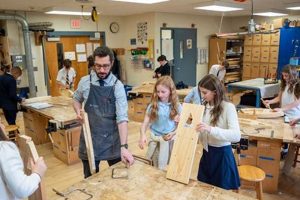
A shared learning experience centered around the craft of woodworking, designed specifically for pairs. These sessions provide instruction and guidance as participants collaborate on projects, often resulting in functional or decorative items. An example includes a two-person team building a small table or a set of coasters together.
Engaging in collaborative creative activities offers multiple advantages. It fosters communication, strengthens relationships through shared accomplishments, and provides a stimulating alternative to conventional date nights. Historically, the transmission of craft skills often occurred within family units, making this a modern adaptation of time-honored practice.
The following sections will delve into the specific types of projects suitable for paired participants, the necessary tools and safety precautions, and how to locate and select a beneficial instructional opportunity. Furthermore, the potential for continued exploration and personal development in woodworking will be addressed.
Guidance for Engaging in Woodworking as a Pair
The following recommendations are intended to optimize the experience of learning and practicing woodworking with a partner. Thoughtful preparation and clear communication are essential for success.
Tip 1: Define Shared Objectives: Before beginning, discuss desired outcomes. Establish whether the primary goal is skill acquisition, creative expression, or relationship enhancement. Agree upon the types of projects that align with shared interests and abilities.
Tip 2: Assign Roles and Responsibilities: Divide tasks based on individual strengths and preferences. One person may be more adept at measuring and cutting, while the other excels at sanding and finishing. Rotating responsibilities can provide exposure to different aspects of the craft.
Tip 3: Prioritize Safety Protocols: Thoroughly review safety guidelines for each tool and technique. Ensure both individuals understand the proper use of safety equipment, such as eye protection and hearing protection. Maintaining a clean and organized workspace minimizes potential hazards.
Tip 4: Communicate Clearly and Respectfully: Open and honest communication is critical for avoiding misunderstandings and resolving conflicts. Offer constructive feedback and be receptive to suggestions. Celebrate successes and learn from mistakes together.
Tip 5: Select Appropriate Projects: Begin with simple projects that allow for skill development and collaboration. Avoid overly complex designs that may lead to frustration or require advanced expertise. Gradual progression to more challenging tasks fosters confidence and builds teamwork.
Tip 6: Allocate Sufficient Time: Rushing through projects can compromise quality and increase the risk of errors. Schedule dedicated time for woodworking sessions, allowing for focused attention and relaxation. Enjoy the process of creating together.
Tip 7: Explore Various Resources: Supplement instruction with books, online tutorials, and workshops. Seek guidance from experienced woodworkers and observe different techniques. Continuous learning enhances skills and inspires new ideas.
These guidelines will help pairs to benefit fully from woodworking, fostering cooperation, creating tangible objects, and strengthening bonds.
In conclusion, by carefully applying these tips, couples can effectively navigate the challenges and reap the rewards of collaborative woodworking. This shared activity presents a unique opportunity for personal growth and enhanced partnership.
1. Project Selection

Within the context of woodworking instruction for pairs, project selection serves as a foundational element determining the overall success and satisfaction derived from the experience. The chosen project directly influences the level of engagement, the acquisition of new skills, and the potential for collaborative synergy. A project too complex for the combined skill level can lead to frustration and discord, while an overly simplistic project may fail to stimulate interest or provide a sense of accomplishment. For example, selecting a project like building a small picture frame introduces basic cutting, joining, and finishing techniques, promoting teamwork without overwhelming participants. The careful consideration of project parameters is, therefore, paramount in ensuring a positive and productive learning environment.
Real-world scenarios underscore the practical significance of informed project selection. In a beginner’s class, the construction of a simple birdhouse demonstrates the cause-and-effect relationship between appropriate project difficulty and skill development. Success in such a task can foster confidence and encourage further exploration of woodworking techniques. Conversely, attempting a project like crafting a dovetailed drawer in an introductory setting can easily lead to disillusionment and a negative perception of the craft. The effective integration of project selection involves assessing existing skill sets, defining clear learning objectives, and providing adequate support and guidance throughout the process.
In summary, project selection is not merely a preliminary step but an integral component that dictates the efficacy of woodworking instruction for paired participants. By aligning project complexity with skill levels, instructors can facilitate a collaborative and rewarding learning experience. A strategically chosen project cultivates teamwork, enhances skill acquisition, and lays the foundation for continued engagement with the craft. The challenges associated with mismatched projects can be mitigated through thorough planning, clear communication, and a commitment to fostering a supportive environment.
2. Skill Level Matching

The alignment of woodworking proficiency within a pair significantly impacts the instructional dynamic and overall outcome of shared learning experiences. Disparities in skill can create imbalances, affecting participation, engagement, and the ultimate quality of the collaborative effort. Careful consideration of existing skill levels is therefore essential.
- Impact on Collaborative Synergy
Significant differences in woodworking expertise between partners may hinder effective collaboration. An experienced individual might dominate the project, overshadowing the less skilled partner, potentially leading to feelings of inadequacy or disengagement. Conversely, a lack of proficiency in both individuals can create frustration and impede project progress. Skill level matching aims to foster a more equitable distribution of tasks and a shared sense of accomplishment.
- Course Selection Implications
The choice of instructional setting should reflect the average or lower skill level of the pair. Introductory classes designed for beginners are suitable when neither individual possesses prior woodworking experience. More advanced courses are appropriate only when both participants have demonstrated competence in foundational techniques. Misaligned course selection can result in one individual being bored or overwhelmed, negatively impacting the shared experience.
- Project Complexity and Task Allocation
Skill level considerations directly influence project selection and the allocation of specific tasks. Simpler projects that require basic techniques, such as cutting, sanding, and assembly, are more suitable for pairs with limited experience. Complex projects involving intricate joinery or advanced finishing techniques necessitate a higher level of skill. Tasks should be assigned based on individual strengths and weaknesses, allowing each partner to contribute meaningfully to the overall project.
- Adaptation and Individualized Instruction
Effective instruction acknowledges and addresses disparities in skill level. Instructors should provide individualized guidance and support to ensure both partners are actively engaged and progressing at a comfortable pace. Adaptive teaching strategies may involve modifying project components or providing supplemental instruction to address specific skill deficits. The goal is to create a supportive learning environment where both individuals can develop their woodworking skills and contribute to a successful collaborative outcome.
In conclusion, skill level matching represents a critical factor in optimizing woodworking instruction for paired participants. By carefully assessing existing skill sets, selecting appropriate courses and projects, and providing individualized support, instructors can foster a collaborative and rewarding learning experience for all involved. The ultimate aim is to promote skill development, enhance teamwork, and create tangible objects that represent a shared accomplishment.
3. Tool Safety Training

Tool safety training constitutes a cornerstone of any woodworking instruction, and its significance is amplified in a “couples woodworking class” setting. The presence of two individuals sharing tools and workspace introduces a heightened potential for accidents if proper safety protocols are not rigorously enforced. A lack of comprehensive training can lead to injuries ranging from minor cuts and abrasions to more severe incidents involving power tools. Therefore, integrating thorough safety instruction is not merely a recommendation but a prerequisite for a successful and secure “couples woodworking class” environment. Examples include demonstrations of proper machine guarding, the use of personal protective equipment (PPE) such as safety glasses and hearing protection, and instruction on safe tool handling techniques.
Furthermore, effective tool safety training extends beyond the demonstration of basic procedures. It involves fostering a culture of awareness and responsibility among participants. Couples must be educated on identifying potential hazards in the workshop, communicating effectively about safety concerns, and responding appropriately in emergency situations. For instance, participants should understand the importance of clear communication when one partner is operating a potentially hazardous tool, ensuring that the other remains at a safe distance and is aware of the operational parameters. In a real-world scenario, a properly trained pair will know how to safely shut down a machine if an emergency occurs, minimizing the risk of injury. This proactive approach to safety is essential for preventing accidents and promoting a positive learning environment.
In summary, tool safety training is inextricably linked to the success and well-being of participants in “couples woodworking class”. Comprehensive instruction, coupled with a culture of safety awareness, mitigates risks, prevents injuries, and fosters a collaborative learning environment. By prioritizing tool safety training, instructors ensure that participants acquire not only woodworking skills but also the knowledge and habits necessary for safe and responsible practice, both within and beyond the instructional setting. The consequences of neglecting this critical component can be severe, underscoring the practical significance of integrating thorough safety training into all “couples woodworking class” curricula.
4. Collaborative Planning
Collaborative planning serves as a pivotal element within the context of a “couples woodworking class,” directly influencing project success, participant satisfaction, and relationship dynamics. The structured process of joint decision-making, task allocation, and problem-solving significantly mitigates potential conflicts and enhances the overall learning experience. For instance, the absence of a pre-defined plan can result in disagreements over design choices, inefficient use of materials, and an uneven distribution of labor, leading to frustration and diminished enjoyment. Conversely, a well-developed collaborative plan fosters a sense of shared ownership, promotes effective communication, and facilitates the efficient execution of woodworking projects.
The practical application of collaborative planning involves several key steps. Initial discussions should focus on defining project goals, assessing individual skill sets, and identifying preferred design aesthetics. Subsequent planning involves breaking down the project into manageable tasks, assigning responsibilities based on individual strengths, and establishing clear timelines and milestones. Real-world examples demonstrate the benefits of this approach. A couple constructing a small table might collaboratively decide on the table’s dimensions, wood type, and finishing style. One partner, possessing greater experience with power tools, could handle the cutting and shaping of the wood, while the other partner focuses on sanding, assembly, and finishing. This division of labor ensures that each partner contributes meaningfully to the project, leveraging their respective skills and interests.
In conclusion, collaborative planning is not merely a recommended practice but an essential component of a successful “couples woodworking class.” Its implementation fosters teamwork, promotes efficient project execution, and strengthens interpersonal bonds. While challenges may arise in the form of differing opinions or conflicting schedules, the benefits of collaborative planning far outweigh the potential drawbacks. By prioritizing shared decision-making and open communication, couples can transform woodworking projects into opportunities for both skill development and relationship enhancement, leading to a more rewarding and fulfilling learning experience.
5. Communication Techniques

Effective communication techniques form an indispensable component of any successful “couples woodworking class.” The shared nature of the learning environment necessitates clear, concise, and respectful exchange between partners to ensure project success and maintain a positive atmosphere. Inadequate communication can lead to misunderstandings, errors in execution, and ultimately, a diminished learning experience. For instance, a disagreement on measurement interpretation, if left unaddressed, may result in incorrectly cut pieces and the need for costly material replacement. The absence of clear communication regarding tool usage can also pose significant safety risks, underscoring the critical link between effective dialogue and a safe working environment.
Specific examples illustrate the practical significance of communication techniques. Before commencing any task, partners must collaboratively define the project scope, clarify individual responsibilities, and establish agreed-upon procedures. During the execution phase, continuous communication is crucial for coordinating efforts, identifying potential problems, and implementing corrective measures. Consider a scenario where one partner notices a flaw in the wood grain that could affect the structural integrity of the project. Alerting the other partner immediately allows for a joint assessment and a revised plan, preventing potential damage and ensuring the project’s longevity. Furthermore, active listening skills are essential for understanding instructions, providing constructive feedback, and resolving conflicts that may arise during the learning process.
In conclusion, communication techniques are not merely ancillary skills but integral elements that determine the efficacy of a “couples woodworking class.” By prioritizing clear, respectful, and continuous dialogue, partners can navigate challenges, enhance their learning experience, and strengthen their relationship. While mastering these techniques requires conscious effort and practice, the benefits extend far beyond the workshop, contributing to improved communication dynamics in other aspects of their lives. Neglecting the importance of communication, however, can undermine the entire learning experience, transforming what could be a rewarding shared activity into a source of frustration and discord.
6. Creative Problem Solving

The inherent challenges within a woodworking project necessitate the application of creative problem-solving skills, a connection that is amplified in a “couples woodworking class.” The combined perspectives and skill sets within a pair create a synergistic environment where innovative solutions can emerge. Discrepancies between initial design and practical execution, material limitations, and unexpected tool malfunctions represent common impediments. For example, if a piece of wood intended for a table leg exhibits an unforeseen knot, the pair must collaboratively devise an alternative strategy, such as modifying the leg’s design or sourcing a replacement piece. This process cultivates adaptability and resourcefulness, qualities that extend beyond the confines of the woodworking workshop.
The importance of creative problem-solving as a component of “couples woodworking class” stems from its ability to transform potential setbacks into opportunities for growth. When confronted with a challenge, partners must communicate effectively, explore alternative approaches, and critically evaluate the implications of each decision. A real-life example could involve adapting a traditional joint technique to accommodate a non-standard wood thickness. The pair must analyze the structural requirements, consider various joint configurations, and implement a solution that balances aesthetics, functionality, and material constraints. This experience fosters critical thinking, strengthens decision-making skills, and enhances the ability to collaborate under pressure, directly contributing to both the success of the project and the strength of the relationship.
In conclusion, the nexus between creative problem-solving and “couples woodworking class” is a fundamental aspect of the learning experience. The collaborative environment fosters innovation, adaptability, and effective communication, enabling partners to overcome obstacles and achieve shared goals. While challenges inevitably arise, the ability to creatively address these challenges strengthens both woodworking skills and interpersonal bonds. This understanding underscores the practical significance of incorporating problem-solving exercises and fostering a collaborative spirit within woodworking instruction designed for pairs, ultimately enhancing the overall value and impact of the course.
7. Relationship Building

The integration of relationship building within a “couples woodworking class” transcends the mere acquisition of woodworking skills. The shared activity provides a structured environment that inherently fosters communication, cooperation, and mutual support, elements essential for relationship strengthening. The challenges and triumphs experienced during the process become catalysts for deeper connection and understanding.
- Shared Goal Orientation
Working towards a common objective, such as constructing a functional or decorative item, promotes a sense of unity and purpose. The act of jointly conceiving, planning, and executing a project necessitates compromise, negotiation, and a shared vision. Success, defined by the completed project, becomes a tangible representation of their collaborative effort, strengthening the bond between participants. An example includes the joint construction of a coffee table, where each partner contributes specific skills and perspectives to achieve a common aesthetic and functional outcome.
- Enhanced Communication
Woodworking requires precise instruction and clear communication to avoid errors and ensure safety. Partners must articulate their ideas, listen attentively to feedback, and effectively convey their intentions. This active exchange of information, often under time constraints or technical challenges, can improve communication patterns within the relationship. The collaborative design and execution of a complex joint, for instance, demands that partners express their understanding of the process and actively listen to each other’s concerns or suggestions.
- Development of Mutual Respect
Recognizing and valuing each other’s strengths and weaknesses is crucial for successful collaboration. The “couples woodworking class” provides an opportunity for partners to appreciate each other’s skills and learn from their expertise. This mutual respect extends beyond the workshop, fostering a more supportive and equitable relationship dynamic. Observing a partner’s proficiency with hand tools or problem-solving techniques can cultivate admiration and appreciation, strengthening the overall relationship.
- Shared Learning and Growth
Acquiring new skills together fosters a sense of shared accomplishment and intellectual stimulation. The process of learning woodworking techniques provides opportunities for partners to support each other, celebrate milestones, and overcome challenges. This shared growth experience contributes to a more dynamic and engaging relationship. Successfully mastering a new jointing technique or completing a challenging woodworking project together creates a lasting memory and strengthens the bond between partners.
In summation, the integration of these facets within a “couples woodworking class” extends its value beyond mere skill acquisition. The structured environment inherently promotes collaboration, communication, and mutual respect, fostering stronger relationships. This shared experience serves as a catalyst for deeper connection and understanding, contributing to a more resilient and fulfilling partnership. The tangible outcome of the woodworking project acts as a lasting symbol of the couple’s ability to work together effectively, reinforcing the positive impact of the shared activity.
Frequently Asked Questions
This section addresses common inquiries regarding couples woodworking instruction, providing clear and concise answers to assist in informed decision-making.
Question 1: What is the optimal skill disparity between partners to ensure a positive learning experience?
Ideally, skill levels should be relatively similar. Large discrepancies can lead to one partner dominating the project or the other feeling inadequate. Beginner-level courses are recommended if neither partner possesses prior woodworking experience. If one partner has moderate experience, an intermediate class with tailored instruction may be appropriate.
Question 2: What safety precautions are essential for participants in couples woodworking classes?
Adherence to safety protocols is paramount. Participants must wear appropriate personal protective equipment, including safety glasses, hearing protection, and closed-toe shoes. Instruction on proper tool handling, machine guarding, and emergency procedures is mandatory. A clear understanding of potential hazards and a commitment to safe practices are crucial.
Question 3: How does collaborative planning contribute to the success of woodworking projects in a couples class?
Collaborative planning ensures that both partners are aligned on project goals, design specifications, and task assignments. This process minimizes disagreements, promotes efficient resource allocation, and fosters a sense of shared ownership. A well-defined plan enhances the overall quality of the project and strengthens the collaborative dynamic.
Question 4: What communication techniques are most effective in a shared woodworking environment?
Clear, concise, and respectful communication is essential. Partners should actively listen to each other, provide constructive feedback, and articulate their ideas effectively. Open dialogue facilitates problem-solving, prevents misunderstandings, and promotes a positive learning atmosphere.
Question 5: How does a woodworking class specifically benefit the relationship between partners?
A woodworking class provides a structured environment for couples to collaborate on a shared goal, fostering teamwork, communication, and mutual respect. The experience of overcoming challenges and celebrating successes together strengthens their bond and creates lasting memories.
Question 6: What are the common project types suitable for introductory couples woodworking classes?
Suitable introductory projects include cutting boards, small picture frames, coasters, and simple boxes. These projects introduce basic woodworking techniques, such as cutting, sanding, and assembly, without requiring advanced skills or complex joinery. Successful completion of these projects provides a solid foundation for further exploration.
In summary, successful engagement in a couples woodworking class necessitates careful consideration of skill levels, adherence to safety protocols, emphasis on collaborative planning, and effective communication. The shared experience can enhance relationships and provide a lasting sense of accomplishment.
The following section will explore the long-term benefits of woodworking and how to continue developing skills after completing the initial course.
Conclusion
This exploration of “couples woodworking class” has highlighted key aspects including project selection, skill level matching, safety protocols, collaborative planning, communication techniques, creative problem-solving, and relationship building. The integration of these elements is crucial for creating a productive and fulfilling learning environment. The potential benefits extend beyond skill acquisition, fostering stronger interpersonal bonds and enhancing teamwork abilities.
Considering the demonstrated advantages, participation in a “couples woodworking class” represents a valuable investment in both personal and relational development. The craft of woodworking, when shared, offers a unique avenue for growth and collaboration, yielding tangible creations and lasting memories. Individuals are encouraged to seek opportunities for shared learning experiences that promote skill development and relationship enhancement.

![Learn Woodworking: Classes in Fort Collins [Skills!] | Step-by-Step Guides, Tools & Inspiration to Build Beautiful Wooden Decor on a Budget](https://woodfromhome.com/wp-content/uploads/2026/04/th-267-300x200.jpg "Learn Woodworking: Classes in Fort Collins [Skills!] Step-by-Step Guides, Tools & Inspiration to Build Beautiful Wooden Decor on a Budget")