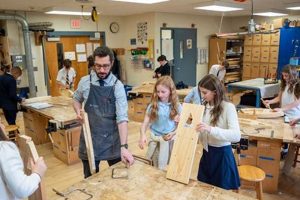
The acquisition of woodworking skills within the Japanese tradition represents a commitment to precision, artistry, and respect for natural materials. These instructional programs offer participants the opportunity to learn techniques passed down through generations, focusing on joinery, tool usage, and finishing methods distinctive to the region. For example, a beginner’s workshop might cover the fundamentals of using a Japanese hand plane (kanna) and saw (nokogiri) to create simple wooden boxes.
The significance of studying these crafts lies in the preservation of cultural heritage and the development of valuable practical abilities. These courses promote an understanding of sustainable forestry practices and the aesthetic principles inherent in Japanese design. Historically, woodworking played a critical role in the construction of temples, shrines, and homes, demanding a high degree of skill and attention to detail. Consequently, mastery provides not only a creative outlet but also a connection to a rich artistic lineage.
The subsequent sections will detail the range of programs available, typical curriculum structures, the cost implications, and considerations for prospective students wishing to immerse themselves in this specialized area of craft education. Factors such as instructor qualifications, workshop duration, and required materials will also be addressed to provide a comprehensive overview for those interested in pursuing this unique learning experience.
Guidance for Prospective Participants
The following points offer essential guidance for individuals considering enrollment. Careful consideration of these factors will enhance the learning experience and ensure a productive engagement with the craft.
Tip 1: Research Instructor Credentials: Evaluate the instructor’s experience and qualifications. Look for evidence of formal training in traditional Japanese woodworking techniques or apprenticeship under a recognized master craftsman. This ensures instruction grounded in authentic methods.
Tip 2: Assess Curriculum Structure: Examine the program’s syllabus for a clear progression of skills. Beginners should expect foundational training in tool sharpening and basic joinery before advancing to more complex projects. A well-structured curriculum facilitates gradual skill development.
Tip 3: Understand Tool Requirements: Inquire about the tools provided versus those required for personal purchase. High-quality Japanese woodworking tools can be expensive. Understanding the tool list allows for budgeting and planning before commencement.
Tip 4: Evaluate Class Size: Smaller class sizes typically afford more individualized attention from the instructor. Consider the student-to-teacher ratio to gauge the level of personalized guidance available. Focused instruction enhances learning efficiency.
Tip 5: Confirm Material Sourcing: Investigate the type and origin of wood used in the class. Programs that prioritize sustainably sourced materials contribute to responsible forestry practices. Understanding wood properties is integral to effective woodworking.
Tip 6: Clarify Completion Expectations: Determine the expected level of proficiency upon course completion. Will participants be able to independently execute specific projects, or is the class designed solely as an introductory experience? Manage expectations accordingly.
Tip 7: Consider Location and Duration: Evaluate the accessibility of the class location and the duration of the program in relation to personal schedules and commitments. Adequate time investment is necessary to achieve meaningful skill acquisition.
Diligent application of these suggestions promotes a more informed decision-making process. This results in a higher likelihood of a positive and enriching experience, ultimately maximizing the benefits derived from engaging with the art of Japanese woodworking.
The subsequent section will address potential challenges and considerations related to language barriers and cultural nuances within this specific educational context.
1. Traditional Techniques

The integration of traditional techniques is paramount within woodworking instruction in Japan. These methods, refined over centuries, represent not merely a set of skills but a codified approach to material manipulation, joinery, and design. Woodworking courses commonly feature instruction in joinery methods like dovetailing, mortise and tenon, and various forms of Japanese interlocking joints, each optimized for specific structural and aesthetic requirements. For example, the kanawa tsugi, a complex scarf joint, exemplifies the intricate joinery techniques taught, demanding precision and patience.
The significance of these techniques extends beyond their functional utility. They embody a deep respect for the properties of wood and a commitment to longevity and structural integrity. In many courses, students learn to select wood based on grain orientation and moisture content, applying historical knowledge to contemporary projects. The use of hand tools, such as the kanna (plane) and nokogiri (saw), is central, emphasizing tactile understanding and control. Demonstrations by experienced instructors underscore the subtle nuances of each tool’s application, showcasing the efficiency and elegance of traditional workflows. Students might be guided to create a small kumiko panel, a latticework screen showcasing complex geometric patterns.
Effective mastery of these techniques provides participants with a distinct skill set applicable to both traditional and modern woodworking endeavors. While challenges, such as the time investment required to achieve proficiency, exist, the resulting proficiency unlocks a profound understanding of Japanese design philosophy and the enduring value of craftsmanship. This understanding contributes directly to the preservation and perpetuation of a cultural heritage, while also offering tangible benefits in terms of structural knowledge and aesthetic sensibility.
2. Cultural Immersion

Cultural immersion, in the context of woodworking instruction within Japan, extends beyond mere exposure to a foreign environment. It represents a deliberate integration of cultural values, historical understanding, and social practices into the learning experience, significantly enriching and contextualizing the acquisition of woodworking skills.
- Historical Context of Craft
Woodworking in Japan is inextricably linked to its historical development, particularly in the construction of temples, shrines, and traditional homes. Classes often incorporate visits to historical sites or lectures on the role of woodworking in Japanese society, fostering an appreciation for the craft’s evolution and its continued relevance. Students learn not just how to build, but also why certain techniques were developed, understanding the cultural impetus behind each skill.
- Aesthetic Principles and Philosophy
Japanese woodworking is deeply influenced by philosophical principles such as wabi-sabi, which emphasizes the beauty of imperfection and impermanence. Courses often include discussions on these aesthetic concepts, guiding students to appreciate the natural characteristics of wood and to incorporate them into their designs. The goal is not simply to create technically proficient objects, but to embody a deeper aesthetic understanding rooted in Japanese culture.
- Interaction with Local Craftspeople
Many programs facilitate interactions with local artisans and master craftsmen, providing students with invaluable opportunities to observe and learn from experienced practitioners. These interactions may involve demonstrations, workshops, or informal discussions, offering insights into the daily lives and working philosophies of Japanese woodworkers. Such direct engagement fosters a deeper connection to the craft and the community that sustains it.
- Etiquette and Social Customs
Cultural immersion also encompasses the understanding and practice of Japanese social customs and etiquette within the woodworking studio. This includes proper tool handling, respect for instructors and fellow students, and adherence to traditional workshop protocols. Observing these customs not only demonstrates respect for Japanese culture but also contributes to a harmonious learning environment, facilitating deeper engagement with the craft.
These interconnected facets of cultural immersion underscore the profound connection between woodworking and Japanese society. Students participating in programs often find that this cultural understanding significantly enhances their technical skills, transforming a purely practical exercise into a deeply meaningful and culturally enriching experience. This holistic approach cultivates not just skilled woodworkers but also informed and appreciative ambassadors of Japanese craft traditions.
3. Material Sourcing
The selection and procurement of wood, termed material sourcing, constitutes an integral component of woodworking instruction within Japan. The type of wood employed directly influences the techniques taught, the final aesthetic, and the structural integrity of the created object. For instance, Hinoki cypress, prized for its durability and aroma, is often utilized in temple construction and, consequently, features prominently in courses focusing on traditional architectural woodworking. The origin and sustainability of this material significantly affect the environmental impact of the training and the long-term viability of the craft. Irresponsible harvesting practices can deplete resources and disrupt ecosystems, directly contradicting the respect for nature often emphasized in Japanese woodworking philosophy.
Furthermore, the specific characteristics of each wood species necessitate the adaptation of techniques and tool usage. Working with hardwoods like Japanese oak (Mizunara) demands greater precision and sharper tools compared to working with softer woods like cedar (Sugi). Instruction frequently involves a detailed examination of wood grain, density, and moisture content, enabling students to make informed decisions regarding material selection for particular projects. Some classes may even explore traditional wood preservation methods, such as burning the surface (Shou Sugi Ban), which enhances durability and resistance to pests. The ability to identify and properly utilize various wood types is, therefore, a crucial skill imparted during woodworking instruction.
In summary, material sourcing in woodworking instruction extends beyond simply providing raw materials. It encompasses an understanding of sustainable forestry practices, knowledge of wood properties, and the adaptation of techniques to suit specific species. The careful consideration of these factors promotes both environmental responsibility and the production of high-quality, enduring woodworking creations, reinforcing the holistic approach characteristic of Japanese craftsmanship.
4. Instructor Expertise

The quality of woodworking instruction in Japan hinges significantly on the expertise of the instructors. A direct correlation exists between the proficiency of the instructor and the skill acquisition of the students. Instructors in this context are not merely facilitators; they are often master craftspeople who have dedicated years, even decades, to honing their skills through rigorous training and practical application. Their knowledge extends beyond the technical aspects of woodworking to encompass a deep understanding of Japanese aesthetics, cultural values, and historical context. For example, an instructor well-versed in traditional joinery techniques can impart not only the steps involved in creating a complex joint but also the underlying principles of structural integrity and design philosophy. Without this level of expertise, the essence of Japanese woodworking is diminished, resulting in a superficial understanding of the craft.
Furthermore, the practical application of this understanding manifests in the instructor’s ability to diagnose and correct student errors, adapt teaching methods to individual learning styles, and provide guidance on material selection and tool usage. A highly skilled instructor can identify subtle nuances in a student’s technique, offering targeted feedback that leads to significant improvements. Consider an instance where a student is struggling to achieve a smooth surface with a hand plane. An expert instructor can analyze the student’s stance, grip, and blade angle, providing precise adjustments that dramatically enhance the outcome. This personalized guidance is crucial for fostering skill development and preventing the formation of bad habits. The preservation and transmission of traditional techniques rely heavily on the ability of experienced instructors to effectively communicate their knowledge to the next generation of craftspeople.
In conclusion, instructor expertise is an indispensable element of quality woodworking programs in Japan. It ensures that students receive authentic and comprehensive training, fostering a deep appreciation for the craft and its cultural significance. While challenges exist in finding and retaining qualified instructors, the long-term benefits of investing in instructor development far outweigh the costs. The continued success of woodworking education in Japan depends on the dedication and expertise of these skilled craftspeople who serve as both teachers and custodians of a rich artistic heritage.
5. Workshop Duration

Workshop duration represents a critical variable influencing the depth and breadth of skill acquisition within woodworking classes in Japan. The time allotted to a given course directly impacts the complexity of projects undertaken, the degree of individual instruction received, and the overall immersion in the craft’s cultural context. A careful consideration of program length is essential for prospective students to align their learning objectives with realistic expectations.
- Introductory Workshops (1-3 Days)
These short-duration workshops typically focus on foundational skills, such as basic tool usage (sharpening, planing, sawing) and simple joinery techniques. Participants may complete a small, pre-designed project, such as a wooden box or a small cutting board. The limited time necessitates a concentrated approach, prioritizing essential skills over nuanced techniques. Introductory workshops serve as an accessible entry point for individuals with little to no prior woodworking experience, providing a foundational understanding upon which to build further skills.
- Intermediate Courses (1-2 Weeks)
Longer durations allow for exploration of more intricate joinery methods, complex projects, and specialized techniques. Students may undertake the construction of small furniture pieces or traditional Japanese woodworking elements like kumiko screens. Instructors have more time to provide individualized guidance, addressing specific challenges and fostering a deeper understanding of wood properties and design principles. These courses often incorporate elements of cultural immersion, such as visits to local workshops or lectures on the history of Japanese woodworking.
- Advanced Programs (Several Weeks to Months)
These extended programs, often structured as apprenticeships or intensive training courses, provide an immersive experience in traditional Japanese woodworking. Students may work under the tutelage of master craftsmen, participating in the construction of complex architectural elements or elaborate furniture pieces. Emphasis is placed on refining existing skills, mastering advanced joinery techniques, and developing a keen eye for detail. Advanced programs typically require a significant time commitment and a substantial investment in tools and materials, representing a pathway towards professional craftsmanship.
- Immersive Residencies (Months to Years)
A few programs exist that offer extended stays, often in rural areas, dedicating months to years to learn the craft. These options foster a deep connection not just to the skills, but to the source of materials and the philosophy of the craft. This duration allows for complete immersion in the culture. The cost tends to be high, but is an investment in lifestyle and personal understanding.
Ultimately, the selection of a woodworking class should align with the individual’s prior experience, learning objectives, and available time commitment. Short workshops provide a valuable introduction to the craft, while longer courses offer the opportunity for deeper skill development and cultural immersion. Regardless of the chosen duration, a well-structured woodworking class in Japan can provide a rewarding and enriching experience, fostering an appreciation for the artistry and craftsmanship inherent in this traditional art form.
Frequently Asked Questions
This section addresses common inquiries regarding woodworking instruction within Japan, providing clarity on essential aspects for prospective students.
Question 1: What level of prior experience is typically required to enroll?
Many introductory programs require no prior woodworking experience. However, intermediate and advanced courses may necessitate demonstrable proficiency in basic techniques. Specific prerequisites are typically outlined in the course description.
Question 2: Are these programs primarily taught in Japanese?
While some programs are exclusively in Japanese, a number of courses cater to international students and are conducted in English. It is advisable to confirm the language of instruction prior to enrollment. Translation services may also be available in some cases.
Question 3: What is the typical cost associated with these programs?
The cost can vary significantly depending on the duration, instructor expertise, and materials provided. Introductory workshops may range from several hundred dollars, while longer, more intensive courses can cost several thousand dollars. The price often includes tuition, materials, and access to workshop facilities.
Question 4: What types of tools are typically used in these woodworking classes?
Instruction often centers on traditional Japanese hand tools, such as kanna (planes), nokogiri (saws), and nomi (chisels). Some programs provide tools for student use, while others require participants to purchase their own. Inquire regarding specific tool requirements prior to the course.
Question 5: Are accommodations typically included as part of the course fee?
Accommodation policies vary widely. Some programs may offer on-site lodging, while others require students to arrange their own accommodations. Investigate accommodation options and associated costs during the enrollment process.
Question 6: What types of projects are typically undertaken in these classes?
Project types range from small wooden boxes and cutting boards in introductory workshops to more complex furniture pieces and architectural elements in advanced courses. The specific projects depend on the skill level of the students and the curriculum of the program.
In summation, researching program details, language options, costs, tool requirements, accommodations, and projects enables informed decisions. Thorough investigation ensures a productive and enriching educational experience.
The subsequent section delves into the ethical considerations and sustainable practices employed within the context of woodworking instruction in Japan.
Conclusion
This exploration has illuminated the multifaceted nature of woodworking classes in Japan. These programs offer access to a tradition deeply intertwined with the nations cultural heritage, sustainable practices, and meticulous craftsmanship. Emphasis on traditional techniques, cultural immersion, appropriate material sourcing, instructor expertise, and workshop duration all contribute to the comprehensive learning experience available.
The preservation of these artisanal skills remains crucial. Continued investment in woodworking education ensures the transmission of these invaluable practices to future generations. Prospective students are encouraged to thoroughly research program offerings, aligning their learning objectives with specific courses, thus actively contributing to the longevity of this revered art form.

![Learn Woodworking: Classes in Fort Collins [Skills!] | Step-by-Step Guides, Tools & Inspiration to Build Beautiful Wooden Decor on a Budget](https://woodfromhome.com/wp-content/uploads/2026/04/th-267-300x200.jpg "Learn Woodworking: Classes in Fort Collins [Skills!] Step-by-Step Guides, Tools & Inspiration to Build Beautiful Wooden Decor on a Budget")