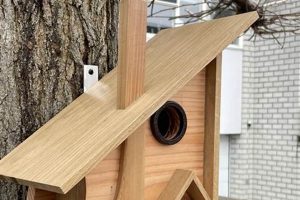
Visual representations showcasing completed carpentry endeavors serve as a valuable resource within the woodworking community. These images often depict a range of items, from intricate furniture pieces to simpler, functional objects, providing examples of design and craftsmanship. For instance, a photograph might feature a finely crafted dining table, highlighting its joinery and finish.
The benefits of accessing these visual aids are multifaceted. They offer inspiration for new projects, provide a means of assessing skill levels, and facilitate the learning process through observation. Historically, artisans relied on drawings and physical examples; contemporary imagery offers wider access and greater detail.
The subsequent sections will delve into various aspects related to this visual medium, including sources of high-quality examples, effective methods for utilizing them in project planning, and considerations for photographing personal woodworking creations. These resources aim to improve woodworking outcomes.
Guidance for Utilizing Visual Woodworking References
This section outlines practical advice for leveraging imagery of finished carpentry items to enhance project outcomes.
Tip 1: Analyze Structural Elements. Scrutinize the joinery techniques employed in exhibited pieces. Understand how different joints contribute to overall stability and aesthetics. For example, examine dovetail joints for drawer construction or mortise-and-tenon joints for frame assembly.
Tip 2: Evaluate Finishing Methods. Observe the surface treatments applied to the woodworking. Identify the types of stains, varnishes, or oils used and assess their impact on the wood’s appearance and durability. Note the grain patterns emphasized by different finishes.
Tip 3: Study Design Proportions. Pay close attention to the relationship between dimensions and overall form. Analyze how the height, width, and depth of a piece contribute to its visual balance. Consider the principles of golden ratio or other design guidelines.
Tip 4: Identify Wood Species. Determine the types of wood utilized in the projects. Observe the unique characteristics of different species, such as grain patterns, color variations, and hardness. Understand how wood selection impacts the project’s durability and aesthetic appeal.
Tip 5: Decipher Hardware Choices. Examine the selection and placement of hardware elements, including hinges, knobs, and pulls. Assess how these elements contribute to the functionality and aesthetic of the overall piece. Note the style and finish of the hardware.
Tip 6: Compare Various Styles. Analyze examples from different woodworking styles, such as Shaker, Craftsman, or contemporary. Observe the distinct design elements and techniques associated with each style. Understand the historical context and underlying principles of each approach.
Tip 7: Document Observations. Maintain a record of noteworthy examples, including detailed notes on design elements, techniques, and materials. Create a personal archive for future reference and inspiration.
By carefully analyzing available examples of crafted wooden items, woodworkers can glean valuable insights that will inform their own projects and improve their overall skillset.
The subsequent section will cover resources and platforms where quality examples of carpentry items can be found.
1. Visual clarity

The effectiveness of illustrations showing carpentry items hinges on their visual clarity. Sharp focus, adequate lighting, and appropriate framing are essential for conveying detailed information. A photograph with poor visual quality obscures intricate details, such as the precision of a joint or the smoothness of a finished surface, thereby diminishing its instructional value. For example, an image showcasing a complex table leg carving is rendered useless if the carving’s contours are blurred or hidden in shadow.
Adequate illumination reveals subtle grain patterns and surface textures, providing insight into wood selection and finishing techniques. Clear visual representation of joint constructions, such as dovetails or mortise-and-tenon joints, allows for the analysis of craftsmanship and structural integrity. Images with high resolution and proper exposure convey the tangible qualities of the project, enabling woodworkers to observe and learn from existing techniques.
In summary, visual clarity is a cornerstone of illustrative carpentry documentation. Its absence negates the image’s purpose as a learning tool and source of inspiration. Achieving visual clarity requires meticulous attention to photographic techniques, ensuring that every detail of the carpentry work is faithfully represented. This visual documentation promotes excellence in craftsmanship and contributes to the continued evolution of carpentry techniques.
2. Construction details

The utility of visual depictions showcasing carpentry endeavors is intrinsically linked to the level of construction detail they reveal. An image devoid of clear construction specifics offers limited value for education or replication. The presence, or absence, of discernible joinery, material selection, and assembly methods directly impacts the image’s capacity to inform. Cause and effect are clearly evident: detailed visuals lead to greater comprehension; obscured details impede understanding. For instance, illustrations portraying furniture construction with explicit views of the internal frame, corner reinforcements, and hardware attachment methods are significantly more informative than those presenting only the finished exterior.
The importance of construction details within photographic examples of carpentry becomes apparent when considering practical application. A novice woodworker, seeking to replicate a specific design, requires visual guidance on the construction process. High-resolution close-ups of joints, annotations indicating dimensions, and exploded diagrams clarifying assembly order provide invaluable assistance. Furthermore, these details serve as a reference point for experienced craftspeople, allowing them to assess the quality of workmanship and potentially adapt or refine their techniques. The absence of these details renders the image merely aesthetic, lacking practical utility. These are elements such as precise measurements of elements of a joint, information on the type of adhesive used, or specifications for the screws or nails.
In conclusion, the symbiotic relationship between visual representations of carpentry and detailed construction information is undeniable. The practical significance of this connection lies in its ability to democratize woodworking knowledge, allowing individuals of varying skill levels to learn from and replicate existing designs. Challenges arise when images lack sufficient clarity or annotation. Nevertheless, by prioritizing the inclusion of comprehensive construction details, illustrations of crafted wooden items can serve as powerful educational tools, fostering innovation and maintaining standards of excellence within the craft.
3. Design inspiration

Visual depictions of completed carpentry endeavors frequently serve as a primary source of design inspiration for woodworkers of all skill levels. The exposure to diverse styles, forms, and techniques observed within these images can trigger new ideas, spark creativity, and inform project planning. Cause and effect are clearly demonstrable: consistent interaction with visual references directly correlates to an expanded design vocabulary and the development of unique project concepts. For example, a woodworker seeking to create a modern coffee table might find inspiration in the clean lines and minimalist aesthetic evident in visual representations of Scandinavian furniture design.
The importance of design inspiration as a component of carpentry images stems from its capacity to bridge the gap between concept and creation. By providing tangible examples of successful designs, these visuals offer a concrete foundation for experimentation and innovation. Consider the role of historical examples in the revival of traditional woodworking techniques. Images of antique furniture, showcasing intricate carving or complex joinery, can inspire contemporary woodworkers to rediscover and adapt these time-honored methods. Furthermore, visual inspiration facilitates communication and collaboration within the woodworking community. Shared references and design elements create a common language, enabling woodworkers to exchange ideas and critique each other’s work effectively. The scope of available visual references and access to them is critical to this process.
In summary, the interplay between carpentry visuals and design inspiration is integral to the advancement of the craft. These visuals function as catalysts for innovation, enabling woodworkers to transcend limitations and push the boundaries of design. Challenges remain in discerning high-quality design from purely aesthetic presentations, but the practical significance of cultivating visual literacy cannot be overstated. The act of reviewing photographic representation fosters critical thinking, aesthetic awareness, and a deeper appreciation for the art of woodworking, ultimately enriching both the individual’s creative process and the overall trajectory of the craft.
4. Joinery techniques
Visual documentation of carpentry projects serves as a repository of construction methodologies, with joinery techniques occupying a prominent position. The clarity with which these techniques are depicted directly influences the educational value of the image. Cause and effect are readily apparent: a clear illustration of a dovetail joint, for example, facilitates comprehension of its interlocking mechanism, whereas an obscured view renders the joint’s function opaque. The importance of joinery representation within carpentry documentation arises from its role in conveying structural integrity and aesthetic refinement. Without explicit visual reference to the joinery employed, the image primarily showcases the finished form, neglecting the underlying principles of construction. Consider, for instance, images of Shaker furniture. The exposed joinery often represents a deliberate design element, integral to the style’s aesthetic. Its clear presentation in photographic form is essential for capturing the essence of the Shaker design ethos.
Practical application of this understanding is evident in woodworking tutorials and instructional materials. Diagrams and photographs depicting joinery methods, accompanied by explanatory text, enable woodworkers to replicate techniques and adapt them to their own projects. Furthermore, the ability to visually analyze joinery in existing carpentry examples allows for the assessment of quality and durability. A photograph revealing gaps or misalignments in a joint, for example, indicates potential structural weaknesses. Similarly, the careful selection of joinery appropriate to the materials and intended use contributes significantly to the longevity of the finished item. Analysis of a completed woodworking project relies on the ability to understand the underlying construction processes.
In summary, the relationship between joinery techniques and the visual representation of carpentry projects is symbiotic. High-quality illustrations of joinery enhance comprehension, facilitate skill development, and inform design choices. Challenges arise when photographic documentation fails to adequately capture the intricacies of joinery, but the practical significance of this connection remains paramount. By prioritizing clear and detailed visual representations of joinery, woodworking resources can contribute to the preservation and advancement of carpentry skills.
5. Finishing quality

The depiction of carpentry projects in images directly reflects the quality of the finish applied. The resolution, lighting, and angle of the photographs either accentuate or obscure the nuances of the surface treatment. Cause and effect are evident: meticulous finishing results in a visually appealing surface that is readily captured in a photograph, whereas a poorly executed finish is equally apparent. The importance of finishing quality as a component of images of woodworking arises from its significant impact on the overall perception of the piece. For example, an image showcasing a table with a flawless, glossy finish projects an image of high craftsmanship, while an image of the same table with a blotchy or uneven finish detracts from its perceived value.
Practical application of this understanding extends to both the creation and the consumption of illustrative carpentry documentation. Woodworkers aiming to showcase their work should prioritize professional-quality photographs that accurately represent the finish. This entails utilizing controlled lighting, high-resolution cameras, and appropriate post-processing techniques. Conversely, those seeking to learn from visual resources must be discerning in their evaluation of finishing quality. Pay close attention to details such as the smoothness of the surface, the consistency of the color, and the absence of imperfections such as brush marks or dust inclusions. Consider the different finishing choices applied, and their impact on different woods. A good example includes shellac on mahogany versus polyurethane on pine, both of which affect visual perception.
In summary, the visual representation of carpentry projects is inextricably linked to the quality of the applied finish. Accurate and detailed photographic documentation is crucial for conveying the skill and care invested in this aspect of the craft. While technical challenges may arise in capturing the subtleties of certain finishes, the practical significance of understanding and appreciating finishing quality remains paramount. This understanding fosters a deeper appreciation for the art of woodworking and encourages woodworkers to strive for excellence in every stage of the process.
6. Project scale

Visual depictions of carpentry endeavors invariably convey a sense of project scale, whether explicitly stated or implicitly understood. The dimensions and proportions visible in these images provide crucial context for assessing the complexity, material requirements, and overall skill level required for replication. Cause and effect are readily apparent: a photograph depicting a large-scale cabinetry installation immediately suggests a more involved undertaking than one showcasing a small, hand-carved box. The importance of project scale as a component of illustrative carpentry documentation arises from its direct influence on resource allocation, time management, and the suitability of the project for individual woodworkers. For instance, an image displaying a multi-piece dining set implies a significantly greater investment of time, materials, and workspace compared to a single, smaller project.
Practical application of this understanding extends to both project selection and educational content creation. Woodworkers utilize visual representations to gauge the feasibility of undertaking a specific project, considering factors such as available workspace, budget constraints, and skill limitations. A novice woodworker might initially select smaller, less complex projects to develop foundational skills, while an experienced craftsperson might seek out larger, more challenging projects to push the boundaries of their expertise. From a content perspective, accurate indication of scale (through dimensions or comparative objects) is critical. Including a scale reference in photographs, such as a common tool or a human figure, allows viewers to readily assess the size of the project and evaluate its complexity.
In summary, visual depictions of carpentry projects inherently communicate information about project scale. This aspect is crucial for informed decision-making, realistic project planning, and the effective dissemination of woodworking knowledge. Challenges exist in accurately conveying scale through two-dimensional images, but the practical significance of considering project dimensions remains paramount. An understanding of scale enriches the viewer’s appreciation of the craft and enables woodworkers to make informed choices about the projects they undertake, aligning their ambitions with their capabilities and resources.
Frequently Asked Questions Regarding Woodworking Visual Documentation
This section addresses common inquiries about the utilization and interpretation of woodworking illustrations. It aims to clarify potential points of confusion and provide guidance on maximizing the value derived from these visual resources.
Question 1: What constitutes a valuable visual reference for carpentry projects?
A valuable visual reference exhibits clarity, comprehensive construction detail, and accurate representation of scale. The image should illuminate joinery methods, material selection, and finishing techniques.
Question 2: How can project depictions inspire innovative designs?
Exposure to varied carpentry examples can stimulate creative thinking and inform design choices. Observing successful implementations can serve as a foundation for developing novel approaches.
Question 3: How is project size accurately determined?
Project size is assessed via dimensional references, comparative objects (e.g., tools or human figures), or explicitly stated measurements. These elements provide context for understanding scale.
Question 4: How does clarity of image impact?
Image clarity allows a precise assessment of a project. Quality image enables joinery, dimensions, type of wood, and the quality of finish to be observed.
Question 5: How does construction detail relate to project understanding?
Construction details like exploded diagrams, annotations, and close-ups are crucial for understanding the build process of a project. They enable a woodworker to visualize construction techniques and order of operations. These elements turn an aesthetic piece into a practical guide.
Question 6: Why consider the quality of a project’s finish?
The finish is a primary indicator of skill. The smoothness, consistency, and uniformity are all visual cues to the woodworker’s capabilities. A flawless finish indicates a thorough process; flaws can indicate a lack of attention to detail. Finishes also allow the wood to stand out as another important indicator.
In summary, the effective utilization of woodworking illustrations hinges on discerning the quality of visuals and interpreting the information they convey. Attention to detail, analytical assessment, and a critical eye are crucial for maximizing the learning potential of these resources.
The subsequent section will cover the tools and the techniques needed for taking accurate illustrations of woodworking projects.
Conclusion
The preceding analysis has underscored the critical role of images documenting carpentry projects. High-quality “pictures of woodworking projects” are essential for skill development, design inspiration, and the preservation of craftsmanship standards. Elements such as visual clarity, detailed construction information, and accurate representation of scale contribute to the utility of these resources.
The woodworking community benefits from the continued creation and dissemination of quality photographic examples. By prioritizing detail, clarity, and accuracy, practitioners contribute to the collective knowledge base and foster a deeper appreciation for the art of woodworking. Attention to these aspects will advance the field and further benefit practitioners through the preservation and further refinement of skills.