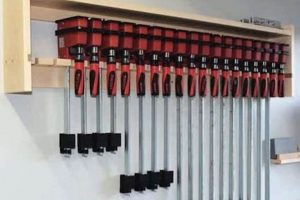
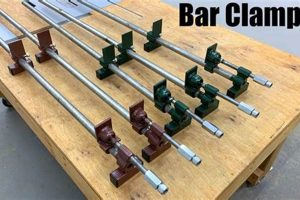
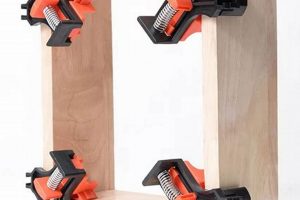
These essential tools provide adjustable clamping pressure for assembling workpieces in various woodworking projects. The design typically incorporates a clamping head and tailstock that slide onto a length of threaded pipe, allowing for customized lengths based on project requirements. Examples include edge-gluing panels, assembling cabinets, and securing large or oddly shaped items during glue-up.
Their significance lies in the ability to exert substantial and even pressure across a broad surface, crucial for strong and accurate joints. This type of clamp facilitates the secure adhesion of components, which is fundamental to the structural integrity and aesthetic quality of the finished product. Historically, they offered an economical and adaptable solution to joinery challenges compared to other clamping systems.
This article will delve into the selection criteria for these tools, considering factors such as pipe diameter, thread quality, and clamping force. Furthermore, it will examine best practices for their use to avoid common problems like workpiece damage and uneven pressure distribution, while also providing guidance on maintenance and storage.
Essential Usage Guidelines
The correct application of these tools significantly impacts the quality and longevity of woodworking projects. Adherence to these guidelines ensures optimal performance and minimizes the risk of damage.
Tip 1: Pipe Selection: Utilize schedule 40 steel pipes for enhanced durability and resistance to bending under pressure. The pipe’s diameter directly influences the maximum clamping force achievable.
Tip 2: Thread Inspection: Before each use, thoroughly inspect the pipe threads for damage or debris. Clean and lubricate the threads to ensure smooth operation and prevent premature wear.
Tip 3: Protective Measures: Employ wooden cauls or padding between the clamp jaws and the workpiece to distribute pressure evenly and prevent indentation or marring of the wood surface.
Tip 4: Parallel Alignment: Ensure the clamping heads are parallel to each other and perpendicular to the workpiece faces. This alignment is critical for even pressure distribution and prevents distortion of the assembly.
Tip 5: Gradual Tightening: Apply clamping pressure gradually and incrementally. Overtightening can damage the wood fibers and compromise the integrity of the joint. Alternating between clamps when tightening promotes even pressure.
Tip 6: Joint Monitoring: Observe the joint line during tightening to detect any signs of slippage or misalignment. Adjust the clamp positions as needed to maintain a consistent and tight fit.
Tip 7: Storage Practices: When not in use, store these tools in a dry environment to prevent rust and corrosion. Regularly clean the pipe threads and apply a light coat of oil to maintain their functionality.
Proper application and maintenance extend the lifespan of these tools and ensure consistent, high-quality results in woodworking endeavors. The judicious use of these tools facilitates the creation of durable and aesthetically pleasing wood assemblies.
The following sections will explore advanced techniques and troubleshooting strategies for optimal clamping performance.
1. Clamping Pressure

Clamping pressure, a critical component in woodworking, dictates the strength and longevity of glued joints. With these tools, this pressure is exerted through the tightening mechanism on the clamp head, drawing the workpieces together. Insufficient pressure results in weak bonds vulnerable to failure under stress. Conversely, excessive pressure can crush wood fibers, compromising structural integrity and potentially leading to joint failure over time. Examples include edge-gluing hardwood panels, where consistent and adequate pressure is essential to prevent gaps and ensure a flush surface. Understanding the correlation between applied force and material resistance is, therefore, paramount for successful assembly.
The pipe diameter and thread pitch significantly influence the attainable clamping pressure. A larger diameter pipe generally offers greater resistance to bending, allowing for higher pressure without deformation. Finer thread pitch allows for more controlled pressure application, minimizing the risk of over-tightening. The application of these tools is frequently observed in cabinet construction, where substantial pressure is required to align and secure frame components. A lack of adequate or evenly distributed pressure can lead to misaligned frames, impacting both functionality and aesthetics.
In summary, appropriate clamping pressure, achieved through careful selection of pipe diameter, thread quality, and controlled tightening, is crucial for achieving robust and lasting wood joints. Challenges arise from variations in wood density and the need to distribute pressure evenly. However, mastering the principles of force application with these tools directly translates to enhanced project quality and durability, underlining the importance of this understanding in the broader context of woodworking practices.
2. Pipe Diameter

Pipe diameter is a critical factor influencing the performance and suitability of these tools for specific woodworking tasks. The diameter directly relates to the clamping force that can be applied, the stability of the clamp, and its overall durability under pressure. A well-chosen pipe diameter ensures efficient and reliable clamping action, contributing to the integrity and longevity of woodworking projects.
- Clamping Force and Resistance to Bending
A larger pipe diameter inherently offers greater resistance to bending under pressure. This increased rigidity allows for the application of higher clamping forces without deforming the pipe itself. For example, when assembling large cabinet carcasses or edge-gluing wide panels, a wider diameter pipe minimizes the risk of bowing, ensuring even pressure distribution across the joint. Insufficient pipe diameter can lead to uneven clamping, resulting in weakened joints and potential structural failure.
- Thread Engagement and Stability
The pipe’s diameter directly impacts the amount of thread engagement between the pipe and the clamp heads. A larger diameter allows for more robust threads, enhancing the grip and preventing slippage during tightening. This improved thread engagement contributes to overall clamp stability, particularly when working with heavy or awkward workpieces. For instance, when clamping irregular shapes or objects with uneven surfaces, secure thread engagement is essential to maintain consistent clamping pressure and prevent the clamp from shifting.
- Compatibility with Clamp Head Design
The design of the clamp heads is directly related to the pipe diameter it is intended to accommodate. Using a pipe diameter outside the recommended range for a particular clamp head can compromise its functionality and safety. Attempting to fit a pipe that is too large can damage the threads or prevent proper engagement, while a pipe that is too small may not provide adequate support, leading to instability. Ensuring compatibility between the pipe diameter and the clamp head is therefore essential for optimal performance and preventing equipment failure.
- Cost and Availability
Pipe diameter affects the cost and availability of the pipe itself. Larger diameter pipes typically cost more per unit length and may be less readily available at local hardware stores. Conversely, smaller diameter pipes are generally more affordable and widely accessible. Woodworkers must balance the need for increased clamping force and stability with budgetary constraints and the ease of sourcing materials when selecting the appropriate pipe diameter. While larger diameter pipes offer advantages for heavy-duty applications, smaller diameter pipes may suffice for lighter woodworking projects.
The selection of pipe diameter is a critical decision that depends on project requirements, material characteristics, and the specific clamp head design. Careful consideration of clamping force needs, thread engagement, compatibility, and budget factors ensures the selection of a pipe diameter that optimizes performance and maximizes the reliability of these woodworking tools. Choosing the correct diameter also contributes to safer operations and the long-term structural integrity of finished woodwork.
3. Thread Quality

The thread quality on the pipe used with these clamping tools directly influences their effectiveness and lifespan. Threads serve as the mechanism through which clamping pressure is applied and maintained. Poorly formed, damaged, or corroded threads compromise this mechanism, reducing the achievable clamping force and increasing the risk of slippage under load. For instance, when edge-gluing hardwood tabletops, degraded threads may prevent the application of sufficient pressure to create tight, invisible glue lines, resulting in structurally weak and visually flawed joints. Consequently, meticulous inspection and maintenance of thread quality are essential for optimal clamping performance.
Thread integrity is further crucial for smooth operation and longevity. Clean, well-defined threads allow the clamp head to move freely along the pipe, facilitating precise adjustments in clamping pressure. Conversely, damaged or dirty threads create friction, hindering movement and potentially damaging the clamp head’s internal mechanisms. A practical example is in assembling cabinet frames. Consistent, reliable thread engagement ensures even pressure distribution across the frame, preventing distortion and promoting squareness. Lack of attention to thread maintenance can lead to uneven clamping, requiring additional shimming and adjustments during assembly.
In summary, thread quality is an indispensable attribute of effective these tools. Its impact spans from clamping force and ease of use to the tool’s overall durability. Maintaining thread integrity through regular cleaning, lubrication, and inspection directly contributes to stronger joints, more efficient workflow, and extended tool life. Addressing potential thread issues proactively minimizes the risk of project failures and underscores the practical significance of thread quality in the broader context of woodworking.
4. Parallel Alignment
Parallel alignment, in the context of pipe clamps used for woodworking, refers to the state in which the clamping faces of the clamp heads are equidistant and perpendicular to the workpiece surfaces. This alignment is not merely an aesthetic concern but a crucial determinant of uniform pressure distribution. Deviation from parallel induces uneven force vectors, resulting in potential joint failure or workpiece distortion. A practical example of this is evident in edge-gluing wide boards to create a tabletop. If the clamp heads are not aligned, the force exerted will be concentrated on specific points along the joint line, causing some areas to be under-clamped while others are over-clamped. This imbalance can lead to gaps, weak glue bonds, and an unlevel final surface. Achieving and maintaining parallel alignment, therefore, is a fundamental component of utilizing these tools effectively.
Several factors can disrupt parallel alignment. Uneven pipe lengths, worn clamp heads, or improperly prepared workpiece surfaces contribute to alignment issues. Consider the assembly of a cabinet carcass. If the cabinet sides are not precisely square, placing clamps will exacerbate this deviation, potentially warping the entire structure. To mitigate these problems, careful attention must be paid to workpiece preparation, ensuring surfaces are flat and square. Furthermore, using cauls, which are sacrificial pieces of wood placed between the clamp heads and the workpiece, helps to distribute pressure evenly and compensate for minor imperfections. Regular inspection of the clamps themselves, checking for wear and tear or any deformation, also contributes to maintaining parallel alignment over time.
In conclusion, parallel alignment is not simply a desirable attribute but an essential requirement for successful woodworking with pipe clamps. Uneven force vectors caused by misalignment introduce significant risks to joint integrity and dimensional accuracy. Adhering to best practices in workpiece preparation, employing auxiliary tools like cauls, and maintaining vigilance over the condition of the clamps themselves are critical for preserving parallel alignment. By ensuring this alignment, woodworkers can maximize the potential of these versatile tools and achieve high-quality, durable results. The ability to accurately implement and uphold alignment directly ties to the success of many woodworking projects.
5. Wood Protection

Wood protection, in the context of pipe clamps used for woodworking, is paramount for preventing damage to the workpiece during the clamping process. The pressure exerted by the clamps, while necessary for secure joinery, can easily mar, dent, or crush wood fibers, especially in softer species. Therefore, employing appropriate protective measures is crucial for preserving the aesthetic and structural integrity of the wood.
- Cauls: Pressure Distribution and Surface Protection
Cauls, typically made from wood or other rigid materials, serve to distribute clamping pressure evenly across a larger surface area. By placing cauls between the clamp jaws and the workpiece, the concentrated force is dispersed, preventing localized indentations or crushing. This is particularly useful when clamping thin or delicate materials. In edge-gluing operations, cauls ensure uniform pressure along the joint line, minimizing the risk of gaps or misalignments.
- Padding: Preventing Direct Contact and Abrasion
Padding, such as cork, felt, or cloth, provides a soft barrier between the clamp jaws and the wood surface, preventing direct contact and minimizing the risk of abrasion or staining. This is especially important when working with finished or delicate surfaces. Applying padding to the clamp jaws cushions the impact and reduces the potential for unsightly marks. For example, when clamping a pre-finished cabinet door, padding is essential for preserving the finish and preventing damage.
- Clamp Jaw Design: Surface Area and Contact Points
The design of the clamp jaws themselves influences the potential for wood damage. Clamps with wider jaws distribute pressure over a larger area, reducing the risk of localized stress. Conversely, clamps with narrow or sharp jaws concentrate force, increasing the likelihood of marring. Choosing clamps with appropriately sized and shaped jaws, or modifying existing jaws with padding, contributes to effective wood protection. Clamps with pivoting jaws are particularly beneficial, as they automatically adjust to accommodate slight variations in workpiece thickness, ensuring even pressure distribution.
- Controlled Tightening: Minimizing Over-Clamping
Even with the best protective measures, excessive clamping pressure can still damage wood. Controlled tightening, achieved through careful monitoring and gradual adjustment of the clamp pressure, is essential for preventing over-clamping. Overtightening can crush wood fibers, especially in softer species, compromising the structural integrity of the joint. By applying just enough pressure to achieve a tight, secure bond, while avoiding excessive force, woodworkers can minimize the risk of damage. Using a torque wrench can provide a more precise control over the applied force.
These methods of wood protection are not mutually exclusive and are often used in combination to achieve optimal results. Effective wood protection ensures that the clamping process enhances, rather than detracts from, the quality and appearance of the final product. Employing appropriate protective measures demonstrates attention to detail and contributes to the long-term durability and aesthetic appeal of woodworking projects. Proper implementation increases the success and professionalism of woodworking.
6. Joint Integrity

Joint integrity, in the context of woodworking, directly correlates with the efficacy of clamping methods employed during assembly. Pipe clamps, as a specific clamping solution, play a pivotal role in achieving and maintaining this integrity. The primary function of these clamps is to exert consistent and controlled pressure on joint surfaces during adhesive curing, which is fundamentally necessary for creating robust and lasting bonds. Failure to apply adequate clamping pressure results in weak, compromised joints susceptible to separation under stress. A practical example is the construction of a load-bearing cabinet frame; insufficient clamping pressure during glue-up inevitably leads to structural instability and premature failure under weight. The relationship, therefore, is causal: effective clamp usage directly contributes to joint strength and stability.
The configuration and quality of the pipe clamps themselves also significantly affect joint integrity. Factors such as pipe diameter, thread quality, and parallel alignment directly influence the distribution of clamping force. Uneven pressure application, caused by warped pipes or misaligned clamp heads, can create localized stress points, weakening the overall joint. Consider edge-gluing a wide panel. If the clamps are not properly aligned, sections of the joint will be under-clamped, leading to visible glue lines and a structurally compromised surface. This highlights the importance of selecting appropriate clamp sizes, ensuring proper thread engagement, and verifying parallel alignment before initiating the clamping process. The practical significance is that careful clamp selection and setup are prerequisites for achieving optimal joint performance.
In summary, joint integrity is inextricably linked to the proper application of pipe clamps in woodworking. The clamps provide the means to exert the necessary force for strong, durable joints, but their effectiveness hinges on careful selection, setup, and maintenance. Achieving proper alignment and adequate pressure, while avoiding over-tightening, is essential to mitigate potential joint failures. The challenges often involve compensating for variations in material thickness, ensuring even pressure distribution, and preventing damage to the wood surfaces. Ultimately, understanding the interplay between joint integrity and clamp usage is critical for producing high-quality, structurally sound woodworking projects.
7. Rust Prevention
Rust prevention is a critical aspect of maintaining pipe clamps used in woodworking, directly influencing their lifespan and operational reliability. These tools are often exposed to moisture, humidity, and wood glue, all of which accelerate the oxidation of the steel pipe component. The resulting rust weakens the pipe, compromises thread engagement, and ultimately reduces the clamping force achievable. For example, a clamp used frequently in a humid workshop without rust prevention measures might exhibit significant corrosion within a year, rendering it unusable for projects requiring high clamping pressure or precise alignment. The detrimental effects of rust highlight the importance of proactive measures to preserve the functionality of these woodworking essentials.
Several practical rust prevention techniques can be implemented to extend the service life of pipe clamps. Regular cleaning of the pipe threads with a wire brush removes debris and superficial rust. Application of a protective coating, such as oil, wax, or a rust-inhibiting spray, creates a barrier against moisture and oxygen. Proper storage in a dry environment further minimizes the risk of corrosion. For instance, wiping down the pipes with a linseed oil-soaked cloth after each use and storing them in a rack away from damp areas can significantly reduce rust formation. Additionally, using galvanized or stainless steel pipes, while more expensive initially, offers inherent resistance to corrosion and eliminates the need for frequent maintenance. Implementing these strategies ensures continued performance and minimizes the need for costly replacements.
In conclusion, rust prevention is not merely a cosmetic concern but an essential element of responsible tool maintenance for pipe clamps in woodworking. The degradation caused by rust undermines the clamp’s structural integrity and diminishes its ability to perform effectively. Employing preventative measures such as cleaning, protective coatings, and proper storage prolongs the lifespan of these tools, preserving their functionality and contributing to successful woodworking outcomes. The challenges in maintaining rust prevention lie in the consistency of these practices and the awareness of the environments promoting corrosion. Overcoming these challenges ensures the reliable use of pipe clamps for years to come.
Frequently Asked Questions
This section addresses common inquiries regarding pipe clamps for woodworking, providing clarity and guidance for optimal usage.
Question 1: What constitutes an appropriate pipe diameter for woodworking clamps?
The suitability of a pipe diameter is determined by the anticipated clamping force and the pipe’s resistance to bending. Schedule 40 steel pipes are generally recommended, with larger diameters offering greater resistance to deformation under heavy loads. Selection should align with project demands to prevent uneven pressure distribution.
Question 2: How can thread quality on pipe clamps be effectively maintained?
Thread quality is maintained through regular cleaning with a wire brush to remove debris, followed by the application of a lubricant such as oil or wax. This practice minimizes friction, prevents corrosion, and ensures smooth operation over time. Inspection for damage or wear should be conducted periodically, and damaged pipes should be replaced promptly.
Question 3: What are the best methods for achieving parallel alignment when using pipe clamps?
Parallel alignment is achieved through careful workpiece preparation, ensuring surfaces are flat and square. The use of cauls, which are sacrificial pieces of wood placed between the clamp and workpiece, distributes pressure evenly and compensates for minor imperfections. Clamp heads should be inspected for wear and adjusted as needed to maintain proper alignment.
Question 4: How should wood be protected from damage during clamping?
Wood protection is achieved through the use of cauls and padding, such as cork or felt, between the clamp jaws and the workpiece. These materials distribute pressure and prevent direct contact, minimizing the risk of indentation or marring. Controlled tightening of the clamps is also crucial to avoid over-clamping and crushing wood fibers.
Question 5: What factors influence the long-term integrity of joints secured with pipe clamps?
Joint integrity is influenced by several factors, including adequate clamping pressure, proper alignment, and the quality of the adhesive used. Ensuring that clamps are evenly spaced and applying sufficient pressure to create tight glue lines are essential. Proper surface preparation and the use of appropriate adhesives further contribute to joint strength and durability.
Question 6: What is the recommended procedure for preventing rust on pipe clamps?
Rust prevention involves regular cleaning, application of a rust-inhibiting coating, and proper storage in a dry environment. Wiping down the pipes with a cloth soaked in oil after each use and storing them in a rack away from moisture minimizes the risk of corrosion. Galvanized or stainless steel pipes offer inherent resistance to rust and may be considered for increased longevity.
Proper understanding and application of these principles are critical for maximizing the effectiveness and lifespan of pipe clamps in woodworking projects.
The next section will delve into advanced techniques and troubleshooting strategies for using pipe clamps.
Conclusion
The preceding examination of pipe clamps for woodworking has illuminated their multifaceted role in achieving robust and precise joinery. Key considerations, including pipe diameter, thread quality, parallel alignment, wood protection, joint integrity, and rust prevention, collectively determine the efficacy of these tools. Adherence to established best practices in each of these areas is paramount for ensuring project success and longevity.
While challenges persist in achieving optimal clamping performance across diverse project scenarios, a thorough understanding of these principles empowers woodworkers to mitigate potential issues and maximize the capabilities of this essential clamping solution. Continued refinement of techniques and ongoing commitment to preventative maintenance are vital for upholding the enduring significance of pipe clamps in the craft of woodworking.