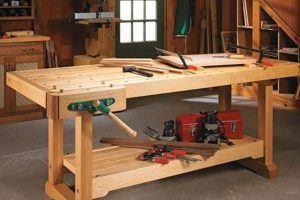
This specialized work platform, often lower and wider than its Western counterparts, facilitates a unique approach to joinery and fabrication. Characterized by features such as leg vises, mortise support structures, and a flush surface, it enables artisans to secure workpieces firmly at various angles and positions. Its design promotes efficient use of hand tools, a hallmark of Japanese woodworking.
The value of this design lies in its adaptability and contribution to precision craftsmanship. The lower working height allows for greater stability and control, while the vise mechanisms provide robust clamping action, essential for intricate cuts and joinery. Historically, these platforms were integral to temple construction, furniture making, and numerous other applications, shaping the refined aesthetic celebrated in Japanese woodworking traditions.
The subsequent discussion will delve into the specific construction techniques employed in building such a platform, the tools commonly used in conjunction with it, and the advantages offered by its particular features for various woodworking tasks. Examination of these aspects will further illuminate the significance of this essential piece of equipment.
Essential Considerations for a Japanese-Style Woodworking Platform
Proper construction and utilization of a specialized woodworking platform are crucial for achieving the accuracy and efficiency characteristic of traditional Japanese woodworking. The following guidelines offer essential considerations for its effective implementation.
Tip 1: Material Selection: Prioritize dense, stable hardwoods such as oak or beech for the primary structural components. This ensures the platform’s rigidity and resistance to warping, essential for maintaining accuracy during demanding joinery tasks.
Tip 2: Leg Attachment Methodology: Securely mortise and tenon the legs into the tabletop. Employ traditional tapered tenons and drawbore pins for enhanced stability and longevity, mitigating the risk of joint failure under stress.
Tip 3: Vise Mechanism Integration: Carefully consider the placement and functionality of the leg vise. Ensure the vise chop is parallel to the tabletop surface to provide consistent clamping pressure across the workpiece.
Tip 4: Surface Flatness Maintenance: The platform’s surface must remain consistently flat. Regularly check for discrepancies using a straightedge and plane as needed to eliminate imperfections that can compromise accuracy.
Tip 5: Working Height Optimization: Adjust the platform’s height to suit the individual woodworker’s stature. A height that allows for comfortable arm positioning and efficient power transfer is critical for reducing fatigue and increasing control.
Tip 6: Mortise Support Implementation: Incorporate dedicated mortise support structures or attachments. These features provide stability and accurate positioning when chiseling mortises, particularly essential for complex joinery.
Tip 7: Regular Maintenance: Routinely inspect all joints, vise mechanisms, and the surface for wear or damage. Address any issues promptly to maintain the platform’s structural integrity and operational effectiveness.
Adherence to these considerations will result in a woodworking platform that facilitates precise, efficient, and comfortable work, enabling the execution of intricate Japanese woodworking techniques with greater accuracy.
The ensuing section will examine specific joinery techniques commonly employed in conjunction with a platform of this design, further illustrating its contribution to the broader practice of Japanese woodworking.
1. Low working height

The diminished elevation is a fundamental characteristic integral to the design and functionality. This feature is not merely an ergonomic preference but a deliberate engineering choice that directly influences the woodworker’s stability, control, and overall efficiency. The proximity to the ground provides a lower center of gravity, enhancing the user’s ability to apply force with greater precision. This is particularly beneficial when executing demanding tasks such as sawing dovetails or paring mortises.
The lower stance minimizes unnecessary body movement, conserving energy and reducing fatigue during extended periods of work. It also allows the woodworker to utilize their body weight more effectively, maximizing the leverage applied to tools such as chisels and hand planes. The effect of this altered posture extends beyond comfort; it directly impacts the accuracy and finesse achievable in intricate joinery. For instance, when flattening a large panel with a hand plane, the stability afforded by the lower working height reduces the likelihood of unintentional rocking or skewing, resulting in a more consistently flat surface.
In essence, the low working height is a critical design element that underpins the precision and control synonymous with Japanese woodworking. By understanding the biomechanical advantages it offers, woodworkers can better appreciate and leverage this feature to enhance their craft. The following sections will explore other key attributes and their interdependencies, further elucidating the complete functionality of this specialized workbench.
2. Specialized leg vise

The specialized leg vise represents an integral component of the traditional Japanese woodworking platform. This vise’s design and function are inextricably linked to the overall purpose and methodology associated with this type of workbench. Its primary role involves securely clamping workpieces for various woodworking operations, a function critical to achieving precise and efficient hand tool usage. Unlike conventional vises, the leg vise typically features a long, vertical chop that extends from the tabletop to the floor or near it, providing significant clamping surface area. This allows for securing wide boards or panels without significant racking or distortion. A real-life example would be clamping a large section of hinoki wood to prepare it for dovetail joinery on a cabinet; the leg vise’s broad clamping surface prevents the wood from bowing under pressure.
The construction of the leg vise often incorporates a parallel guide system or a robust screw mechanism to ensure even clamping pressure across the workpiece. The chop itself may be faced with a soft material, such as leather or wood, to protect the workpiece surface from damage. Further examples can be seen in temple construction, where large timbers require secure fastening to facilitate mortise and tenon joinery. Without the stability and secure hold provided by the specialized leg vise, executing intricate cuts and joinery with hand tools becomes significantly more challenging and less accurate. The precise positioning and firm holding enabled by this vise are thus essential for creating the high-quality, finely detailed work that characterizes traditional Japanese woodworking.
In conclusion, the specialized leg vise is not merely an add-on but a foundational element of the Japanese woodworking platform. Its design directly supports the techniques and standards prevalent in this tradition. Understanding the leg vise’s construction, operation, and benefits is paramount for anyone seeking to replicate or appreciate traditional Japanese woodworking practices. The next section will explore the significance of mortise support on these platforms, offering another key insight into the unique advantages offered by the overall design.
3. Mortise support

Mortise support, in the context of a traditional Japanese woodworking platform, refers to specialized features integrated into the platform’s design to facilitate the precise and stable creation of mortise joints. These features are essential for achieving the accuracy and clean execution demanded by traditional Japanese joinery techniques.
- Adjustable Height Support
Some platforms incorporate adjustable height supports, allowing the woodworker to position a workpiece at the optimal level for mortising. This reduces strain and improves control over the chisel, especially when working on larger pieces. For example, when creating mortises for a sliding door frame, an adjustable support ensures the frame remains level and stable, preventing unwanted movement that could compromise the accuracy of the mortise.
- Integrated Mortise Post
Certain designs feature a dedicated mortise post integrated into the platform’s structure. This post provides a solid backing against which the workpiece can be firmly secured during mortising. This is particularly valuable when working with softer woods or creating deep mortises, where the risk of splitting is higher. An example is the construction of a Kumiko screen where the mortise post offers the stability needed for the intricate mortises without damaging the delicate wood.
- Clamping Mechanisms
Clamping mechanisms are often incorporated into the mortise support system, allowing the woodworker to secure the workpiece precisely and immovably. These clamps can be adjusted to accommodate various sizes and shapes of wood, providing a versatile solution for different mortising tasks. In the construction of temple joints, specialized clamps can hold the piece securely, guaranteeing the precision needed for those integral support structures.
- Surface Texture and Material
The surface of the mortise support is often designed with a specific texture or material to prevent slippage during mortising. This can include a rubberized coating or a toothed surface that grips the workpiece, ensuring it remains stable throughout the process. During the creation of traditional furniture, a textured support provides a non-slip surface for the work pieces, improving safety and precision.
The presence and thoughtful design of mortise support features underscore the emphasis placed on precision and stability in traditional Japanese woodworking. By providing a dedicated and adjustable means of securing workpieces, these features contribute significantly to the accuracy and efficiency of mortise creation, ultimately enhancing the quality and longevity of the final product.
4. Surface flatness

Surface flatness is a crucial attribute of a traditional Japanese woodworking platform, significantly influencing the precision and quality of the resulting woodwork. The work surface serves as a primary reference plane, and any deviation from flatness introduces errors that propagate through subsequent operations. Therefore, maintaining a true and level surface is paramount.
- Reference Plane Establishment
The platform’s surface functions as a fundamental reference plane for tasks such as planing, marking, and joinery. A flat surface ensures that workpieces placed upon it are consistently oriented, allowing for accurate measurements and consistent application of force. Deviation from flatness introduces inaccuracies that can compromise the integrity of joints and the overall dimensions of the finished piece. For example, when planing a board to a specific thickness, a non-flat platform surface will result in an uneven thickness across the board, hindering its integration into a larger assembly.
- Joinery Accuracy
Precise joinery, a hallmark of traditional Japanese woodworking, relies heavily on accurate mating surfaces. A flat platform surface enables the precise fitting of joints such as dovetails, mortise and tenons, and rabbets. If the platform is not flat, mating pieces may not align correctly, leading to gaps, weak joints, and a compromised structural integrity. During the construction of a Shoji screen, where precise alignment of thin wooden members is critical, a flat reference surface ensures that all joints are accurately fitted, resulting in a structurally sound and visually appealing screen.
- Tool Performance
The performance of hand tools, such as planes and chisels, is directly affected by the flatness of the work surface. A flat surface allows these tools to operate efficiently and consistently, producing smooth and accurate cuts. An uneven platform can cause the tool to rock or skip, resulting in irregular cuts and increased effort. Preparing a surface for lacquering requires an absolutely flat surface so a hand plane can glide smoothly across the wood.
- Dimensional Consistency
Maintaining dimensional consistency in woodworking projects is critical for achieving the desired outcome. A flat platform surface ensures that workpieces are consistently supported, preventing warping or bending during the construction process. This consistency is particularly important when working with long or thin pieces of wood, which are more susceptible to distortion. When constructing a long, straight beam, a stable and flat platform surface is essential to prevent the beam from warping during shaping and joinery.
The relationship between surface flatness and this type of platform is fundamental to the practice of traditional Japanese woodworking. The accuracy and quality achievable using traditional techniques are intrinsically linked to the integrity of the reference plane provided by the work surface. Attention to surface flatness is therefore a defining characteristic of both the platform and the resulting woodwork.
5. Stable structure

The stable structure of a traditional Japanese woodworking platform is not merely a desirable attribute, but a foundational requirement dictating its functionality and efficacy. This stability directly influences the precision, safety, and efficiency of woodworking operations conducted upon it. The design and construction methods employed in creating these platforms prioritize rigidity and resistance to movement, ensuring a consistent and reliable work surface. Without a stable structure, the benefits of other features, such as the low working height and specialized leg vise, are significantly diminished. The platform’s inherent steadiness enables the craftsman to exert force accurately without the interference of unwanted vibrations or shifts in position. A real-life illustration of this necessity can be observed during the creation of intricate Kumiko panels, where the slightest movement of the platform would compromise the delicate joinery, resulting in flawed intersections and a weakened final product.
Further, the stable structure mitigates the risk of workpiece displacement during critical operations, such as chiseling mortises or planing surfaces. A wobbling or unstable platform increases the potential for miscuts and injuries, reducing overall productivity. Traditional construction techniques, such as mortise-and-tenon joinery with robust pegging, are employed to achieve this stability, effectively distributing weight and resisting deformation under stress. The absence of a stable structure would render the platform unsuitable for the demands of traditional Japanese woodworking, which often involves precise and forceful manipulation of hand tools. A temple carpenter creating large mortise and tenon joints would be unable to perform this operation accurately without the stable support provided by the platform.
In summary, the stable structure is an indispensable characteristic of a traditional Japanese woodworking platform. Its contribution extends beyond simple support, enabling the accurate execution of intricate joinery, enhancing safety, and improving overall efficiency. Challenges related to achieving and maintaining this stability often involve the careful selection of materials and adherence to time-tested construction methods. The understanding of its significance is pivotal to appreciating the design philosophy and practical advantages of this specialized woodworking tool.
Frequently Asked Questions
The following addresses frequently asked questions regarding traditional Japanese woodworking platforms, providing clarity on their design, purpose, and practical application.
Question 1: What distinguishes traditional Japanese woodworking platforms from Western-style workbenches?
The primary distinctions lie in working height, vise mechanisms, and overall design philosophy. These platforms are typically lower than Western workbenches, promoting stability and control. The leg vise and integrated mortise supports are unique features not commonly found on Western benches.
Question 2: What are the key advantages of a lower working height?
A lower working height allows for enhanced stability and leverage when using hand tools. It reduces fatigue and enables more precise application of force, particularly beneficial for intricate joinery tasks.
Question 3: Why is surface flatness so critical?
Surface flatness provides a reliable reference plane for marking, planing, and joinery operations. Any deviation from flatness introduces inaccuracies that can compromise the dimensional consistency and structural integrity of the final product.
Question 4: What types of wood are best suited for constructing this type of platform?
Dense, stable hardwoods such as oak, beech, or maple are preferred for their resistance to warping and ability to withstand heavy use. Proper material selection is crucial for ensuring the platform’s longevity and accuracy.
Question 5: How is the leg vise different from other types of vises?
The leg vise extends from the tabletop to near the floor, providing a large clamping surface area. This design minimizes racking and distortion when clamping wide boards or panels. The long lever arm also generates significant clamping force.
Question 6: Is this type of platform suitable for modern woodworking techniques?
While rooted in traditional practices, the underlying principles of stability, precise clamping, and ergonomic design remain relevant to modern woodworking. The platform can be adapted for use with various hand tools and some power tools, though its strengths lie primarily in hand tool-based operations.
The traditional Japanese woodworking platform embodies a thoughtful integration of design and function, optimized for precise hand tool work. Understanding its key attributes facilitates its effective use and appreciation within the broader context of woodworking.
The ensuing discussion will delve into the specific techniques employed when using the platform for traditional Japanese joinery.
In Summary
This exploration has detailed the design, function, and significance of the traditional Japanese woodworking bench. Key attributes, including the low working height, specialized leg vise, mortise support features, surface flatness, and stable structure, have been examined. These elements collectively contribute to a platform optimized for precise hand tool work, enabling the creation of intricate and durable joinery characteristic of Japanese woodworking traditions.
The continued study and application of the principles embodied in this specialized platform offer valuable insights for woodworkers seeking to enhance their precision, efficiency, and understanding of traditional techniques. Further investigation into specific joinery methods and adaptation for modern practices may further refine woodworking processes. The legacy of craftsmanship inherent in this platform merits ongoing consideration and application within the woodworking community.