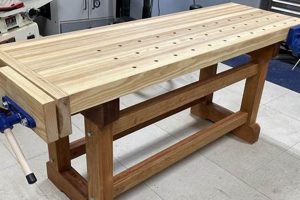
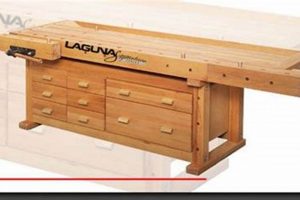
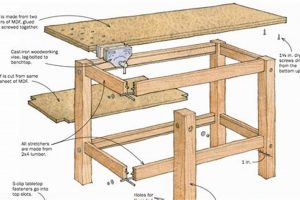
The flat, durable surface designed for supporting work during carpentry and related tasks represents a vital component in any woodworking environment. Constructed from materials such as solid hardwood or laminated composites, these surfaces provide a stable platform for tasks ranging from simple joinery to complex assembly. For example, a carpenter might use this surface to plane a board, ensuring a smooth and even finish.
The presence of a dedicated work surface of this kind is fundamental to efficient and accurate woodworking. It enables the secure clamping of materials, reduces the likelihood of damage to surrounding areas, and provides a centralized location for tools and project components. Historically, craftspeople have relied on these surfaces to elevate the quality and precision of their work, facilitating the creation of intricate and lasting pieces.
Considerations for selecting an appropriate work surface include size, material, and the presence of features such as vises, dog holes, and integrated storage. These elements contribute significantly to the functionality and adaptability of the work area, influencing project workflow and overall productivity. Further analysis will delve into the specifics of these design choices and their impact on the woodworking process.
Tips for Optimal Selection and Use
Achieving superior woodworking results necessitates a carefully considered approach to the foundational element upon which projects are built. The following guidelines offer insights for selecting and maintaining an optimal work surface for diverse woodworking applications.
Tip 1: Material Selection: Prioritize dense hardwoods like maple or beech for superior durability and resistance to warping. Consider laminated composites for cost-effectiveness and dimensional stability in fluctuating humidity conditions.
Tip 2: Surface Flatness: Verify the surface is consistently flat across its entire area. Deviations can compromise accuracy in joinery and assembly. Use a straightedge and feeler gauges to assess and correct any inconsistencies.
Tip 3: Vise Placement and Functionality: Evaluate the placement and quality of integrated vises. A robust vise system is crucial for securely holding workpieces during sawing, planing, and other critical operations. Consider both face and end vise configurations.
Tip 4: Dog Hole Configuration: Utilize dog holes strategically for versatile clamping options. Align them precisely and ensure they are compatible with a variety of clamping accessories. A well-planned dog hole system expands the range of projects that can be tackled.
Tip 5: Surface Treatment and Maintenance: Apply a durable finish, such as a penetrating oil or varnish, to protect the surface from moisture and scratches. Regularly clean and re-apply the finish as needed to maintain optimal performance and longevity.
Tip 6: Size and Ergonomics: Select dimensions that are appropriate for the typical size of projects undertaken. The height should be adjusted to promote comfortable posture and minimize strain during extended periods of use.
Adhering to these principles contributes significantly to enhanced precision, efficiency, and longevity within the woodworking workspace. A properly selected and maintained work surface forms the cornerstone of successful woodworking endeavors.
The subsequent sections will address advanced techniques for optimizing work surface utilization and integrating it into a comprehensive woodworking system.
1. Material Density

Material density, in the context of a woodworking bench top, dictates the stability, vibration dampening, and overall durability of the work surface. A higher density translates directly to improved performance under load and resistance to wear and tear, influencing the precision and longevity of the woodworking bench top.
- Vibration Dampening
Denser materials, such as maple or beech, exhibit superior vibration dampening characteristics compared to lighter materials like pine. This quality minimizes the propagation of vibrations induced by hammering, sawing, or routing, resulting in a more stable work environment and improved precision. For instance, planing a thin piece of stock on a less dense top may result in chatter and an uneven surface, whereas a denser top absorbs the vibration, leading to a smoother finish.
- Resistance to Deformation
Work surfaces constructed from dense materials demonstrate greater resistance to deformation under load. The weight of tools, equipment, and workpieces can induce sagging or warping over time, compromising the flatness and accuracy of the surface. High-density materials maintain their shape more effectively, preserving the integrity of the woodworking bench top for extended periods. Consider the example of a heavy cast-iron vise mounted on a low-density top, which could cause noticeable deflection over time, affecting its performance.
- Impact Resistance and Durability
The capacity of a material to withstand impacts and resist wear is directly proportional to its density. A woodworking bench top will inevitably be subjected to accidental impacts from tools, dropped materials, and the forces exerted during woodworking operations. High-density materials are more resistant to denting, scratching, and chipping, extending the lifespan of the bench top and maintaining its aesthetic appeal. A softwood work surface is prone to damage from even minor impacts compared to a hardwood alternative.
- Mass and Stability
Higher material density contributes to the overall mass of the woodworking bench top, enhancing its stability. A heavier bench is less prone to movement during aggressive sawing or planing operations, providing a more secure and controlled work environment. This increased stability reduces the risk of accidents and improves the efficiency of woodworking tasks. The difference in stability between a lightweight, portable bench and a solid, dense bench is readily apparent when performing demanding operations.
The selection of a woodworking bench top material with adequate density is a critical factor in determining its performance, longevity, and overall suitability for demanding woodworking applications. The interplay between vibration dampening, resistance to deformation, impact resistance, and mass underscores the importance of considering material density when choosing or constructing a work surface.
2. Surface Flatness

Surface flatness constitutes a paramount characteristic of a woodworking bench top, directly influencing the accuracy and quality of finished pieces. Deviations from a true plane, however minute, introduce cumulative errors in joinery, dimensioning, and assembly. The primary cause of non-flatness stems from material instability, inherent in wood’s response to humidity and temperature variations, coupled with inconsistencies introduced during the manufacturing or construction process. For instance, a workbench with a warped surface compromises the ability to plane a board square, leading to gaps in joints and a weakened structure. Therefore, flatness is not merely a desirable feature but an essential component impacting the bench’s functionality.
The practical significance of a flat work surface becomes evident when executing tasks requiring precision. Hand-planing relies entirely on the plane’s sole making consistent contact with the wood; any unevenness in the bench induces inaccuracies in the workpiece. Similarly, when assembling a cabinet, a non-flat work surface can lead to misaligned components and structural instability. The ability to trust the trueness of the work surface is a prerequisite for achieving professional-grade results. Maintaining flatness often involves employing strategies such as selecting stable wood species, utilizing laminated construction, and implementing methods to correct deviations through planing or shimming.
In summary, the relationship between surface flatness and the overall performance of a woodworking bench top is unequivocal. A flat surface facilitates accurate work, reduces errors, and ultimately contributes to higher-quality finished projects. Addressing challenges associated with maintaining flatness through careful material selection, construction techniques, and ongoing maintenance is crucial for any woodworker seeking reliable and precise results. The integration of these practices ensures that the workbench remains a dependable foundation for all woodworking endeavors.
3. Vise Integration
The incorporation of vises into a woodworking bench top represents a fundamental aspect of the work surface’s functionality. Vises provide a secure means of clamping workpieces, enabling precise execution of various woodworking tasks. Their design, placement, and operational characteristics significantly impact the versatility and efficiency of the overall bench system. Vise integration is not merely an addition but a crucial component influencing the utility of the woodworking bench top.
- Face Vise Functionality
The face vise, typically mounted on the front apron of the bench, serves as a primary clamping mechanism for securing workpieces during operations such as planing, chiseling, and sawing. A robust face vise with minimal racking allows for even clamping pressure across the workpiece, preventing movement and ensuring accurate results. For instance, when hand-planing the edge of a long board, a well-functioning face vise holds the piece firmly, allowing for consistent removal of material.
- Tail Vise Utility
The tail vise, often situated on the end of the bench, in conjunction with dog holes strategically placed across the surface, offers versatile clamping configurations. This combination facilitates the secure holding of wide boards or complex assemblies. Consider the example of assembling a drawer; the tail vise and dog holes can clamp the components together, allowing for precise alignment and fastening.
- Vise Jaw Construction and Material
The construction and material of the vise jaws directly affect their gripping power and ability to protect the workpiece. Hardwood jaws with a textured surface provide a secure grip without marring the wood. The flatness and alignment of the jaws are critical for even clamping pressure. For example, soft jaws made of leather or cork can be used to protect delicate pieces from damage during clamping.
- Quick-Release Mechanisms
Vises equipped with quick-release mechanisms allow for rapid adjustment and workpiece changes. This feature enhances efficiency, particularly when working on projects that require frequent adjustments. The ability to quickly loosen and tighten the vise saves time and reduces fatigue during repetitive tasks. The convenience of a quick-release mechanism is evident when switching between different sized workpieces during a complex assembly.
The effective integration of vises into a woodworking bench top is essential for securing workpieces and enabling precise execution of woodworking tasks. The selection of appropriate vise types, jaw materials, and mechanisms significantly influences the overall functionality and versatility of the bench system. Thoughtful consideration of vise integration results in a more efficient and productive woodworking environment.
4. Dog Hole System

The dog hole system represents a critical component of a functional woodworking bench top, enabling versatile clamping and workholding capabilities. The strategic placement and precise alignment of these holes across the bench surface directly influence the ease and efficiency with which workpieces can be secured for various operations. These holes, typically round or square, accept bench dogs, which, in conjunction with vises or other clamping accessories, exert pressure to hold the wood firmly in place. The absence of a well-designed dog hole system limits the clamping options available, hindering the woodworker’s ability to tackle complex or irregularly shaped projects.
The effectiveness of a dog hole system hinges on the accuracy of its implementation. Misaligned or inconsistently sized holes compromise the stability and security of the clamping setup. A practical example is the process of edge-joining two boards; with a properly aligned dog hole system and corresponding bench dogs, the boards can be held flush and square, ensuring a tight and seamless glue joint. Conversely, if the dog holes are not precisely aligned, the boards may shift during clamping, resulting in a misaligned joint and necessitating corrective measures. The dog hole system also extends the reach and flexibility of traditional vises, allowing for the clamping of larger or oddly shaped items that would otherwise be difficult to secure.
In summary, the dog hole system is integral to the functionality and adaptability of a woodworking bench top. Its proper design, precise execution, and integration with other clamping mechanisms directly influence the woodworker’s capacity to handle a wide range of projects with accuracy and efficiency. Overcoming challenges associated with alignment and hole size consistency is paramount for maximizing the benefits of this essential workholding system, thereby enhancing the overall productivity and precision of woodworking operations.
5. Dimensional Stability

Dimensional stability, the ability of a material to maintain its size and shape over time and under varying environmental conditions, is a critical factor in the performance and longevity of a woodworking bench top. Fluctuations in temperature and humidity cause wood to expand and contract, potentially leading to warping, cracking, and joint failure. The degree to which a bench top resists these changes directly impacts its accuracy and usability.
- Wood Species Selection
Different wood species exhibit varying degrees of dimensional stability. Species such as mahogany, teak, and quartersawn hardwoods are known for their inherent resistance to moisture-induced movement. Selecting a wood with low volumetric shrinkage minimizes the risk of warping or cupping in the bench top. The choice of wood directly affects the bench’s ability to maintain a flat and true working surface.
- Construction Techniques
Construction methods significantly influence the dimensional stability of a woodworking bench top. Laminated construction, where multiple layers of wood are glued together with alternating grain directions, reduces the overall movement of the assembly. This technique distributes stress and counteracts the tendency of individual boards to warp or twist. Solid wood tops are more susceptible to movement than laminated alternatives.
- Environmental Control
Maintaining a stable workshop environment is crucial for preserving the dimensional stability of a woodworking bench top. Controlling temperature and humidity fluctuations minimizes the expansion and contraction of the wood. Humidifiers and dehumidifiers can be used to regulate moisture levels, while consistent heating and cooling prevents extreme temperature swings. Environmental control extends the lifespan and accuracy of the work surface.
- Finishing and Sealing
Applying a protective finish to the woodworking bench top helps to seal the wood and reduce moisture absorption. Finishes such as varnish, polyurethane, and penetrating oils create a barrier that slows down the rate of moisture exchange with the environment. Regular application of a finish minimizes the impact of humidity fluctuations on the wood, preserving its dimensional stability and preventing warping or cracking.
The dimensional stability of a woodworking bench top is not solely determined by a single factor, but rather by a combination of material selection, construction methods, environmental control, and finishing techniques. A holistic approach to managing these elements ensures that the bench top remains flat, stable, and reliable for years of woodworking activities. Prioritizing dimensional stability translates directly into improved accuracy, reduced maintenance, and a more enjoyable woodworking experience.
6. Ergonomic Height

Ergonomic height, in the context of a woodworking bench top, is a critical design parameter influencing user comfort, safety, and productivity. The proper bench height minimizes strain, reduces fatigue, and allows for optimal force application during various woodworking tasks. A bench that is too low or too high necessitates awkward postures, increasing the risk of musculoskeletal disorders and diminishing the quality of work.
- Posture and Reach
The ideal bench height facilitates a neutral spine and comfortable reach to the workpiece. A bench that is too low requires excessive bending, straining the lower back, while one that is too high forces the user to raise their shoulders, leading to neck and shoulder pain. For example, when hand-planing a board, the user should be able to apply downward pressure without hunching or reaching excessively. The correct height promotes efficient and comfortable workflow.
- Force Application and Leverage
Ergonomic height optimizes the application of force during tasks such as sawing, chiseling, and hammering. A properly positioned bench allows the user to leverage their body weight effectively, reducing the effort required for each stroke. For instance, when chopping mortises, a bench that is too low diminishes leverage, while one that is too high compromises control. Optimal height facilitates efficient power transfer and reduces fatigue.
- Task-Specific Adjustments
The optimal bench height may vary depending on the specific task being performed. Fine detail work often requires a higher bench to bring the workpiece closer to eye level, while tasks requiring significant force may benefit from a slightly lower bench to enhance stability and leverage. Adjustable-height benches offer versatility, allowing the user to customize the work surface to the demands of each project. The flexibility to adapt the bench height enhances both comfort and precision.
- Minimizing Fatigue and Strain
Prolonged woodworking sessions can be physically demanding. An ergonomically designed bench minimizes fatigue and strain by promoting proper posture and reducing the need for awkward movements. This not only enhances user comfort but also improves focus and reduces the risk of injury. A well-designed workspace supports sustained productivity and overall well-being.
In summary, ergonomic height is a key design consideration for woodworking bench tops. By optimizing posture, force application, task-specific adjustments, and fatigue reduction, an ergonomically designed bench enhances user comfort, improves productivity, and minimizes the risk of musculoskeletal disorders. Prioritizing ergonomic height ensures that the bench serves as a reliable and comfortable foundation for woodworking endeavors.
Frequently Asked Questions About Woodworking Bench Tops
The following section addresses common inquiries regarding the selection, use, and maintenance of woodworking bench tops. The information is intended to provide clear and concise guidance for optimizing performance and longevity.
Question 1: What constitutes a suitable material for a woodworking bench top?
Dense hardwoods, such as maple or beech, offer superior durability and stability. Laminated composites provide a cost-effective alternative, exhibiting dimensional stability and resistance to warping. Material selection should align with the anticipated workload and environmental conditions.
Question 2: How is surface flatness assessed and maintained?
Surface flatness can be evaluated using a straightedge and feeler gauges. Deviations should be corrected through planing, shimming, or surface grinding. Regular maintenance includes preventing moisture exposure and protecting the surface from impacts.
Question 3: What are the essential features of a well-integrated vise system?
A well-integrated vise system should offer secure clamping pressure, minimal racking, and smooth operation. The vise jaws should be constructed from durable materials that protect the workpiece. Quick-release mechanisms enhance efficiency and ease of use.
Question 4: How should dog holes be positioned and utilized for optimal clamping?
Dog holes should be precisely aligned and spaced to accommodate a variety of clamping accessories. Strategic placement enables versatile workholding configurations for different workpiece shapes and sizes. The holes should be compatible with standard bench dog dimensions.
Question 5: What measures can be taken to enhance the dimensional stability of a woodworking bench top?
Dimensional stability can be improved through the selection of stable wood species, laminated construction techniques, environmental control within the workshop, and the application of protective finishes. Minimizing moisture exposure is crucial.
Question 6: What constitutes an ergonomically appropriate height for a woodworking bench top?
The optimal bench height promotes a neutral spine and comfortable reach to the workpiece. Task-specific adjustments may be necessary to optimize force application and minimize fatigue. Adjustable-height benches offer versatility for diverse woodworking activities.
These inquiries represent fundamental considerations for maximizing the utility and lifespan of a woodworking bench top. Understanding these aspects contributes to enhanced precision and efficiency in woodworking endeavors.
The subsequent section will explore advanced techniques for optimizing the use of a woodworking bench top in various woodworking applications.
Conclusion
The preceding discussion underscores the paramount importance of the woodworking bench top as a foundational element in the craft. The analysis has encompassed critical aspects ranging from material selection and surface flatness to vise integration, dog hole systems, dimensional stability, and ergonomic height. Each of these attributes directly influences the precision, efficiency, and safety of woodworking operations. A deficiency in any area can compromise the quality of finished projects and increase the risk of injury.
Consequently, diligent consideration must be given to the selection, construction, and maintenance of this essential work surface. Prioritizing quality and functionality over cost savings yields long-term benefits, including improved productivity, reduced rework, and enhanced enjoyment of the woodworking process. Investing in a well-equipped and meticulously maintained work surface is an investment in the craft itself, fostering a commitment to excellence and precision in every project undertaken. Further exploration and refinement of these principles will undoubtedly contribute to continued advancements in woodworking techniques and practices.
![Top-Rated Best Portable Woodworking Bench [2024 Guide] | Step-by-Step Guides, Tools & Inspiration to Build Beautiful Wooden Decor on a Budget](https://woodfromhome.com/wp-content/uploads/2026/05/th-181-300x200.jpg "Top-Rated Best Portable Woodworking Bench [2024 Guide] Step-by-Step Guides, Tools & Inspiration to Build Beautiful Wooden Decor on a Budget")