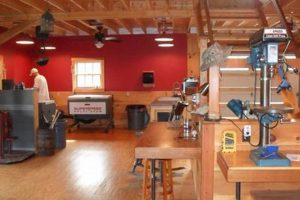
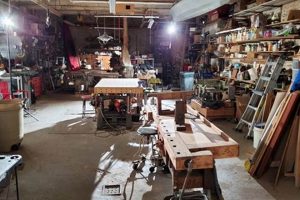
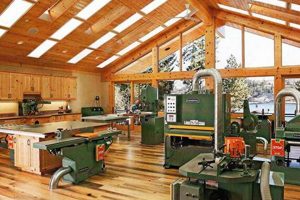
A dedicated area for crafting objects from wood, equipped with specialized tools and machinery, serves as the central hub for woodworking endeavors. This space may range from a small, contained corner in a garage to a sprawling, purpose-built structure designed exclusively for the fabrication of wooden articles. For instance, a craftsman might use this space to construct furniture, carve intricate designs, or restore antique wooden pieces.
The presence of such a facility enables the precise and efficient manipulation of wood, leading to enhanced productivity and superior project outcomes. Historically, these workspaces have been integral to the development of civilization, providing the foundation for building structures, creating essential tools, and producing artistic expressions. The ability to effectively shape wood has consistently contributed to both practical advancements and aesthetic achievements.
The following discussion will elaborate on specific aspects of establishing and maintaining an effective woodworking environment, including tool selection, safety protocols, and optimal workspace organization. These considerations are crucial for both novice and experienced woodworkers seeking to maximize their creative potential and ensure a safe working environment.
Woodworking Space Optimization
Maximizing efficiency and safety within a woodworking environment requires careful consideration of several key factors. Implementing the following tips can significantly improve productivity and reduce the risk of accidents.
Tip 1: Prioritize Adequate Lighting. Insufficient illumination can lead to errors and potential injuries. Implement a combination of overhead and task lighting to ensure clear visibility of all work surfaces and tools.
Tip 2: Invest in Effective Dust Collection. Wood dust poses a significant health hazard. A robust dust collection system, including both stationary and portable units, is crucial for maintaining air quality and protecting respiratory health.
Tip 3: Organize Tools Strategically. Implementing a tool storage system based on frequency of use and proximity to workstations enhances workflow. Utilize wall-mounted racks, drawers, and designated storage containers to keep tools readily accessible and prevent clutter.
Tip 4: Maintain a Clean and Unobstructed Workspace. Regularly remove wood scraps, sawdust, and other debris to minimize tripping hazards and ensure a clear path of movement. A clean workspace contributes to both safety and efficiency.
Tip 5: Establish Designated Zones. Divide the woodworking area into distinct zones for specific activities, such as cutting, sanding, assembly, and finishing. This separation minimizes interference and promotes a more organized workflow.
Tip 6: Implement Regular Tool Maintenance. Sharpening blades, lubricating moving parts, and inspecting electrical cords are essential for ensuring optimal tool performance and preventing equipment malfunctions. Establish a routine maintenance schedule to prolong tool life and maintain safety.
Tip 7: Secure Workpieces Firmly. Utilizing clamps, vises, and other workholding devices to secure workpieces is crucial for accurate cuts and safe operation. A stable workpiece minimizes the risk of slippage and potential injuries.
Implementing these strategies will contribute to a safer, more efficient, and more productive woodworking environment. By prioritizing organization, cleanliness, and proper tool maintenance, woodworkers can maximize their creative potential and minimize the risk of accidents.
The subsequent sections will delve into specific equipment considerations and advanced woodworking techniques.
1. Safety Implementation

Safety implementation within a woodworking environment is paramount to mitigating potential hazards and ensuring the well-being of individuals operating within the space. The integration of comprehensive safety measures directly correlates with a reduction in workplace accidents and contributes to a more productive and sustainable woodworking practice.
- Eye and Face Protection
The use of appropriate eye and face protection, such as safety glasses or face shields, is essential when operating machinery or performing tasks that generate dust, debris, or projectiles. Failure to employ adequate protection can result in severe eye injuries, including corneal abrasions or permanent vision impairment. Regular inspection and maintenance of protective equipment is also crucial.
- Respiratory Protection
Woodworking activities often produce airborne particulate matter that can pose a significant respiratory health risk. Implementing dust collection systems, utilizing respirators or dust masks, and ensuring adequate ventilation are critical for minimizing exposure to harmful wood dust. Prolonged exposure to wood dust can lead to respiratory illnesses, including asthma and occupational rhinitis.
- Machine Guarding
All power tools and machinery should be equipped with functional safety guards designed to prevent accidental contact with moving parts. Regular inspection of machine guards is necessary to ensure they are properly installed and functioning correctly. Disabling or bypassing safety guards significantly increases the risk of serious injury.
- Hearing Protection
Many woodworking tools and machines generate high noise levels that can cause permanent hearing damage. The consistent use of hearing protection, such as earplugs or earmuffs, is crucial for preserving auditory health. A proactive hearing conservation program should be implemented, including noise level monitoring and employee training on proper hearing protection usage.
These safety measures, when consistently and diligently implemented, contribute significantly to a safer woodworking environment. The effective integration of safety protocols not only protects the physical well-being of individuals but also fosters a culture of safety consciousness, leading to a more responsible and productive woodworking practice.
2. Tool Organization
Tool organization is a critical determinant of efficiency and safety within a dedicated woodworking area. The systematic arrangement of tools and equipment directly impacts workflow, reduces the likelihood of accidents, and optimizes the use of available space. When tools are readily accessible and logically arranged, the time required to locate and retrieve them is minimized, thereby increasing productivity and reducing project completion times. A disorganized workspace, conversely, introduces delays, frustration, and the potential for misplacing or damaging tools.
Consider, for example, a scenario where a craftsman requires a specific chisel for a detailed carving project. In an organized environment, the chisel would be located in a designated area, perhaps a labeled drawer or a wall-mounted rack, allowing for immediate retrieval. However, in a disorganized setting, the craftsman might spend a considerable amount of time searching for the tool, potentially disrupting the workflow and introducing unnecessary stress. Furthermore, a disorganized workspace increases the risk of accidents, as misplaced tools can become tripping hazards or be inadvertently damaged, rendering them unsafe to use. A well-organized space allows for clear pathways and unobstructed access to machinery and work surfaces, minimizing the risk of slips, trips, and falls.
In conclusion, effective tool organization is an indispensable component of a functional woodworking environment. The systematic arrangement of tools contributes directly to increased efficiency, enhanced safety, and optimized workspace utilization. Addressing the challenges associated with tool disorganization through the implementation of strategic storage solutions and consistent organizational practices is essential for maximizing the potential of any woodworking endeavor.
3. Workspace Size

Workspace size functions as a fundamental parameter governing the practicality and efficiency of a dedicated woodworking area. The dimensions of the space directly dictate the types of projects that can be undertaken, the quantity and configuration of equipment that can be accommodated, and the overall workflow within the environment. A workspace that is too small can restrict movement, limit the size of workpieces, and create a hazardous working environment. Conversely, an excessively large workspace can lead to inefficiencies, increased heating and cooling costs, and a feeling of isolation. The optimal workspace size is therefore contingent upon the specific needs and priorities of the woodworker, as well as the scope and nature of the projects undertaken.
Consider, for example, a woodworker who specializes in crafting large-scale furniture pieces. Such a project would necessitate a substantial workspace capable of accommodating the dimensions of the workpiece, as well as providing ample room for maneuverability around the project. The equipment involved in the process, such as table saws, jointers, and planers, would also require sufficient floor space to operate safely and effectively. In contrast, a woodworker who focuses on smaller-scale projects, such as carving or woodturning, might find a smaller workspace to be adequate. However, even in these cases, it is important to ensure that the space is well-organized and that there is sufficient room for tool storage and movement.
In summary, workspace size represents a crucial element in the establishment of an effective woodworking environment. The selection of an appropriate workspace size should be based on a comprehensive assessment of the woodworker’s needs, the types of projects to be undertaken, and the available resources. Optimizing workspace size contributes to increased efficiency, enhanced safety, and improved project outcomes. Disregarding these factors will inevitably hinder the practical application of a woodworking area and limit its potential.
4. Environmental Control

Environmental control within a woodworking area directly impacts the quality of finished projects, the safety of the workspace, and the longevity of tools and materials. Proper management of factors such as humidity, temperature, and ventilation is essential for creating an optimal environment for woodworking activities.
- Humidity Regulation
Maintaining stable humidity levels is crucial to prevent warping, cracking, and dimensional changes in wood. Excessive humidity can cause wood to swell, while low humidity can lead to shrinkage and cracking. Implementing a dehumidifier or humidifier can help regulate moisture content and ensure the stability of wooden projects. An environment with stable moisture content is beneficial for wood storage as well. Failure to properly regulate humidity can result in compromised projects requiring rework or total failure.
- Temperature Management
Temperature fluctuations can also affect wood stability and adhesive performance. Extreme temperatures can cause wood to expand or contract, leading to stress and potential damage. Maintaining a consistent temperature range within the workspace promotes consistent wood behavior and optimal adhesive bonding. A stable temperature also increases the life span of tools by preventing condensation and rust formation.
- Ventilation and Air Quality
Effective ventilation is essential for removing dust, fumes, and volatile organic compounds (VOCs) generated during woodworking processes. Adequate ventilation reduces the risk of respiratory problems, eye irritation, and other health hazards. Implementing a dust collection system and ensuring proper airflow are crucial for maintaining a safe and healthy working environment. The quality of the air is critical for finishing work such as staining and lacquering.
- Lighting Control
While often overlooked in discussions of environmental control, proper lighting is essential for precision work and safety. Adequate illumination minimizes eye strain, reduces the risk of errors, and enhances overall productivity. Combining ambient and task lighting can provide optimal visibility for all woodworking activities. Natural light is desirable, however, artificial light is necessary during hours of darkness and on cloudy days.
In summary, environmental control plays a critical role in the success and sustainability of any woodworking endeavor. By carefully managing humidity, temperature, ventilation, and lighting, woodworkers can create a workspace that promotes high-quality workmanship, safety, and longevity of tools and materials. The failure to consider these factors can lead to compromised project outcomes, health risks, and premature equipment failure. Therefore, integrating comprehensive environmental control measures is a necessary investment for any dedicated woodworking space.
5. Project Scope

Project scope, in the context of a dedicated woodworking area, defines the boundaries and objectives of any given woodworking endeavor. It directly influences the required resources, time investment, and ultimate success of the project. A clearly defined scope ensures alignment between the woodworker’s capabilities, the available resources within the workspace, and the desired outcome.
- Project Complexity and Skill Requirements
The intricacy of a project dictates the requisite skill level and experience necessary for its successful completion. A complex project, such as crafting a period-style cabinet with intricate joinery, demands advanced woodworking techniques and a thorough understanding of wood properties. Conversely, a simple project, such as constructing a basic shelving unit, requires less specialized skills. The skill level required directly impacts the feasibility of undertaking a project within a given woodworking environment. Inadequate skills can lead to frustration, wasted materials, and ultimately, project failure. An appropriately skilled woodworker can then complete a project while following all safety implementations in place.
- Material Requirements and Availability
The scope of a project determines the types and quantities of materials needed. Projects involving exotic hardwoods or specialized hardware require careful planning to ensure material availability and cost-effectiveness. A well-stocked woodworking area with a diverse range of wood species and hardware components can accommodate a wider range of projects. Limited material availability may necessitate adjustments to the project design or the selection of alternative materials. The material is a part of the project scope. The material may also need environmental consideration.
- Time Constraints and Scheduling
The allocated timeframe for a project directly affects its scope and feasibility. Projects with tight deadlines may require simplification of the design or the delegation of tasks to multiple individuals. A realistic assessment of the time required for each stage of the woodworking process, from material preparation to finishing, is essential for effective project management. Unrealistic time constraints can lead to rushed work, compromised quality, and increased stress levels. The time can also be affected by number of available workers.
- Equipment Capabilities and Limitations
The available equipment within a woodworking area sets constraints on the types of projects that can be undertaken. A workspace equipped with a comprehensive range of power tools and specialized machinery can handle more complex and demanding projects. Limited equipment capabilities may necessitate outsourcing certain tasks or modifying the project design to accommodate the available tools. The project scope should align with the capabilities of the woodworking shop to ensure project viability and efficient project implementation. The capability and limitations are important during any project planning.
These facets collectively underscore the critical relationship between project scope and the resources and capabilities inherent within a woodworking environment. A well-defined project scope, aligned with the available skills, materials, time, and equipment, ensures a successful and fulfilling woodworking experience. Disregarding these interdependencies can lead to project inefficiencies, compromised quality, and ultimately, project failure. The woodworker should always be aware of the project scope to achieve high-quality woodworking projects.
Frequently Asked Questions About a Dedicated Woodworking Area
The following section addresses common inquiries regarding the establishment, maintenance, and optimal utilization of a designated woodworking space. The information provided is intended to offer clear and concise guidance on various aspects of woodworking practices.
Question 1: What is the minimal space requirement for a functional woodworking area?
The minimal space requirement is contingent upon the scope of intended projects and the quantity of equipment. However, a space of at least 100 square feet is generally recommended to accommodate essential tools and provide adequate room for maneuverability. Smaller spaces may be suitable for specialized tasks, such as carving or woodturning, but larger projects necessitate correspondingly larger workspaces.
Question 2: What are the essential power tools for a beginner’s woodworking area?
A beginner’s woodworking area should include a table saw, a miter saw, a drill press, a random orbital sander, and a jigsaw. These tools provide the foundational capabilities for a wide range of woodworking tasks, including cutting, shaping, drilling, and sanding. Additional tools can be acquired as skills and project requirements evolve.
Question 3: How can dust accumulation be effectively managed in a woodworking area?
Effective dust management requires a multi-faceted approach, including the implementation of a dust collection system, the use of respirators or dust masks, and the regular cleaning of work surfaces and the surrounding environment. A dedicated dust collector connected to power tools is highly recommended. Additionally, ensuring adequate ventilation helps to remove airborne particulate matter.
Question 4: What safety precautions should be prioritized in a woodworking area?
Prioritized safety precautions include the consistent use of eye and face protection, the wearing of appropriate respiratory protection, the proper guarding of power tools, and the implementation of safe operating procedures. Regular inspection of equipment and adherence to manufacturer’s safety guidelines are also essential.
Question 5: How can the organization of tools and materials be optimized in a woodworking area?
Optimal organization involves the implementation of a systematic storage system, the labeling of storage containers, and the strategic placement of tools and materials based on frequency of use. Wall-mounted racks, drawers, and designated storage areas can significantly improve efficiency and reduce clutter.
Question 6: What is the recommended approach for maintaining woodworking equipment?
Regular maintenance should include sharpening blades, lubricating moving parts, inspecting electrical cords, and cleaning equipment after each use. Adhering to a routine maintenance schedule prolongs the life of woodworking tools and ensures optimal performance. Damaged or malfunctioning equipment should be repaired or replaced promptly.
These frequently asked questions provide a foundational understanding of key considerations for establishing and maintaining an effective woodworking area. Adhering to these guidelines will contribute to a safer, more efficient, and more productive woodworking experience.
The following section will delve into advanced woodworking techniques and project planning strategies.
Conclusion
The preceding discussion has elucidated essential aspects pertaining to “my woodworking shop,” emphasizing critical considerations for safety, organization, environmental control, project scope, and frequently encountered challenges. A comprehensive understanding of these factors contributes directly to the establishment and maintenance of a functional and productive workspace.
The principles outlined herein should serve as a foundational guide for individuals seeking to engage in woodworking pursuits. Diligent application of these principles will foster a safer, more efficient, and ultimately more rewarding woodworking experience. The pursuit of excellence in woodworking necessitates a commitment to continuous learning and refinement of skills within a well-defined and thoughtfully managed environment.