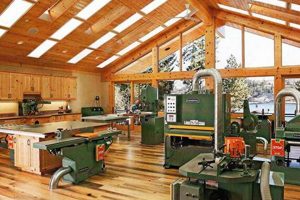
A dust collection apparatus specifically designed for woodworking environments employs a vacuum to extract particulate matter and debris generated during processes such as sawing, sanding, and routing. This equipment typically comprises a vacuum unit, a collection container, and a network of hoses or ductwork to connect to power tools or machinery. Its purpose is to maintain a cleaner and healthier workspace by removing airborne dust and minimizing the accumulation of larger shavings. Consider a setup utilizing a powerful vacuum connected to a table saw and a dust separator to efficiently capture sawdust during cutting operations.
The implementation of effective dust extraction methods offers significant advantages in a woodworking shop. Improved air quality reduces the risk of respiratory problems for woodworkers and creates a safer, more comfortable environment. The reduction of dust accumulation on surfaces and equipment minimizes the potential for fire hazards and maintains the longevity of machinery. Historically, rudimentary dust collection methods evolved from simple exhaust fans to the sophisticated, multi-stage systems available today, reflecting an increasing awareness of the health and safety implications of wood dust exposure.
Understanding the diverse types of collectors, their filtration capabilities, and the proper installation techniques is crucial for establishing an optimal system. Subsequent sections will delve into the specifications of various units, strategies for system design, and considerations for effective maintenance and troubleshooting.
Tips for Optimizing a Woodworking Shop Vac System
Maximizing the performance and longevity of a dust collection setup requires careful planning and consistent maintenance. Adhering to the following recommendations will enhance its efficiency and ensure a cleaner, safer working environment.
Tip 1: Select an Appropriately Sized Unit: Prioritize a model with sufficient cubic feet per minute (CFM) airflow for the intended applications. Underpowered vacuums will struggle to effectively capture dust at the source, diminishing their overall utility. Consult tool manufacturer specifications to determine optimal CFM requirements.
Tip 2: Employ a Dust Separator: A cyclone separator, placed inline before the vacuum unit, removes a significant portion of larger debris. This prevents the main filter from becoming clogged prematurely, thereby maintaining airflow and extending filter life.
Tip 3: Utilize Dedicated Hoses and Fittings: Employ smooth-bore hoses of adequate diameter to minimize airflow restriction. Securely connect hoses and fittings to prevent leaks, which reduce suction and compromise the system’s effectiveness.
Tip 4: Strategically Position Collection Points: Place collection ports as close as possible to the source of dust generation. This maximizes capture efficiency and minimizes the dispersal of particulate matter into the surrounding air. Consider overhead placement for tools that generate airborne dust.
Tip 5: Regularly Clean or Replace Filters: Clogged filters significantly reduce airflow. Inspect and clean or replace filters according to the manufacturer’s recommendations. Some filters can be cleaned with compressed air, while others require replacement.
Tip 6: Seal Leaks and Gaps: Ensure all connections and ductwork are airtight. Seal any gaps or leaks with appropriate sealant to prevent loss of suction and maintain optimal performance.
Tip 7: Ground the System: Static electricity can build up in plastic hoses and ductwork, posing a fire hazard. Ground the system by connecting a grounding wire to a metal component of the vacuum unit and a grounded metal object.
Tip 8: Implement a Blast Gate System: Install blast gates on each branch of the ductwork to direct suction to the active tool. Closing unused gates maximizes airflow to the tool in use, improving dust collection efficiency.
By implementing these strategies, a dust collection system can be optimized to provide superior performance, contributing to a healthier and more productive woodworking shop.
The following sections will discuss troubleshooting common issues and explore advanced dust collection techniques.
1. Airflow (CFM)

Airflow, measured in Cubic Feet per Minute (CFM), constitutes a fundamental performance metric for a woodworking shop vac system. It defines the volume of air the system can move per unit of time, directly impacting its dust collection efficacy. An insufficient CFM rating compromises the system’s ability to capture airborne particles at the source, leading to a degraded work environment and potential health risks.
- Dust Capture Velocity
Adequate CFM generates sufficient suction velocity at the tool’s dust port to overcome the momentum of airborne dust particles. Without sufficient capture velocity, dust escapes into the surrounding environment. For example, a wide-belt sander requires a significantly higher CFM than a small spindle sander due to the greater volume of dust produced and its higher initial velocity.
- Hose and Ductwork Resistance
CFM ratings are typically measured at the vacuum unit itself. However, the introduction of hoses, ductwork, and fittings creates resistance, reducing the effective CFM at the tool. Long runs of ductwork, sharp bends, and undersized hoses significantly diminish airflow, requiring a higher initial CFM to compensate. Consider a scenario where a system rated for 600 CFM only delivers 300 CFM at the tool due to excessive ductwork resistance.
- Tool-Specific Requirements
Different woodworking tools generate varying volumes of dust and require different CFM levels for effective collection. A table saw, with its enclosed blade and dedicated dust port, generally requires less CFM than an open-blade bandsaw. Consulting tool manufacturers’ recommendations for CFM requirements ensures optimal dust collection performance.
- Filter Clogging
As the filter in a woodworking shop vac system accumulates dust, airflow decreases. Regular filter maintenance or replacement is crucial to maintain optimal CFM. A clogged filter restricts airflow, reducing the system’s dust collection efficiency and potentially overloading the vacuum motor.
The relationship between CFM and each component of a woodworking shop vac system is interdependent. Selecting a vacuum unit with an appropriate CFM rating, accounting for hose and ductwork resistance, and maintaining clean filters are essential for effective dust collection and a healthier woodworking environment. Ignoring these considerations will result in a system that underperforms, regardless of its initial specifications.
2. Filtration Efficiency

Filtration efficiency constitutes a critical performance parameter of any woodworking shop vac system, directly affecting the air quality within the workspace and, consequently, the health of the individuals working there. A system’s ability to capture and retain fine particulate matter determines its overall effectiveness in mitigating the risks associated with wood dust exposure.
- Minimum Efficiency Reporting Value (MERV) Rating
The MERV rating provides a standardized measure of a filter’s ability to capture particles of varying sizes. Higher MERV ratings indicate greater filtration efficiency, particularly for smaller, more hazardous dust particles. For woodworking environments, filters with MERV ratings of 13 or higher are generally recommended to effectively capture fine dust generated during sanding and other operations. Using a lower MERV rating risks releasing respirable dust back into the air.
- Filter Media Types
Various filter media are employed in woodworking shop vac systems, each offering different levels of filtration efficiency and durability. Cloth filters, while economical, typically exhibit lower filtration efficiency compared to pleated paper or HEPA filters. HEPA (High-Efficiency Particulate Air) filters are designed to capture at least 99.97% of particles 0.3 microns in diameter, providing superior protection against fine dust inhalation. The selection of filter media should align with the specific needs and budget of the woodworking shop, considering the types of materials processed and the desired level of air quality.
- Filter Surface Area
The surface area of the filter directly impacts its airflow capacity and longevity. Filters with larger surface areas tend to clog less frequently and maintain higher airflow rates over extended periods. Pleated filters, for example, offer significantly greater surface area compared to flat filters of the same dimensions. Insufficient filter surface area leads to reduced suction power and necessitates more frequent filter cleaning or replacement.
- Two-Stage Filtration Systems
Implementing a two-stage filtration system, employing a cyclone separator in conjunction with a fine-particle filter, enhances overall filtration efficiency and extends filter life. The cyclone separator removes larger debris before it reaches the filter, reducing the filter load and preventing premature clogging. This approach is particularly beneficial in woodworking shops that generate substantial amounts of shavings and coarse dust.
The proper selection and maintenance of filtration components are paramount for ensuring the long-term effectiveness of a woodworking shop vac system. Neglecting filtration efficiency compromises the system’s ability to protect worker health and maintain a clean, safe working environment. By understanding the nuances of MERV ratings, filter media types, surface area considerations, and multi-stage filtration systems, woodworkers can optimize their dust collection strategies and mitigate the risks associated with wood dust exposure.
3. Hose Diameter

Hose diameter constitutes a critical variable in the design and performance of a woodworking shop vac system. Its influence extends to airflow, suction power, and the overall efficiency of dust and debris extraction, directly impacting the cleanliness and safety of the woodworking environment.
- Airflow Restriction
Hose diameter directly impacts airflow resistance within the system. Narrower hoses impede airflow, reducing the Cubic Feet per Minute (CFM) delivered at the tool’s dust port. This diminished airflow compromises the system’s ability to capture dust effectively, particularly for tools that generate large volumes of particulate matter. For instance, using a 1-inch diameter hose on a table saw connected to a standard shop vac will result in significantly reduced dust collection compared to a 2.5-inch diameter hose. The restriction increases with the length of the hose as well.
- Particle Size and Clogging
Hose diameter must be sufficient to accommodate the size of the debris generated by woodworking operations. Undersized hoses are prone to clogging, particularly when processing materials that produce larger shavings or chips. A hose diameter that is too small for the material being extracted will require more frequent clearing and reduce the overall efficiency of the system. Consider the difference between extracting fine sanding dust versus large wood chips from a planer; the latter requires a larger hose diameter to prevent blockages.
- Velocity of Airflow
While increasing hose diameter reduces resistance and allows for greater overall airflow, it can also decrease the velocity of the air stream within the hose if the vacuum unit does not have sufficient power. Lower velocity can result in heavier particles settling within the hose, leading to clogs over time. The ideal hose diameter is a balance between maximizing airflow volume and maintaining adequate velocity to keep debris suspended in the air stream. Therefore, matching the hose diameter to the capabilities of the vacuum unit is essential.
- System Compatibility and Adaptability
Woodworking tools often feature dust ports of varying sizes. A flexible hose diameter allows for easy adaptation to different tools, maximizing the system’s versatility. Using stepped adapters or fittings, a single vacuum system can be configured to work with a variety of equipment, each with its own specific dust collection requirements. However, excessive use of adapters can also introduce airflow restrictions, necessitating careful consideration of the overall system design.
The selection of an appropriate hose diameter requires a comprehensive understanding of the woodworking processes involved, the types of materials processed, and the specifications of the vacuum unit. Choosing a hose diameter that is too small can compromise the system’s performance and lead to operational inefficiencies, while selecting a hose that is too large may not be optimal for all tools or applications. A balanced approach, considering airflow, particle size, velocity, and system compatibility, is crucial for maximizing the effectiveness of a woodworking shop vac system.
4. Collection capacity

Collection capacity, in the context of a woodworking shop vac system, denotes the volumetric measure of the receptacle designed to accumulate extracted dust, shavings, and debris. This parameter directly influences the operational frequency required for emptying the system, impacting workflow efficiency and overall user experience. A system with an insufficient collection capacity necessitates more frequent interruptions for emptying, increasing downtime and potentially hindering productivity. Conversely, an excessively large collection capacity may lead to unnecessary bulkiness and storage challenges, without providing commensurate benefits if the system’s output is not high.
The practical significance of collection capacity becomes particularly evident in woodworking environments characterized by high material throughput. For example, a cabinetmaking operation generating substantial volumes of sawdust and wood chips from sawing, routing, and sanding processes benefits significantly from a system with a large collection container. This minimizes interruptions and allows for sustained operation. Smaller workshops, or those focusing on projects that generate less waste, may find a smaller collection capacity sufficient. Choosing the correct capacity involves evaluating production volume, material type, and the frequency with which the user is willing to empty the system.
Optimization of collection capacity involves balancing several factors. While a larger container reduces emptying frequency, it also increases the overall weight and footprint of the system, potentially impacting maneuverability and storage. Furthermore, excessively large containers may lead to compaction of collected material, making emptying more difficult. Therefore, selection requires careful consideration of workflow requirements, physical space constraints, and user preferences, ensuring that the collection capacity aligns with the demands of the specific woodworking application.
5. Portability/Placement

The portability and placement of a woodworking shop vac system directly influence its operational efficiency and suitability for diverse workshop layouts. A system’s capacity for movement and strategic positioning dictates its accessibility to various tools and workstations, ultimately affecting the efficacy of dust collection at the source. A stationary system, while potentially offering higher capacity or power, necessitates a fixed workspace design and can limit the scope of woodworking activities. Conversely, a highly portable system allows for greater flexibility in shop arrangement but may compromise on other performance characteristics.
Examples illustrating the importance of portability/placement abound in woodworking. Consider a small, multi-purpose shop where space is a premium. A compact, wheeled dust collector can be readily moved to different machines as needed, optimizing dust extraction during tasks such as routing, sanding, or sawing. In contrast, a larger, stationary dust collection system installed in a production-oriented cabinet shop might employ a network of overhead ductwork to serve multiple workstations simultaneously. The optimal choice reflects a trade-off between initial investment, space constraints, and the dynamic nature of the woodworking processes undertaken. Furthermore, placement considerations extend to factors such as proximity to power outlets, accessibility for emptying the collection container, and minimizing obstruction to workflow pathways.
Ultimately, an informed decision regarding portability and placement requires a thorough assessment of the woodworking environment and anticipated usage patterns. While a highly portable system offers advantages in flexibility and adaptability, stationary systems can provide greater capacity and performance in dedicated workspaces. Balancing these considerations ensures that the chosen dust collection system effectively supports the woodworking activities while minimizing disruption to the overall workshop layout and workflow.
6. Noise level

Noise level constitutes a significant ergonomic consideration in the operation of a woodworking shop vac system. Excessive noise exposure can lead to auditory fatigue, long-term hearing damage, and a reduction in overall work efficiency. Therefore, understanding and mitigating the noise generated by these systems is crucial for maintaining a safe and productive work environment.
- Source of Noise Generation
The primary source of noise in a woodworking shop vac system is the vacuum motor itself. High-speed motors, designed to generate sufficient suction power, inherently produce significant levels of airborne noise. The design of the impeller and the motor housing contribute substantially to the overall noise signature. Inefficient motor designs or worn components can exacerbate noise production.
- Resonance and Amplification
The materials and construction of the vacuum unit and its associated ductwork can amplify noise through resonance. Thin-walled metal or plastic components vibrate in response to the motor’s operation, radiating sound waves into the surrounding environment. Ductwork, particularly long runs of rigid piping, can act as a conduit for sound, transmitting noise to distant parts of the shop. Securing ductwork and using sound-dampening materials can minimize this effect.
- Decibel (dB) Ratings and Hearing Protection
Noise levels are measured in decibels (dB). Prolonged exposure to noise levels above 85 dB can cause permanent hearing damage. Woodworking shop vac systems can often generate noise levels exceeding this threshold. Therefore, the use of appropriate hearing protection, such as earplugs or earmuffs, is essential when operating these systems. Selecting a system with a lower dB rating at the point of purchase can also mitigate risks.
- Noise Reduction Strategies
Various strategies can be employed to reduce the noise generated by a woodworking shop vac system. Enclosing the vacuum unit in a sound-dampening cabinet can significantly reduce airborne noise. Using flexible hoses instead of rigid ductwork minimizes vibration transmission. Selecting a vacuum system with noise-reducing features, such as insulated motor housings or variable speed controls, can further contribute to a quieter work environment. Consideration should also be given to the location of the unit, placing it away from work areas where possible.
The noise level of a woodworking shop vac system is not merely an inconvenience but a legitimate health and safety concern. Understanding the sources of noise, implementing effective mitigation strategies, and utilizing appropriate hearing protection are crucial steps in creating a more comfortable and sustainable woodworking environment. Prioritizing noise reduction, whether through system selection or modification, demonstrates a commitment to worker well-being and long-term productivity.
7. Power consumption
Power consumption is a critical consideration in the selection and operation of a woodworking shop vac system. The energy demands of these systems directly influence operational costs and environmental impact, necessitating a comprehensive understanding of the factors contributing to power usage.
- Motor Efficiency and Horsepower
The efficiency of the vacuum motor is a primary determinant of power consumption. Motors with higher efficiency ratings convert a greater percentage of electrical energy into mechanical energy, minimizing wasted energy in the form of heat. Horsepower (HP) indicates the motor’s power output capacity; higher horsepower typically correlates with increased power consumption, even if the system is not consistently operating at its maximum capacity. A 2 HP motor, for instance, consumes significantly more power than a 1 HP motor, regardless of the actual load.
- Airflow Requirements and System Resistance
The power required to operate a woodworking shop vac system is directly proportional to the airflow (CFM) it generates and the resistance it encounters. Systems designed to move larger volumes of air, necessary for collecting dust from larger machinery or multiple workstations, require more power. Similarly, systems with long runs of ductwork or restrictive filters experience increased resistance, demanding greater power output to maintain adequate airflow. A system with poorly designed ductwork may consume significantly more power than a well-optimized system with similar airflow capabilities.
- Duty Cycle and Operational Frequency
The duty cycle, defined as the percentage of time the system is actively collecting dust, significantly influences overall power consumption. Systems that operate continuously, or for extended periods, consume considerably more energy than those used intermittently. A small shop using a vac system only for a few hours each week will have lower power costs than a large shop with continuous operation.
- Standby Power and Energy Management
Many woodworking shop vac systems consume power even when not actively collecting dust. This standby power, often used to maintain electronic controls or power indicator lights, can contribute significantly to overall energy consumption over time. Implementing energy management strategies, such as using power strips to completely disconnect the system when not in use, can minimize wasted energy. Systems equipped with automatic shut-off features when tools are not in use can also reduce overall power demand.
The interplay between motor efficiency, airflow requirements, duty cycle, and standby power determines the total energy consumption of a woodworking shop vac system. Understanding these factors allows woodworkers to make informed decisions about system selection and operational practices, minimizing energy costs and promoting environmental sustainability. Choosing a system with a high-efficiency motor, optimizing ductwork design, and implementing energy management strategies can significantly reduce the long-term operating costs associated with dust collection.
Frequently Asked Questions
This section addresses common inquiries regarding the selection, operation, and maintenance of woodworking shop vac systems.
Question 1: What distinguishes a “woodworking shop vac system” from a standard household vacuum cleaner?
A woodworking shop vac system is specifically engineered to handle the unique demands of woodworking environments. It features a more robust motor, a larger collection capacity, and a filtration system designed to capture fine wood dust effectively. Standard household vacuums are not typically equipped to handle the volume or type of debris generated in a woodworking shop, and their filtration systems may not be adequate to capture hazardous fine dust particles.
Question 2: What CFM (Cubic Feet per Minute) rating is appropriate for a woodworking shop vac system?
The appropriate CFM rating depends on the type and size of the woodworking tools being used. Larger tools, such as table saws and planers, require higher CFM levels to effectively capture dust at the source. Consulting the tool manufacturer’s recommendations for CFM requirements is advisable. Generally, a CFM rating of at least 350 CFM is recommended for a small shop, while larger shops may require systems with CFM ratings of 600 or higher.
Question 3: How often should the filter in a woodworking shop vac system be cleaned or replaced?
Filter cleaning or replacement frequency depends on the volume of dust collected and the type of filter used. Filters should be inspected regularly for signs of clogging. Some filters can be cleaned with compressed air, while others require replacement. As a general guideline, filters should be cleaned or replaced at least every three to six months, or more frequently if dust collection performance declines.
Question 4: Is it necessary to ground a woodworking shop vac system?
Grounding a woodworking shop vac system is recommended to prevent the buildup of static electricity, which can pose a fire hazard. Static electricity can accumulate in plastic hoses and ductwork, creating a spark that could ignite combustible dust. Grounding the system involves connecting a grounding wire to a metal component of the vacuum unit and a grounded metal object.
Question 5: What is the benefit of using a cyclone separator in conjunction with a woodworking shop vac system?
A cyclone separator pre-separates larger debris from the airstream before it reaches the filter, reducing the filter load and preventing premature clogging. This extends filter life, maintains airflow, and improves overall dust collection efficiency. Cyclone separators are particularly beneficial in woodworking shops that generate substantial amounts of shavings and coarse dust.
Question 6: What safety precautions should be observed when operating a woodworking shop vac system?
Operating a woodworking shop vac system requires adherence to several safety precautions. These include wearing appropriate respiratory protection, such as a dust mask or respirator, to prevent inhalation of fine dust. Hearing protection should also be worn to mitigate noise exposure. Ensuring the system is properly grounded and that all connections are secure is essential to prevent electrical hazards and leaks.
Effective dust collection is paramount for maintaining a safe and healthy woodworking environment. Understanding the nuances of these systems is essential for maximizing their performance and mitigating the risks associated with wood dust exposure.
The subsequent section will address troubleshooting common problems encountered with woodworking shop vac systems.
Conclusion
This article has explored the essential facets of a woodworking shop vac system, emphasizing the importance of adequate airflow, efficient filtration, appropriate hose diameter, sufficient collection capacity, strategic portability/placement, mitigated noise levels, and optimized power consumption. These elements collectively determine the system’s effectiveness in maintaining a safe and productive woodworking environment.
The proper selection, operation, and maintenance of a woodworking shop vac system are crucial investments in both worker health and the longevity of woodworking equipment. Diligent attention to these details ensures not only compliance with safety standards but also fosters a more efficient and enjoyable woodworking experience.