



Devices designed to apply pressure evenly across a surface, facilitating the secure bonding of multiple boards into a single, larger unit, are essential tools in furniture making and cabinet construction. These tools, often featuring adjustable mechanisms and sturdy frames, ensure a tight and seamless connection between components. An example of their application is the creation of wide tabletops or door panels where individual pieces of lumber are joined edge-to-edge.
The use of these specialized clamping mechanisms is critical for achieving flat, stable, and visually appealing results in woodworking projects. Their application minimizes warping and misalignment during the glue-up process, leading to enhanced structural integrity and a professional finish. Historically, various methods were employed for achieving similar results, but modern versions offer improved precision, ease of use, and consistent performance.
The following sections will delve into the various types available, factors to consider when selecting the appropriate model, and best practices for their effective application in woodworking.
Tips for Effective Use
Maximizing the effectiveness of these tools requires careful attention to technique and proper selection for each project. These suggestions offer guidance on optimizing their use for superior results.
Tip 1: Ensure Flat Surfaces: Before applying clamping pressure, verify that the surfaces to be joined are planed flat. Uneven surfaces will result in stress points and a compromised bond.
Tip 2: Even Glue Distribution: Apply adhesive uniformly across the entire surface to be joined. Insufficient or uneven adhesive application can lead to weak spots in the joint.
Tip 3: Alternate Clamp Direction: To prevent bowing or cupping, alternate the orientation of the clamping mechanisms above and below the workpiece. This distributes pressure more evenly.
Tip 4: Use Cauls: Employ caulsstraight, rigid boardsalong the edges of the assembly. Cauls distribute clamping force, preventing localized pressure marks and ensuring a flat surface.
Tip 5: Moderate Pressure: Excessive pressure can squeeze out too much adhesive, weakening the joint. Apply sufficient pressure to close the joint but avoid over-tightening.
Tip 6: Allow Adequate Cure Time: Adhere to the adhesive manufacturer’s recommended cure time before removing the clamping mechanisms. Premature removal can compromise the strength of the bond.
Tip 7: Clean Up Squeeze-Out: Remove any adhesive squeeze-out before it fully cures. This simplifies sanding and finishing processes.
Implementing these techniques will significantly improve the quality and durability of wood assemblies. Correct application leads to stronger, more aesthetically pleasing results.
The following sections will explore specific types and brands available on the market and how to maintain these tools.
1. Even Pressure

The application of consistent and uniform force is paramount in woodworking, especially when joining multiple boards to create larger surfaces. Without it, structural integrity is compromised, leading to potential failures and aesthetic imperfections. This connection directly impacts the effectiveness of the tools and techniques used to achieve secure bonds.
- Preventing Warping and Twisting
Uneven pressure induces stress within the wood, resulting in warping or twisting as the adhesive cures. The clamping mechanisms are specifically designed to distribute force across the entire surface, counteracting these tendencies. For instance, utilizing multiple parallel clamps spaced appropriately across the width of the project minimizes localized stress points.
- Ensuring Joint Integrity
Gaps or voids within a glued joint weaken the overall structure. Appropriate devices help maintain intimate contact between the wood surfaces, squeezing out excess adhesive and maximizing the bond area. Example: A large tabletop constructed without proper pressure will be prone to separation over time, particularly in environments with fluctuating humidity.
- Minimizing Surface Imperfections
Inconsistent pressure can cause boards to become misaligned, leading to noticeable steps or gaps along the joined edges. These imperfections require additional sanding and can compromise the final finish. A well-executed glue-up with proper clamping force results in a flush, seamless surface requiring minimal post-processing.
- Optimizing Adhesive Performance
Adhesives require a certain level of compression to achieve optimal bond strength. Insufficient force results in a weak bond, while excessive force can starve the joint of adhesive. Selecting the correct clamping method and applying appropriate pressure are critical for maximizing the adhesive’s performance characteristics. Example: Using bar clamps with adequate force, but not overtightening, ensures the adhesive forms a strong, reliable bond.
In summary, the ability of these wood joining tools to deliver this pressure uniformly is fundamental to the success of woodworking projects. It directly impacts the structural stability, aesthetic appeal, and longevity of the finished product. Choosing the right type and applying them correctly is therefore an indispensable skill for any woodworker.
2. Joint Alignment
Maintaining accurate joint alignment during wood assembly is paramount to achieving a strong, aesthetically pleasing final product. This precision is especially critical when constructing large surfaces where even slight misalignments accumulate and become visually prominent. Panel clamps serve as an essential tool in ensuring this accuracy.
- Preventing Surface Irregularities
Misaligned joints result in uneven surfaces that require extensive sanding and planing to correct. This process not only increases labor but also removes material, potentially altering the intended dimensions and profile of the workpiece. Proper alignment, facilitated by clamping systems, minimizes the need for such corrections.
- Ensuring Structural Integrity
Gaps or offsets in a glued joint weaken the overall structure. When boards are not properly aligned, the adhesive bond is compromised, leading to reduced strength and increased susceptibility to failure under stress. Clamping mechanisms maintain consistent contact between surfaces, maximizing the adhesive’s bonding capacity.
- Facilitating Efficient Assembly
Accurate initial alignment streamlines the subsequent steps in the woodworking process. When joints are properly aligned from the outset, tasks such as trimming, shaping, and finishing become more efficient. The use of appropriate systems reduces the time and effort required to achieve a professional result.
- Preserving Material Dimensions
Correcting misaligned joints often involves removing material, potentially reducing the overall size or altering the intended shape of the workpiece. Clamping promotes accuracy, preserving material dimensions and maintaining the design intent. This is particularly important in projects where precise measurements are critical.
These facets of joint alignment underscore the critical role of these devices in achieving high-quality results. By preventing surface irregularities, ensuring structural integrity, facilitating efficient assembly, and preserving material dimensions, these tools contribute directly to the success of woodworking endeavors. Selection of the appropriate type, combined with careful application, is essential for maximizing their effectiveness.
3. Cure Time
The duration required for an adhesive to achieve its maximum bond strength is a critical factor directly influenced by and interacting with the application of these joining mechanisms. Insufficient cure time, while pressure is applied or shortly thereafter, compromises joint integrity, irrespective of the clamping system’s quality. Premature removal can induce stress within the partially cured joint, leading to warping, cracking, or a weakened bond. Consider a tabletop glued with a PVA adhesive; if these devices are removed before the recommended cure time (often 24 hours), the internal stresses may cause the individual boards to shift, resulting in an uneven surface.
Furthermore, environmental factors such as temperature and humidity significantly impact adhesive cure rates. Higher temperatures typically accelerate curing, while higher humidity levels can prolong the process for certain adhesives. The recommended cure time specified by the adhesive manufacturer serves as a baseline; adjustments based on environmental conditions may be necessary. For instance, a woodworking project glued in a humid workshop might require an extended period under pressure to ensure complete curing. Adhesives with extended open times benefit most from prolonged clamping to fully permeate wood fibers before solidifying.
In summary, cure time is an inseparable element of effective woodworking. Its correct consideration mitigates risks associated with bond failure and dimensional instability. While these tools are critical for applying pressure, understanding the necessity of allowing adhesives to cure fully under pressure is essential for long-lasting, structurally sound woodworking projects. Ignoring cure time negates the benefits derived from proper clamping techniques, leading to unsatisfactory outcomes, and potentially rework.
4. Clamp Type

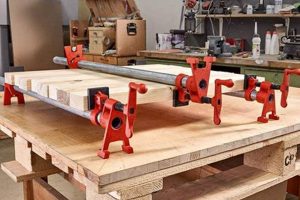
The selection of the appropriate type of clamp is intrinsically linked to the successful creation of large wooden surfaces. The effectiveness of this relies heavily on choosing a clamp that can apply even pressure across the boards, preventing warping and ensuring a tight, seamless bond. Bar clamps, with their long reach and ability to apply substantial force, are frequently employed for this purpose. Pipe clamps offer a similar functionality, allowing for customization of length by using standard threaded pipes. Specialized systems, designed specifically for this task, often incorporate features like integrated leveling mechanisms and greater pressure distribution capabilities.
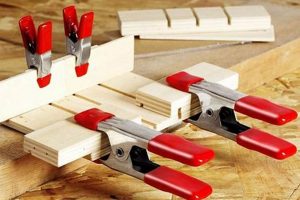
The relationship between this selection and project success is causal: the wrong type of clamp can lead to an uneven surface or a weak glue joint, necessitating rework or compromising the integrity of the finished piece. For instance, using spring clamps, designed for light-duty tasks, would be wholly inadequate for assembling a wide tabletop; the pressure would be insufficient, and the resulting surface would likely be uneven. Conversely, utilizing multiple heavy-duty bar clamps on a small panel might induce excessive pressure, potentially damaging the wood. The practical significance of understanding clamp types lies in the ability to predict and mitigate these potential problems, optimizing the likelihood of a flawless glue-up.
In summation, clamp selection is a critical decision point in the fabrication of wooden surfaces. An informed choice, considering the size and nature of the project, the properties of the wood, and the characteristics of the adhesive, contributes significantly to the quality and longevity of the final product. The challenges lie in understanding the diverse range of available options and their respective strengths and weaknesses, but mastering this aspect of woodworking is essential for achieving professional-level results.
5. Material Compatibility

Material selection exerts a considerable influence on the application and effectiveness of joining mechanisms. The interaction between the clamp, the wood species, and the adhesive dictates the success of the bonding process. Hardwoods, for instance, require greater clamping pressure than softwoods to achieve optimal joint closure. Similarly, certain wood species contain oils or resins that can interfere with adhesive bonding, necessitating surface preparation or the use of specialized adhesives. The clamping force must be carefully regulated to avoid crushing softer woods or damaging delicate surfaces. A failure to account for these material properties can result in weakened joints, surface imperfections, or even project failure. A practical example is clamping oily hardwoods like teak or rosewood; improper adhesive selection or inadequate surface preparation will lead to a compromised bond, regardless of the force applied. Therefore, a thorough understanding of material characteristics is paramount when selecting and employing these devices.
The selection of clamping accessories also relies on an appreciation for material compatibility. Metal clamping faces, for instance, can react with certain wood finishes or leave indentations on softer wood species. The use of protective pads, such as cork or leather, is essential to prevent damage and maintain the aesthetic integrity of the workpiece. Similarly, some adhesives can react with metal components, causing corrosion or staining. Consideration must be given to the chemical compatibility of all materials involved in the assembly process. Consider a situation where steel clamps are used directly on a tannin-rich wood like oak in a damp environment; the combination can accelerate corrosion and leave unsightly stains on the wood surface. The application of appropriate barrier materials and preventative measures mitigates these risks.
In conclusion, material considerations represent an integral aspect of successful woodworking. Recognizing the interaction between wood species, adhesives, clamping forces, and clamping accessories is crucial for achieving strong, durable, and aesthetically pleasing results. Challenges arise from the vast array of materials available and the complex chemical interactions that can occur. Addressing these challenges requires careful planning, informed material selection, and meticulous attention to detail. Awareness of these material compatibility factors transforms clamping from a mechanical process into a carefully orchestrated application of applied force that takes into account the complex nature of the materials being joined.
Frequently Asked Questions About Woodworking Panel Clamps
This section addresses common inquiries regarding the selection, application, and maintenance of woodworking panel clamps.
Question 1: What constitutes appropriate clamping pressure for joining wood panels?
Appropriate clamping pressure is contingent on the wood species and adhesive employed. Hardwoods necessitate greater pressure than softwoods to achieve intimate contact. Excessive pressure, however, can starve the joint of adhesive, weakening the bond. Refer to adhesive manufacturer specifications for guidance.
Question 2: How does one mitigate warping during panel glue-ups?
Warping is minimized by ensuring flat, parallel surfaces prior to clamping. Alternating the direction of the clamping mechanism above and below the workpiece distributes pressure evenly. The use of cauls, rigid boards placed along the edges, further prevents bowing and ensures a flat surface.
Question 3: What is the optimal spacing between clamps during panel assembly?
Clamp spacing depends on the thickness and stiffness of the wood being joined. Closer spacing is recommended for thinner materials or those prone to warping. Generally, a spacing of 6 to 12 inches provides adequate support.
Question 4: Are pipe clamps or bar clamps preferable for panel construction?
Both pipe and bar clamps are suitable for panel construction. Pipe clamps offer customizable lengths, while bar clamps generally provide greater rigidity. The choice depends on project size and individual preference.
Question 5: How is adhesive squeeze-out best managed during panel clamping?
Adhesive squeeze-out should be removed promptly with a damp cloth or scraper before it fully cures. This simplifies subsequent sanding and finishing operations. A thin bead of squeeze-out indicates adequate adhesive application.
Question 6: What maintenance procedures prolong the lifespan of panel clamps?
Panel clamps require regular cleaning and lubrication to ensure smooth operation. Remove adhesive residue with a solvent-based cleaner. Lubricate threaded components with a light machine oil. Inspect clamps periodically for damage and replace worn parts as needed.
Understanding these fundamental aspects of panel clamping contributes significantly to successful woodworking projects.
The following section will cover the proper storage of the panel clamps
Conclusion
The preceding discussion has comprehensively explored panel clamps for woodworking, underscoring their crucial role in achieving structurally sound and aesthetically pleasing results. From selecting the appropriate type to mastering application techniques and understanding material compatibility, the knowledge presented is essential for any woodworker undertaking panel construction.
Proficient utilization of panel clamps facilitates the creation of furniture and other woodworking projects built to last. The future of woodworking relies on understanding best practices. Invest wisely in the knowledge and implementation of these techniques, ensuring the continued production of high-quality, durable woodworking projects for years to come.
![Top-Rated: Best Quick Clamps for Woodworking Projects [2024] | Step-by-Step Guides, Tools & Inspiration to Build Beautiful Wooden Decor on a Budget](https://woodfromhome.com/wp-content/uploads/2026/04/th-264-300x200.jpg "Top-Rated: Best Quick Clamps for Woodworking Projects [2024] Step-by-Step Guides, Tools & Inspiration to Build Beautiful Wooden Decor on a Budget")