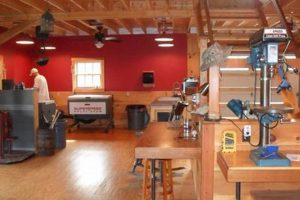
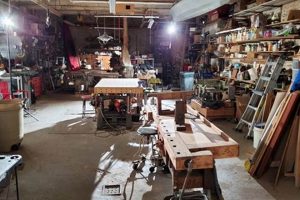
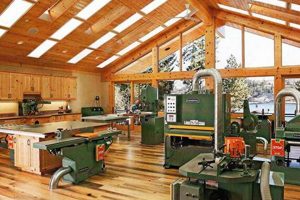
The practice of dividing a woodworking operation into two distinct physical locations or departments, each specializing in a specific set of tasks, is a strategy employed to enhance efficiency and workflow. One area typically focuses on initial milling and preparation of raw materials, while the second is dedicated to assembly, finishing, and quality control. This separation mitigates bottlenecks and allows for a more streamlined manufacturing process. For instance, one space might house heavy machinery like planers and jointers, while the other accommodates assembly tables and finishing booths.
Employing this segmented approach can yield several advantages. It promotes better organization and cleanliness, reducing the risk of cross-contamination between processes like sanding and finishing. It also allows for dedicated tooling and equipment in each area, optimized for the specific tasks performed there. Historically, larger woodworking businesses adopted similar separations as they scaled their operations, leading to increased output and improved product consistency.
Understanding the principles behind optimized workspace division is crucial for effective woodworking, whether operating from a small home shop or managing a larger commercial enterprise. This article will delve further into the practical considerations, equipment needs, and organizational strategies necessary to implement such a division effectively, exploring how it impacts project timelines, material handling, and overall operational success.
Tips for Optimized Woodworking Workflow
Implementing a divided workshop, where distinct processes occur in separate locations, necessitates careful planning and organization. The following tips are designed to maximize the efficiency and benefits derived from this arrangement.
Tip 1: Dedicated Space Allocation: Accurately assess the square footage required for each phase. The milling area will likely need more space for larger machinery and raw material storage than the finishing area, which requires ventilation and dust control.
Tip 2: Process-Oriented Layout: Arrange equipment in each shop to facilitate a logical workflow. In the preparation shop, lumber should flow from rough storage, to milling machines, to a staging area for projects ready for assembly.
Tip 3: Dust Collection Systems: Invest in robust dust collection for both shops, but especially in the milling area. Consider a dedicated dust collector for each major machine to minimize airborne particles and maintain air quality.
Tip 4: Strategic Material Handling: Develop a system for efficiently moving materials between shops. This may involve carts, dollies, or even a small forklift, depending on the scale of operations and the size of the projects.
Tip 5: Environmental Control: Ensure adequate ventilation and temperature control, particularly in the finishing shop. Consistent temperature and humidity levels are crucial for achieving optimal finish application and drying times.
Tip 6: Tool Organization: Maintain strict tool organization within each shop. Shadow boards and clearly labeled drawers will prevent wasted time searching for tools and ensure they are readily available when needed.
Tip 7: Cross-Contamination Prevention: Implement procedures to prevent cross-contamination between the shops. This includes dedicated cleaning tools and protocols, as well as proper storage of materials to avoid dust or finish transfer.
By implementing these tips, woodworking operations can realize improved efficiency, reduced material waste, and enhanced product quality through the strategic division of tasks and resources across multiple workspaces.
The next section will cover case studies and practical applications of these techniques, showcasing how they have been successfully implemented in various woodworking environments.
1. Workflow Optimization

Workflow optimization, in the context of woodworking, refers to the systematic streamlining of processes to maximize efficiency and minimize wasted time, effort, and resources. This is intrinsically linked to the concept of separate woodworking areas because a strategically divided workspace naturally lends itself to a more organized and efficient workflow.
- Sequential Task Management
Dividing woodworking tasks into distinct shopssuch as a preparation area and an assembly/finishing areaallows for the sequential execution of project phases. This prevents bottlenecks that can arise when all processes are crammed into a single space. For example, the preparation shop can focus on milling lumber and preparing components, while the finishing shop simultaneously focuses on assembly or sanding other prepped parts. This parallel processing minimizes idle time and speeds up project completion.
- Dedicated Equipment and Tooling
Workflow optimization thrives when each distinct area is equipped with the specific tools and equipment required for its dedicated tasks. The preparation area might house heavy machinery like planers, jointers, and saws, while the assembly area might feature clamps, fasteners, and assembly tables. This eliminates the need to constantly reconfigure equipment or move tools between processes, thereby reducing setup time and enhancing productivity.
- Reduced Material Handling
By establishing a logical flow of materials between dedicated spaces, material handling is minimized. For instance, raw lumber can be processed in the preparation shop and then passed directly to the assembly area, rather than being moved back and forth multiple times. This reduction in unnecessary material movement conserves time, reduces the risk of damage, and improves overall efficiency.
- Specialized Skill Application
A two-shop system allows for the potential specialization of skills among workers. One individual or team may become proficient in the preparation processes, while another specializes in assembly and finishing. This specialization can lead to increased expertise, improved quality, and faster completion times for each task, further optimizing the overall workflow.
These facets highlight how dividing a woodworking operation into two shops fundamentally supports and enhances workflow optimization. The resulting organization, dedicated resources, and streamlined processes contribute to a more efficient and productive woodworking environment.
2. Space Specialization
The core principle of “two shops woodworking” rests upon the concept of space specialization. This involves dedicating each physical location to a distinct set of woodworking tasks, maximizing efficiency and mitigating process conflicts. The division is not arbitrary; it is driven by the inherent requirements of the various stages of woodworking. Milling and rough shaping, for instance, necessitate heavy machinery and substantial material storage, whereas assembly and finishing demand cleaner environments and specialized tools for precision work. Therefore, the specialized allocation of space is a fundamental driver of the “two shops” approach, influencing equipment selection, workflow design, and overall productivity. A cabinet shop might, for example, designate one area for rough lumber processing, sizing, and joinery preparation, while a separate climate-controlled area would house finishing equipment and assembly benches. The specialized setup of each space dramatically reduces process interference and maximizes efficiency.
The impact of effective space specialization extends beyond mere convenience. It directly influences product quality by minimizing the risk of cross-contamination between processes. Sawdust, a byproduct of milling, can negatively affect finish quality if it permeates the assembly and finishing area. By physically separating these processes, the potential for defects is significantly reduced. Furthermore, space specialization encourages the development of expertise within each area. Craftsmen can focus their skills and knowledge on a specific set of tasks, leading to increased proficiency and improved quality control. An individual dedicated to finishing, for instance, can develop expertise in achieving optimal surface preparation, color matching, and finish application techniques. Similarly, space specialization often impacts organizational choices, material handling systems, and even the architectural design of dedicated woodworking facilities.
In conclusion, space specialization is not merely a design choice within a “two shops woodworking” setup; it is its defining characteristic and primary driver of efficiency and quality. Understanding the specific needs of each woodworking stage and strategically allocating space accordingly is crucial for successful implementation. Potential challenges, such as initial investment costs or the need for additional space, must be weighed against the long-term benefits of enhanced productivity, reduced defects, and improved craftsmanship. Ultimately, a well-executed space specialization strategy is vital for realizing the full potential of a “two shops” approach.
3. Equipment Dedication

Equipment dedication is a fundamental tenet of “two shops woodworking” and a critical driver of its benefits. Dividing woodworking operations into separate, specialized areas necessitates a corresponding allocation of equipment specific to the tasks performed in each location. This principle moves beyond simply having duplicates of essential tools. It entails strategically selecting and positioning equipment optimized for the particular workflow and demands of each designated shop. The milling and preparation area benefits most from heavy-duty machinery designed for processing rough lumber, such as planers, jointers, and large-format saws. Conversely, the assembly and finishing area thrives with specialized tools for joinery, clamping, surface preparation, and finish application, like spray booths, detail sanders, and precision measuring instruments. This dedicated setup eliminates the inefficiencies associated with constantly reconfiguring machines for different operations or transporting tools between areas.
The practice of equipment dedication directly impacts several key performance indicators. First, it reduces setup time. Workers in each shop have immediate access to the tools they need, allowing them to begin tasks without delay. Second, it promotes better organization and workflow. Specialized equipment allows for a more streamlined and efficient process within each area. Third, it minimizes the risk of cross-contamination, particularly between the dusty milling area and the sensitive finishing area. Fourth, dedicating equipment allows for optimization based on task-specific needs. An example is a finishing shop with a spray booth that can be dedicated to the application of a particular type of finish, with the appropriate ventilation and filtration systems permanently in place. In another area, automated CNC machines or panel saws may be incorporated into the rough milling to assist with project component preparation. In this manner, the two spaces can be configured differently and strategically to perform project tasks.
The decision to invest in dedicated equipment requires careful consideration of cost, space constraints, and anticipated workload. However, the potential benefits of increased efficiency, improved quality, and reduced material waste often outweigh the initial investment. Equipment dedication is not merely a matter of convenience; it is an integral part of the “two shops woodworking” philosophy, driving process optimization and contributing significantly to the overall success of the woodworking operation. By meticulously selecting and allocating equipment specific to the demands of each designated area, woodworking businesses can realize substantial improvements in productivity and craftsmanship.
4. Dust Containment
The implementation of “two shops woodworking” inherently underscores the critical role of dust containment. Wood dust, a ubiquitous byproduct of milling, sanding, and sawing, presents a multifaceted challenge in woodworking environments. Beyond posing health risks to workers, dust contamination can compromise finish quality, damage machinery, and increase cleaning and maintenance costs. The physical separation of woodworking processes into two distinct shops offers a strategic advantage in mitigating these issues. By isolating dust-generating activities within a dedicated preparation shop, the risk of dust migration to the assembly and finishing area is significantly reduced. For example, a shop separating rough milling from finish application prevents airborne particles from settling on freshly applied finishes, ensuring a smoother, more professional result. The effectiveness of this approach, however, hinges on the implementation of robust dust collection systems and strict adherence to cleaning protocols within the designated areas.
Effective dust containment within a “two shops woodworking” setup extends beyond mere physical separation. It necessitates the implementation of localized dust collection systems at each dust-generating machine in the preparation shop. These systems, often incorporating dust collectors, cyclones, and strategically placed ductwork, capture dust at the source, minimizing its dispersal into the surrounding environment. Air filtration systems, equipped with HEPA filters, can further improve air quality by removing fine particulate matter. Moreover, positive air pressure in the finishing area can prevent dust from infiltrating from the preparation shop. Case studies have demonstrated that companies implementing comprehensive dust containment strategies, integrated with a “two shops” approach, experience significant reductions in respiratory illnesses among workers, improved product quality, and reduced machine downtime due to dust-related malfunctions. A furniture manufacturer might employ downdraft tables in the sanding area of the finishing shop and a high-efficiency dust collector in the milling shop, creating a cleaner and more productive workspace.
In conclusion, dust containment is not merely an ancillary benefit of “two shops woodworking” but rather an integral component of its success. The strategic separation of processes, coupled with effective dust collection and air filtration systems, creates a healthier, cleaner, and more efficient woodworking environment. Challenges remain, including the initial investment costs associated with dust collection equipment and the ongoing maintenance requirements. However, the long-term benefits of improved worker health, enhanced product quality, and reduced operational costs far outweigh these challenges, solidifying dust containment as a critical consideration for any woodworking operation employing the “two shops” approach. The effective management of dust contributes directly to the overall sustainability and success of the woodworking enterprise.
5. Project Phasing

Project phasing, within the context of woodworking, involves breaking down a complex project into discrete, manageable stages, each with specific goals and deliverables. The “two shops woodworking” model directly facilitates and enhances project phasing by providing dedicated spaces for distinct stages of the project lifecycle. The preparation shop serves as the initial phase, encompassing tasks like lumber selection, milling, dimensioning, and joinery preparation. The second shop, often dedicated to assembly, finishing, and quality control, represents the subsequent phase. This separation allows for concurrent execution of tasks, minimizing bottlenecks and reducing overall project completion time. For instance, while components for one project are being finished in the dedicated finishing area, the preparation shop can concurrently begin the milling and shaping phases for a subsequent project. This structured approach is vital for efficient resource allocation and workflow management.
The importance of project phasing as a component of “two shops woodworking” is underscored by its impact on quality control and risk mitigation. By separating the phases, potential issues can be identified and addressed at earlier stages of the project. Any defects arising during milling or joinery preparation, for example, can be rectified within the preparation shop before the project moves to the assembly and finishing phase. This proactive approach minimizes rework, reduces material waste, and ensures a higher quality finished product. A practical application of this is a cabinet shop where the initial “rough” work is separated from the finish work ensuring that dust is not an issue in final assembly. Furthermore, project phasing allows for better tracking of project progress, enabling more accurate estimation of completion times and more effective communication with clients or stakeholders.
In summary, the connection between project phasing and “two shops woodworking” is intrinsic and mutually beneficial. The “two shops” model provides the physical infrastructure and organizational framework necessary to implement effective project phasing strategies. This, in turn, leads to enhanced efficiency, improved quality control, reduced risk, and better overall project management. Challenges may arise in coordinating material flow between the two shops and ensuring clear communication between teams working in different locations. However, the strategic benefits of a phased approach within a well-defined “two shops” environment outweigh these challenges, making it a valuable strategy for any serious woodworking operation.
6. Reduced Contamination
The concept of reduced contamination is fundamentally linked to the efficacy of “two shops woodworking.” Woodworking processes, particularly milling and finishing, inherently generate contaminants that can significantly impact product quality and worker health. Sawdust, airborne particles from sanding, and volatile organic compounds (VOCs) from finishes pose distinct threats. The strategic separation of these processes into two distinct physical spaces allows for targeted containment and mitigation of these contaminants, minimizing their impact on subsequent stages of production. This approach aims to prevent cross-contamination, where particles or fumes from one area compromise the integrity of work being done in another. For example, separating a sanding area from a finishing room prevents dust particles from settling onto wet finishes, ensuring a smoother, more professional result. The cause-and-effect relationship is clear: separating processes reduces the pathways for contamination, directly enhancing final product quality and creating a safer working environment.
Effective contamination control, within the framework of “two shops woodworking”, often involves the implementation of specialized systems and protocols. Dedicated dust collection systems in the milling area, equipped with high-efficiency particulate air (HEPA) filters, are crucial for capturing airborne particles at the source. Air filtration units in the finishing area, designed to remove VOCs and other fumes, maintain a clean and healthy environment for applying finishes. Furthermore, positive air pressure in the finishing area can prevent the infiltration of contaminants from the milling area. Strict cleaning schedules and designated work clothing further minimize the risk of cross-contamination. Practical application of these principles is evident in custom cabinet shops, where the milling area is often isolated with enclosed dust collection systems, while the finishing area incorporates a spray booth with negative pressure to exhaust fumes. These measures are not merely aesthetic improvements; they directly contribute to the durability, appearance, and overall value of the finished product.
In summary, reduced contamination is not simply a desirable outcome of “two shops woodworking” but rather an integral component of its success. The strategic separation of processes, coupled with dedicated contamination control systems and protocols, creates a cleaner, safer, and more efficient woodworking environment. While challenges may exist in terms of initial investment costs and the ongoing maintenance of these systems, the long-term benefits of improved product quality, reduced health risks, and increased operational efficiency outweigh these challenges. A deep understanding of the link between reduced contamination and the “two shops” approach is crucial for any woodworking operation seeking to optimize performance and deliver high-quality, consistent results. The principles described contribute directly to sustainability and long-term profitability of the business.
Frequently Asked Questions About Two Shops Woodworking
This section addresses common inquiries and clarifies misunderstandings regarding the concept of two shops woodworking, a strategy involving the separation of woodworking processes into distinct physical spaces.
Question 1: What is the fundamental principle behind two shops woodworking?
The underlying principle involves dividing a woodworking operation into two designated areas, each specializing in a specific set of tasks. Typically, one shop is dedicated to milling and preparation, while the other focuses on assembly, finishing, and quality control.
Question 2: What are the primary benefits associated with employing the two shops woodworking approach?
Key advantages include improved workflow, enhanced space specialization, optimized equipment dedication, effective dust containment, streamlined project phasing, and reduced risk of cross-contamination between processes.
Question 3: How does separating woodworking operations into two shops improve workflow efficiency?
The physical separation allows for concurrent execution of tasks, minimizing bottlenecks and reducing overall project completion time. Specialized equipment in each area eliminates the need for constant reconfiguration, further enhancing efficiency.
Question 4: What is the significance of equipment dedication within a two shops woodworking setup?
Equipment dedication ensures that each shop is equipped with the specific tools and machinery required for its designated tasks, reducing setup time and promoting better organization.
Question 5: How does the two shops woodworking method contribute to improved dust containment?
By isolating dust-generating activities within a dedicated preparation shop, the risk of dust migration to the assembly and finishing area is significantly reduced. This requires localized dust collection systems.
Question 6: What are the challenges associated with implementing a two shops woodworking system?
Potential challenges include the initial investment costs associated with acquiring additional equipment, the need for sufficient space to accommodate two separate shops, and the logistical considerations of material flow between the two areas.
In essence, the strategic separation of woodworking operations into two shops represents a comprehensive approach to optimizing efficiency, improving quality control, and promoting a safer working environment.
The subsequent section will delve into the practical considerations and implementation strategies for establishing a successful two shops woodworking system.
Conclusion
The preceding exploration has elucidated the fundamental principles and multifaceted benefits inherent in two shops woodworking. This approach, predicated on the strategic separation of woodworking processes into distinct physical locations, demonstrably enhances operational efficiency, improves product quality, and fosters a safer working environment. Core tenets, including workflow optimization, space specialization, and dedicated equipment allocation, contribute synergistically to a streamlined and productive woodworking operation.
The commitment to a divided workspace demands careful consideration of resources, space, and workflow management. However, the potential for increased output, reduced material waste, and enhanced craftsmanship positions two shops woodworking as a viable strategy for serious woodworking professionals. The adoption of this methodology necessitates a thorough evaluation of specific needs and a deliberate commitment to process optimization. Thoughtful implementation promises a significant return on investment, solidifying its relevance within contemporary woodworking practices. Its significance rests in providing the framework that promotes project management and quality output for its products.