The fundamental implements for introductory timber crafting encompass devices used to shape, join, and finish wood. These instruments facilitate the creation of diverse projects, from simple boxes to intricate furniture. A well-chosen selection allows for precision and efficiency in the woodworking process, enabling accurate cuts, secure fastenings, and refined surfaces.
Possessing appropriate instruments is critical for achieving desired results and maximizing safety. Their selection not only enhances efficiency but also enables the craftsman to execute designs effectively. Historically, access to proper tools distinguished skilled artisans and continues to be a hallmark of quality woodworking. The availability of these items is also important to reducing errors during construction.
This article outlines essential tools for establishing a basic woodworking shop. It will categorize implements based on their primary function, addressing measuring and marking, cutting, shaping, joining, and finishing. It is important to learn to identify which of these tools you will need to do a project.
Selection Guidance
When assembling a foundational set of instruments for timber crafting, a thoughtful approach can optimize both expenditure and workspace efficiency.
Tip 1: Prioritize Quality over Quantity: Investing in fewer, high-quality instruments yields better results and longevity compared to acquiring numerous inexpensive items. Focus on reputable brands known for precision and durability.
Tip 2: Begin with Essentials: Focus initially on instruments required for basic tasks: a hand saw, measuring tape, combination square, chisel set, and a smoothing plane. Additional tools can be acquired as project requirements evolve.
Tip 3: Research Tool Functionality: Before purchasing, thoroughly investigate the intended purpose and application of each instrument. Understand the nuances of various saw types or the differences between various planes, for instance.
Tip 4: Consider Multi-Purpose Tools: Some tools offer versatility across multiple tasks. A combination square, for example, serves as both a square and a measuring device, minimizing initial investment.
Tip 5: Explore Used Tool Markets: High-quality, used instruments are often available at reduced prices. However, assess the condition and functionality before purchase. Ensure blades are sharp and mechanisms operate smoothly.
Tip 6: Account for Sharpening and Maintenance: Any cutting instrument requires periodic sharpening. Factor in the cost of sharpening stones or services, and understand proper maintenance procedures to prolong tool life.
Tip 7: Safety Equipment is Paramount: Include safety goggles, ear protection, and a dust mask in the initial purchase. These are non-negotiable for safe woodworking practice.
Careful selection and proper maintenance of these instruments are the basis for ensuring safety and the development of skills in the crafting of wood items.
Following a deliberate and informed process, one can assemble a set of timber-crafting implements that are well-suited to their current needs, with the potential to expand the selection to meet future project requirements.
1. Measuring

Precise measurement constitutes the foundation of accurate and successful woodworking. The instruments utilized for measuring directly influence the final dimensions, alignment, and overall structural integrity of any woodworking project. Accurate measurement allows for proper fit and finish of wood pieces. Without proper measuring instruments, the woodworker risks wasting materials and time on improperly sized elements.
- Tape Measure
A tape measure is an indispensable tool for determining the overall dimensions of stock lumber, marking cut lines, and transferring measurements between components. A durable tape measure with clear markings is essential for consistent accuracy. For example, when constructing a tabletop, a tape measure ensures uniform width and length of the boards, preventing gaps or misalignments during assembly.
- Combination Square
The combination square is primarily utilized for establishing 90-degree angles and marking perpendicular lines. It also serves as a depth gauge and a marking gauge, providing versatility for various woodworking tasks. This instrument is critical for ensuring squareness in joinery, such as creating mortise and tenon joints, where precise angles are essential for structural strength.
- Marking Gauge
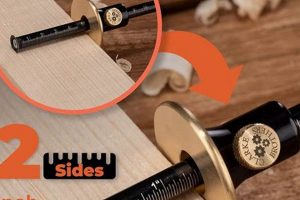
A marking gauge creates consistent, parallel lines to an edge, invaluable for marking mortise and tenon shoulders, dadoes, and rabbets. Its precision is crucial for ensuring uniform depth and width of joinery features. It is commonly used to mark the thickness of a tenon consistently along multiple workpieces, ensuring a tight and accurate fit.
- Protractor/Angle Finder
When projects require angles other than 90 degrees, a protractor or angle finder becomes essential. These tools accurately measure and transfer angles for precise cuts and joinery. For instance, when building a picture frame with angled corners, a protractor ensures that all corners are cut at the correct angle for a seamless assembly.
In conclusion, accurate measuring instruments are fundamental for achieving precision and quality in woodworking. The correct selection and diligent utilization of tools, such as the tape measure, combination square, marking gauge, and protractor, contribute directly to the success and professional appearance of woodworking projects. The aforementioned tools provide the means to measure and mark accurately, forming the base of proper construction in woodworking.
2. Cutting

The capacity to accurately sever wood is paramount in woodworking. This fundamental process necessitates a selection of cutting instruments tailored to various tasks, wood types, and project requirements. The nature of the cutting implement significantly dictates the precision, speed, and finish quality achievable in any woodworking endeavor. The selection for introductory woodcraft is carefully selected to balance function with budget.
A rudimentary set of cutting implements commonly includes a hand saw, specifically a crosscut saw for perpendicular cuts and a rip saw for cuts along the grain. These manual saws provide control and tactile feedback, valuable for developing fundamental skills. Additionally, a coping saw aids in creating curved cuts and intricate shapes, while a backsaw, often used with a miter box, ensures accurate angled cuts for joinery. The selection of saws affects the overall efficiency, reducing wasted materials and improving the overall quality of the completed product.
Efficient and precise severance is a core skill within woodworking. The appropriate selection of blades, maintained and correctly applied, forms a primary component of essential tools. A foundational understanding and skilled application are critical for all woodworking projects. While mechanized options exist, beginning artisans frequently prefer blades, due to the added control and lower financial outlay during startup.
3. Shaping

The manipulation of wood to achieve desired forms constitutes a critical phase in woodworking. This process, often termed “shaping,” involves refining the dimensions, contours, and surface characteristics of timber components. Effective shaping relies on a suite of specialized instruments, each designed to perform distinct material removal or surface modification tasks.
- Chisels
Chisels are fundamental for removing small amounts of wood, refining joinery, and creating decorative details. Beveled edge chisels are versatile for general shaping, while firmer chisels withstand heavier mallet blows for mortise creation. A well-honed chisel enables precise material removal, allowing for the creation of clean edges and intricate forms in woodworking projects. For example, a chisel might be used to refine the edges of a dovetail joint or to create a decorative chamfer along the edge of a board.
- Planes
Planes are employed to flatten surfaces, reduce stock thickness, and create smooth, even finishes. Block planes excel at end-grain work and chamfering, while smoothing planes are designed for achieving a flawless surface. The proper use of planes ensures consistent dimensions and a high-quality surface finish, essential for furniture making and other precision woodworking applications. The flat surface of a table or the smooth curves of a chair back are often achieved through the skillful use of various planes.
- Rasps and Files
Rasps and files are abrasive tools used for shaping curved surfaces, refining contours, and removing material from difficult-to-reach areas. Rasps remove material aggressively, while files provide a smoother finish. These tools are particularly useful for shaping chair spindles, carving decorative elements, and refining curved edges. For example, a rasp might be used to rough out the shape of a cabriole leg before a file is used to smooth the surface.
- Spokeshaves
Spokeshaves are specifically designed for shaping curved surfaces, such as chair legs, Windsor chair components, and boat parts. These tools allow for controlled material removal, enabling the creation of smooth, flowing curves. Spokeshaves are essential for any woodworking project involving complex curves, allowing for the creation of comfortable and aesthetically pleasing forms. The curved back of a rocking chair is often shaped using a spokeshave.
The implements employed in wood shaping are essential for producing elements that are both functionally sound and aesthetically agreeable. Expertise in the selection and application of chisels, planes, rasps, files, and spokeshaves empowers the artisan to convert raw timber into refined, purposeful forms. These are just a few examples of shaping and related instruments one may want to explore.
4. Joining
The secure and aesthetic amalgamation of individual wood components represents a pivotal facet of woodworking. Competent execution of joints necessitates a specific array of implements designed to create precise and durable connections. The effectiveness of these instruments directly influences the structural integrity and visual appeal of the finished product. The tools employed must accommodate various joint types, including butt joints, lap joints, mortise and tenon joints, and dovetail joints.
- Hand Saws and Chisels for Joinery
Hand saws, particularly backsaws with fine teeth, enable precise cuts essential for creating tight-fitting joints. Chisels, available in various sizes and bevels, facilitate the refinement of joint surfaces and the creation of mortises. The proper technique with these instruments results in joints that exhibit minimal gaps and maximal surface contact, contributing to structural robustness. The use of hand tools over power tools for joinery often provides a higher degree of control and precision, crucial for intricate joint designs.
- Measuring and Marking Tools for Accuracy
Accurate measurement and marking are paramount for achieving properly aligned and dimensionally accurate joints. Instruments such as combination squares, marking gauges, and precision rulers ensure that joint components are cut and shaped to exact specifications. Consistent use of these tools minimizes errors that can compromise the joint’s strength and aesthetic qualities. The application of a marking gauge, for example, allows for the uniform marking of mortise depths, ensuring consistent joint geometry across multiple workpieces.
- Clamps for Secure Assembly
Clamps are indispensable for holding joint components in place during glue-up and assembly. A variety of clamp types, including bar clamps, pipe clamps, and hand screws, provide the necessary pressure to ensure tight bonds and proper alignment. The selection of appropriate clamps is dependent on the size and geometry of the joint. Applying even pressure across the joint surface promotes optimal glue adhesion and prevents distortion during the curing process.
- Drills and Fasteners for Added Strength
Drills and various types of fasteners, such as screws and dowels, can augment the strength of certain joints. Pilot holes, created with a drill, prevent wood splitting when inserting screws, while dowels provide additional mechanical interlocking. The strategic use of fasteners can enhance the load-bearing capacity of joints and improve their resistance to shear forces. When constructing a frame, screws can reinforce mortise and tenon joints, particularly in applications where high stress is anticipated.
The proficient application of implements for joining is central to producing stable and aesthetically pleasing woodworking outcomes. Skillful selection and application contribute directly to the longevity and visual quality of woodworking fabrications. These skills take dedication to develop.
5. Finishing
The application of a protective and aesthetic coating, commonly termed “finishing,” represents the concluding phase in most woodworking projects. It directly impacts the durability, appearance, and tactile properties of the completed item. Effective finishing necessitates a distinct set of implements and materials, integrated within the broader scope of essential woodworking tools.
- Sandpaper and Sanding Blocks
Preparation for finishing invariably involves sanding, which requires sandpaper in a range of grits and sanding blocks or pads for even application. Sanding removes imperfections, smooths surfaces, and prepares the wood to accept finishes uniformly. Sandpaper grit selection is a crucial consideration, progressing from coarser grits for initial leveling to finer grits for achieving a polished surface. An example of this would be to sand the surface of a wooden desktop with progressively finer grits of sandpaper before applying a varnish, creating a glass-smooth finish.
- Brushes and Applicators
The application of finishes, such as stains, varnishes, lacquers, and paints, typically requires brushes or applicators designed for specific coatings. High-quality brushes with natural or synthetic bristles ensure even distribution and minimize brush marks. Foam brushes and spray equipment offer alternative application methods, particularly for larger surfaces or specialized finishes. Choosing the right brush is important to avoid uneven and streaky finishes.
- Spraying Equipment
For certain finishing applications, especially when using lacquers or creating a high-gloss surface, spraying equipment such as compressed air sprayers or HVLP (High Volume Low Pressure) systems are employed. These systems atomize the finish into a fine mist, allowing for even and consistent coverage. They require proper ventilation and safety precautions due to the potentially hazardous nature of the coatings. Spraying equipment is commonly used when finishing cabinets or furniture to achieve a professional, factory-like finish.
- Safety Gear and Ventilation
The application of finishes often involves exposure to volatile organic compounds (VOCs) and other potentially harmful substances. Adequate safety gear, including respirators, gloves, and eye protection, is essential to mitigate health risks. Proper ventilation is also crucial to prevent the accumulation of hazardous fumes. A well-ventilated workspace or spray booth is important to ensure a safe and healthy working environment. Failing to protect oneself with a respirator when applying finishes such as lacquer or polyurethane could result in respiratory damage.
The integration of appropriate finishing implements and techniques within the woodworking process enhances both the aesthetic and functional attributes of the completed item. Selection of these tools are chosen to improve appearance and protection from the elements. This step requires safety measures.
6. Safety

The incorporation of safety measures directly corresponds to the selection and application of instruments within introductory timber crafting. Emphasis on safety protocols is not merely an adjunct consideration but an integral component of tool acquisition and utilization. Safe practices reduce the likelihood of injury and promote prolonged tool lifespan.
- Personal Protective Equipment (PPE)
PPE constitutes a primary defense against potential woodworking hazards. Safety eyewear protects against projectiles, such as wood chips and dust, while hearing protection mitigates noise-induced hearing loss from power tools. Respiratory protection, including dust masks or respirators, safeguards against the inhalation of fine particles and volatile organic compounds. The use of PPE is non-negotiable when operating any woodworking implement, power or manual. Gloves should be worn when handling chemicals, wood preservatives, or adhesives.
- Tool Condition and Maintenance
The safe operation of woodworking instruments is contingent upon their condition and maintenance. Dull blades necessitate increased force, escalating the risk of slippage and injury. Regular sharpening and lubrication are essential for maintaining optimal tool performance and reducing user strain. Damaged tools should be repaired or replaced promptly to prevent potential malfunctions. For example, a cracked handle on a hammer or chisel compromises grip and increases the risk of accidental injury.
- Workspace Organization and Awareness
A well-organized and illuminated workspace minimizes tripping hazards and allows for unimpeded movement. Tools should be stored methodically, with sharp edges and points covered to prevent accidental contact. Awareness of one’s surroundings and maintaining a clear line of sight is critical for avoiding collisions and ensuring safe operation of machinery. The layout of the workspace should facilitate efficient workflow and minimize distractions.
- Tool-Specific Safety Procedures
Each woodworking implement necessitates adherence to specific safety protocols. Power tools require the use of guards and safety switches, while hand tools demand proper grip and controlled movements. A thorough understanding of each tool’s operating manual is essential for safe and effective use. Instruction on the safe operation of saws, routers, and jointers reduces the incidence of kickback, blade contact, and other common woodworking injuries. For instance, when using a table saw, employing a push stick keeps hands away from the blade, and ensuring that the blade guard is properly installed reduces the risk of injury.
The integration of safety considerations within tool selection and application protocols is foundational for responsible and injury-free woodworking practice. Prioritizing safety not only protects the individual but also promotes a productive and sustainable woodworking environment. Safety is important for any woodworking project you want to tackle.
7. Maintenance

The longevity and effectiveness of implements for introductory timber crafting are directly contingent upon diligent maintenance practices. Degradation of function and increased risk of operational failure are consequences of neglected maintenance. The correlation between acquiring implements and implementing maintenance regimes is thus of critical importance. Tools, if not well maintained, will not perform to the level required for proper wood working.
A program of periodic inspection, cleaning, and repair ensures optimal tool performance. Cutting implements, such as saws and chisels, require frequent sharpening to maintain edge integrity and prevent the application of excessive force during use, thereby mitigating the risk of slippage and injury. Lubrication of moving parts in planes and marking gauges reduces friction and prevents premature wear. Cleaning removes debris that can impede function and accelerate corrosion. Real-world examples are illustrative: A dull hand plane necessitates increased physical exertion and yields a substandard surface finish, while a rusty saw blade exhibits reduced cutting efficiency and is more prone to binding. These examples show that in both instances, project quality suffers. A well-executed maintenance protocol not only extends the operational life of implements but also preserves the quality of the work they produce. Also, the safety of the tool increases as maintenance continues.
Effective maintenance transcends mere preservation; it constitutes a fundamental investment in the woodworking process. Addressing minor issues promptly prevents their escalation into major repairs or complete tool replacement. By adhering to recommended maintenance schedules and employing appropriate cleaning and sharpening techniques, the artisan maximizes the return on investment in implements and minimizes the disruptions caused by tool failure. Maintaining the condition of woodworking tools provides both long term savings and continued use. Therefore, a tool collection is only as good as the maintenance put into it.
Frequently Asked Questions
This section addresses common inquiries regarding the selection and utilization of essential tools for introductory timber crafting. The intent is to provide concise, authoritative answers based on established woodworking principles.
Question 1: What constitutes the absolute minimum set of tools necessary to begin woodworking?
A minimal set comprises a crosscut saw, a combination square, a sharp chisel, a smoothing plane, and a measuring tape. This selection enables basic cutting, measuring, shaping, and finishing operations.
Question 2: Is it advisable to purchase power tools immediately, or should one begin with hand tools?
Starting with hand tools is generally recommended. This approach fosters a deeper understanding of wood behavior and cultivates essential skills in precision and control. Power tools can be added later as proficiency increases.
Question 3: What are the primary safety considerations when using woodworking tools?
Essential safety measures include wearing appropriate personal protective equipment (PPE), maintaining sharp tools, ensuring adequate workspace illumination, and adhering to tool-specific safety protocols.
Question 4: How frequently should woodworking tools be sharpened?
Sharpening frequency depends on the type of tool, the hardness of the wood being worked, and the frequency of use. A general guideline is to sharpen when the tool exhibits reduced cutting efficiency or requires increased force to operate.
Question 5: What is the significance of wood selection in relation to tool performance?
Wood species vary in density, grain pattern, and workability. Softer woods are generally easier to shape and cut, while hardwoods require sharper tools and greater force. Matching tool selection to the wood species is critical for achieving optimal results.
Question 6: What are common mistakes made by novice woodworkers regarding tool selection?
Frequent errors include purchasing inexpensive, low-quality tools; neglecting tool maintenance; failing to understand tool-specific safety procedures; and attempting overly complex projects before mastering basic skills.
In summary, tool selection involves balancing project requirements with skill level and budget constraints. Adherence to safety protocols and diligent maintenance are essential for ensuring productive and injury-free woodworking practice.
This concludes the discussion regarding essential implements for introductory timber crafting. Further exploration into specific tool types and techniques is encouraged for continued skill development.
Conclusion
This exploration of what tools do I need for basic woodworking has underscored the importance of a well-considered selection. Beginning with fundamental measuring and marking devices, progressing through cutting and shaping implements, and culminating in joining and finishing tools, each category contributes to the successful execution of woodworking projects. Safety protocols and maintenance procedures are not optional addenda but integral components of responsible woodworking practice.
The ongoing acquisition of knowledge and refinement of technique are paramount for continued growth. Mastery of the fundamentals outlined here provides a solid foundation for more advanced woodworking endeavors. Consistent practice, coupled with a commitment to safety and quality, will yield increasingly refined and enduring results.