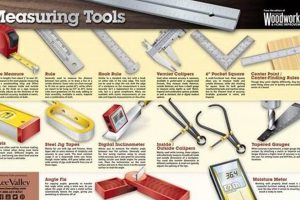
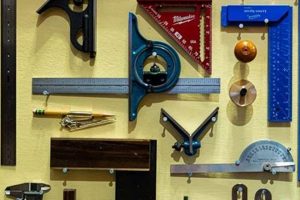
Devices employed for ascertaining and transferring angular dimensions in the fabrication of wooden objects constitute a critical subset of instruments within the broader woodworking domain. These instruments facilitate precision in joinery, ensuring accurate miter cuts, bevels, and compound angles. Examples range from simple protractors and T-bevels to more sophisticated digital angle finders and combination squares designed for multifaceted measurement tasks.
The capacity to accurately determine and replicate angles directly impacts the structural integrity and aesthetic appeal of finished woodwork. Historically, artisans relied on basic tools and geometric principles for angular measurement. Modern instruments, with their enhanced accuracy and ease of use, expedite the construction process and minimize errors, leading to improved project outcomes and reduced material waste. The evolution of these instruments reflects the ongoing pursuit of precision and efficiency in woodworking.
The subsequent sections will delve into specific types of these instruments, examining their features, applications, and techniques for optimal utilization in diverse woodworking scenarios. This exploration will cover both traditional and contemporary options, providing a comprehensive overview for woodworkers of all skill levels.
Tips for Accurate Angular Measurement in Woodworking
Achieving precision in woodworking hinges on the accurate use of instruments designed for angular measurement. The following tips will aid in maximizing the effectiveness and accuracy of these tools, leading to superior project outcomes.
Tip 1: Calibrate Before Each Use: Prior to commencing any project, verify the calibration of any digital or adjustable instruments. A minor misalignment can propagate errors throughout the entire piece. For mechanical devices, inspect for wear or damage that may affect accuracy.
Tip 2: Secure Workpiece Placement: Ensure the workpiece is firmly secured during measurement. Movement or vibration can introduce inaccuracies, particularly when using sensitive electronic instruments. Clamps or a stable workbench are essential.
Tip 3: Utilize Proper Lighting: Adequate illumination is crucial for clear visibility of markings and scales. Shadows can distort readings, especially when working with fine gradations. Employ task lighting to enhance visibility in the immediate work area.
Tip 4: Employ Reference Surfaces: When transferring angles, consistently use a known square or flat surface as a reference point. This minimizes cumulative errors that can arise from repeated measurements or transfers. A reliable reference surface ensures accurate alignment.
Tip 5: Double-Check Measurements: To minimize the risk of error, always verify critical measurements multiple times. Comparing results obtained from different instruments or techniques can help identify discrepancies. This proactive approach mitigates potential problems later in the project.
Tip 6: Maintain Instrument Cleanliness: Dust and debris can impede accurate readings on both digital and mechanical tools. Regularly clean instruments with a soft cloth to ensure smooth operation and clear visibility of scales and markings. Proper maintenance extends the lifespan and accuracy of measurement devices.
Tip 7: Understand Tool Limitations: Each type of measurement instrument possesses inherent limitations regarding accuracy and suitability for specific tasks. Selecting the appropriate instrument for the job and understanding its operating parameters is essential for reliable results. Avoid exceeding the tool’s capabilities.
By adhering to these guidelines, woodworkers can enhance the precision and reliability of angular measurements, ultimately contributing to the production of high-quality, accurately crafted wooden objects.
The next section will examine the specific applications of these measuring tools in common woodworking joinery techniques.
1. Accuracy

In woodworking, accuracy in angular measurement is not merely desirable; it is often a prerequisite for structural integrity and aesthetic quality. Angular deviations, even minute ones, can accumulate and compound, leading to ill-fitting joints, instability in assembled structures, and a compromised final appearance. The selection and proper utilization of instruments directly influence the attainable level of precision, affecting the overall outcome of a project. For example, constructing a multi-sided frame requires each angle to be precisely calculated and executed. A discrepancy of even half a degree at each joint can result in significant closure gaps or an irregularly shaped final product. The inverse also holds true; accurate angular measurements, made using high-quality instruments, are what enable the successful construction of intricate and complex joinery.
The degree of accuracy required is also contingent on the project itself. Cabinetry, where precise fitting of doors and drawers is essential, necessitates a higher level of angular precision compared to, say, a rustic outdoor bench. Digital angle finders, with their ability to provide readings to within a tenth of a degree, are often preferred for tasks demanding high precision. Traditional bevel gauges, while simpler, are still valuable for transferring angles, but their accuracy is more dependent on the user’s skill and the quality of the gauge. Regardless of the tool chosen, understanding its inherent limitations and employing proper techniques are crucial for optimizing accuracy.
Ultimately, the connection between accuracy and angular measurement is a cause-and-effect relationship. Inaccurate angular measurements invariably lead to compromised results, while precise measurements, facilitated by appropriate instruments and skilled usage, contribute to high-quality craftsmanship. Therefore, a commitment to accurate angular measurement is integral to successful woodworking practice, minimizing material waste, and ensuring the production of durable, aesthetically pleasing wooden objects. It’s a commitment that extends from the selection and calibration of tools to the diligent application of established measurement techniques.
2. Calibration

Calibration, the process of verifying and adjusting an instrument’s accuracy, holds paramount importance in the context of instruments used for determining angular dimensions in woodworking. The reliability of these instruments is directly linked to their proper calibration, ensuring the precision necessary for high-quality woodworking projects.
- Ensuring Accuracy and Repeatability
Calibration establishes a known standard, allowing woodworkers to trust the measurements obtained. Over time, instruments can drift from their original settings due to wear, temperature fluctuations, or accidental impacts. Calibration returns the instrument to its optimal operating parameters, minimizing the risk of errors that can compromise the integrity of woodworking joints and designs. Regular calibration promotes repeatability, allowing a woodworker to duplicate angles with confidence over time, essential for batch work or complex projects.
- Types of Calibration Methods
Different instruments require different calibration methods. Mechanical devices, such as bevel gauges and combination squares, may involve adjusting the alignment of the blade to a known square or straight edge. Digital angle finders often have built-in calibration routines that require placement on a flat, level surface. Some instruments may require professional calibration services using specialized equipment and traceable standards. Understanding the appropriate calibration method for each instrument is crucial for maintaining its accuracy.
- Frequency of Calibration
The frequency of calibration depends on the instrument’s usage, the working environment, and the required level of accuracy. Instruments used frequently or in demanding environments may require more frequent calibration. A best practice is to calibrate before undertaking critical projects or after any event that may have affected the instrument’s accuracy, such as a drop or significant temperature change. Keeping a log of calibration dates helps to maintain a consistent schedule.
- Impact on Project Outcomes
The absence of proper calibration can lead to cumulative errors in woodworking projects. Inaccurate angles in joinery, such as dovetails or miters, can result in weak joints, gaps, or misaligned components. Conversely, well-calibrated instruments ensure that angles are accurately transferred and executed, leading to strong, visually appealing, and professional-grade woodworking projects. The time invested in calibration represents a safeguard against costly mistakes and wasted materials.
In conclusion, the meticulous calibration of instruments employed for angular measurement in woodworking is essential for achieving precise, reliable results. This practice promotes accuracy, repeatability, and confidence in the measurements obtained, ultimately contributing to the creation of high-quality woodworking projects.
3. Material

The materials constituting instruments designed for angular measurement in woodworking exert a significant influence on their accuracy, durability, and overall utility. The selection of appropriate materials directly affects the instrument’s resistance to wear, susceptibility to environmental factors such as humidity and temperature, and its ability to maintain calibration over prolonged use. For example, a T-bevel crafted from high-carbon steel will exhibit greater resistance to bending or warping compared to one constructed from softer alloys. This inherent rigidity translates to more precise angle transfers, minimizing the potential for inaccuracies introduced by material deformation under pressure. The choice of material also dictates the instrument’s susceptibility to corrosion, which can obscure markings and compromise the smoothness of moving parts, thus affecting both readability and operational efficiency.
Furthermore, the type of material employed influences the manufacturing processes used and, consequently, the instrument’s dimensional stability and precision. Digital angle finders, which incorporate electronic components, often utilize high-grade plastics or aluminum alloys for their housings. These materials provide a stable platform for the sensitive electronic circuitry while also offering a degree of impact resistance. The quality of the laser-etched markings on a protractor, a crucial element for accurate reading, is directly dependent on the material’s surface properties and its interaction with the etching process. Similarly, the smooth, friction-free movement of a combination square’s head along its rule is contingent upon the precision machining and surface finish of both components, which are, in turn, dictated by the selected material. Brass fittings are often incorporated into precision instruments to provide smooth gliding surfaces and to minimize wear, further emphasizing the direct impact of material selection on performance.
In summation, the selection of materials for woodworking angle measuring instruments is a critical design consideration that directly impacts their accuracy, durability, and longevity. The inherent properties of these materials, including their resistance to deformation, corrosion, and environmental factors, directly influence the instrument’s ability to maintain its calibration and deliver reliable measurements. An understanding of the relationship between material properties and instrument performance is essential for woodworkers seeking to select and maintain tools that meet the demands of precision woodworking.
4. Application
The utility of woodworking angle measuring instruments is fundamentally defined by their application within diverse construction and fabrication scenarios. These instruments are not generic; their design and functionality are tailored to specific tasks, impacting the precision and efficiency of woodworking processes. Selecting the appropriate tool for a given application is paramount for achieving accurate and repeatable results. For instance, the creation of accurate dovetail joints demands precise angle replication using tools like sliding bevel gauges, whereas the installation of crown molding often necessitates digital protractors for measuring and transferring complex compound angles.
Consider the construction of a polygonal tabletop: A miter saw, in conjunction with a digital angle finder, facilitates precise cuts, ensuring seamless joinery and structural integrity. Conversely, attempting to create these precise miters using solely a protractor and hand saw would likely result in inaccuracies, requiring extensive adjustments and potentially compromising the project’s outcome. Similarly, restoring antique furniture may necessitate the use of specialized gauges for replicating unique or non-standard angles. Thus, the application directly dictates the type of instrument required and the level of precision attainable. Failure to match the instrument to the application can result in increased material waste, extended project timelines, and a diminished final product quality.
Ultimately, the application of woodworking angle measuring instruments serves as a critical link between design intent and tangible realization. The effectiveness of these tools is not inherent but rather dependent on their judicious selection and utilization in appropriate contexts. A comprehensive understanding of the various applications for each tool, coupled with proficiency in their operation, is essential for any woodworker striving for accuracy, efficiency, and professional-grade results. Recognizing the inherent limitations of each instrument and aligning them with the specific demands of the task at hand remains a cornerstone of successful woodworking practice.
5. Durability

The longevity and consistent performance of instruments used for angular measurement in woodworking are directly contingent upon their inherent robustness. A tool’s capacity to withstand the rigors of a workshop environment, including exposure to dust, moisture, and physical impacts, directly affects its accuracy and lifespan. The materials and construction methods employed in manufacturing these instruments determine their ability to maintain calibration and function reliably over extended use.
- Material Composition and Resistance to Wear
The primary factor influencing instrument resilience lies in the choice of materials. High-carbon steel, stainless steel, and hardened aluminum alloys are commonly used due to their inherent resistance to abrasion, corrosion, and deformation. Instruments fabricated from these materials are less susceptible to damage from accidental drops or contact with abrasive particles. For example, a stainless-steel protractor will maintain its smooth surface and legible markings longer than one made from a softer metal, ensuring accurate readings over time.
- Joint Integrity and Structural Stability
The method of joining components within an instrument significantly affects its overall strength. Riveted joints, welded seams, and precisely machined interlocking parts contribute to structural stability and prevent loosening or misalignment under stress. A well-constructed bevel gauge, with tightly fitted and securely fastened components, will maintain its angular setting even when subjected to moderate force, unlike a poorly constructed gauge where the blade may slip or wobble.
- Protection Against Environmental Factors
Woodworking environments often present challenges in the form of humidity, dust, and temperature fluctuations. Instruments designed for durability incorporate features that mitigate the effects of these factors. Sealed electronic components in digital angle finders prevent moisture ingress, and protective coatings on metal surfaces inhibit corrosion. A combination square with a hardened chrome finish will resist rust and maintain its smooth sliding action, ensuring accurate and consistent measurements regardless of environmental conditions.
- Calibration Retention and Long-Term Accuracy
A durable instrument is one that retains its calibration over an extended period. This requires the use of stable materials and robust construction techniques that resist dimensional changes and prevent components from shifting out of alignment. For example, a high-quality T-bevel will maintain its squareness even after repeated use and exposure to temperature variations, ensuring that transferred angles remain accurate and consistent throughout the project.
In conclusion, the durability of woodworking angle measuring instruments is a critical factor influencing their long-term value and reliability. The materials, construction methods, and protective features incorporated into these tools directly affect their ability to withstand the demands of a woodworking environment and maintain their accuracy over time. Investing in durable instruments ensures consistent performance, reduces the risk of errors, and contributes to the production of high-quality woodworking projects.
6. Readability

In the realm of woodworking, accurate angular measurements are paramount, rendering the ease with which these measurements can be obtained and interpretedreadabilitya critical attribute of measuring instruments. The ability to quickly and unambiguously discern angular values directly impacts efficiency, reduces the likelihood of errors, and ultimately contributes to the quality of the finished product.
- Scale Clarity and Precision
The legibility of the scale on a measuring instrument is fundamental to its usability. Clearly defined markings, sufficient contrast between the markings and the background, and appropriate spacing are essential for accurate readings. A scale with finely etched gradations that are difficult to discern, or one with markings that are obscured by glare, will invariably lead to errors. For example, a protractor with a scale printed in a low-contrast color against a reflective surface will be far less readable than one with bold, high-contrast markings on a matte finish. The precision of the scale, defined by the smallest increment it displays, must also be appropriate for the task at hand; a coarse scale may suffice for rough carpentry, but fine woodworking demands scales capable of resolving angles to within a fraction of a degree.
- Digital Display Attributes
For digital instruments, display characteristics significantly influence readability. Large, high-resolution displays with adequate backlighting are crucial for clear visibility in various lighting conditions. The displayed numerical values must be easily distinguishable, with sufficient digit size and clear character formation. The presence of extraneous information or a cluttered display can detract from readability and increase the risk of misinterpretation. The ability to adjust brightness and contrast settings is also important for optimizing readability in different environments. Furthermore, the responsiveness of the display to changes in angle is a key factor; a slow or jerky display can hinder precise adjustments and measurements.
- Parallax Reduction Features
Parallax error, the apparent shift in an object’s position when viewed from different angles, can significantly impact the accuracy of readings on analog instruments. Instruments designed to minimize parallax incorporate features such as mirrored scales or pointers positioned close to the scale surface. These features reduce the potential for angular displacement errors and enhance the reliability of measurements. For example, a bevel gauge with a mirrored scale allows the user to align their eye directly perpendicular to the scale, eliminating parallax and ensuring accurate readings.
- Ergonomic Design and Handling
The physical design of an instrument can also affect its readability. A comfortable grip and balanced weight distribution allow for stable and controlled handling, reducing the likelihood of unintentional movements that can obscure the scale or pointer. The placement of controls, such as locking mechanisms or adjustment knobs, should be intuitive and easily accessible without obstructing the user’s view of the scale. An instrument that is cumbersome or difficult to manipulate will invariably lead to increased fatigue and a higher probability of errors.
These facets of readability are inextricably linked to the successful application of woodworking angle measuring instruments. An instrument, regardless of its accuracy or precision, is only as effective as the user’s ability to accurately interpret its readings. Optimizing readability through careful design and manufacturing considerations directly contributes to improved efficiency, reduced errors, and enhanced overall quality in woodworking projects. Therefore, readability should be a primary consideration when selecting and using these instruments.
7. Maintenance

The longevity and accuracy of woodworking angle measuring tools are significantly influenced by adherence to appropriate maintenance procedures. Regular upkeep ensures consistent performance and extends the operational lifespan of these precision instruments.
- Cleaning Procedures
Dust, wood shavings, and other debris can accumulate on measuring tools, obscuring markings and hindering smooth operation. Regular cleaning with a soft cloth removes contaminants that can compromise accuracy. Solvent-based cleaners may be necessary for removing stubborn residues, but care must be taken to avoid damaging delicate components or finishes. For example, neglecting to clean a digital angle finder can lead to inaccurate readings due to obstructed sensors or compromised display visibility. Proper cleaning maintains the tool’s functionality and preserves its readability.
- Lubrication Requirements
Moving parts in tools such as bevel gauges and combination squares require periodic lubrication to ensure smooth and accurate adjustments. Applying a light oil or specialized lubricant to pivot points and sliding surfaces reduces friction and prevents wear. Improper lubrication can lead to stiffness, binding, or accelerated deterioration of components. The selection of an appropriate lubricant is crucial; heavy greases can attract dust and create further problems. A well-lubricated tool operates smoothly and retains its precision over time.
- Storage Practices
Proper storage protects measuring tools from damage and environmental factors. Storing tools in a dry, secure location prevents corrosion and physical damage. Individual tool cases or dedicated storage racks minimize the risk of accidental impacts or abrasion. Tools should be stored in a manner that prevents them from coming into contact with other objects that could scratch or dent their surfaces. Thoughtful storage practices contribute to the long-term preservation of accuracy and functionality.
- Calibration Verification
Periodic calibration verification ensures that measuring tools maintain their accuracy. Comparing measurements against known standards allows for the detection of any deviations from the original specifications. If inaccuracies are identified, the tool may require adjustment or professional calibration services. Digital angle finders often have built-in calibration routines, while mechanical tools may require manual adjustment using precision squares and reference surfaces. Regular calibration verification is essential for maintaining confidence in the reliability of angular measurements.
These maintenance practices collectively safeguard the integrity and performance of woodworking angle measuring tools. Consistent application of these procedures ensures accurate and reliable measurements, contributing to the production of high-quality woodworking projects while minimizing the risk of errors and material waste. Neglecting maintenance can lead to diminished accuracy, premature tool failure, and compromised project outcomes, underscoring the importance of proactive tool care.
Frequently Asked Questions
The following addresses common inquiries regarding the selection, usage, and maintenance of instruments employed for determining angular dimensions in woodworking.
Question 1: What factors determine the accuracy of a woodworking angle measuring tool?
Accuracy is influenced by material quality, manufacturing precision, calibration integrity, and the user’s technique. High-grade materials resist deformation, precise machining ensures dimensional stability, and regular calibration maintains alignment with established standards.
Question 2: How frequently should woodworking angle measuring tools be calibrated?
Calibration frequency depends on usage intensity and environmental conditions. High-use instruments or those subjected to temperature fluctuations may require monthly checks. Low-use instruments generally benefit from quarterly verification.
Question 3: What are the key differences between digital and analog woodworking angle measuring tools?
Digital instruments offer direct numerical readouts, facilitating rapid measurements. Analog instruments rely on visual interpretation of scales and pointers. Digital instruments can be more precise, while analog instruments are generally more resistant to electronic malfunctions.
Question 4: How does material selection impact the durability of a woodworking angle measuring tool?
High-carbon steel and hardened aluminum alloys resist wear, corrosion, and deformation, extending tool lifespan. Lower-grade materials are more susceptible to damage from impacts, abrasion, and environmental exposure.
Question 5: What are some best practices for storing woodworking angle measuring tools?
Tools should be stored in a dry, secure environment to prevent corrosion and physical damage. Individual tool cases or dedicated storage racks minimize impacts and abrasion. Suspension or horizontal storage reduces stress on sensitive components.
Question 6: How do I clean a woodworking angle measuring tool without damaging it?
Use a soft, dry cloth to remove dust and debris. Stubborn residues may require a mild solvent, but avoid harsh chemicals that can damage finishes or electronic components. Lubricate moving parts sparingly with an appropriate oil or lubricant.
Understanding these facets of woodworking angle measuring instruments leads to informed tool selection and optimized project outcomes.
The subsequent segment will delve into advanced techniques for utilizing these instruments in complex woodworking applications.
Conclusion
This exploration has underscored the pivotal role of instruments employed for angular measurement in woodworking. From fundamental aspects of accuracy and calibration to considerations of material durability and ease of use, a comprehensive understanding of these tools is essential for achieving precision and quality in woodworking projects. The correct selection, diligent maintenance, and skillful application of these instruments are paramount.
The continued pursuit of knowledge regarding woodworking angle measuring tools, coupled with a commitment to rigorous technique, will contribute to elevated standards of craftsmanship and innovation within the woodworking community. Further research into emerging technologies and evolving techniques in angular measurement will undoubtedly shape the future of this craft, ensuring its continued relevance and refinement.