



Determining the appropriate holding devices for a woodworking project is essential for secure and precise assembly. The selection of these tools hinges on the project’s size, complexity, and the materials being joined. For instance, a small picture frame might only require spring clamps, whereas a large table build necessitates a variety of bar clamps and pipe clamps.
Proper clamping ensures strong and accurate joints, preventing movement during glue drying. This contributes to the longevity and structural integrity of the finished piece. Historically, woodworkers relied on rudimentary wedges and ropes before the advent of modern clamping mechanisms, highlighting the significant advancements in woodworking techniques.
The ensuing discussion will delve into the various types of woodworking clamps available, offering guidance on their specific applications and helping to inform the selection process for different woodworking needs. Factors such as clamping pressure, jaw size, and adjustability will be considered to facilitate a comprehensive understanding of clamp functionality.
Guidance on Woodworking Clamp Selection
Selecting the correct holding tools is crucial for successful woodworking projects. The following tips provide guidance to optimize clamp selection based on specific needs.
Tip 1: Assess Project Requirements: Before acquiring any devices, thoroughly evaluate the projects planned. The size, shape, and materials will dictate the type and quantity of clamps required.
Tip 2: Prioritize Bar Clamps for Large Surfaces: For assembling large panels or tabletops, bar clamps offer substantial clamping force and wide coverage. Choose lengths that exceed the dimensions of the workpiece.
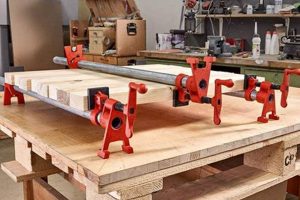
Tip 3: Utilize Pipe Clamps for Versatility: Pipe clamps, using standard threaded pipes, are cost-effective and adaptable to various lengths. They are particularly useful for curved or irregularly shaped items.
Tip 4: Employ Hand Screw Clamps for Delicate Work: Hand screw clamps provide even pressure distribution and are ideal for fragile materials or intricate joinery where marring is a concern. Their wooden jaws minimize damage.
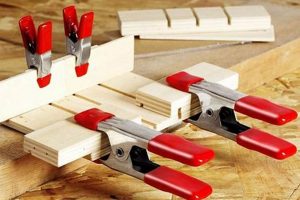
Tip 5: Incorporate Spring Clamps for Quick Fixes: Spring clamps offer rapid application and release, making them suitable for temporary holding or light-duty tasks, such as edge gluing trim.
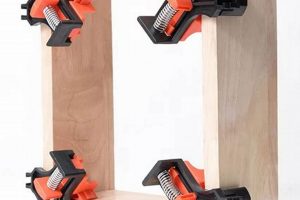
Tip 6: Consider Angle Clamps for Square Assemblies: Angle clamps assist in achieving precise 90-degree corners during frame construction. Their design ensures accurate alignment and simplifies the assembly process.
Tip 7: Invest in a Variety of Clamp Pads: Clamp pads, made of cork, rubber, or soft plastic, protect the wood surface from indentation and prevent slippage during clamping. A selection of pads is advisable.
Adhering to these tips ensures that appropriate holding tools are chosen, which leads to improved project quality, reduced waste, and increased efficiency.
The concluding section will consolidate the information presented, offering a comprehensive strategy for mastering the art of clamp selection in woodworking.
1. Project size

Project size exerts a direct and significant influence on the selection of appropriate holding devices. The overall dimensions of the woodworking project dictate the necessary reach and capacity of clamps to ensure adequate pressure distribution across the joints. Larger projects, such as constructing a bookcase or a dining table, necessitate the use of longer bar clamps or pipe clamps capable of spanning the width and length of the assembled components. Failure to accommodate project size results in insufficient clamping force and potential joint failure.
Conversely, smaller projects, like crafting a jewelry box or a picture frame, may only require smaller hand screw clamps or spring clamps. Employing excessively large clamps on small-scale projects can be unwieldy and may even damage the material due to concentrated pressure. A real-world example illustrates this point: attempting to clamp a small drawer front with a 48-inch bar clamp is inefficient and increases the risk of denting the wood. Conversely, using only 6-inch spring clamps on a 6-foot table assembly would clearly be insufficient for a secure bond.
In summary, project size is a crucial determinant when establishing the holding tools required for woodworking. Accurately assessing the project’s dimensions before selecting the clamping mechanism is essential for achieving strong, precise joints and preventing potential damage to the workpiece. Ignoring this aspect compromises the integrity and longevity of the final product.
2. Material type

Material type significantly influences the selection of holding devices in woodworking, dictating the required clamping pressure, the need for protective measures, and the specific clamping mechanisms best suited for the job. Different wood species and materials exhibit varying degrees of density, hardness, and susceptibility to damage, which must be considered when determining the appropriate tools.
- Hardwood Considerations
Hardwoods such as oak, maple, and walnut require higher clamping pressures to achieve secure joints. Bar clamps and pipe clamps are frequently used due to their ability to exert substantial force. However, excessive pressure can still lead to indentation; therefore, clamp pads made of cork or rubber are crucial to protect the surface. Ignoring this can result in visible blemishes on the finished piece.
- Softwood Precautions
Softwoods, including pine, cedar, and fir, are more prone to compression and marking. Lower clamping pressures are necessary, and the use of hand screw clamps or spring clamps, which distribute force more evenly, becomes more critical. Additionally, wider and softer clamp pads are essential to prevent indentations and preserve the integrity of the woods surface. Direct contact with metal clamp jaws should be avoided entirely.
- Plywood and Manufactured Boards
Plywood and MDF present unique challenges due to their layered construction and tendency to chip or delaminate. Even clamping pressure is paramount to prevent these issues. Clamps with larger surface areas, such as bar clamps with wide jaws, are often preferred. Care must be taken not to overtighten, as this can cause the layers to separate. Specialized edge clamps are beneficial when joining plywood edges.
- Exotic Wood Specifics
Exotic woods like ebony and rosewood often have high value and unique grain patterns, making them particularly susceptible to damage. Hand screw clamps with soft wood jaws are highly recommended. Applying moderate pressure and using custom-fitted cauls or pads helps to distribute pressure evenly and protect the wood’s delicate surface. Test clamping on scrap pieces is advised to determine optimal pressure settings.
The correlation between material type and suitable woodworking clamps underscores the importance of a nuanced approach. An understanding of each material’s properties is indispensable for determining the appropriate tools and techniques to ensure successful and aesthetically pleasing results. Overlooking these material-specific considerations can lead to project failure, material waste, and compromised structural integrity.
3. Joint complexity
Joint complexity directly influences the type and quantity of holding devices necessary for successful woodworking outcomes. The intricacy of a joint dictates the clamping strategy and the specific clamp designs required to maintain alignment and ensure adequate pressure during adhesive curing. Simpler joints, such as butt joints, require only basic clamps like bar clamps or pipe clamps to apply uniform pressure. More complex joints, such as dovetails or mortise and tenons, necessitate specialized clamps capable of accommodating irregular shapes and providing targeted pressure.
For instance, dovetail joints, renowned for their strength and aesthetic appeal, demand precise alignment during glue-up. Tail clamps and miter clamps are often employed to maintain squareness and prevent slippage. Mortise and tenon joints, similarly complex, benefit from the use of mortise clamps, which apply pressure specifically to the tenon while maintaining alignment within the mortise. A failure to consider the joint’s intricacy leads to misalignment, weakened bonds, and ultimately, a compromised final product. Furthermore, complex assemblies involving multiple joints simultaneously may require a higher number of clamps to ensure consistent pressure across the entire structure, preventing stress concentrations that could lead to joint failure.
In summary, joint complexity is a critical determinant in the selection of appropriate holding devices for woodworking. A thorough understanding of the joint’s geometry and pressure requirements enables woodworkers to choose the right clamps, leading to stronger, more accurate, and visually appealing finished pieces. Neglecting this aspect can result in structural weaknesses and aesthetic imperfections, thereby diminishing the overall quality and longevity of the woodworking project.
4. Clamping pressure
Clamping pressure, the force applied by a holding device to secure wood pieces during adhesive bonding, is a critical factor in determining the necessary tools. The appropriate pressure level directly correlates with the strength and quality of the resulting joint. Insufficient pressure weakens the bond, leading to potential failure, while excessive pressure can damage the material, causing indentation, compression, or even cracking. Therefore, understanding the material properties and joint design is paramount to selecting clamps capable of delivering the optimal pressure range.
The type of adhesive used also influences the clamping pressure requirement. For example, polyvinyl acetate (PVA) glues typically require moderate pressure, while epoxy resins may necessitate higher clamping forces to ensure proper gap filling and adhesion. Wood species also play a significant role; hardwoods generally withstand higher pressure than softwoods. Furthermore, specific joint configurations, such as mortise and tenon joints, may distribute pressure more effectively than butt joints, requiring adjustments to the applied force. Using a spring clamp on hardwood requiring a strong bond is not sensible because it may be suitable only for softwood
In summary, appropriate clamping pressure is a primary consideration when determining the necessary holding devices for woodworking projects. Selecting clamps with adjustable pressure settings, combined with a thorough understanding of material properties, adhesive characteristics, and joint design, enables woodworkers to achieve robust and durable bonds. The choice of clamp must align with the project’s specific needs to optimize joint strength and prevent material damage, thereby ensuring the structural integrity and longevity of the finished piece.
5. Jaw depth
Jaw depth, representing the distance from the clamp’s bar or screw to the deepest point it can reach on a workpiece, is a crucial consideration when determining which holding devices are necessary for woodworking. Insufficient jaw depth restricts the ability to effectively clamp materials, particularly in situations involving wide boards, assemblies with protruding elements, or projects requiring clamping pressure at a distance from the edge. A clamp with inadequate jaw depth simply cannot reach the area requiring support, rendering it unsuitable for the task.
Consider constructing a frame with internal supports. Securing the joints between the frame’s outer pieces and the internal supports necessitates clamps with sufficient jaw depth to reach over the frame’s outer width. Similarly, when edge-gluing wide boards to create a tabletop, clamps with deep jaws provide even pressure distribution across the entire width, preventing warping or misalignment during the glue-up process. For smaller projects, like assembling small boxes, shallow-jawed clamps may suffice. However, failing to accurately assess the required jaw depth before selecting clamps can lead to project delays and necessitate purchasing additional, more suitable clamping devices.
Ultimately, jaw depth is a non-negotiable specification when assessing the holding devices required for a woodworking endeavor. Accurate measurement and foresight regarding the project’s dimensions and construction methods ensure that the selected clamps can effectively perform their intended function. Overlooking this seemingly minor detail can compromise the structural integrity and aesthetic quality of the final product, highlighting the practical significance of understanding jaw depth as a critical component in woodworking clamp selection.
6. Throat capacity
Throat capacity, representing the maximum thickness of material a clamp can accommodate, is a pivotal factor in determining appropriate holding devices for woodworking projects. The capacity dictates whether a clamp can effectively grip the materials being joined, making its assessment crucial prior to clamp selection.
- Limitations on Stock Thickness
If stock exceeds a clamp’s throat capacity, achieving adequate clamping pressure is impossible. This scenario necessitates the selection of clamps with a greater capacity to ensure proper engagement and force distribution. For example, a project involving 4-inch-thick timbers requires clamps with a throat capacity exceeding this dimension.
- Influence on Project Geometry
Complex project geometries, such as assembling large boxes or cabinets with protruding elements, demand clamps with sufficient throat capacity to reach over these features. Failure to account for these protrusions limits clamp placement and compromises joint integrity. Cases involving edge banding on thick panels likewise require clamps with sufficient reach.
- Impact on Clamp Versatility
Acquiring clamps with a diverse range of throat capacities enhances their versatility across various woodworking projects. A collection of clamps with varying capacities provides the flexibility to address different project needs, optimizing efficiency and minimizing the need for frequent clamp purchases. This variety streamlines workflow and accommodates project adaptations.
- Considerations for Specialized Applications
Specific woodworking tasks, such as clamping items within a jig or fixture, require careful consideration of throat capacity. The clamp must accommodate both the workpiece and the jig’s dimensions. This requirement is especially relevant in production settings where repeatability and precision are paramount. Failure to consider this results in inefficiencies and compromised accuracy.
The consideration of throat capacity is indispensable when assessing holding device requirements for woodworking. Selecting clamps with appropriate capacity ensures their effective application across a range of projects and materials. A failure to account for this specification leads to compromised joint integrity, project delays, and potential material waste. The capacity specification, therefore, represents a fundamental parameter in the clamp selection process.
7. Quantity needed

The requisite number of holding devices is a critical, often underestimated, factor in woodworking. An insufficient quantity of clamps can severely compromise project quality and efficiency, regardless of individual clamp quality. Determining the appropriate number necessitates careful consideration of project-specific factors.
- Simultaneous Glue-Ups
Projects involving multiple simultaneous glue joints demand a sufficient clamp number to secure each joint concurrently. Assembling a cabinet carcass, for example, typically involves gluing multiple frame members at once. An inadequate supply of clamps forces sequential glue-ups, extending project timelines and potentially introducing inaccuracies due to shifting or drying inconsistencies between stages. Therefore, the clamp quantity must align with the project’s assembly sequence.
- Joint Complexity and Stability
More complex joints, such as mortise-and-tenon or dovetail joints, frequently require multiple clamps per joint to ensure proper alignment and prevent slippage during the curing process. Joints that lack inherent stability during glue-up particularly benefit from an increased clamp presence. The increased pressure distribution ensures secure bonding and mitigates the risk of joint failure.
- Workpiece Size and Shape
Larger workpieces and those with irregular shapes require a greater distribution of clamps to maintain uniform pressure across the entire surface. A tabletop glue-up, for example, necessitates numerous clamps spaced evenly along the length and width of the boards to prevent cupping or warping as the adhesive dries. The clamp quantity directly influences the flatness and stability of the final product.
- Margin for Contingencies
Maintaining a surplus of clamps beyond the initially calculated requirement provides a crucial buffer for unforeseen circumstances. Breakage, misplacement, or the need for supplemental pressure in specific areas can all necessitate additional clamps. This margin of safety allows for uninterrupted workflow and prevents compromises in project quality due to clamp scarcity. Preparing for unexpected occurrences minimizes project setbacks.
Ultimately, determining the optimal number is an essential component of addressing “what woodworking clamps do I need.” The intersection of simultaneous operations, joint complexity, workpiece characteristics, and proactive planning dictates the ideal clamp quantity, ensuring project success through secured, stable, and timely assembly processes. Disregarding quantity needs can invalidate the correct choices for clamp type and size.
Frequently Asked Questions Regarding Woodworking Clamp Selection
The following questions address common concerns and clarify misconceptions related to determining the appropriate holding devices for woodworking projects.
Question 1: Is it possible to use too much clamping pressure?
Yes, excessive clamping pressure can damage wood fibers, leading to indentation, compression, or even cracking. The appropriate pressure is contingent on the wood species and joint type. Softwoods are particularly susceptible to damage from overtightening.
Question 2: Can one clamp type effectively handle all woodworking tasks?
No, a diverse selection of clamps is typically required for comprehensive woodworking capabilities. Different clamp types are designed for specific applications, and no single clamp is universally suitable for all situations.
Question 3: What factors determine the required quantity of clamps?
The quantity is dependent on the project size, joint complexity, glue-up strategy (simultaneous vs. sequential), and available workspace. Complex or large assemblies necessitate a greater clamp volume.
Question 4: Are inexpensive clamps a viable option for occasional woodworking?
While inexpensive clamps can suffice for light-duty tasks, investing in higher-quality clamps is generally advisable for long-term reliability and performance. Lower-quality clamps are often prone to breakage and may lack the precision required for accurate joinery.
Question 5: How does humidity affect clamping time?
Increased humidity can extend adhesive curing times. Consequently, the workpiece may need to remain clamped for a longer duration to ensure a strong and durable bond. Monitoring humidity levels is essential for optimal results.
Question 6: Is there a standard guideline for clamp spacing?
While a universal standard does not exist, a general guideline suggests spacing clamps approximately 6 to 12 inches apart. However, this distance should be adjusted based on the specific project requirements and the material’s tendency to warp or bend.
The answers provided offer clarity on essential considerations for informed clamp selection in woodworking. A comprehensive understanding of these principles leads to improved project outcomes.
The subsequent discussion will present a concluding summary, consolidating the key information related to efficient clamp selection in woodworking.
Conclusion
The foregoing discussion elucidates the multifaceted considerations involved in determining appropriate holding devices for woodworking. Factors encompassing project size, material properties, joint complexity, clamping pressure, jaw depth, throat capacity, and quantity requirements collectively shape the selection process. A comprehensive understanding of these elements is critical for achieving accurate, durable, and aesthetically pleasing results.
The effectiveness of any woodworking project hinges on a judicious assessment of its specific clamping demands. Prudent application of the principles outlined herein ensures the successful realization of woodworking endeavors, yielding outcomes that reflect both precision craftsmanship and structural integrity. Careful planning and execution are vital to maximizing the potential of any woodworking project.
![Top-Rated: Best Quick Clamps for Woodworking Projects [2024] | Step-by-Step Guides, Tools & Inspiration to Build Beautiful Wooden Decor on a Budget](https://woodfromhome.com/wp-content/uploads/2026/04/th-264-300x200.jpg "Top-Rated: Best Quick Clamps for Woodworking Projects [2024] Step-by-Step Guides, Tools & Inspiration to Build Beautiful Wooden Decor on a Budget")