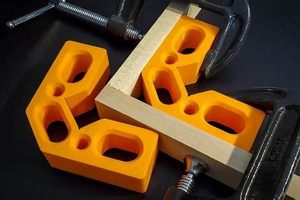
The assemblage of implements necessary for successful woodworking encompasses a wide range, from basic hand tools to sophisticated power equipment. The specific composition of this collection varies based on the type of projects undertaken, the scale of operation, and the preferred working methods of the artisan. A foundational set typically includes items for measuring, cutting, shaping, joining, and finishing wood.
Possessing the correct instruments enhances efficiency, precision, and safety in woodworking endeavors. A well-equipped workshop allows for a broader scope of projects, reduces the likelihood of errors, and contributes to a higher quality finished product. Historically, the progression of woodworking tools has directly impacted the evolution of furniture design, building construction, and various other crafts.
The following sections will detail essential categories and specific examples that form the core of a proficient woodworking arsenal. Considerations will be given to tools suited for both beginners and experienced craftspeople, offering a comprehensive overview of the equipment instrumental in the art of woodworking.
Essential Guidance for Woodworking Tool Acquisition
Strategic selection and proper maintenance of implements are critical for achieving optimal results and ensuring longevity in the craft. Adhering to the following guidance will assist in building a reliable and versatile set.
Tip 1: Prioritize Quality over Quantity: Invest in higher-quality versions of fundamental implements before accumulating a large collection of inexpensive ones. Superior materials and construction translate to improved performance and durability.
Tip 2: Start with the Essentials: Begin with measuring tools (tape measure, combination square), cutting tools (hand saw, utility knife), and safety equipment (safety glasses, dust mask). Expand the arsenal as project requirements dictate.
Tip 3: Understand Tool Functionality: Thoroughly research the intended purpose of each item before purchase. Misapplication can lead to damage or injury.
Tip 4: Maintain Sharp Cutting Edges: Regularly sharpen blades and bits to ensure clean, efficient cuts. Dull tools require more force and increase the risk of accidents.
Tip 5: Store Tools Properly: A designated storage system protects tools from damage and allows for easy access. Organize based on frequency of use.
Tip 6: Learn Proper Techniques: Seek instruction on the correct usage of each item. Improper technique can compromise both the work piece and the implement.
Tip 7: Inspect Before Each Use: Check for damage or wear before commencing any project. Damaged items should be repaired or replaced immediately.
Adherence to these recommendations will facilitate a safer, more efficient, and ultimately more rewarding woodworking experience. A judicious and informed approach to selection and upkeep ensures optimal performance.
The subsequent sections will explore specific types and brands that consistently demonstrate excellence in their respective categories, offering further insight into the selection process.
1. Precision Measurement

Accurate dimensioning is paramount in woodworking. Imprecise measurements inevitably lead to flawed joinery, structural instability, and compromised aesthetics. Therefore, reliable measuring instruments are indispensable for any woodworker.
- Tape Measure Accuracy
A tape measure provides overall dimensions and is used extensively for rough cutting and initial layout. However, inaccuracies can arise from blade sag or end-hook play. Regularly check tape measures against a known standard and compensate for any discrepancies. In cabinet making, even a 1/16-inch error across multiple components can result in misalignment.
- Combination Square Utility
The combination square serves multiple purposes, including marking perpendicular lines, checking squareness, and measuring depth. Its sliding head and integrated level enhance versatility. Use a combination square to ensure that the edges of a board are perfectly square before proceeding with joinery. Failure to do so can result in racking or twisting in the finished piece.
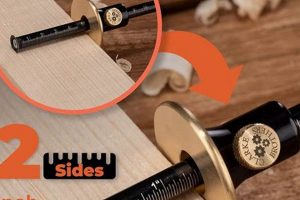
- Marking Gauge Precision
A marking gauge scribes parallel lines used for defining joinery, such as mortise and tenon shoulders. Its sharp pin creates a consistent and easily followed line. Employ a marking gauge to establish consistent reveals on drawers and doors, contributing to a professional and refined appearance.
- Digital Angle Finder Applications
Digital angle finders accurately measure angles for complex joinery or miter cuts. They eliminate the subjectivity of visual estimation. Use a digital angle finder to precisely set the bevel angle on a miter saw when constructing picture frames or segmented turnings.
The cumulative effect of accurate measurements translates directly into the quality and longevity of the finished product. A commitment to precision and the utilization of appropriate measuring implements is a hallmark of skilled woodworking. Investing in quality measuring tools is a foundational investment in woodworking success.
2. Effective Cutting

Effective cutting is a linchpin of woodworking, directly impacting project precision, efficiency, and safety. The right cutting instruments, properly maintained, are indispensable for shaping raw materials into desired forms. Inadequate or poorly maintained cutting instruments increase the risk of material waste, compromised joinery, and potential injury. For example, using a dull hand saw on hardwood requires excessive force, increasing the likelihood of slipping and resulting in inaccurate cuts or personal harm. Conversely, a sharp, well-tuned hand saw allows for precise and controlled cuts, minimizing tear-out and promoting efficient stock removal. Selecting the appropriate cutting instrument for the task at hand is also crucial. A delicate dovetail saw is ideal for intricate joinery, whereas a robust circular saw is better suited for rough dimensioning of sheet goods.
Practical application of effective cutting principles extends beyond mere material removal. Precise cuts are fundamental for creating tight-fitting joints, such as mortise and tenon or dovetail joints. These joints rely on accurate dimensions and clean edges to ensure structural integrity and aesthetic appeal. The efficient removal of waste material, whether using a chisel, saw, or router, minimizes the need for extensive sanding or shaping, saving time and effort. In furniture construction, for instance, properly cut tenons that precisely fit their corresponding mortises result in strong, durable, and visually appealing joints. The skilled use of cutting tools, supported by appropriate jigs and fixtures, allows for the creation of complex shapes and profiles, expanding the creative possibilities of woodworking projects.
In summation, effective cutting is not merely a skill but a cornerstone of successful woodworking. Choosing the correct instruments, mastering their proper use, and maintaining sharp cutting edges are essential for achieving precision, efficiency, and safety. A comprehensive understanding of cutting techniques and instruments, from basic hand saws to advanced power tools, empowers the woodworker to transform raw materials into finely crafted objects. Failure to prioritize effective cutting compromises the entire woodworking process, leading to flawed results and increased risks. Thus, the diligent pursuit of effective cutting techniques is an ongoing endeavor for any serious woodworker.
3. Secure Joinery

The creation of durable and stable wooden structures hinges upon secure joinery techniques. The effectiveness of these techniques is directly related to the quality and suitability of the implements employed. Inadequate tools compromise the integrity of joints, leading to structural weakness and premature failure. Conversely, appropriate implements, properly utilized, result in robust connections capable of withstanding significant stress and strain. For instance, a dovetail joint, renowned for its strength, requires precise cutting tools such as a dovetail saw and chisels to achieve tight-fitting, interlocking components. Without these tools, or with poorly maintained versions, the joint will lack the necessary mechanical strength to perform its intended function.
The relationship between secure joinery and woodworking implements extends beyond hand tools. Power tools, such as routers and jointers, also play a critical role in creating accurate and consistent joinery. A router, equipped with appropriate bits and jigs, enables the precise cutting of mortises and tenons, while a jointer ensures that board edges are perfectly square and flat, facilitating seamless glue-ups. In cabinetmaking, for example, the use of a biscuit joiner or pocket-hole jig can significantly enhance the strength and alignment of cabinet frames, contributing to the overall structural integrity of the finished piece. Failure to utilize these tools effectively can result in misaligned components and weakened joints, ultimately diminishing the quality and longevity of the cabinetry.
The ability to execute secure joinery is intrinsically linked to the availability and proper application of woodworking tools. Selection of appropriate tools, combined with proficient technique, ensures the creation of durable and aesthetically pleasing wooden structures. Neglecting the importance of this relationship results in compromised structural integrity and diminished craftsmanship. Therefore, a thorough understanding of joinery techniques and the corresponding tools is paramount for any woodworker seeking to produce high-quality, lasting results. This understanding, coupled with a commitment to precision and the ongoing maintenance of implements, is essential for achieving secure and reliable joinery in all woodworking projects.
4. Controlled Shaping

Controlled shaping in woodworking refers to the precise manipulation of wood to achieve desired forms and profiles. This process relies heavily on a selection of specific implements, with the availability and skillful application of these instruments defining the scope and quality of the final product.
- Hand Plane Mastery
Hand planes allow for incremental material removal and the creation of exceptionally smooth surfaces. Different types of planes, such as smoothing planes, jack planes, and block planes, cater to varying tasks, from flattening large surfaces to refining intricate details. The ability to finely adjust blade depth and angle provides unparalleled control over the shaping process. For example, a well-tuned smoothing plane is essential for eliminating imperfections and creating a flawless surface on a tabletop or cabinet door. Improper use or a dull blade results in tear-out and uneven surfaces, necessitating additional sanding and potentially compromising the intended design.
- Chisel Precision
Chisels are used for both removing waste material and refining shapes, particularly in tight corners and intricate details. A sharp chisel, wielded with controlled force, allows for precise paring of wood fibers, creating clean lines and crisp edges. Examples include shaping dovetail joints, cleaning up the bottom of a mortise, or creating decorative chamfers. A dull chisel or excessive force results in crushed fibers and imprecise cuts, undermining the structural integrity and aesthetic quality of the workpiece.
- Spokeshave Versatility
Spokeshaves are specialized tools designed for shaping curved surfaces, such as chair spindles, table legs, and boat hulls. Their curved blade and adjustable mouth allow for controlled removal of material along complex contours. Skillful use of a spokeshave enables the creation of graceful curves and ergonomic forms that would be difficult to achieve with other tools. The spokeshave’s adjustability is key to achieving the desired shape without unwanted gouges or flat spots.
- Router Functionality
Routers, both handheld and table-mounted, offer a versatile means of shaping edges, creating grooves, and cutting decorative profiles. A variety of router bits, each designed for a specific shaping task, expands the instrument’s capabilities. Routers are commonly used to create edge profiles on countertops, cut dadoes for shelving, and shape intricate moldings. Proper use requires careful selection of bits, precise speed control, and secure work holding to prevent tear-out and maintain accuracy.
The connection between controlled shaping and woodworking implements is undeniable. The attainment of desired forms and profiles necessitates a comprehensive toolkit, including hand planes, chisels, spokeshaves, and routers. Skillful use and proper maintenance of these devices directly impact the precision, efficiency, and overall quality of woodworking projects, demonstrating their integral role in the craft.
5. Smooth Finishing
The attainment of a smooth, professional finish represents the culmination of the woodworking process. The quality of this finish is intrinsically linked to the tools employed throughout the project, extending beyond specialized finishing equipment. Imperfections introduced during earlier stages, such as rough cuts, imprecise joinery, or inadequate sanding, are often difficult, if not impossible, to rectify during the finishing phase. Consequently, the implements used for stock preparation, shaping, and assembly directly influence the final outcome. For instance, a dull jointer leaves behind milling marks that necessitate extensive sanding, while poorly executed joinery creates gaps that may require filling, both compromising the aesthetic integrity of the finish. Therefore, the selection and proper use of all tools within a woodworker’s arsenal are critical for achieving a superior finish.
The actual finishing process itself relies on a distinct set of tools and materials. Sandpaper, ranging from coarse grits for initial leveling to ultra-fine grits for final polishing, is essential for creating a smooth substrate. The application of finishes, whether by brush, spray gun, or rag, necessitates tools designed for even and consistent distribution. A high-quality brush, for example, minimizes brush strokes and ensures a uniform coating, while a properly calibrated spray gun atomizes the finish into a fine mist, resulting in a flawless surface. Furthermore, specialized tools such as scrapers and burnishers can be used to further refine the finish, enhancing its clarity and luster. The selection of appropriate finishing tools depends on the type of finish being applied, the size and complexity of the workpiece, and the desired level of gloss.
In conclusion, smooth finishing is not an isolated step, but rather the result of a holistic approach to woodworking that emphasizes precision and quality throughout the entire process. The tools employed at each stage, from initial stock preparation to final coat application, contribute to the overall quality of the finish. Investing in high-quality tools and mastering their proper use is essential for achieving a smooth, durable, and aesthetically pleasing finish that enhances the beauty and longevity of woodworking projects. The challenges inherent in achieving a flawless finish underscore the importance of meticulous attention to detail and a comprehensive understanding of the interplay between tools, materials, and techniques.
6. Safety Protocols
Adherence to established safety protocols is paramount when operating any woodworking implement. Neglecting these guidelines significantly elevates the risk of injury and compromises the overall safety of the work environment. The implementation of safety procedures is an integral component of responsible woodworking practice, and is inextricably linked to the selection, maintenance, and utilization of instruments.
- Eye Protection Imperative
Safety glasses or face shields serve as a primary defense against airborne debris, such as sawdust, wood chips, and projectiles. These protective barriers mitigate the risk of corneal abrasions, eye punctures, and other potentially sight-threatening injuries. For example, when operating a lathe or router, the forceful ejection of small particles necessitates the consistent use of appropriate eye protection. Failure to wear safety glasses during these operations can result in serious and permanent eye damage.
- Hearing Protection Measures
Prolonged exposure to high decibel levels generated by power tools can induce irreversible hearing loss. Hearing protection devices, such as earplugs or earmuffs, attenuate the noise reaching the inner ear, thereby reducing the risk of noise-induced hearing damage. Operating a planer or thickness sander for extended periods without hearing protection can lead to gradual and often imperceptible hearing impairment. Consistent use of hearing protection is essential for preserving auditory health.
- Respiratory Protection Requirements
Woodworking activities generate substantial amounts of dust, some of which may contain hazardous substances or irritants. Respiratory protection, such as dust masks or respirators, filters out these airborne particles, preventing them from entering the respiratory system. Sanding hardwoods, such as oak or walnut, can produce fine dust that irritates the lungs and nasal passages. A properly fitted dust mask or respirator provides a crucial barrier against these irritants, mitigating the risk of respiratory ailments.
- Machine Guard Utilization
Machine guards are physical barriers designed to prevent accidental contact with moving parts on power tools. These guards are intended to shield operators from blades, cutters, and other potentially hazardous components. Operating a table saw with a removed or disabled blade guard significantly increases the risk of finger or hand injuries. Ensuring that all machine guards are properly installed and functioning is essential for safe power tool operation. Modification of guards can lead to severe consequences.
The aforementioned safety measures represent a non-exhaustive list of critical safety protocols in woodworking. The integration of these practices into daily workflow, coupled with a thorough understanding of equipment operation and potential hazards, facilitates a safer and more productive woodworking experience. Consistent enforcement of these principles is a hallmark of skilled and responsible woodworking practice.
Frequently Asked Questions
This section addresses common inquiries and clarifies prevalent misconceptions surrounding the selection and utilization of woodworking implements.
Question 1: Is it necessary to invest in expensive tools when starting woodworking?
Initial investment should prioritize quality in essential tools, not overall quantity. Core implements, such as measuring tools, saws, and chisels, benefit from superior construction and materials. Less critical tools can be acquired as project requirements expand.
Question 2: How often should woodworking tools be sharpened?
Sharpening frequency depends on tool usage and material hardness. A dull tool necessitates increased force, compromising precision and safety. Regular honing and sharpening, based on observable performance degradation, is recommended.
Question 3: What is the most essential safety equipment for a woodworking shop?
Eye protection, hearing protection, and respiratory protection are paramount. Safety glasses or a face shield protect against projectiles. Earplugs or earmuffs mitigate noise-induced hearing loss. Dust masks or respirators filter airborne particulates.
Question 4: Are cordless power tools suitable for professional woodworking?
Cordless power tools offer portability and convenience. However, battery life and power output may limit their suitability for demanding or prolonged tasks. Corded power tools generally provide consistent performance for heavy-duty applications.
Question 5: How does one properly maintain woodworking hand tools?
Maintenance includes regular cleaning, sharpening, and lubrication. Remove dust and debris after each use. Apply rust preventative to exposed metal surfaces. Store tools in a dry environment to prevent corrosion.
Question 6: Can one tool substitute for another in woodworking?
While some tools exhibit overlapping functionality, optimal results typically require the use of the appropriate tool for a specific task. Attempting to substitute one tool for another may compromise precision, efficiency, or safety.
Informed selection, diligent maintenance, and strict adherence to safety protocols are crucial for realizing the full potential of woodworking implements.
The subsequent section will offer recommendations for specific tool brands and models, providing further guidance for woodworking tool acquisition.
Tools Every Woodworker Should Have
This discourse has elucidated the fundamental implements essential for woodworking. Precise measurement devices, effective cutting instruments, secure joinery tools, controlled shaping implements, smooth finishing materials, and personal protective equipment constitute the core of a competent woodworker’s inventory. Selection criteria encompass quality, suitability for specific tasks, and adherence to safety standards. Neglecting any of these categories compromises the efficacy and safety of the woodworking process.
The acquisition and maintenance of said implements represent a long-term investment in the craft. Continued refinement of skills, coupled with judicious procurement of necessary tools, will invariably elevate the quality and longevity of woodworking endeavors. Mastery of these elements is therefore paramount for practitioners seeking to achieve professional-grade results and uphold the standards of this time-honored craft.