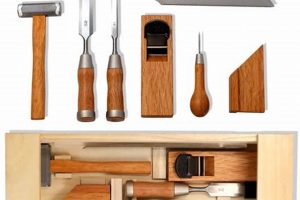
This implement, essential for shaping wood, features a sharpened blade at the end of a handle. It is employed to remove material through controlled cuts, allowing for precise shaping, carving, or cleaning of joints. For example, it can pare away thin shavings to achieve a flush surface or create intricate decorative details.
The utility of this edge tool extends to a wide range of applications, from rough shaping to fine detail work. Its historical significance is substantial, as it has been used for centuries in construction, furniture making, and various crafts. The accuracy it provides is invaluable for achieving quality and precision in woodworking projects.
The following sections will delve into specific types, proper usage techniques, maintenance practices, and safety considerations related to these indispensable instruments, offering a complete guide for woodworkers of all skill levels.
Essential Tips for Using Edge Tools in Woodworking
The effective use of these implements is paramount for achieving quality results in woodworking. Here are some key tips to enhance performance and safety:
Tip 1: Sharpen Regularly: A keen edge is crucial. Honing should be performed before each use to maintain optimal cutting ability. Dull blades require more force, increasing the risk of slippage and injury.
Tip 2: Select the Appropriate Tool: Different sizes and bevel angles exist for specific tasks. A wider blade is suitable for removing large amounts of material, while a narrow blade is better for detailed work. Bevel angle dictates optimal use.
Tip 3: Use a Mallet When Necessary: For mortising or removing substantial material, a mallet provides controlled force. Strike the handle squarely to avoid damaging it and to ensure the blade moves in the desired direction.
Tip 4: Maintain Proper Body Positioning: Stable footing and a secure grip are essential. Keep hands behind the cutting edge and ensure the workpiece is firmly secured. Avoid working in awkward positions.
Tip 5: Practice Grain Direction Awareness: Cutting with the grain minimizes tear-out and produces a cleaner cut. Observe the grain direction closely before each cut and adjust technique accordingly.
Tip 6: Store Securely: Sharp cutting instruments should be stored safely to prevent accidental injury and to protect the cutting edge. A tool roll or dedicated storage rack is recommended.
Tip 7: Understand Bevel Orientation: The direction of the bevel significantly impacts cut performance. Bevel-down is typical for paring surfaces flat, while bevel-up excels at slicing fibers, as in dovetail work.
By adhering to these guidelines, woodworkers can improve precision, safety, and overall quality of their work. Prioritizing sharpness, selection, and safe handling ensures optimal results.
The subsequent section will address specific maintenance procedures to prolong the life and performance of these crucial tools.
1. Sharpness

The keenness of a woodworking implement’s edge is paramount to its function and effectiveness. Sharpness directly affects the ease and precision with which the tool can sever wood fibers, allowing for controlled cuts and minimizing the risk of tearing or splintering the material. A dull edge necessitates increased force, leading to reduced control, potential slippage, and compromised accuracy. For example, when creating dovetail joints, a razor-sharp edge ensures clean, crisp lines, essential for a strong and aesthetically pleasing joint.
Maintaining optimal sharpness is not merely a matter of convenience; it is intrinsically linked to safety. A sharper edge requires less force, reducing the likelihood of accidental slips that can result in injury. The process of sharpening also allows for closer examination of the tool’s edge, revealing any imperfections or damage that could compromise its performance. Furthermore, different woodworking tasks demand varying degrees of sharpness. A more acute edge is required for delicate paring operations, while a slightly less refined edge may suffice for rougher stock removal.
In summary, sharpness is not an optional attribute but a fundamental requirement for any woodworking edge tool. Its influence extends to precision, safety, and overall quality of the finished product. The investment in sharpening equipment and the diligent practice of sharpening techniques are therefore essential for any woodworker seeking to achieve professional results and maintain a safe working environment.
2. Steel Quality
Steel quality is a determinant factor in the performance and longevity of any woodworking edge tool. The composition, hardness, and heat treatment of the steel directly influence its ability to hold an edge, resist wear, and withstand the stresses of repeated use. The selection of appropriate steel is therefore a critical consideration for manufacturers and end-users alike.
- Hardness and Edge Retention
The hardness of the steel, typically measured on the Rockwell C scale, directly correlates with its ability to retain a sharp edge. Harder steels, such as those in the range of RC60-65, can maintain a keen edge for longer periods, reducing the frequency of sharpening. However, excessive hardness can make the steel brittle and prone to chipping. The optimal hardness represents a balance between edge retention and impact resistance.
- Wear Resistance
The presence of alloying elements, such as chromium and vanadium, enhances the steel’s resistance to abrasion and wear. These elements form hard carbides within the steel matrix, providing increased resistance to the gradual erosion of the cutting edge caused by contact with wood fibers. Superior wear resistance translates to a longer tool life and reduced maintenance requirements.
- Toughness and Impact Resistance
While hardness is essential for edge retention, toughness refers to the steel’s ability to withstand impact without fracturing. Steels with higher toughness are less susceptible to chipping or breaking when subjected to sudden forces, such as those encountered when using a mallet. The addition of elements like manganese and silicon can improve toughness without significantly compromising hardness.
- Grain Structure and Heat Treatment
The microstructure of the steel, including grain size and carbide distribution, significantly affects its overall performance. Fine-grained steels typically exhibit superior sharpness and edge retention compared to coarse-grained steels. Proper heat treatment, including hardening and tempering, is essential to achieve the desired microstructure and optimize the steel’s hardness, toughness, and wear resistance.
In essence, steel quality dictates the working life and performance of these specific woodworking tools. Choosing an appropriate alloy, coupled with precise manufacturing processes, determines the tool’s capabilities, from shaping softwoods to hardwoods. Factors like hardness, wear resistance, toughness, and grain structure directly influence its reliability and longevity in the woodworker’s shop.
3. Handle Design

The configuration of a woodworking implement’s handle profoundly influences both the tool’s functionality and the user’s experience. Handle design affects grip, control, and the transmission of force, directly impacting precision and safety.
- Material Composition
Traditional handle materials include hardwoods such as ash, beech, and maple, chosen for their durability and shock-absorbing properties. Modern alternatives include polymers and composite materials that offer increased resistance to wear and moisture. The material’s density and texture influence the comfort and security of the grip. The choice of material must balance durability, ergonomic considerations, and the demands of the intended application. For example, a dense hardwood handle can withstand repeated mallet blows without deforming, while a textured polymer handle can provide a secure grip even with sweaty hands.
- Shape and Ergonomics
Handle shape is a crucial determinant of user comfort and control. Contoured handles that conform to the natural shape of the hand reduce fatigue during extended use. Different handle shapes cater to different grip styles and tasks. A cylindrical handle may be suitable for general-purpose work, while a faceted or oval handle may offer greater precision for detailed carving. Ergonomic design aims to minimize strain on the hand and wrist, reducing the risk of repetitive stress injuries. The diameter and length of the handle also contribute to the overall ergonomic performance.
- Length and Balance
The length of the handle influences the leverage and control that the user can exert. Longer handles generally provide greater leverage, making them suitable for heavy stock removal. Shorter handles offer increased precision for fine detail work. The balance point of the tool, determined by the distribution of weight between the blade and the handle, affects its handling characteristics. A well-balanced tool feels more natural and responsive in the hand, reducing fatigue and improving accuracy. The optimal handle length and balance depend on the intended application and the user’s preferences.
- Tang and Ferrule Integration
The method of attaching the blade (tang) to the handle is critical for the tool’s structural integrity. A full tang, extending through the entire length of the handle, provides maximum strength and stability. Partial tangs, which extend only partway into the handle, are common but may be less durable. A ferrule, typically made of metal, reinforces the handle and prevents it from splitting under stress. The ferrule also protects the handle from damage caused by repeated mallet blows. A secure and well-integrated tang and ferrule are essential for ensuring the tool’s longevity and preventing accidents.
Collectively, these facets underscore the significance of handle design. A well-designed handle optimizes control and reduces fatigue, which in turn enhances accuracy and overall woodworking outcomes. The careful consideration of material, shape, length, and tang integration reflects a commitment to quality and user experience. Thus, handle design remains integral to the performance and utility of any edge tool.
4. Bevel Angle
The bevel angle of a woodworking implement is a critical parameter determining its cutting performance and application. This angle, formed between the primary surface of the blade and the ground facet forming the cutting edge, directly influences the tool’s ability to sever wood fibers effectively. A steeper angle necessitates greater force but provides a more robust cutting edge, suitable for heavy stock removal or working with dense hardwoods. Conversely, a shallower angle requires less force and produces a finer cut, ideal for delicate paring or shaping softwoods. For example, a bevel angle of 30 degrees might be employed for general-purpose work, while a 25-degree angle would be preferred for fine detailing.
The selection of an appropriate bevel angle is dictated by the specific woodworking task. Mortising, which involves removing substantial material to create a recess for a joint, benefits from a steeper angle that can withstand the impact of a mallet. Paring, on the other hand, requires a shallower angle to achieve a smooth, clean surface without tearing the wood fibers. The angle also affects the tool’s ability to navigate varying grain directions. A steeper angle is more resistant to deflection caused by grain irregularities, ensuring a straighter cut. The skill of a woodworker often lies in the ability to sharpen and maintain the bevel angle precisely, adapting it to the demands of each project.
In summary, the bevel angle is not an arbitrary dimension but a fundamental characteristic that governs a cutting instrument’s performance. Its selection and maintenance are essential for achieving optimal results in woodworking. An understanding of the relationship between bevel angle, wood properties, and cutting techniques enables woodworkers to execute precise, clean, and efficient cuts, contributing to the overall quality and craftsmanship of their work. Any deviation from an appropriate bevel angle can result in inefficient cutting, increased tool wear, and compromised precision.
5. Tool Type
The designation of tool type represents a fundamental classification criterion for woodworking implements, directly influencing their application and efficacy. In the specific context of edge tools, variations in design, size, and intended function necessitate categorization into distinct types. These delineations are not merely semantic; rather, they reflect substantive differences in performance characteristics and suitability for particular tasks. For instance, a bench instrument, designed for general stock removal and shaping at a workbench, differs significantly from a specialized carving tool intended for intricate detail work. The former typically possesses a wider blade and a robust handle, while the latter exhibits a narrower blade and a handle optimized for fine control. Understanding the nuanced relationship between tool type and intended application is crucial for achieving optimal results and avoiding potential damage to both the workpiece and the tool itself.
The selection of an appropriate type hinges on a thorough understanding of the task at hand. Consider the task of creating mortise and tenon joints. A mortise tool, with its thick blade and rectangular cross-section, is specifically designed to withstand the lateral forces encountered when removing material from within a mortise. Employing a standard bench instrument for this purpose would likely result in blade damage or inaccurate cuts. Similarly, a paring tool, characterized by its long, thin blade and shallow bevel angle, is ideally suited for trimming joints to a precise fit. Using a heavier, more robust tool for paring would compromise accuracy and potentially damage the delicate edges of the joint. Historical examples further illustrate this point; the development of specialized tools such as the dovetail instrument directly correlates with the increasing sophistication of woodworking techniques and the demand for greater precision.
In summary, tool type is not merely a descriptive label; it is a determinant factor influencing performance, safety, and the overall quality of woodworking outcomes. A comprehensive understanding of the various types available, and their respective strengths and limitations, empowers woodworkers to make informed tool selections, optimize their techniques, and achieve professional-caliber results. The inherent challenges lie in recognizing the subtle differences between seemingly similar tools and appreciating the impact of these differences on the final product. Mastery of tool type selection is thus an essential element of woodworking expertise.
6. Striking Surface

The striking surface, typically located at the end of the handle of a woodworking implement, is a crucial interface for transmitting force when using mallets or other striking implements. This surface experiences direct impact during operations such as mortising or driving the blade through dense materials. The integrity and design of this surface directly affect the efficiency and longevity of the tool. For instance, a poorly designed or inadequately reinforced striking surface can fracture or deform under repeated impact, leading to handle failure and rendering the tool unusable. Conversely, a well-designed striking surface, often reinforced with a metal ferrule or constructed from a durable material, ensures efficient force transfer, minimizing wasted energy and reducing the risk of damage. An example of this importance can be observed when chopping mortises in hardwoods, such as oak or maple; an insufficient striking surface will quickly degrade, leading to a loss of control and reduced accuracy.
The composition and construction of the striking surface vary depending on the intended application and the overall design of the tool. Some handles feature a separate striking cap made of a particularly resilient material, such as brass or hardened steel, designed to absorb impact and protect the underlying wood. Others rely on the inherent strength of the handle material itself, often reinforced with a metal band to prevent splitting. The angle and shape of the striking surface also contribute to its effectiveness. A flat, perpendicular surface provides maximum contact with the striking implement, ensuring efficient force transfer. However, a slightly rounded or angled surface may offer improved comfort and reduce the risk of glancing blows. Careful consideration of these factors during the design and manufacturing process is essential to ensure the striking surface can withstand the rigors of demanding woodworking tasks.
In summary, the striking surface represents a critical component of a woodworking implement, playing a vital role in force transmission, tool longevity, and user safety. Its design and construction must be carefully considered to withstand the repeated impact associated with various woodworking operations. Neglecting the importance of the striking surface can lead to tool failure, reduced efficiency, and potential injury. Therefore, proper understanding and maintenance of this feature are essential for any woodworker seeking to achieve consistent and reliable results. The effectiveness of this striking surface is directly proportional to the quality and longevity of the tool, impacting every task that requires the use of a mallet or other impacting instrument.
7. Edge Retention

Edge retention is a crucial characteristic of a woodworking implement, directly impacting its performance and the efficiency of woodworking tasks. This property refers to the ability of the blade to maintain a sharp cutting edge over time and with use. Superior edge retention minimizes the frequency of sharpening, saving time and preserving the tool’s geometry. The interplay between the steel’s composition, heat treatment, and the wood being worked directly determines the longevity of a sharpened edge. The use of a high-quality, hardened steel alloy, properly tempered, is essential for optimal edge retention. Without adequate edge retention, a woodworking implement will quickly become dull, leading to increased effort, reduced precision, and potential damage to the workpiece. For example, when carving intricate details in hardwoods like maple or walnut, an instrument with poor edge retention would require frequent sharpening, interrupting the workflow and potentially compromising the final result.
The practical significance of understanding edge retention lies in the informed selection and maintenance of these essential woodworking tools. Choosing a tool made from a steel known for its superior edge-holding capabilities, such as high-speed steel (HSS) or certain high-carbon steels, is a worthwhile investment. Furthermore, employing proper sharpening techniques, including the use of honing guides and appropriate abrasives, can significantly extend the life of the edge. Conversely, using improper sharpening methods or working with abrasive materials can rapidly degrade the edge, necessitating frequent resharpening or even premature tool replacement. The type of wood being worked also influences edge retention; hardwoods naturally dull edges faster than softwoods. Therefore, woodworkers often dedicate specific tools to working with different types of wood to preserve the sharpness of each implement.
In summary, edge retention represents a critical performance metric for a woodworking implement. It is fundamentally linked to the quality of the steel, the precision of sharpening techniques, and the nature of the materials being worked. The challenge for the woodworker is to balance the cost of high-quality tools with the long-term benefits of reduced sharpening frequency and improved performance. A deeper understanding of edge retention allows for more efficient workflow, improved accuracy, and ultimately, a higher quality of finished woodworking projects. The effective management of edge retention distinguishes experienced woodworkers and contributes to the craft’s efficiency and artistry.
Frequently Asked Questions About Woodworking Edge Tools
The following addresses common inquiries regarding the selection, use, and maintenance of these essential woodworking implements.
Question 1: What are the primary differences between bevel-edge and skew edge designs?
Bevel-edge designs feature a single bevel ground on one side of the blade, making them suitable for general-purpose tasks such as paring and shaping. Skew edge designs have an angled cutting edge, allowing them to excel in smoothing surfaces and reaching into tight corners. The choice depends on the specific requirements of the woodworking project.
Question 2: How frequently should these cutting instruments be sharpened?
Sharpening frequency depends on the type of wood being worked and the amount of use. As a general guideline, resharpening is necessary when the cutting edge begins to dull or when increased force is required to make clean cuts. Regular honing with a fine stone or strop can extend the time between more extensive sharpening sessions.
Question 3: What is the correct method for storing these sharp tools?
Proper storage is crucial for maintaining the integrity of the cutting edge and preventing injury. Storing them in a dedicated tool roll, rack, or cabinet protects the blades from damage and accidental contact. Avoid storing them loose in drawers or toolboxes where they can become damaged or pose a safety hazard.
Question 4: Are there specific safety precautions to observe when using these implements?
Safety is paramount when working with sharp tools. Always maintain a firm grip, keep hands behind the cutting edge, and ensure the workpiece is securely clamped or held in place. Wear appropriate eye protection to guard against flying wood chips and avoid distractions while working.
Question 5: What types of mallets are suitable for striking these woodworking tools?
Mallets made of wood, plastic, or rubber are commonly used for striking handles. Wooden mallets are traditional and provide a solid, controlled impact. Plastic and rubber mallets offer a softer blow, reducing the risk of damaging the handle. The size and weight of the mallet should be appropriate for the task at hand.
Question 6: How does one select the appropriate size for a specific woodworking task?
The choice depends on the scale of the project and the type of cut being made. Smaller sizes are ideal for detail work and intricate carvings, while larger sizes are better suited for removing significant amounts of material. Consider the width of the cut, the depth of the mortise, or the size of the surface being pared when selecting the appropriate dimension.
In summary, proper selection, use, maintenance, and storage are essential for maximizing the performance and longevity of woodworking implements. Adhering to these guidelines ensures safe and efficient woodworking practices.
The subsequent section will explore advanced techniques for sharpening and maintaining these important woodworking tools.
In Conclusion
This article has provided a comprehensive overview of the essential edge tool, encompassing its definition, usage, maintenance, and safety considerations. From understanding the nuances of steel quality and handle design to mastering the art of sharpening and selecting the appropriate tool type, each element plays a crucial role in achieving precision and quality in woodworking projects. The detailed exploration of bevel angles, striking surfaces, and edge retention underscores the intricate relationship between tool characteristics and woodworking outcomes.
The effective utilization and diligent care of the chisel woodworking tool represent a cornerstone of skilled craftsmanship. By adhering to the principles outlined herein, woodworkers can enhance their abilities, extend the lifespan of their implements, and ultimately elevate the quality of their work. The knowledge and application of these concepts serve as a testament to the dedication required for mastering the art of woodworking and ensuring the enduring legacy of this time-honored craft.