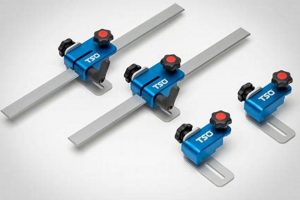
Instruments employed in the shaping and construction of wooden objects where dimensional precision is paramount are essential for quality craftsmanship. These instruments ensure that cuts, joints, and assemblies conform to the intended design specifications. For instance, a precisely calibrated measuring tape allows for marking wood pieces to their exact required lengths, while a high-quality square guarantees right angles crucial for stable and aesthetically pleasing structures.
The utilization of instruments offering high precision yields numerous advantages. It minimizes material waste by reducing errors during the cutting and shaping processes. Projects exhibit increased structural integrity and durability due to properly fitted joints and connections. Historically, the evolution of these instruments reflects a quest for greater efficiency and refinement in woodworking practices, leading to more intricate and lasting creations. The result is an enhanced aesthetic appeal and value of the finished product.
The subsequent sections will explore various categories of instruments essential for achieving dimensional precision in woodworking, including measuring and marking instruments, cutting tools, and clamping devices. These sections will delve into specific examples, offering practical guidance on their selection, usage, and maintenance.
Enhancing Precision in Woodworking Projects
Achieving accurate and repeatable results in woodworking necessitates careful attention to the selection, maintenance, and application of appropriate instruments. The following guidelines are designed to maximize the effectiveness of instruments crucial for dimensional precision.
Tip 1: Calibrate Measuring Devices Regularly: Verify the accuracy of measuring tapes, rulers, and squares against a known standard. Recalibration is essential after significant impacts or prolonged use to maintain reliability. A certified steel rule can serve as a reliable benchmark for calibration.
Tip 2: Prioritize High-Quality Marking Instruments: Employ fine-point mechanical pencils or marking knives instead of pens or thick pencils. These instruments produce thinner, more precise lines, reducing the potential for errors in cutting and shaping. Test the sharpness of the marking knife regularly.
Tip 3: Invest in Precision Cutting Instruments: When using saws, select blades with an appropriate tooth count for the material being cut. Finer teeth yield smoother, more accurate cuts. Similarly, router bits should be chosen for their sharpness and profile accuracy to ensure clean edges and consistent dimensions.
Tip 4: Secure Workpieces Firmly: Utilizing clamps to firmly secure workpieces during cutting and shaping operations is crucial. This prevents movement that can lead to inaccurate cuts or misaligned joints. Employ a variety of clamp types to accommodate different workpiece geometries.
Tip 5: Practice Proper Tool Maintenance: Regularly sharpen blades, plane irons, and chisels to maintain their cutting efficiency. A dull tool is more likely to cause inaccuracies and tear-out. Honing with progressively finer stones is vital for achieving optimal sharpness.
Tip 6: Use a Reference Surface: Rely on a known flat surface when using hand tools such as planes and chisels. This reference plane ensures that the tool is creating a uniformly flat surface, aiding in dimensional accuracy.
Tip 7: Lightly Sand After Cutting: After cutting a piece of wood, lightly sand or plane it to remove any imperfections or splinters. This will not only improve the piece’s appearance but also ensure that it is exactly the size you want it to be.
Implementing these strategies improves the precision and quality of woodworking projects, minimizing material waste and enhancing the overall craftsmanship. Consistent application of these techniques will result in more accurate and aesthetically pleasing finished products.
The subsequent article sections will explore specific projects where adhering to these principles demonstrates tangible benefits in terms of efficiency, material utilization, and the final appearance of woodworking creations.
1. Precise Measurement

Precise measurement forms the bedrock upon which accurate woodworking rests. Instruments designed for this purpose, and functioning with a high degree of fidelity, directly influence the dimensions of the final product. Discrepancies in measurement, even minute ones, propagate through subsequent stages of construction, culminating in misaligned joints, structural instability, and aesthetic deficiencies. An example of this interdependence is observed in the creation of a mortise and tenon joint. The accurate measurement of both mortise and tenon is paramount to ensuring a snug, strong fit. A deviation of even a fraction of a millimeter can result in a loose joint, compromising the overall strength of the piece.
The accuracy of woodworking tools is inextricably linked to the capacity for precise measurement. A marking gauge, meticulously calibrated, provides consistent reference lines for cutting joinery. A digital angle finder, accurate to within a fraction of a degree, ensures that angled cuts are executed with the required precision. The practical significance of this understanding lies in the ability to predict and control the outcome of a woodworking project. Employing tools that maintain accuracy minimizes material waste, reduces the need for corrective measures, and ultimately elevates the quality of the finished product. For example, consider building a drawer. If the internal dimensions of the cabinet are not measured precisely, the drawer may not fit properly, leading to wasted material and time.
In summary, precise measurement, facilitated by instruments designed for accuracy, is an indispensable component of woodworking. Mastering the proper use of these instruments and understanding their limitations allows for improved efficiency, reduced errors, and the creation of woodworking projects that exhibit both structural integrity and aesthetic appeal. The challenge lies in selecting appropriate instruments, maintaining their calibration, and consistently applying sound measurement techniques. Achieving proficiency in these areas is essential for any woodworker seeking to produce high-quality work.
2. Sharp Cutting Edges

The sharpness of a tool’s cutting edge is a fundamental determinant of its capacity for precision in woodworking. Cutting instruments lacking optimal sharpness induce inaccuracies due to increased resistance, leading to deviations from intended lines. This resistance can cause the tool to wander, tear the wood fibers instead of cleanly severing them, and ultimately result in dimensions that deviate from specifications. Consider the example of a hand plane: a dull blade requires significantly more force to achieve a smooth, even surface, increasing the risk of gouging or creating uneven thicknesses. Conversely, a honed blade effortlessly glides across the wood, removing thin shavings with minimal force and yielding a precise, predictable result. The efficacy of joinery is also directly influenced. A dull chisel, when used to pare a mortise, will crush wood fibers, producing an ill-defined, loose-fitting joint, compromising the structural integrity of the final assembly.
Maintaining optimal sharpness in cutting instruments requires consistent effort and the employment of appropriate sharpening techniques. The selection of sharpening stones, honing guides, and stropping compounds plays a critical role in achieving and preserving edge quality. Failure to regularly sharpen tools necessitates increased force during use, amplifying the potential for errors and fatigue. Furthermore, dull tools are more prone to causing dangerous kickback events, posing a safety risk to the user. The link between edge sharpness and precision extends beyond hand tools. The performance of power tools, such as saws and routers, is equally dependent on blade sharpness. A dull saw blade produces splintered edges and requires increased feed pressure, resulting in inaccurate cuts. Sharp router bits deliver clean, smooth profiles, reducing the need for extensive sanding and ensuring accurate dimensions.
In summary, the sharpness of cutting edges is an indispensable component of precision in woodworking. Dull tools introduce inaccuracies, increase the risk of material waste and injury, and compromise the overall quality of the finished product. Maintaining sharp edges through regular sharpening, proper tool maintenance, and careful selection of sharpening equipment is essential for achieving predictable and accurate results in all woodworking endeavors. The inherent connection between edge sharpness and precision underscores the importance of this often-overlooked aspect of the craft.
3. Stable Jigs
Stable jigs serve as critical auxiliary components within the framework of accurate woodworking. Their primary function is to guide tools and workpieces, ensuring repeatable precision in cutting, shaping, and assembly operations. The absence of stability in a jig directly undermines its effectiveness, leading to inaccuracies that negate the benefits of employing precision instruments.
- Enhanced Repeatability
A stable jig allows for the consistent replication of cuts, angles, or joinery elements. For instance, a well-constructed dovetail jig ensures that each dovetail is cut to the same dimensions and with the same spacing, resulting in a uniform and aesthetically pleasing joint. Conversely, a jig that flexes or shifts during use will produce variable results, even when used with the most precisely calibrated saws and chisels.
- Improved Accuracy
Stability minimizes the potential for tool deflection or workpiece movement, enabling the user to execute cuts with greater accuracy. A router jig designed for creating mortises, if properly braced and secured, guides the router bit along a precise path, resulting in mortises that are dimensionally accurate and square. Instability in the jig would lead to wandering cuts and inaccurate mortise dimensions, compromising the strength and aesthetics of the joint.
- Increased Safety
A stable jig reduces the risk of accidents by providing a secure and predictable platform for tool operation. A jig used to hold small or irregularly shaped workpieces during sawing or routing operations, when firmly clamped to the workbench, prevents the workpiece from slipping or kicking back. An unstable jig, however, increases the likelihood of workpiece movement, potentially leading to injury.
- Efficient Production
The reliability afforded by a stable jig streamlines the production process, reducing setup time and minimizing errors. A jig designed for repetitive tasks, such as drilling holes at consistent intervals, allows for efficient and accurate execution of the task. In contrast, a jig that requires constant adjustment or recalibration introduces inefficiencies and increases the potential for mistakes.
The value of accurate woodworking tools is intrinsically linked to the stability of the jigs used in conjunction with them. Instruments offering precision alone are insufficient to guarantee accurate results if the jigs employed to guide and support the work are not equally stable and reliable. Therefore, the construction and utilization of stable jigs are essential for maximizing the effectiveness of woodworking instruments and achieving consistent, high-quality outcomes.
4. Consistent Calibration

Consistent calibration represents an indispensable aspect of maintaining the accuracy of woodworking instruments. Tools, regardless of their initial precision, are subject to drift over time due to wear, environmental factors, and mechanical stress. This drift, if unchecked, introduces systematic errors into the woodworking process, undermining the benefits of employing high-quality instruments. The frequency of calibration varies depending on tool usage and environmental conditions, but regular verification against known standards is critical. For example, a dial caliper used daily in a professional woodworking environment requires more frequent calibration checks than one used occasionally in a hobbyist workshop. A lack of consistent calibration transforms a potentially precise instrument into a source of error, compromising the dimensional accuracy of woodworking projects. Imagine a scenario where a miter saw, initially calibrated for 90-degree cuts, gradually drifts out of alignment. Without periodic recalibration, this saw will produce angled cuts that deviate from the intended 90 degrees, leading to mismatched joints and structurally unsound assemblies. This example underscores the direct relationship between calibration frequency and the accuracy of woodworking tools.
The practical application of consistent calibration extends beyond individual instruments. It encompasses the entire woodworking process, from initial measurement to final assembly. Establishing a calibration schedule and documenting the results provides a traceable record of instrument accuracy. This documentation is particularly valuable in professional settings where adherence to quality control standards is essential. Furthermore, calibrating instruments against a common standard ensures consistency across multiple tools. For instance, calibrating all measuring tapes within a workshop against a certified steel rule eliminates discrepancies that could arise from using tapes with varying degrees of stretch or wear. The process also involves understanding the limitations of each instrument and applying appropriate correction factors when necessary. Some instruments, such as digital protractors, may exhibit inherent inaccuracies that require compensation through software adjustments or manual calculations. Regular calibration ensures that these correction factors are accurately applied, maximizing the instrument’s precision.
In summary, consistent calibration is not merely a recommended practice; it is a fundamental requirement for maintaining the accuracy and reliability of woodworking tools. By establishing a calibration schedule, utilizing appropriate standards, and documenting the results, woodworkers can mitigate the effects of instrument drift and ensure that their projects adhere to the intended design specifications. The challenge lies in recognizing the importance of calibration, allocating time for its execution, and investing in the necessary calibration standards and equipment. Ultimately, consistent calibration transforms woodworking tools from potential sources of error into reliable instruments of precision, enabling woodworkers to achieve consistent, high-quality results.
5. Durable Materials

The dimensional precision attainable from a woodworking tool is inextricably linked to the durability of its constituent materials. Instruments crafted from inferior materials are prone to deformation, wear, and breakage, directly impacting their ability to maintain accuracy over time. Consider a metal ruler manufactured from a low-grade alloy: repeated bending or exposure to temperature fluctuations can induce warping, rendering its measurements unreliable. Similarly, a plastic-bodied protractor, when subjected to impact, may crack or chip, altering its angular reference points. Therefore, durable materials are not merely a desirable attribute, but an essential component of woodworking instruments intended for precision work. The relationship is causal: the inherent properties of the material directly influence the instrument’s capacity to retain its original form and function under normal operating conditions. This durability, in turn, allows for the consistent and accurate execution of woodworking tasks.
The selection of materials with high strength, stability, and resistance to environmental degradation is paramount in the manufacturing of precision woodworking tools. High-carbon steel, for instance, is commonly employed in the construction of saw blades and chisels due to its hardness and ability to maintain a sharp cutting edge. Hardwoods, such as maple or cherry, are favored for tool handles and jigs because of their resistance to splitting and warping. Polymer composites, engineered for dimensional stability and impact resistance, are increasingly used in the fabrication of precision measuring instruments. The practical implications of this material selection are readily apparent. A well-maintained hand plane, constructed from hardened steel and seasoned hardwood, can provide decades of accurate service, while a cheaply made alternative may fail within a few months. The investment in tools crafted from durable materials represents a long-term commitment to precision and reliability in woodworking.
In conclusion, the durable materials that underpin the construction of woodworking tools directly contribute to their capacity for accuracy. The selection of appropriate materials is a critical factor in ensuring that instruments retain their dimensional integrity and functional reliability over time. While the initial cost of tools crafted from durable materials may be higher, the long-term benefits in terms of accuracy, longevity, and reduced material waste outweigh the initial investment. Understanding the connection between durability and precision is essential for woodworkers seeking to achieve consistent, high-quality results. This understanding underscores the importance of prioritizing material quality when selecting woodworking tools, recognizing that durability is not merely a desirable attribute but an indispensable requirement.
6. Ergonomic Design

Ergonomic design, when applied to woodworking tools, directly influences the user’s ability to operate those tools with precision and control. The correlation stems from the reduction of fatigue, strain, and discomfort, factors that inherently diminish accuracy. A tool ill-suited to the user’s hand size or grip strength requires excessive force to manipulate, leading to involuntary movements and deviations from the intended cutting line. For example, a hand plane with a poorly shaped handle can cause hand cramping and wrist fatigue, compromising the user’s ability to maintain a consistent planing depth and angle. The consequence is an uneven surface or inaccurate thicknessing. Ergonomic design, therefore, transforms a woodworking tool from a mere instrument into an extension of the user’s body, facilitating greater control and minimizing the potential for error.
The practical application of ergonomic principles in tool design encompasses several key considerations. Handle shape and size must accommodate a range of hand sizes and grip styles. Weight distribution must be carefully balanced to minimize strain on the user’s joints. Vibration dampening features can reduce fatigue and improve tool control. The placement of controls, such as power switches or adjustment knobs, should be intuitive and easily accessible without requiring awkward movements. Consider a modern power sander: an ergonomically designed sander will feature a comfortable grip, low vibration levels, and easily accessible speed controls, enabling the user to achieve a smooth, even finish with minimal fatigue. Contrast this with an older, poorly designed sander, which may vibrate excessively, have an uncomfortable grip, and require the user to strain to reach the speed controls, resulting in an uneven finish and increased user fatigue.
In summary, ergonomic design is not merely a cosmetic feature of woodworking tools; it is an integral component of achieving and maintaining accuracy. By minimizing fatigue, strain, and discomfort, ergonomic design enhances the user’s ability to control the tool and execute woodworking tasks with precision. The challenge lies in selecting tools that are not only well-made and durable but also ergonomically suited to the individual user. The long-term benefits of investing in ergonomically designed tools include improved accuracy, reduced risk of injury, and increased enjoyment of the woodworking process.
7. Secure Clamping
Secure clamping is a prerequisite for realizing the full potential of instruments offering dimensional precision in woodworking. Clamping, in this context, is the application of force to hold a workpiece stationary during cutting, shaping, or assembly. The absence of secure clamping introduces instability, which directly undermines the accuracy achievable with even the finest woodworking tools. Vibration, slippage, or movement of the workpiece during tool operation inevitably results in deviations from the intended dimensions and angles, rendering the investment in precision instruments moot. A practical example is encountered when routing a dado: if the workpiece is not securely clamped to the workbench or a suitable jig, the router bit can cause the wood to shift, resulting in a dado that is wider or shallower than specified, or one that wanders from its intended path. The consequence is a compromised joint and a reduction in the structural integrity of the assembly.
Effective clamping requires careful consideration of clamp type, placement, and pressure. The selection of appropriate clamps depends on the size and geometry of the workpiece, as well as the nature of the operation being performed. Bar clamps, pipe clamps, and hand screws offer varying degrees of clamping force and adaptability to different shapes. Correct placement is critical to ensure that the clamping force is distributed evenly across the workpiece, preventing distortion or crushing. Excessive clamping pressure can damage delicate materials or create stress points, while insufficient pressure allows for movement. For instance, when gluing up a panel, clamps must be positioned strategically to apply uniform pressure across the entire surface, ensuring a tight, gap-free bond. The effectiveness of this process depends not only on the precision of the instruments used to cut the individual pieces but also on the security with which those pieces are held together during the gluing process.
In summary, secure clamping is not merely an ancillary step in woodworking; it is an integral component of achieving accurate results. The proper application of clamping techniques is essential for maximizing the precision and effectiveness of woodworking tools, minimizing errors, and ensuring the structural integrity and aesthetic quality of finished projects. The challenge lies in understanding the principles of clamping, selecting appropriate clamps for specific tasks, and applying them with the correct pressure and placement. Mastering these skills is indispensable for any woodworker striving for accuracy and consistency in their work.
Frequently Asked Questions
This section addresses common inquiries regarding the selection, usage, and maintenance of instruments that provide dimensional precision in woodworking. Clarity on these matters is crucial for achieving predictable and high-quality results.
Question 1: What constitutes an “accurate” woodworking tool?
An accurate woodworking tool is one that consistently provides measurements, cuts, or shapes that conform to predetermined specifications, within an acceptable margin of error. This requires inherent precision in its design and construction, as well as diligent maintenance and calibration.
Question 2: How does the cost of a tool relate to its accuracy?
While a higher price point often reflects superior materials, construction, and quality control, cost is not always a definitive indicator of accuracy. It is imperative to assess the tool’s specifications, read independent reviews, and, if possible, conduct personal testing to verify its precision, irrespective of its price.
Question 3: What are the most critical tools for achieving accuracy in woodworking?
Key instruments include a precision measuring tape or rule, a reliable square (combination or machinist’s), a marking knife for fine layout work, and saws with blades appropriate for the material being cut. The specific needs will vary depending on the nature of the projects undertaken.
Question 4: How frequently should woodworking tools be calibrated?
Calibration frequency depends on usage intensity and environmental conditions. Tools used daily should be checked more frequently than those used occasionally. A general guideline is to calibrate measuring instruments at least every six months, or immediately after any impact or suspected damage.
Question 5: What role do jigs play in ensuring accuracy?
Jigs serve as guides for tools, ensuring repeatable accuracy in cutting and shaping operations. A stable, well-constructed jig minimizes variations in the final product, particularly when performing repetitive tasks. The jig’s accuracy, therefore, is as important as the accuracy of the tool it guides.
Question 6: How can the user contribute to maintaining tool accuracy?
The user contributes through proper tool handling, diligent cleaning and maintenance, appropriate storage to prevent damage, and regular calibration checks. Employing techniques that minimize stress on the tool and adhering to manufacturer’s recommendations extend its lifespan and preserve its accuracy.
A thorough understanding of these questions, along with the answers provided, is essential for any woodworker seeking to elevate the precision and quality of their work. The diligent application of these principles will lead to more predictable and satisfying results.
The subsequent section will explore case studies, showcasing the practical application of accurate tools in specific woodworking projects, highlighting the tangible benefits of precise craftsmanship.
Conclusion
The preceding discussion has illuminated the multifaceted significance of “accurate woodworking tools”. Precision instruments are not mere accessories, but foundational components that determine the ultimate success or failure of a woodworking endeavor. Factors such as material quality, consistent calibration, stable jig construction, ergonomic design, and secure clamping collectively influence the capacity of tools to deliver dimensional precision. Understanding and addressing these elements are essential for achieving predictable and repeatable results.
Therefore, a commitment to employing and maintaining instruments offering precision represents a dedication to excellence in woodworking. This dedication extends beyond the mere acquisition of high-quality tools; it necessitates a comprehensive understanding of their limitations and the skillful application of techniques that maximize their potential. The pursuit of precision is an ongoing endeavor, one that demands continuous learning, meticulous attention to detail, and an unwavering commitment to craftsmanship.