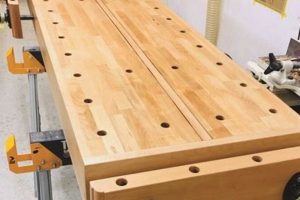
The optimal vertical distance from the floor to the surface of a woodworking bench is a critical factor in workshop ergonomics and efficiency. This dimension directly influences posture, reduces strain, and enhances the overall woodworking experience. An appropriate measurement allows for comfortable and controlled execution of tasks ranging from fine detail work to heavy material processing.
Achieving a suitable elevation for the workbench offers numerous advantages. It minimizes back pain, shoulder discomfort, and wrist fatigue, contributing to long-term physical well-being. Historically, craftspeople have adapted bench dimensions to suit their individual body types and preferred working methods, highlighting the personalized nature of this aspect of workshop design. A well-considered height setting promotes precision and reduces the likelihood of errors, ultimately improving the quality of finished projects.
The following sections will explore methods for determining a proper workbench dimension, considering individual anatomy, common woodworking tasks, and adjustable bench options. Understanding these elements is vital for creating a workspace that supports both productivity and physical health.
Optimizing Workbench Elevation
Selecting an appropriate workbench height involves careful consideration of individual anatomy and task requirements. The following tips provide guidance in determining a suitable dimension for enhanced comfort and efficiency.
Tip 1: Measure Stance Height. Determine the vertical distance from the floor to the crease of the wrist while standing upright. This provides a baseline for bench height, allowing for comfortable hand planing and other surface operations.
Tip 2: Consider Task Variance. Account for the range of woodworking tasks. If primarily performing detailed carving, a slightly higher bench may be beneficial. For heavy material processing, a lower bench often provides increased leverage.
Tip 3: Implement the Elbow Test. With arms hanging loosely at the sides, the ideal workbench surface should fall approximately two to four inches below the elbow. Adjust accordingly based on personal preference and dominant working style.
Tip 4: Utilize Adjustable Benches. If feasible, opt for a bench with adjustable legs. This feature allows for precise customization and adaptation to varying tasks or physical needs over time.
Tip 5: Account for Footwear. Always measure and adjust bench height while wearing typical workshop footwear. Variations in sole thickness can significantly impact working posture and comfort.
Tip 6: Prototype and Refine. Before committing to a permanent bench height, consider using temporary shims or blocks to experiment with different elevations. This allows for real-world testing and iterative refinement.
Tip 7: Assess Vise Placement. Factor in the height of any vises attached to the bench. Ensure that the vise jaws are positioned at a comfortable and accessible height for clamping and holding workpieces.
By carefully applying these guidelines, woodworkers can establish a workbench elevation that promotes ergonomic health, reduces fatigue, and improves the overall quality of their craft.
The subsequent section will delve into the ramifications of improper bench height and potential strategies for remediation.
1. Anatomical suitability

Anatomical suitability, in the context of woodworking bench height, refers to the degree to which the bench’s dimensions accommodate the woodworker’s unique physical characteristics. This alignment is crucial for minimizing physical strain and maximizing efficiency during extended periods of work. Failing to achieve anatomical suitability can lead to discomfort, injury, and reduced productivity.
- Wrist Height and Bench Surface
A primary consideration involves the vertical distance from the floor to the woodworker’s wrist crease while standing. The workbench surface should ideally reside within a few inches of this measurement. This proximity facilitates comfortable hand planing and other surface operations that demand precise control. A bench that is too low forces the woodworker to stoop, inducing back pain, while a bench that is too high elevates the shoulders, causing fatigue in the upper extremities.
- Arm Length and Reach Zones
The woodworker’s arm length dictates the optimal reach zones across the bench surface. Tools and materials should be readily accessible without requiring excessive stretching or contorting. A bench depth that exceeds comfortable reach can lead to postural imbalances and reduced efficiency. The arrangement of vises and other holding mechanisms must also be considered in relation to arm length, ensuring ease of use and preventing unnecessary strain.
- Torso Height and Postural Support
The height of the woodworker’s torso, particularly in relation to the bench surface, influences overall posture. An appropriately sized bench promotes an upright stance, minimizing compression on the spine and promoting healthy circulation. Conversely, an improperly sized bench may encourage slouching or leaning, exacerbating existing musculoskeletal conditions or creating new ones.
- Leg Length and Stance Stability
While often overlooked, leg length contributes to overall stability and balance at the workbench. The feet should be able to rest comfortably on the floor or a footrest, providing a solid foundation for body mechanics. A bench that is too high may necessitate prolonged standing on tiptoes or uneven weight distribution, leading to foot and ankle discomfort.
Integrating these facets of anatomical suitability into the selection and adjustment of woodworking bench height directly impacts the woodworker’s physical well-being and productivity. Prioritizing ergonomic alignment ensures a sustainable and enjoyable woodworking experience, minimizing the risk of injury and maximizing the quality of finished projects.
2. Task Requirements

The specific operations performed at a woodworking bench profoundly influence the determination of an optimal height. Different tasks necessitate variations in posture, leverage, and precision, thereby requiring corresponding adjustments to the vertical dimension of the work surface. The selection of a fixed height, or the adaptability of an adjustable bench, should directly reflect the anticipated range of projects and techniques.
- Hand Planing
Hand planing, a fundamental woodworking operation, typically demands a lower bench height. This position enables the woodworker to apply significant downward force, utilizing body weight to effectively remove material. A bench positioned too high compromises leverage, increasing exertion and potentially leading to inaccurate results. Historical examples demonstrate that benches designed specifically for hand planing were often lower than general-purpose work surfaces.
- Detailed Carving and Joinery
Conversely, intricate carving and joinery often benefit from a higher bench. This elevated position allows for closer visual inspection and facilitates finer motor control. A higher bench can reduce the need for stooping, minimizing back strain during prolonged periods of detailed work. Jewelers’ benches, with their elevated platforms, serve as an analogous example of this principle.
- Assembly and Gluing
Assembly and gluing operations often require a compromise in bench height. The surface must be accessible for clamping and aligning components, while also providing adequate support for larger assemblies. The ideal height balances the need for comfortable reach with the stability required to handle potentially heavy or unwieldy objects. Workbenches designed for cabinetmaking typically reflect this consideration.
- Power Tool Operations
The integration of power tools into woodworking necessitates consideration of safety and ergonomics. Certain power tools, such as routers or sanders, may benefit from a slightly lower bench height to provide increased stability and control. Others, such as benchtop drill presses, may require accommodation in bench height or placement to ensure optimal posture and visibility. The specific requirements of each power tool should be evaluated independently to determine the most appropriate working height.
In conclusion, the diverse range of tasks performed at a woodworking bench necessitates a flexible approach to height determination. While general guidelines offer a starting point, the optimal dimension should be tailored to the individual’s working style and the specific demands of their craft. An understanding of these task-specific requirements is essential for creating a safe, efficient, and ergonomically sound woodworking environment.
3. Adjustability
The concept of adjustability is intrinsically linked to achieving the optimal woodworking bench height. Human physical dimensions vary significantly, and woodworking tasks encompass a wide spectrum of movements and tool applications. A fixed-height bench, regardless of its initial design, can only accommodate a limited range of body types and activities. Consequently, the inclusion of adjustability mechanisms is frequently the determining factor in attaining a truly ergonomic and efficient workspace.
The practical significance of adjustability is evidenced by the increasing prevalence of height-adjustable workbenches in professional woodworking environments. These benches often incorporate threaded leg systems, hydraulic lifts, or other mechanisms that allow for incremental modifications to the work surface elevation. This customization enables woodworkers to fine-tune the bench height to match their individual stature and the specific demands of each project. For example, a woodworker transitioning from hand planing a large panel (requiring a lower bench) to carving intricate details on a small workpiece (benefitting from a higher bench) can swiftly alter the bench height to optimize comfort and control. The absence of adjustability necessitates compromises that can lead to fatigue, reduced precision, and potential musculoskeletal strain.
While fixed-height benches may present an initial cost advantage, the long-term benefits of adjustability, in terms of improved ergonomics, enhanced productivity, and reduced risk of injury, often outweigh the incremental investment. The challenge lies in selecting an adjustable bench design that offers both stability and ease of modification. Moreover, the full potential of adjustability is only realized when woodworkers are educated about proper ergonomic principles and actively utilize the adjustment features to optimize their working posture. Ultimately, adjustability represents a critical component in the pursuit of the best woodworking bench height, contributing directly to the creation of a healthier and more productive workspace.
4. Posture
Posture, in the context of woodworking, refers to the alignment and positioning of the body during the execution of tasks. The selection of an appropriate woodworking bench height directly impacts posture, influencing comfort, efficiency, and long-term physical well-being. A mismatched bench height can induce awkward postures, leading to strain, fatigue, and potential musculoskeletal disorders.
- Spinal Alignment
The maintenance of a neutral spinal alignment is paramount for minimizing back pain and promoting overall comfort. A bench height that is too low forces the woodworker to stoop forward, placing excessive stress on the lumbar region. Conversely, a bench height that is too high can elevate the shoulders and neck, causing tension in the upper back and cervical spine. The goal is to achieve a posture where the spine maintains its natural curves, distributing weight evenly and minimizing strain.
- Shoulder and Arm Positioning
Optimal bench height facilitates comfortable and efficient arm and shoulder positioning. The elbows should be able to remain close to the body, minimizing reaching and reducing the risk of shoulder impingement. A bench that is too high can force the arms to be elevated and extended, leading to fatigue and potential rotator cuff injuries. Proper bench height allows for a relaxed and natural arm posture, enabling precise control and minimizing strain.
- Wrist and Hand Ergonomics
The relationship between bench height and wrist positioning is critical for preventing repetitive strain injuries, such as carpal tunnel syndrome. The wrists should remain in a neutral position, avoiding excessive flexion or extension. A bench that is either too high or too low can force the wrists into awkward angles, increasing stress on the tendons and nerves. Maintaining a neutral wrist posture enhances precision and reduces the risk of injury during tasks that require repetitive hand movements.
- Leg and Foot Support
While often overlooked, the positioning of the legs and feet significantly contributes to overall posture and stability. The feet should rest comfortably on the floor or a footrest, providing a stable base of support. A bench that is too high may require prolonged standing on tiptoes or uneven weight distribution, leading to foot and ankle discomfort. Proper leg and foot support promotes balance, reduces fatigue, and minimizes the risk of musculoskeletal strain throughout the body.
The correlation between posture and woodworking bench height underscores the importance of ergonomic considerations in workshop design. By prioritizing spinal alignment, comfortable shoulder and arm positioning, neutral wrist ergonomics, and adequate leg and foot support, woodworkers can create a workspace that promotes physical well-being and enhances the quality of their craft. The careful selection of a bench height that accommodates individual anatomy and task requirements is a fundamental step towards achieving optimal posture and preventing long-term health issues.
5. Precision
In woodworking, precision defines the accuracy and consistency with which cuts, joinery, and other operations are executed. Achieving this requires minimizing errors and maintaining control throughout the construction process. The appropriate woodworking bench height is a critical factor in facilitating the necessary precision, impacting both stability and ergonomic efficiency.
- Stability and Control
A properly configured workbench provides a stable platform that minimizes movement and vibration during critical operations. When the bench height is correctly matched to the woodworker’s stature, the body can be positioned for optimal balance and control. This stability is particularly crucial when using hand tools, such as chisels or planes, where subtle variations in force or angle can significantly affect the outcome. Conversely, a bench that is too high or too low compromises balance, making it more difficult to maintain consistent pressure and angle, leading to inaccuracies.
- Ergonomic Efficiency and Reduced Fatigue
An ergonomically sound workbench height reduces physical strain and fatigue, enabling the woodworker to maintain focus and control for extended periods. When the body is not forced to compensate for an improperly sized bench, energy is conserved, allowing for greater concentration on the task at hand. Reduced fatigue translates directly into improved accuracy and consistency, particularly during complex or repetitive operations. In contrast, an ill-suited bench height can lead to discomfort, distraction, and a higher likelihood of errors.
- Visual Acuity and Perspective
The vertical positioning of the workpiece relative to the woodworker’s eye level significantly impacts visual acuity and perspective. An appropriate bench height allows for a clear and unobstructed view of the task at hand, facilitating accurate measurements, precise alignment, and detailed inspection. When the bench is too low, the woodworker may be forced to hunch over, obscuring the view and compromising the ability to perceive fine details. A bench that is too high can distort perspective, making it difficult to accurately assess angles and dimensions. An optimized height promotes optimal visual ergonomics and enhanced precision.
- Tool Manipulation and Accessibility
The positioning of tools relative to the workbench surface is crucial for efficient and precise tool manipulation. The appropriate bench height ensures that tools are readily accessible and can be used with minimal reaching or straining. This accessibility allows the woodworker to maintain a smooth and controlled workflow, reducing the likelihood of errors caused by awkward movements or unstable hand positions. Conversely, a poorly configured bench can force the woodworker to contort the body or reach excessively, increasing the risk of dropping tools or losing control of the workpiece. The ideal arrangement facilitates seamless tool transitions and enhanced precision.
The interconnectedness of stability, ergonomic efficiency, visual acuity, and tool manipulation highlights the significant role of woodworking bench height in achieving precision. A bench that is appropriately sized and configured provides a foundation for accurate, consistent, and controlled woodworking, minimizing errors and enhancing the overall quality of the finished product. The selection of the “best” height is therefore a critical consideration for any woodworker seeking to elevate the level of their craft.
Frequently Asked Questions
The following questions address common considerations and misconceptions regarding the optimal vertical dimension for a woodworking bench. This information aims to clarify best practices and promote informed decision-making.
Question 1: Is there a universal, ideal measurement for all woodworking benches?
No. The suitable dimension is highly dependent on individual stature, arm length, and the predominant tasks performed. A singular measurement cannot universally accommodate these variables.
Question 2: How does hand planing influence the selection of a bench height?
Hand planing typically benefits from a lower bench, facilitating the application of body weight for increased leverage and control during stock removal.
Question 3: What are the primary benefits of an adjustable woodworking bench?
Adjustable benches allow for precise customization to individual anatomy and adaptation to varying task requirements, promoting ergonomic health and efficiency.
Question 4: What role does posture play in determining optimal bench height?
Proper posture, characterized by a neutral spine and relaxed shoulder position, is essential for minimizing strain and fatigue. The selected height should support this posture.
Question 5: How can one assess the appropriateness of an existing bench height?
Evaluate comfort during various woodworking operations. Discomfort, strain, or awkward positioning indicates a potential need for adjustment.
Question 6: Does footwear influence measurements for optimal height?
Yes. Typical workshop footwear should be worn during measurements to account for variations in sole thickness, which impact overall working posture.
In summary, the selection of appropriate bench dimensions demands careful consideration of individual factors and task-specific requirements. Prioritizing ergonomics promotes long-term health and productivity.
The subsequent section will examine common pitfalls and recommended solutions when implementing the above discussed strategies.
best woodworking bench height
The preceding discourse has explored the multi-faceted considerations surrounding optimal woodworking bench height. Critical aspects include individual anatomy, task requirements, adjustability mechanisms, postural implications, and the facilitation of precision. Each element contributes to a holistic understanding of workbench ergonomics and their impact on a woodworker’s health and output. The absence of attention to these details results in compromised posture, reduced efficiency, and an increased risk of musculoskeletal disorders.
Implementing these guidelines is a critical investment in a woodworker’s long-term well-being and the consistent execution of quality craftsmanship. Continual evaluation and adjustment, as needed, will ensure the workspace remains conducive to both productivity and physical health. Consideration of these factors is imperative for establishing a sustainable and rewarding woodworking practice.