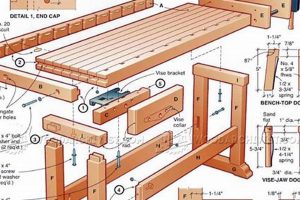
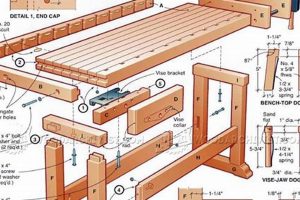
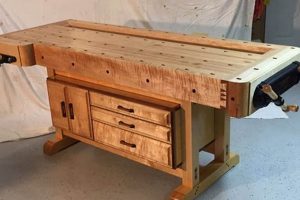
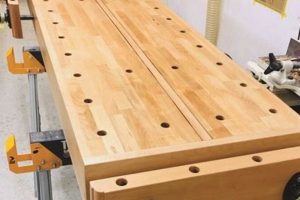
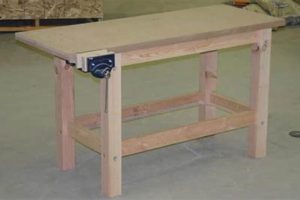
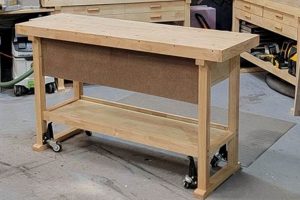
The act of constructing a dedicated surface for woodworking tasks involves assembling various components into a stable and functional platform. This typically entails creating a robust frame, attaching a solid top, and potentially incorporating features such as vises, dog holes, and storage solutions. The final product provides a secure and level area upon which to perform operations such as sawing, planing, chiseling, and joinery.
A well-constructed workspace of this nature significantly enhances the efficiency and precision of woodworking projects. It offers a stable platform that minimizes movement and vibration, leading to improved accuracy in cuts and joinery. Historically, these specialized work surfaces have been essential to the craft of woodworking, evolving over centuries to incorporate design elements that cater to specific techniques and tasks. They provide a central hub for organizing tools and materials, promoting a safer and more productive working environment.
Subsequent sections will detail the essential elements of designing and fabricating such a workspace. It will explore the considerations for material selection, dimensions, construction techniques, and the integration of useful features. This will provide a comprehensive understanding of the process, enabling the creation of a personalized and effective woodworking station.
Essential Considerations for Woodworking Surface Construction
The following recommendations aim to guide the process of constructing a durable and functional woodworking platform, ensuring both precision and longevity.
Tip 1: Material Selection is Paramount: Opt for hardwoods like maple, beech, or birch for the workbench top due to their density and resistance to wear. Softwoods such as pine or fir may be suitable for the base frame, provided they are adequately reinforced.
Tip 2: Prioritize Stability Through Robust Joinery: Employ mortise-and-tenon joints, dovetails, or robust screw connections for the base frame. Weak joinery will compromise the workbench’s ability to resist movement during demanding tasks.
Tip 3: Optimize Dimensions for Ergonomics: Determine the appropriate height for the work surface based on individual stature and typical tasks. A height that minimizes bending or reaching will reduce fatigue and improve working posture.
Tip 4: Incorporate a Substantial Top: A thick and heavy top provides increased stability and reduces vibration. Laminating multiple layers of hardwood or using a solid core door can achieve the desired mass.
Tip 5: Implement a Functional Vise System: Install at least one vise, preferably a face vise, for securing workpieces during sawing, planing, or shaping operations. Consider adding a tail vise for greater versatility.
Tip 6: Integrate Dog Holes Strategically: Drill dog holes along the length and width of the workbench top to accommodate bench dogs, clamps, and other work-holding accessories. Ensure precise alignment of the holes for optimal functionality.
Tip 7: Reinforce the Base with Stretchers: Add stretchers between the legs of the base frame to increase rigidity and prevent racking. Position the stretchers low to the ground to minimize interference with foot traffic.
The adherence to these tips ensures the fabrication of a reliable and efficient woodworking surface. A robust and well-designed platform enhances the precision and safety of woodworking projects.
The next section will address advanced features and customization options for the dedicated woodworking area.
1. Solid work surface

A solid work surface constitutes a fundamental element in woodworking bench construction. The characteristics of this surface directly influence the precision, stability, and safety of tasks performed. The relationship is causal: a more substantial and rigid surface minimizes vibration and deflection, thereby enhancing the accuracy of cuts, joinery, and assembly processes. Conversely, an inadequate work surface may introduce inconsistencies and compromise the integrity of woodworking projects.
The importance of a robust top can be illustrated through examples. Planing operations require a surface that resists movement under the force of the hand plane. A thin or flexible top would absorb energy, making it difficult to achieve a smooth, even surface on the workpiece. Similarly, when using hand tools such as chisels or saws, a solid benchtop provides a stable anchor point, reducing the risk of slippage and improving control. A solid top also adds mass, which helps to dampen vibrations from power tools like routers or sanders, improving their performance and reducing operator fatigue. Workbenches employed in high-volume furniture production settings typically feature thick, laminated hardwood tops to withstand constant use and heavy loads. Furthermore, integration of vise systems is often facilitated by a substantial and sturdy work surface.
In conclusion, understanding the connection between a solid work surface and the overall functionality of a woodworking bench is critical for achieving high-quality results and ensuring safe working practices. The selection of appropriate materials, dimensions, and construction techniques for the workbench top directly impacts the effectiveness of the entire woodworking operation. While constructing a workbench, compromise on the solid work surface element is to risk sacrificing precision and introducing preventable challenges to woodworking projects.
2. Stable base frame

A stable base frame is a non-negotiable requirement in the design and construction of an effective woodworking platform. Its primary function is to provide unwavering support for the work surface, ensuring that the entire structure remains rigid and resistant to movement during woodworking operations. A deficiency in the base frame undermines the utility of the entire bench, regardless of the quality of other components.
- Load-Bearing Capacity and Material Selection
The base frame must possess sufficient load-bearing capacity to accommodate the weight of the workbench top, tools, and workpieces. Consequently, material selection is critical. Dense hardwoods such as maple or oak are frequently employed for their strength and resistance to deflection. The dimensions of the frame members must be calculated to withstand anticipated loads without significant deformation. For instance, a frame constructed of thin, softwood components would likely prove inadequate for heavy-duty tasks, leading to instability and compromised precision.
- Joinery and Structural Integrity
The type of joinery employed in the base frame directly impacts its structural integrity. Mortise-and-tenon joints, dovetails, and robust screw connections are commonly used to create strong, interlocking bonds between the frame members. Weak or poorly executed joinery will result in racking, where the frame distorts under load, compromising the stability of the work surface. An example would be a base frame assembled solely with butt joints and screws, which would likely fail under sustained use.
- Footprint and Ground Contact
The footprint of the base frame, referring to the area it occupies on the floor, influences its stability. A wider footprint generally provides greater resistance to tipping and movement. Additionally, the points of contact between the base frame and the floor must be level and stable. Uneven or inadequate ground contact can introduce wobble and instability, making it difficult to perform precise work. For example, a workbench with one leg shorter than the others would be inherently unstable, requiring shimming or other adjustments to achieve level support.
- Bracing and Reinforcement
Bracing and reinforcement elements, such as stretchers and diagonal supports, are often incorporated into the base frame to further enhance its rigidity. These elements resist racking and prevent the frame from distorting under load. The strategic placement of these supports is crucial for maximizing their effectiveness. A frame without adequate bracing may be prone to flexing, leading to inaccuracies in woodworking operations. Examples of bracing include horizontal stretchers connecting the legs and diagonal braces spanning between corners of the frame.
In summation, a properly engineered and constructed base frame is essential for realizing the full potential of a woodworking surface. Its capacity to bear weight, resist racking, and maintain level support directly influences the precision, safety, and overall efficiency of woodworking tasks. Failure to prioritize the stability of the base frame ultimately undermines the investment in other components of the workbench. The stable base serves not merely as support, but as foundation that allows for intricate and detailed work.
3. Precise joinery

The integration of precise joinery techniques constitutes a cornerstone of successful woodworking bench construction. The strength, stability, and longevity of the finished platform are directly correlated to the accuracy and integrity of the joints connecting its various components. Substandard joinery will invariably compromise the overall performance of the bench, regardless of the quality of materials used.
- Structural Integrity and Load Distribution
Precise joinery ensures efficient load distribution throughout the workbench structure. Well-fitted joints, such as mortise-and-tenon or dovetail joints, maximize the surface area of contact between adjoining pieces, allowing for the uniform transfer of weight and force. This minimizes stress concentrations that could lead to premature failure. For instance, a workbench subjected to heavy planing operations requires joints capable of withstanding significant shear and tensile forces. Sloppy or ill-fitting joints will concentrate these forces at specific points, increasing the likelihood of joint separation or wood fracture.
- Dimensional Stability and Resistance to Movement
Accurate joinery contributes significantly to the dimensional stability of the workbench, minimizing the effects of seasonal humidity changes and preventing unwanted movement. Tight-fitting joints, particularly those employing mechanical interlocking features, resist expansion and contraction, maintaining the overall geometry of the structure. A workbench with poorly executed joinery may experience warping, twisting, or loosening of connections over time, leading to an uneven work surface and reduced stability. This is particularly critical in environments with fluctuating humidity levels.
- Vibration Dampening and Noise Reduction
Precise joinery enhances the vibration dampening properties of the woodworking bench, reducing noise and improving the overall working experience. Tightly fitted joints minimize gaps and voids that can amplify vibrations generated by power tools or hand tools. A workbench with solid, well-connected joints will absorb and dissipate these vibrations more effectively than one with loose or poorly fitted joints. This not only reduces noise levels but also improves the precision and control of woodworking operations, particularly when using delicate or sensitive tools.
- Long-Term Durability and Service Life
The long-term durability and service life of a woodworking bench are directly dependent on the quality of its joinery. Precisely executed joints are inherently more resistant to wear and tear, ensuring that the bench retains its structural integrity and functionality for many years. A workbench constructed with substandard joinery may require frequent repairs or replacements, resulting in increased costs and downtime. Investments in meticulous joinery techniques and high-quality materials ultimately translate into a more durable and cost-effective woodworking platform.
In conclusion, precise joinery is not merely a cosmetic detail but rather a fundamental requirement for constructing a high-performance woodworking bench. Its impact extends to virtually every aspect of the bench’s functionality, from structural integrity and dimensional stability to vibration dampening and long-term durability. A commitment to accurate and robust joinery is essential for creating a reliable and efficient woodworking platform that will provide years of service.
4. Integrated vises

Integrated vises represent a critical element in the design and functionality of a woodworking bench. These clamping devices, permanently affixed to the bench structure, facilitate secure workpiece holding, enabling a wide array of woodworking operations to be performed with precision and safety. The relationship between the vise and the workbench is symbiotic: the vise provides the clamping force, while the bench offers the stable platform necessary to withstand the stresses generated during tasks such as sawing, planing, and joinery.
The absence of an integrated vise system fundamentally limits the utility of the woodworking surface. Consider the task of hand-planing a board. Without a vise to securely hold the workpiece, the board would shift and slide under the pressure of the plane, making it impossible to achieve a smooth, even surface. Similarly, joinery operations, such as cutting dovetails or mortise-and-tenons, demand precise and unwavering clamping. Integrated vises come in various forms, including face vises, leg vises, and tail vises, each designed to accommodate different types of workpieces and clamping orientations. The choice of vise type, and its integration into the bench design, directly impacts the range of tasks that can be effectively performed. High-production woodworking settings often incorporate multiple vise systems to maximize efficiency and versatility. A woodworking bench intended for detailed carving would likely incorporate a smaller vise with greater adjustability to allow precise control over small pieces. The specific needs of the woodworker, therefore, necessitate careful consideration of vise integration during the bench building process.
In conclusion, the incorporation of integrated vises is not merely an optional add-on, but rather a fundamental design consideration when constructing a woodworking bench. The secure clamping provided by vises is essential for performing a wide range of woodworking tasks with accuracy, efficiency, and safety. The selection of appropriate vise types and their seamless integration into the bench structure are critical factors that determine the overall functionality and value of the finished product. The absence of proper vise integration will invariably lead to compromised workmanship and a less effective woodworking platform.
5. Ergonomic height

Ergonomic height is a critical factor in woodworking surface construction, directly influencing user comfort, safety, and efficiency. The correlation between the working surface elevation and the individual’s stature dictates posture, reach, and overall biomechanics. A workbench that is too low forces the user to stoop, leading to back strain and fatigue. Conversely, a surface that is too high necessitates reaching and elevated shoulder posture, causing discomfort in the neck and upper extremities. The consequences of a poorly chosen height manifest as reduced productivity, increased risk of musculoskeletal disorders, and compromised woodworking precision.
The appropriate work surface height is determined by the nature of the tasks to be performed and the individual’s body dimensions. A general guideline suggests that the workbench should be approximately knuckle height when standing, allowing for comfortable planing and other forceful operations. However, this is merely a starting point. For tasks requiring greater precision, such as fine joinery, a slightly higher surface may be preferable. Individuals can further customize the height by wearing shoes with varying heel heights or by utilizing adjustable-height workbenches, which offer maximum flexibility. The impact of ergonomic height on woodworking performance is readily observable in professional workshops. Cabinetmakers, for instance, often employ workbenches optimized for specific tasks, such as assembly or finishing, to minimize strain and maximize efficiency.
Ultimately, the integration of ergonomic principles into woodworking bench design is not merely a matter of comfort but a necessity for ensuring long-term health and productivity. By carefully considering individual needs and task requirements, a work surface height can be selected that promotes proper posture, reduces fatigue, and enhances the overall woodworking experience. Failure to prioritize ergonomics in the construction of a woodworking platform creates an unnecessary physical burden that diminishes both the quality of the work and the well-being of the woodworker.
Frequently Asked Questions
The following addresses common inquiries regarding the design, construction, and functionality of a dedicated woodworking area. Clarity on these topics promotes informed decision-making and ensures a more successful outcome.
Question 1: What is the optimal work surface height?
The optimal height varies based on individual stature and typical tasks. A general recommendation suggests knuckle height while standing. However, fine joinery may benefit from a slightly higher surface. Adjustable-height benches offer maximum flexibility.
Question 2: Is hardwood necessary for the entire construction?
Hardwood is highly recommended for the work surface due to its durability and resistance to wear. Softer woods may be suitable for the base frame, provided they are adequately reinforced to ensure stability.
Question 3: How many vises are typically required?
At least one vise, preferably a face vise, is essential for securing workpieces. The addition of a tail vise or other specialized vises can significantly enhance versatility and clamping options.
Question 4: What type of joinery is most suitable for the base frame?
Mortise-and-tenon joints, dovetails, or robust screw connections are recommended for the base frame. The chosen joinery method should provide sufficient strength and rigidity to resist racking under load.
Question 5: How important are dog holes?
Dog holes, strategically placed across the work surface, greatly enhance work-holding capabilities. They accommodate bench dogs, clamps, and other accessories, enabling secure and versatile clamping configurations.
Question 6: Can an existing table be modified for woodworking?
An existing table can be modified, but careful consideration must be given to its stability and strength. Reinforcements, a thicker top, and the addition of vises may be necessary to transform it into a functional woodworking station.
Understanding these fundamental aspects is paramount for those embarking on a project to build a woodworking bench. Careful planning, material selection, and construction techniques are essential for achieving a safe, efficient, and long-lasting woodworking platform.
The subsequent section will delve into the maintenance and upkeep required to ensure the continued optimal performance of the newly constructed woodworking area.
Conclusion
This exploration has highlighted the essential elements involved in constructing a functional and durable woodworking platform. The key components, including a solid work surface, stable base frame, precise joinery, integrated vises, and ergonomic height, are inextricably linked. Prioritizing these aspects ensures a safe and efficient workspace conducive to accurate and high-quality woodworking. Neglecting any of these core considerations ultimately compromises the overall utility of the platform. The goal of this process is to build a woodworking bench.
The knowledge and application of these principles empower woodworkers to create personalized and optimized working environments. Investing time and resources into careful design and construction yields a valuable asset that enhances both the enjoyment and productivity of woodworking endeavors. Continued adherence to proper maintenance protocols will further ensure the longevity and sustained performance of this essential tool.