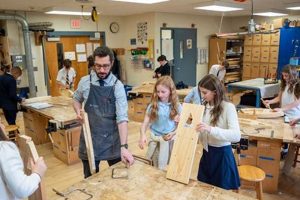
Educational programs designed to introduce young individuals to the fundamental techniques and practices of working with wood are becoming increasingly popular. These structured learning environments provide children with hands-on experience in shaping, joining, and finishing wood materials. Examples of activities within these programs include building simple structures like birdhouses, crafting wooden toys, or creating decorative items such as picture frames.
Participation in such programs offers several developmental advantages. They foster fine motor skills, spatial reasoning, and problem-solving abilities. The sense of accomplishment derived from creating tangible objects enhances self-esteem and encourages creativity. Historically, woodworking skills were often passed down through generations within families, but formalized classes now offer a more accessible and structured approach to learning these skills, ensuring broader participation.
The subsequent sections will delve into the specifics of curriculum design, safety considerations, tool selection, and the long-term impact of introducing woodworking to children at an early age. These aspects are crucial for establishing effective and enriching educational experiences.
Guidance for Introductory Woodcraft Programs
The following recommendations aim to enhance the effectiveness and safety of programs designed to introduce young learners to the craft of woodworking. Implementation of these principles will contribute to a more enriching and secure learning environment.
Tip 1: Prioritize Safety Instruction: Comprehensive safety protocols are paramount. Clearly explain the proper use of tools, emphasize the importance of protective eyewear, and establish firm guidelines for workspace conduct. Regular reinforcement of these protocols is essential.
Tip 2: Begin with Simplified Projects: Initiate instruction with projects that require minimal complexity. Examples include constructing simple boxes, assembling pre-cut kits, or creating basic wooden ornaments. This approach fosters early success and encourages continued engagement.
Tip 3: Utilize Age-Appropriate Tools: Select tools specifically designed for smaller hands and reduced strength. Hand saws, small mallets, and sanding blocks are preferable to power tools for initial instruction. Proper sizing reduces the risk of accidents and increases control.
Tip 4: Emphasize Proper Technique: Demonstrate and supervise correct woodworking techniques. Explain the importance of controlled movements, secure clamping, and accurate measurement. This foundation will prevent errors and promote efficient work habits.
Tip 5: Foster a Supportive Environment: Encourage experimentation and creativity, while maintaining a focus on safety and precision. Provide constructive feedback and celebrate individual achievements. A positive atmosphere enhances learning and promotes confidence.
Tip 6: Ensure Adequate Supervision: Maintain a high ratio of instructors to participants, particularly during tool use. Close supervision allows for immediate intervention in potential safety hazards and provides personalized guidance.
Tip 7: Incorporate Educational Components: Integrate lessons on wood types, tool maintenance, and environmental sustainability. This broadens the educational value of the program and fosters a deeper appreciation for the craft.
These recommendations, when carefully implemented, will contribute to a successful and rewarding introduction to woodworking for young individuals. The focus on safety, simplicity, and supportive instruction will provide a solid foundation for future exploration and skill development.
The final section will address advanced techniques and opportunities for continued learning in the field of woodworking.
1. Safety Protocols in Children's Woodworking Classes

Safety protocols are the cornerstone of any woodworking program designed for children. Their implementation directly impacts the well-being of participants and dictates the viability and ethical standing of the educational initiative.
- Personal Protective Equipment (PPE) Compliance
Mandatory use of PPE, including safety glasses, dust masks, and appropriate attire, is crucial. Safety glasses protect against flying debris, while dust masks mitigate the risks associated with inhaling fine wood particles. Failure to enforce PPE compliance can lead to eye injuries, respiratory problems, and other avoidable health issues. Regular checks and readily available replacements are essential.
- Tool Operation Training and Certification
Comprehensive training on the safe and correct operation of each tool is necessary before allowing children to handle them. This includes demonstrating proper grip, stance, and cutting techniques. Certification or documented competency assessments ensure that each child understands the risks and responsibilities associated with tool use. Restricted access to tools without certification minimizes the potential for accidents.
- Workspace Hazard Mitigation
A well-organized and maintained workspace reduces the risk of trips, falls, and other accidents. This includes clear pathways, adequate lighting, and designated storage areas for tools and materials. Regular inspections to identify and address potential hazards, such as loose cords or slippery surfaces, are vital for maintaining a safe environment. Proper ventilation is also essential to remove dust and fumes.
- Emergency Procedures and Response
Clear and well-rehearsed emergency procedures are essential for responding to accidents or injuries. This includes readily accessible first-aid kits, a documented emergency contact list, and a plan for contacting emergency services. Regular drills and simulations ensure that instructors and participants are prepared to respond effectively in the event of an emergency, minimizing potential harm.
Adherence to rigorous safety protocols in woodworking programs for children is not merely a regulatory requirement; it represents a commitment to their physical and developmental well-being. Effective implementation fosters a secure and positive learning environment, allowing young individuals to explore their creativity and develop valuable skills without undue risk. These measures safeguard against injury and cultivate a respect for tools and materials that extends beyond the classroom.
2. Tool Familiarization

Within the context of children’s woodworking classes, tool familiarization represents a crucial foundational element directly impacting safety, skill development, and project success. The connection is causal: inadequate tool familiarization increases the risk of injury and project failure, while comprehensive familiarization fosters competence and confidence. As a core component, it dictates the scope and complexity of projects achievable by young participants. A child struggling to properly hold a hammer, for instance, is unlikely to successfully build a birdhouse, whereas one who understands the tool’s mechanics can progress with greater ease and safety. Effective instruction integrates demonstrations of correct usage, supervised practice, and reinforcement of safety protocols, embedding foundational knowledge.
Practical applications of tool familiarization extend beyond immediate project completion. For example, teaching a child the difference between a hand saw and a coping saw, and the specific purposes each serves, establishes a basis for informed decision-making in subsequent projects. Understanding the proper care and maintenance of tools also imparts responsibility and an appreciation for craftsmanship. Hands-on experience, coupled with theoretical knowledge, enables children to adapt their techniques and problem-solve when faced with unforeseen challenges during the woodworking process. These skills transfer to other areas of learning and development, enhancing critical thinking and spatial reasoning.
In summary, tool familiarization is inextricably linked to the effectiveness and safety of children’s woodworking classes. Challenges in this area often arise from inadequate instructor training or a lack of sufficient resources, but prioritizing this aspect yields significant benefits. By providing children with a solid understanding of tools and their proper use, these programs can foster creativity, build confidence, and instill a lifelong appreciation for the craft of woodworking. The implications extend beyond the classroom, shaping responsible and capable individuals with valuable practical skills.
3. Project selection

In children’s woodworking classes, project selection functions as a pivotal determinant of engagement, skill acquisition, and safety. The projects chosen dictate the complexity of tasks required, influencing the level of fine motor skills, spatial reasoning, and problem-solving abilities developed. Ill-suited projects, either too simplistic or overly challenging, can lead to boredom, frustration, or, critically, an increased risk of accidents. For example, tasking beginners with intricate dovetail joints before they master basic sawing and joining techniques is a recipe for frustration and potential injury. Conversely, selecting projects that are easily completed within a short timeframe fosters a sense of accomplishment and motivates continued participation. Therefore, a thoughtful, age-appropriate, and skill-calibrated project selection process is essential for maximizing the educational and experiential value of these classes.
Practical applications of strategic project selection are manifold. A curriculum might start with simple projects like assembling pre-cut birdhouse kits, graduating to constructing small wooden toys or picture frames that require precise measurements and cuts. This progression allows instructors to introduce new tools and techniques incrementally, reinforcing previously learned skills while expanding the participants’ woodworking repertoire. Furthermore, integrating educational components into project selection, such as using sustainably sourced wood or exploring different types of wood finishes, enhances the learning experience and promotes responsible practices. Successful implementation requires careful consideration of the children’s age range, prior experience, attention span, and the availability of appropriate tools and materials.
In conclusion, project selection in children’s woodworking classes is not merely a matter of choosing appealing activities; it is a deliberate pedagogical strategy that shapes the learning outcomes and safety profile of the program. Challenges arise in adapting projects to accommodate diverse skill levels and maintaining engagement across varying age groups. However, a commitment to careful planning and thoughtful project design ensures a safe, rewarding, and educational experience for young individuals, fostering creativity, problem-solving skills, and a lifelong appreciation for the craft of woodworking.
4. Skill Progression

In children’s woodworking classes, skill progression serves as a structured framework for the acquisition of woodworking techniques and knowledge. The implementation of a well-defined skill progression directly influences participant engagement, safety, and overall learning outcomes. A logical sequence of learning, starting with basic tool handling and progressing to more complex joinery and finishing techniques, is paramount. For instance, a typical progression might begin with learning to safely hammer nails into softwood, advance to accurate sawing of straight lines, and culminate in constructing simple boxes with glued and nailed joints. The absence of such a structured approach can lead to frustration and increased risk of accidents, as children attempt tasks beyond their current capabilities. Therefore, skill progression is not merely a pedagogical consideration but a safety imperative.
The practical application of skill progression involves the careful selection of projects that align with the learner’s current abilities and provide opportunities for growth. Educators should assess each child’s existing skill level and tailor the curriculum to meet individual needs. This often entails breaking down complex tasks into smaller, more manageable steps. For example, learning to create a dovetail joint, a challenging woodworking technique, might be preceded by exercises focusing on precise marking, sawing to a line, and chisel control. The integration of formative assessments, such as observing tool usage and evaluating project quality, allows instructors to monitor progress and provide targeted feedback. Successful skill progression fosters a sense of accomplishment and motivates children to tackle more challenging projects.
In conclusion, skill progression is an indispensable component of effective children’s woodworking classes. Challenges arise in accommodating diverse learning styles and skill levels within a group setting. However, a commitment to individualized instruction, progressive project selection, and ongoing assessment ensures that children acquire woodworking skills safely and confidently. This structured approach not only fosters creativity and problem-solving abilities but also instills a lifelong appreciation for craftsmanship. The implications extend beyond the classroom, shaping capable and resourceful individuals with valuable practical skills.
5. Material Knowledge

Material knowledge forms a critical cornerstone within children’s woodworking classes. The understanding of wood properties directly influences project feasibility, safety, and the overall learning experience. Lack of material knowledge can lead to project failure, wasted resources, and potentially dangerous situations. For example, attempting to use a hardwood like oak for a beginner’s project that requires intricate cuts can result in frustration and increased risk of injury due to the wood’s density and resistance. Conversely, selecting a softwood like pine or basswood, which are easier to work with, allows children to develop fundamental skills and build confidence. Therefore, the curriculum must incorporate instruction on wood types, grain direction, and appropriate uses to ensure successful outcomes.
Practical application of material knowledge extends beyond mere species identification. Children should learn about the inherent characteristics of different woods, such as hardness, strength, and workability. They can be taught to identify grain patterns and understand how grain direction affects cutting and joining. Furthermore, exposure to sustainable forestry practices and the environmental impact of wood sourcing fosters responsible consumption habits. For example, a lesson could involve comparing the properties of reclaimed wood versus newly harvested wood and discussing the benefits of using sustainably certified lumber. This broader understanding cultivates an appreciation for the material and its origins, enriching the learning experience beyond basic woodworking techniques. Hands-on activities, such as comparing the weight and density of different wood samples or observing how different woods respond to sanding and finishing, reinforce these concepts.
In conclusion, material knowledge is inextricably linked to the success and educational value of children’s woodworking classes. Challenges arise in presenting complex information in an accessible manner and sourcing a diverse range of wood samples for hands-on exploration. However, prioritizing material knowledge fosters a deeper understanding of the craft, enhances safety, and promotes responsible resource management. This fundamental understanding empowers young woodworkers to make informed decisions, appreciate the inherent qualities of the material, and create projects that are both aesthetically pleasing and structurally sound.
6. Creative expression
The integration of creative expression within children’s woodworking classes serves as a catalyst for multifaceted development. These programs, when effectively structured, transcend the mere acquisition of technical skills, providing a platform for young individuals to explore their imagination and translate abstract ideas into tangible forms. The inherent connection between creative thought and practical application in woodworking fosters problem-solving abilities and encourages innovative approaches to design and construction. For instance, a child tasked with building a birdhouse might choose to deviate from a standard template, incorporating unique design elements or functional modifications, thereby engaging in a process of creative problem-solving. This active participation in the design process fosters ownership and enhances the learning experience.
The practical significance of prioritizing creative expression manifests in several ways. Firstly, it enhances engagement and motivation, as children are more likely to invest time and effort into projects they feel personally connected to. Secondly, it fosters a sense of accomplishment and self-efficacy, as children witness their creative visions materialize into tangible objects. Thirdly, it encourages experimentation and risk-taking, as children are given the freedom to explore different design options and construction techniques without fear of failure. Fourthly, it cultivates critical thinking and problem-solving skills, as children are challenged to overcome design constraints and adapt their plans to accommodate unforeseen challenges. The ability to translate abstract ideas into concrete forms is a valuable skill that extends far beyond the woodworking classroom, applicable to various aspects of life and future careers. The inclusion of design challenges, where children are presented with specific constraints (e.g., limited materials, specific functional requirements) further stimulates creative problem-solving abilities.
In conclusion, creative expression is not merely an ancillary component of children’s woodworking classes but an integral element that drives engagement, fosters skill development, and promotes holistic learning. While challenges exist in balancing structured instruction with open-ended exploration and accommodating diverse creative aptitudes, prioritizing creative expression ensures a more enriching and impactful educational experience. This emphasis empowers young individuals to develop their unique talents, cultivate critical thinking skills, and appreciate the transformative power of combining creativity with technical proficiency, resulting in tangible and lasting achievements.
7. Supervision ratio

In the context of children’s woodworking classes, the supervision ratio, defined as the number of instructors or adult supervisors relative to the number of participating children, is a critical factor influencing safety, educational effectiveness, and overall program quality. An appropriately determined ratio mitigates risks inherent in tool use and ensures adequate individualized attention, thereby maximizing learning potential.
- Mitigation of Physical Risks
A low supervision ratio increases the potential for accidents involving tools. The dynamic environment of a woodworking class necessitates vigilant oversight to prevent misuse of tools and ensure adherence to safety protocols. A sufficient number of supervisors allows for immediate intervention in potentially hazardous situations, minimizing the risk of cuts, abrasions, or other injuries. For instance, an instructor can quickly correct improper tool handling or prevent a child from using a tool inappropriately.
- Facilitation of Individualized Instruction
An adequate supervision ratio enables instructors to provide tailored guidance to each child. Woodworking involves a range of skills, and children progress at varying rates. A lower ratio allows instructors to identify and address individual learning needs, offering personalized instruction and support. This individualized attention ensures that each child grasps fundamental concepts and develops proficiency in woodworking techniques. For example, an instructor can provide one-on-one assistance to a child struggling with accurate measurement or sawing.
- Promotion of a Positive Learning Environment
A well-staffed woodworking class fosters a more positive and supportive learning environment. With a sufficient number of supervisors, children are more likely to receive encouragement, constructive feedback, and assistance when needed. This creates a sense of safety and confidence, encouraging exploration and experimentation. Conversely, an understaffed class can lead to increased anxiety, frustration, and a reluctance to participate actively.
- Compliance with Regulatory Standards
Many jurisdictions have specific regulations or guidelines regarding supervision ratios in children’s activities, including woodworking classes. Adhering to these standards is essential for legal compliance and demonstrates a commitment to child safety. Failure to comply with these regulations can result in penalties or the closure of the program. These guidelines often specify a minimum number of supervisors required based on the age of the children and the complexity of the activities.
These facets underscore the integral role of supervision ratio in ensuring the safety and effectiveness of children’s woodworking classes. A carefully considered and implemented ratio is not merely a logistical consideration, but a fundamental element contributing to a positive and enriching learning experience. Prioritizing an appropriate supervision ratio is essential for fostering a safe, supportive, and stimulating environment where young individuals can develop valuable skills and cultivate a lifelong appreciation for the craft of woodworking.
Frequently Asked Questions Regarding Children’s Woodworking Classes
The following section addresses common inquiries and concerns pertaining to children’s woodworking classes. The information is intended to provide clarity and promote informed decision-making regarding participation in such programs.
Question 1: At what age is a child deemed suitable to participate in woodworking classes?
Suitability is determined by a combination of factors, including fine motor skill development, attention span, and the ability to follow instructions. Typically, children aged seven and older are considered appropriate candidates, assuming they possess the requisite dexterity and cognitive capabilities.
Question 2: What are the primary safety considerations within these classes?
Safety is paramount. Classes incorporate rigorous protocols, including mandatory use of personal protective equipment (PPE) such as safety glasses and dust masks, comprehensive tool instruction, and a low student-to-instructor ratio to ensure close supervision. Regular reinforcement of safety procedures is also essential.
Question 3: Are specialized tools required, or are readily available household tools sufficient?
Specialized, age-appropriate tools are generally required to ensure safety and effectiveness. These tools are designed with smaller hands and reduced strength in mind. Household tools may not be suitable and could pose a safety risk if used improperly by children.
Question 4: What types of projects are typically undertaken in introductory woodworking classes?
Introductory projects are deliberately simple and achievable, designed to foster early success and build confidence. Examples include constructing basic boxes, assembling pre-cut kits (e.g., birdhouses), and creating simple wooden ornaments or toys.
Question 5: What are the long-term developmental benefits of children participating in woodworking classes?
Participation offers numerous benefits, including enhanced fine motor skills, spatial reasoning abilities, problem-solving skills, and creativity. The sense of accomplishment derived from creating tangible objects also boosts self-esteem and promotes a deeper appreciation for craftsmanship.
Question 6: What qualifications and certifications should instructors possess?
Instructors should possess a combination of woodworking expertise, experience working with children, and formal training in safety protocols. Certifications in first aid and CPR are also highly desirable. A thorough background check is essential to ensure the safety and well-being of the participants.
In summary, children’s woodworking classes offer valuable learning opportunities, contingent upon prioritizing safety, employing skilled instructors, and utilizing age-appropriate tools and projects. Careful consideration of these factors will contribute to a positive and enriching experience.
The subsequent sections will delve into advanced woodworking techniques and opportunities for continued learning in this domain.
Conclusion
The preceding exploration of children’s woodworking classes has underscored the multifaceted benefits and critical considerations associated with these programs. Key points have included the paramount importance of safety protocols, the need for age-appropriate tool selection and project design, the value of structured skill progression, the significance of material knowledge, the role of creative expression, and the necessity of maintaining an appropriate supervision ratio. These elements, when effectively integrated, contribute to a safe, engaging, and educational experience for young participants.
The enduring impact of providing children with access to woodworking education extends beyond the immediate acquisition of practical skills. It fosters critical thinking, problem-solving abilities, and an appreciation for craftsmanship, qualities that can benefit individuals throughout their lives. Investment in such programs represents an investment in the development of well-rounded, capable individuals who are prepared to contribute meaningfully to society. Continued research and refinement of pedagogical approaches within children’s woodworking classes are essential to maximize their potential and ensure their long-term sustainability.


![Learn Woodworking: Classes in Fort Collins [Skills!] | Step-by-Step Guides, Tools & Inspiration to Build Beautiful Wooden Decor on a Budget](https://woodfromhome.com/wp-content/uploads/2026/04/th-267-300x200.jpg "Learn Woodworking: Classes in Fort Collins [Skills!] Step-by-Step Guides, Tools & Inspiration to Build Beautiful Wooden Decor on a Budget")