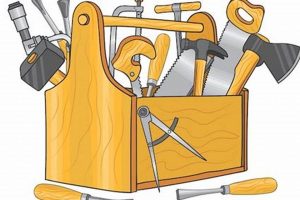
An enumeration of fundamental implements employed in shaping and joining wood constitutes an essential foundation for any woodworking endeavor. This compilation typically encompasses hand tools, such as saws, chisels, planes, and measuring devices, alongside power tools including drills, sanders, and routers. For instance, a beginner’s setup might include a crosscut saw for making perpendicular cuts, a smoothing plane for refining surfaces, and a combination square for accurate measurements.
The significance of possessing a core set of implements lies in their capacity to facilitate precision, efficiency, and safety in woodworking projects. Historically, skilled artisans relied solely on hand-operated versions of these tools, achieving remarkable feats of craftsmanship. Modern iterations, often powered by electricity, enhance productivity while maintaining the core principles of wood manipulation. The ability to select and properly utilize these implements is paramount for achieving desired outcomes and ensuring personal well-being within a woodworking environment.
The subsequent sections will provide a detailed breakdown of essential hand tools, offering guidance on their specific applications and proper maintenance. Furthermore, it will explore the role of power tools in expediting various woodworking tasks, emphasizing safety protocols and operational best practices. This comprehensive overview aims to equip readers with a solid understanding of the resources required for successful and fulfilling engagement with woodworking.
Guidance for Acquiring Fundamental Woodworking Implements
Effective selection and utilization of foundational woodworking implements are crucial for project success and safety. The following recommendations provide a framework for individuals embarking on woodworking endeavors.
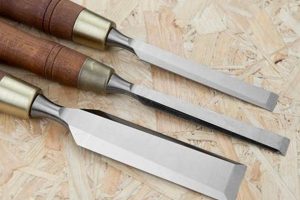
Tip 1: Prioritize Essential Hand Tools: Begin with a high-quality hand saw (rip and crosscut), a set of chisels (various sizes), a smoothing plane, and measuring tools (combination square, tape measure). These form the bedrock of woodworking operations.
Tip 2: Invest in Accurate Measuring Devices: Precise measurements are paramount. Acquire a reliable combination square, measuring tape, and marking gauge to ensure dimensional accuracy in all projects.
Tip 3: Sharpening is Non-Negotiable: Dull blades are dangerous and inefficient. Learn to sharpen chisels and plane irons properly. A sharpening stone and honing guide are essential investments.
Tip 4: Understand Wood Grain: Familiarize yourself with different wood types and their grain patterns. This knowledge informs tool selection and cutting strategies to avoid tear-out and ensure clean results.
Tip 5: Safety Equipment is Mandatory: Always wear safety glasses and hearing protection. Consider a dust mask or respirator to protect against wood dust inhalation.
Tip 6: Research Before Purchasing Power Tools: If incorporating power tools, research models thoroughly and prioritize safety features. Start with a drill and circular saw, expanding as needed.
Tip 7: Maintenance Extends Lifespan: Regularly clean and maintain implements. Wipe down blades with oil to prevent rust, and store tools properly to protect them from damage.
Adhering to these guidelines ensures a safer, more efficient, and ultimately more rewarding woodworking experience. A well-curated selection of quality implements, coupled with proper knowledge and technique, lays the groundwork for successful craftsmanship.
The subsequent sections will explore specific techniques for tool usage and project planning, further enhancing the reader’s woodworking proficiency.
1. Essential hand tools

The designation “Essential hand tools” represents a subset within a comprehensive inventory. These tools are fundamental for performing core woodworking tasks independent of mechanized assistance. Their proficiency is a cornerstone of woodworking skill.
- Sawing and Shaping
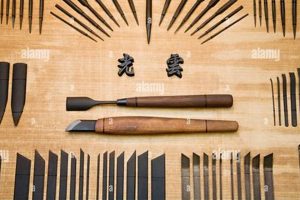
Saws, particularly hand saws such as rip saws and crosscut saws, are indispensable for dividing wood. Chisels enable shaping, paring, and joinery. The selection of saws and chisels must align with the types of wood being worked and the nature of the intended cuts. An improperly selected or maintained saw can result in inaccurate cuts and material waste.
- Planing and Smoothing
Hand planes, including smoothing planes and jack planes, refine wood surfaces, ensuring flatness and smoothness. Planing achieves dimensional accuracy and prepares surfaces for finishing. Understanding plane setup, blade angle, and grain direction is crucial for avoiding tear-out and achieving desired surface quality.
- Measuring and Marking
Accurate measurements are critical for project success. Essential measuring tools include a combination square, a measuring tape, and marking gauges. These instruments ensure precise dimensions and consistent layouts. Errors in measurement compound throughout a project, leading to misalignment and structural instability.
- Fastening and Joinery
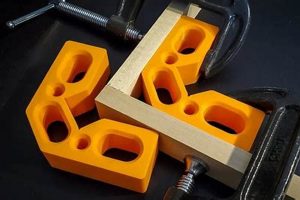
While not directly shaping tools, hand-operated fastening tools, such as hand drills and screwdrivers, are essential for assembling wood components. Secure and properly aligned fasteners are crucial for structural integrity. The type of fastener (screws, nails, dowels) must be chosen based on the load-bearing requirements and aesthetic considerations of the project.
The skillful use of “Essential hand tools” is a prerequisite for any aspiring woodworker. These implements empower the craftsman to execute precise and controlled operations, fostering a deeper understanding of the material and the craft. Their significance extends beyond mere functionality; they embody the fundamental principles of woodworking.
2. Power tool additions

The integration of powered implements into a fundamental inventory represents a strategic expansion, augmenting the capabilities afforded by manually operated instruments. The incorporation of such additions necessitates a comprehensive understanding of their functionalities, limitations, and the inherent safety considerations.
- Efficiency Enhancement
Powered machinery facilitates expedited material removal and processing, thereby increasing overall efficiency in project completion. Examples include the use of electric planers for rapid stock flattening, orbital sanders for accelerated surface preparation, and routers for intricate edge detailing. The selection of appropriate powered tools hinges on the scale and nature of the intended woodworking endeavors.
- Precision Amplification
Certain power tools, such as table saws and miter saws, enable enhanced precision in cutting operations, particularly for repetitive tasks or intricate angles. These tools offer controlled environments and calibrated settings, mitigating the potential for human error. The calibration and maintenance of these devices are paramount to ensuring sustained accuracy.
- Ergonomic Considerations
The utilization of power tools can reduce physical strain, particularly in tasks requiring significant force or repetition. Ergonomic designs and safety features, such as vibration dampening and dust collection, further minimize occupational hazards. It remains essential to employ proper techniques and adhere to safety protocols to prevent injuries.
- Material Versatility
The addition of power tools broadens the spectrum of materials that can be effectively processed. Examples include the use of band saws for shaping complex curves in hardwoods or the application of plunge routers for creating intricate inlays. The selection of appropriate blades and cutters is critical for optimal performance and material compatibility.
The judicious integration of powered implements into an inventory of foundational tools signifies a transition from manual methods to mechanized processes. This transition necessitates a concomitant emphasis on safety, maintenance, and operational proficiency. While power tools enhance efficiency and precision, their effectiveness remains contingent upon a foundational understanding of woodworking principles and practices.
3. Measurement accuracy

Measurement accuracy forms a critical nexus within the realm of woodworking, exerting direct influence on the utility and effectiveness of foundational implements. Inaccurate measurements negate the benefits of even the most sophisticated tools. The selection of tools designed for precise measurement is, therefore, paramount in establishing a well-equipped workshop. For example, the use of a calibrated combination square ensures right angles in joinery, while a precise measuring tape guarantees accurate material dimensions, impacting structural integrity. A lack of accuracy, conversely, can result in misaligned joints, unstable structures, and overall project failure. Therefore, implements like rulers, squares, and levels are inseparable from a standard set of woodworking tools.
The interdependence of accurate measurement and suitable tools extends to various phases of woodworking. During initial layout, precision instruments guide the marking and cutting processes, minimizing material waste and rework. Accurate measurements are equally crucial in joinery, where tight-fitting joints contribute to strength and aesthetic appeal. Real-world examples abound: constructing a cabinet requires meticulous measurements to ensure doors and drawers align correctly; building a table necessitates precise leg positioning for stability; and crafting a dovetail joint demands accurate marking to achieve a seamless fit. The effective use of basic woodworking tools is, thus, predicated on the ability to obtain and apply precise measurements.
The pursuit of measurement accuracy in woodworking is not without challenges. Environmental factors like temperature and humidity can affect material dimensions, necessitating adjustments to compensate for expansion or contraction. Furthermore, parallax error when reading scales and the inherent limitations of measuring devices introduce potential inaccuracies. Despite these challenges, a commitment to precise measurement, coupled with the selection and skillful application of appropriate tools, is essential for achieving high-quality woodworking outcomes. This principle underscores the understanding and importance of measurement as an element for compiling a list of basic woodworking tools.
4. Sharpening proficiency

Sharpening proficiency is intrinsically linked to the effectiveness and safety of a foundational set of woodworking implements. The inherent design of edge tools, such as chisels, planes, and certain types of saws, necessitates periodic sharpening to maintain optimal cutting performance. A dull tool not only compromises the quality of the work but also elevates the risk of injury due to increased force requirements and reduced control.
- Edge Tool Performance
A sharp edge facilitates clean and precise cuts, minimizing tear-out and ensuring dimensional accuracy. Conversely, a dull edge requires excessive force, leading to ragged cuts and potential slippage. For instance, a properly sharpened chisel will pare thin shavings with minimal effort, whereas a dull chisel will crush the wood fibers, resulting in an uneven surface. The quality of joinery is directly dependent on the sharpness of the tools used to create it.
- Safety Considerations
Dull tools are inherently more dangerous than sharp ones. When a cutting edge is not properly honed, greater force must be applied to achieve the desired result. This increased force can lead to loss of control, causing the tool to slip and potentially injure the user. A sharp tool, in contrast, requires less force and provides greater control, reducing the likelihood of accidents. Adherence to proper sharpening techniques is, therefore, an essential component of woodworking safety.
- Tool Longevity
Consistent and proper sharpening practices contribute to the extended lifespan of edge tools. Regular honing prevents the edge from becoming excessively damaged, reducing the amount of material that must be removed during subsequent sharpenings. Furthermore, proper sharpening techniques minimize the risk of damaging the temper of the steel, which can weaken the blade and render it unusable. Investing in sharpening equipment and developing the necessary skills is a long-term investment in the durability of the woodworking tools.
- Cost-Effectiveness
Maintaining a sharp edge on woodworking tools reduces the need for frequent replacements. Sharpening is a relatively inexpensive process compared to purchasing new tools. Furthermore, sharp tools perform more efficiently, reducing the amount of time and effort required to complete a project. Therefore, sharpening proficiency is not only a safety and quality imperative but also a sound economic decision.
Sharpening proficiency is an indispensable skill for any woodworker. It is not merely a supplementary technique but rather an integral part of the overall woodworking process. Without sharp tools, even the most skilled craftsman will struggle to produce high-quality work safely and efficiently. Therefore, the ability to properly sharpen and maintain edge tools is a fundamental requirement for anyone assembling a “list of basic woodworking tools.”
5. Material compatibility

Material compatibility represents a crucial determinant in the effective utilization of woodworking implements. The inherent properties of various wood species, including density, grain structure, and resin content, necessitate the selection of tools specifically suited for their manipulation. A failure to consider these factors can result in compromised tool performance, diminished workpiece quality, and potential safety hazards.
- Tool Selection and Wood Density
The density of a wood species directly influences the choice of cutting tools. Hardwoods, such as maple or oak, demand tools with hardened steel blades and robust construction to withstand the increased resistance. Conversely, softer woods, like pine or cedar, may be effectively worked with tools of lighter construction. Attempting to use a lightweight tool on a dense hardwood can result in tool failure or inaccurate cuts, while employing an excessively heavy tool on softwood can damage the material. For example, a fine-toothed saw designed for hardwoods would be appropriate, while for softwoods, a coarser saw would be preferable.
- Grain Orientation and Cutting Performance
The grain orientation of a wood specimen dictates the optimal cutting strategy. Cutting against the grain can lead to tear-out, resulting in a rough or splintered surface. Understanding grain direction is essential for selecting the appropriate tool and employing proper cutting techniques. For instance, a low-angle block plane is often used for smoothing end grain, while a standard plane is more suitable for working with the grain. Ignoring grain orientation increases the risk of creating defects, undermining the aesthetic and structural integrity of the finished product.
- Resin Content and Tool Maintenance
The resin content of certain wood species, particularly softwoods like pine and fir, can impact tool performance and necessitate more frequent maintenance. Resin can accumulate on cutting edges, reducing their effectiveness and increasing friction. Regular cleaning and lubrication are essential to prevent resin buildup and maintain optimal tool performance. Neglecting to address resin accumulation can lead to overheating, blade dulling, and increased risk of kickback on power tools.
- Abrasiveness and Tool Wear
Some wood species contain abrasive minerals, such as silica, which accelerate tool wear. Tropical hardwoods, like teak and ipe, are known for their abrasive properties. When working with these materials, tools with carbide-tipped blades are often preferred due to their increased resistance to wear. Failing to account for abrasiveness can lead to rapid tool dulling, necessitating frequent sharpening or replacement, thus impacting project efficiency and cost.
The preceding considerations highlight the critical link between material compatibility and tool selection in woodworking. The performance of any item from a “list of basic woodworking tools” is influenced by the characteristics of the wood being worked. A comprehensive understanding of wood properties and their implications for tool usage is essential for achieving high-quality results, ensuring safety, and maximizing tool longevity. Therefore, the list of basic woodworking tools should also include accessories and materials to maintain the tools and address the varying nature of wood.
Frequently Asked Questions About Core Woodworking Implements
This section addresses common inquiries concerning foundational instruments essential for successful woodworking endeavors. These questions aim to clarify misunderstandings and provide concise guidance on tool selection, usage, and maintenance.
Question 1: What constitutes the minimum number of implements for basic woodworking?
A foundational selection commonly includes a crosscut saw, a rip saw, a smoothing plane, a chisel set, a combination square, a measuring tape, and a marking gauge. This ensemble facilitates fundamental operations such as cutting, shaping, smoothing, and measuring.
Question 2: Is it more advantageous to acquire individual tools or a pre-packaged implement set?
Purchasing individual tools allows for selective acquisition of higher-quality implements tailored to specific needs. Pre-packaged sets often offer a more economical entry point but may compromise on the quality of certain items.
Question 3: How frequently should implements be sharpened to maintain optimal performance?
The frequency of sharpening depends on the type of wood being worked and the intensity of use. As a general guideline, implements should be sharpened whenever the cutting edge exhibits a noticeable decline in performance or produces ragged cuts.
Question 4: What safety precautions should be observed when utilizing both hand and power implements?
Essential safety measures include wearing appropriate eye and ear protection, securing workpieces firmly, maintaining a stable stance, and adhering to manufacturer-recommended operating procedures. Power implements should always be disconnected from the power source during maintenance or blade changes.
Question 5: How does the selection of implements vary based on project complexity and scale?
More intricate projects often necessitate specialized implements, such as dovetail saws, carving tools, or routers. Larger-scale projects may benefit from the increased efficiency of power implements, such as table saws or jointers.
Question 6: What are the recommended storage practices for woodworking implements to prevent damage and corrosion?
Implements should be stored in a dry environment, away from direct sunlight and extreme temperature fluctuations. Metal surfaces should be lightly oiled to prevent rust. Edge tools should be protected with sheaths or covers to prevent accidental damage to the cutting edge.
The principles outlined above provide a concise overview of crucial considerations regarding core woodworking implements. Adhering to these guidelines contributes to safe, efficient, and successful woodworking outcomes.
The succeeding sections delve into advanced woodworking techniques and project planning strategies, further enhancing proficiency in this craft.
Conclusion
The preceding discussion has elucidated the composition, significance, and proper utilization of a core woodworking inventory. Emphasis has been placed on both manually operated and powered implements, underscoring the importance of precision measurement, sharpening proficiency, and material compatibility. The effective combination of these elements ensures safety, efficiency, and high-quality results in woodworking projects.
The mastery of “list of basic woodworking tools” provides a solid foundation for woodworking skill. Further study and experimentation with different techniques allow for continuous refinement. Woodworkers with a deep knowledge of fundamental instruments and methods will likely achieve advanced projects with skill and efficiency.