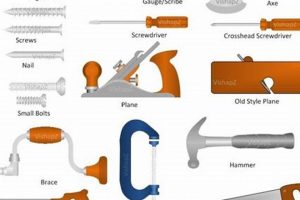
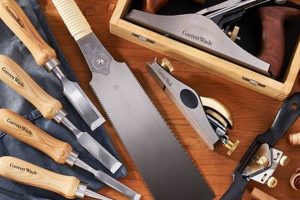
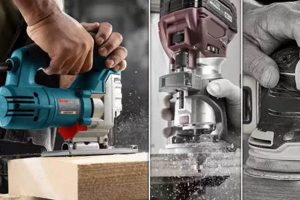
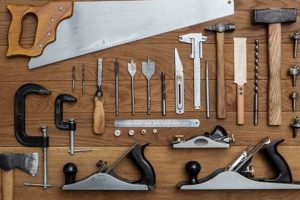
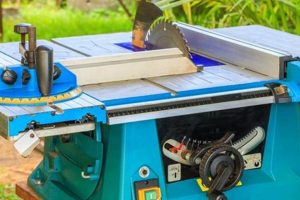
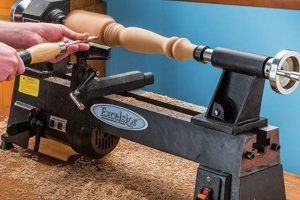
Essential implements employed for shaping, cutting, joining, and finishing wood define the practice of woodworking. These instruments, ranging from hand-operated devices to sophisticated power machinery, enable the manipulation of timber into functional or decorative objects. A hand saw, for example, represents a fundamental tool for cutting wood manually, while a power drill facilitates the creation of precise holes.
The proper selection and application of these devices directly influence the efficiency, precision, and overall quality of woodworking projects. Historically, advancements in metallurgy and engineering have resulted in improved tool designs, contributing to enhanced craftsmanship and enabling more complex construction techniques. Mastery of these instruments is critical for achieving desired outcomes and ensures structural integrity.
The following sections will explore the specific categories of instruments involved, including those for measurement and marking, cutting, shaping, joining, and finishing, providing a detailed overview of their function and application within the woodworking process.
Essential Guidelines for Instrument Selection and Usage
Optimal results in woodworking depend not only on skill but also on the appropriate selection and responsible usage of instruments. The following guidelines offer insights into maximizing efficiency and safety.
Tip 1: Prioritize Quality: Investing in high-quality devices, although initially more expensive, ensures durability, precision, and longevity, ultimately providing better value. For example, a precision-engineered hand plane will maintain its edge and accuracy far longer than a cheaper alternative.
Tip 2: Maintain Sharpness: Sharp cutting edges are essential for safety and efficient material removal. Regular sharpening of chisels, planes, and saw blades is crucial. Dull blades require more force, increasing the risk of accidents and producing inferior cuts.
Tip 3: Utilize Appropriate Safety Equipment: Eye protection, hearing protection, and respiratory masks are indispensable when operating power machinery or working with finishes. Consistent use of such equipment minimizes the risk of injury and exposure to hazardous materials.
Tip 4: Understand Material Properties: Different wood species exhibit varying densities and grain structures. Selecting the appropriate instrument for the specific wood being worked ensures clean cuts and prevents damage. For instance, a fine-toothed saw is preferable for hardwoods to minimize tear-out.
Tip 5: Proper Adjustment and Calibration: Power machinery, such as table saws and jointers, must be accurately adjusted and calibrated before each use. Precise settings guarantee accurate cuts and safe operation. Regularly check fence alignment and blade parallelism.
Tip 6: Employ Secure Work Holding: Workpieces must be securely clamped or held in place during cutting, shaping, and joining operations. Proper work holding prevents movement, ensuring accurate results and minimizing the risk of injury. Bench vises and clamps are essential for this purpose.
Tip 7: Select Task-Specific Instruments: Using the correct device for a specific task optimizes efficiency and precision. A mortise chisel, for instance, is designed specifically for cutting mortises, while a smoothing plane is designed for achieving a flawless surface finish.
Adherence to these guidelines ensures safer and more effective woodworking practices, ultimately leading to improved project outcomes and enhanced craftsmanship. Proper handling and maintenance extend the lifespan of implements, representing a responsible and cost-effective approach to the craft.
The subsequent section will discuss specific types of power machinery often employed in woodworking, focusing on their respective functionalities and safety considerations.
1. Measurement accuracy

Measurement accuracy constitutes a foundational element in woodworking, directly influencing the outcome of any project. The dimensional precision achieved through the correct application of measuring instruments impacts the fit and function of individual components within an assembly. Inaccurate measurements invariably lead to misaligned joints, structural instability, and a compromised final product. For example, a cabinet constructed with inaccurate dimensions will exhibit uneven gaps between doors and drawers, ultimately diminishing its aesthetic appeal and functional utility. The relationship between precise measurements and successful woodworking is causal; deviations from specified dimensions cascade through the entire construction process, amplifying errors and necessitating corrective actions.
The range of instruments employed to ensure measurement accuracy encompasses both manual and digital options, each possessing inherent advantages and limitations. Measuring tapes, rulers, squares, and protractors serve as primary tools for linear measurement and angle determination. Digital calipers and laser distance measurers offer increased precision and efficiency, particularly when dealing with complex geometries or large-scale projects. Regardless of the instrument used, proper calibration and consistent application are critical to achieving reliable results. A poorly calibrated instrument, even a digital one, will provide inaccurate readings, negating any potential benefits derived from its use.
In summary, measurement accuracy is not merely a desirable attribute but a prerequisite for successful woodworking. The correct selection, calibration, and consistent application of measuring instruments are paramount. The implications of inaccurate measurements extend beyond aesthetics, impacting structural integrity and overall functionality. Therefore, a thorough understanding of measurement principles and meticulous execution are essential skills for any woodworker striving to produce high-quality work.
2. Cutting Efficiency

Cutting efficiency in woodworking refers to the ratio of material removed to the time and energy expended, directly influenced by the type, condition, and application of instruments utilized. Optimizing this efficiency reduces project time, minimizes material waste, and enhances overall productivity.
- Blade Geometry and Material
The geometric configuration of a saw blade, including tooth pitch, rake angle, and gullet depth, profoundly impacts its cutting performance. Blades designed for ripping (cutting along the grain) typically feature larger teeth with aggressive rake angles for efficient material removal. Blades intended for crosscutting (cutting against the grain) possess finer teeth with minimal rake to produce cleaner cuts. Furthermore, the material composition of the blade, such as high-speed steel or carbide-tipped teeth, dictates its durability and ability to maintain sharpness over extended use. For example, a carbide-tipped blade will maintain a sharper cutting edge for a longer duration than a high-speed steel blade, resulting in sustained cutting efficiency when processing abrasive materials.
- Power Tool Horsepower and RPM
For power saws, horsepower and RPM (revolutions per minute) directly influence the instrument’s capacity to efficiently sever wood. Higher horsepower enables the saw to maintain consistent blade speed even under load, preventing stalling and reducing the risk of kickback. Optimal RPM ensures the blade operates at the correct cutting speed, maximizing material removal while minimizing friction and heat buildup. An underpowered saw will struggle to cut through dense hardwoods, resulting in slow progress, excessive heat, and potential damage to the motor. A table saw with sufficient horsepower, combined with appropriate RPM, significantly increases cutting efficiency when processing large volumes of lumber.
- Sharpness and Maintenance
The sharpness of the cutting edge is paramount to cutting efficiency. A dull saw blade or chisel requires significantly more force to remove material, leading to slower progress, increased physical exertion, and a greater risk of injury. Regular sharpening and maintenance of tools are crucial for sustaining optimal cutting performance. A dull chisel, for instance, will crush wood fibers rather than cleanly severing them, resulting in ragged edges and a compromised finish. Conversely, a properly sharpened chisel will effortlessly slice through the wood, leaving a smooth, clean surface. A consistent maintenance regimen, including cleaning and lubrication, extends the lifespan of implements and preserves their cutting efficiency.
- Feed Rate and Technique
The rate at which the workpiece is advanced into the cutting instrument, along with the operator’s technique, impacts efficiency. Applying excessive force can overload the tool, leading to stalling, binding, and potential damage. Conversely, feeding the material too slowly can result in burning and inefficient material removal. A consistent and controlled feed rate, combined with proper body positioning and tool handling, optimizes cutting performance. For example, when using a hand saw, applying steady pressure and maintaining a consistent cutting angle maximizes the saw’s efficiency while minimizing fatigue.
The interplay between blade geometry, power tool specifications, sharpness, and operator technique underscores the multifaceted nature of cutting efficiency. Implementing strategies to optimize these aspects, such as selecting appropriate implements, maintaining sharp cutting edges, and employing proper techniques, will improve productivity and reduce waste in woodworking projects.
3. Shaping precision
Shaping precision, in the context of woodworking, denotes the degree of accuracy and control achievable in altering the form and dimensions of wood. It is intrinsically linked to the selection and skillful application of implements. Deviations from intended shapes or dimensions compromise the structural integrity and aesthetic quality of the final product. Attaining the desired shape requires a comprehensive understanding of tool characteristics and material properties.
- Chisel Selection and Application
Chisels, available in various sizes and bevel angles, permit the controlled removal of wood to create precise shapes and joinery elements. The selection of an appropriate chisel, coupled with proper sharpening and handling techniques, is crucial for achieving shaping precision. For example, a paring chisel, characterized by its long, thin blade, allows for the precise trimming of mortise and tenon joints, ensuring a tight, gap-free fit. Inadequate sharpness or incorrect application can lead to splintering and inaccurate shaping.
- Plane Adjustment and Manipulation
Hand planes serve to refine surfaces and create specific shapes. Achieving shaping precision with a plane necessitates careful blade adjustment and a consistent stroke. The depth of cut, determined by the blade projection, and the lateral alignment of the blade directly impact the flatness and smoothness of the planed surface. For instance, a smoothing plane, finely adjusted, can remove minute imperfections, creating a flawless surface ready for finishing. Improper plane setup or technique results in uneven surfaces and tear-out.
- Router Bit Profiles and Control
Routers, equipped with various bit profiles, enable the creation of intricate shapes and decorative edges. Shaping precision with a router demands careful selection of the appropriate bit, precise depth setting, and controlled movement along the workpiece. A roundover bit, for example, produces a rounded edge, enhancing both aesthetics and safety. Uncontrolled router movement or an incorrect bit selection can lead to irreversible damage to the workpiece.
- Spindle and Belt Sander Techniques
Spindle and belt sanders facilitate the refinement of curved shapes and the removal of imperfections. Achieving shaping precision with these instruments requires the use of appropriate grit sandpaper and consistent pressure. The rotational or linear motion of the abrasive material gradually shapes the wood to the desired form. Over-sanding or using excessively coarse grit can result in unwanted alterations to the intended shape.
The attainment of shaping precision in woodworking is contingent upon a holistic approach encompassing implement selection, meticulous adjustment, proper technique, and a thorough understanding of material properties. The skillful application of these instruments enables the transformation of raw wood into functional and aesthetically pleasing forms. The relationship between the instruments utilized and the level of shaping precision achieved is direct and undeniable.
4. Joining strength

The integrity of any wooden structure or object is contingent upon the strength of its joinery. Implements selected for creating connections between wood components directly dictate the durability and longevity of the assembled piece. The efficiency and reliability of these joining mechanisms depend entirely on the correct implementation of suitable devices.
- Mortise and Tenon Joint Precision
The mortise and tenon joint, a foundational woodworking technique, relies on the precise creation of a mortise (hole) and a tenon (protruding tongue). Chisels, mortisers, and tenon saws are essential for achieving the tight fit necessary for optimal strength. Accurate dimensions and clean cuts ensure maximum surface area contact, distributing stress and preventing joint failure. An ill-fitting mortise and tenon joint, caused by imprecise use of these implements, compromises the entire structure, leading to instability and potential collapse under load. This weakness compromises structural integrity.
- Dovetail Joint Interlock Integrity
Dovetail joints, renowned for their exceptional tensile strength, feature interlocking pins and tails that resist pulling forces. Saws, chisels, and marking gauges are critical for crafting precise dovetails. The tightness and accuracy of the interlock determine the joint’s resistance to separation. Poorly executed dovetails, resulting from inaccurate cuts and measurements, reduce the surface area of the glue bond and diminish the mechanical interlock, thereby severely reducing joint strength and long-term reliability.
- Screw and Fastener Application Effectiveness
Screws and other fasteners provide mechanical reinforcement for wood joints. Drills, screwdrivers, and impact drivers are necessary for installing these fasteners securely. Proper pilot hole sizing and torque control prevent wood splitting and ensure maximum holding power. Over-tightening or misaligned screws, caused by incorrect pilot holes or improper tool handling, can weaken the joint by stripping the screw threads or fracturing the surrounding wood fibers. The effectiveness of fasteners directly correlates to the longevity of woodworking joints.
- Adhesive Bond Strength and Surface Preparation
Adhesives play a crucial role in augmenting joint strength. Clamps, spreaders, and scrapers are used to apply adhesive evenly and maintain pressure during curing. Proper surface preparation, including sanding and cleaning, ensures optimal adhesive bond. Insufficient clamping pressure or contaminated surfaces prevent adequate adhesive penetration and create weak bonds that fail under stress. The strength of an adhesive bond directly affects the structural integrity of the woodworking assembly.
The examples above are connected by the fact that selecting tools is a foundational aspect that determines the success of achieving required joints and that translates into the structural integrity of any woodworking endeavour. In addition to above techniques there are others available such as dowel joints which similarly rely on precision. The effectiveness of joinery is closely tied to the proper selection and employment of woodworking implements, the resulting durability and stability of the finished product.
5. Finishing quality

Finishing quality represents the culmination of the woodworking process, determining the aesthetic appeal, protection, and longevity of the project. The instruments selected and applied during the finishing stages directly influence the final appearance and durability of the surface treatment.
- Sanding Implements and Surface Preparation
The achievement of a smooth, defect-free surface necessitates the use of sanding implements. Sandpaper, sanding blocks, and power sanders remove imperfections, prepare the wood for finish adhesion, and create a uniform texture. The selection of appropriate grit levels and sanding techniques directly impacts the final finish quality. Inadequate sanding results in visible scratches and uneven finish absorption, compromising the overall aesthetic. For example, failing to properly sand out milling marks before applying a clear coat will leave those imperfections magnified and permanently visible.
- Application Tools and Finish Uniformity
The manner in which the finish is applied significantly affects its uniformity and appearance. Brushes, spray guns, and rags serve as primary application implements. The selection of the correct tool, coupled with proper technique, ensures an even coat, minimizes brush strokes or orange peel texture, and prevents runs or drips. For instance, using a high-quality brush with natural bristles typically results in a smoother finish than using a disposable foam brush. Uneven application compromises the finish’s protective properties and detracts from the project’s visual appeal.
- Polishing Compounds and Surface Sheen
Polishing compounds and buffing wheels enhance the surface sheen and smoothness of the cured finish. These instruments remove fine scratches, level minor imperfections, and create a glossy or satin luster. The application of appropriate polishing compounds, combined with controlled buffing techniques, achieves a professional-grade finish. Over-polishing or using excessively abrasive compounds can damage the finish, resulting in swirl marks or a hazy appearance.
- Specialized Tools for Specific Finishes
Certain finishes necessitate the use of specialized instruments for optimal results. French polishing, for example, requires a rubber (a pad made of wool or cotton) to apply thin layers of shellac, gradually building up a deep, lustrous finish. Similarly, applying a milk paint finish may benefit from using a specialized brush designed for even application and minimal brush strokes. Using the correct implements, designed for the unique properties of the finish being applied, can greatly improve the final result.
The instruments employed during the finishing process determine not only the visual appeal but also the durability and protective qualities of the finished surface. Proper selection, application, and maintenance of these devices are essential for achieving a professional-grade finish that enhances the beauty and longevity of the woodworking project. Quality implements, used correctly, therefore directly impact the long term value of the finished product.
6. Maintenance longevity

The operational lifespan of implements used in woodworking is inextricably linked to diligent maintenance practices. The longevity of these devices, encompassing both hand-operated and power-driven tools, directly impacts the efficiency and cost-effectiveness of woodworking endeavors. The failure to maintain implements adequately results in diminished performance, increased risk of malfunction, and premature degradation, necessitating costly replacements. The converse, consistent and thorough maintenance, ensures sustained functionality and extends the period of productive use.
Consider, for example, the maintenance of a high-quality hand plane. Regular honing of the blade preserves its cutting edge, ensuring clean, effortless planing action. Neglecting this task results in a dull blade that tears wood fibers rather than slicing them cleanly. Over time, the dull blade requires excessive force, potentially damaging the plane’s sole or blade adjustment mechanism. Similarly, power machinery necessitates scheduled maintenance, including lubrication, belt tension adjustments, and blade sharpening. A table saw with a neglected drive belt, for instance, will operate inefficiently, placing undue strain on the motor and potentially leading to premature failure. The financial implications of such negligence extend beyond the cost of repairs, encompassing lost productivity and project delays. Adopting proactive maintenance is not merely a matter of convenience; it represents a fiscally prudent strategy. A maintained and protected instrument translates directly to a longer lifespan, less material waste, and a better final product.
In conclusion, the relationship between maintenance longevity and implements utilized in woodworking is symbiotic; each reinforces the other. Prioritizing regular maintenance safeguards the investment in these instruments, sustains optimal performance, and contributes to the overall success and profitability of woodworking projects. The long-term economic and functional benefits derived from diligent maintenance far outweigh the initial investment of time and resources required. It is, therefore, imperative to integrate comprehensive maintenance protocols into all woodworking practices.
Frequently Asked Questions
The following questions and answers address common inquiries and misconceptions regarding the selection, application, and maintenance of implements used in woodworking.
Question 1: What constitutes the essential core instruments for initiating woodworking projects?
A foundational toolkit comprises a measuring tape, a combination square, a hand saw (crosscut and rip), a set of chisels, a hand plane, a drill, and a selection of clamps. These instruments enable basic cutting, shaping, joining, and finishing operations.
Question 2: How does one determine the optimal type of saw blade for a specific cutting task?
The selection hinges on the material being cut and the desired outcome. Blades with fewer teeth are suited for rapid material removal (ripping), while blades with more teeth produce smoother cuts (crosscutting). Blade material, such as high-speed steel or carbide-tipped, impacts durability and performance.
Question 3: What are the key considerations when selecting a power drill for woodworking applications?
Important factors include power (voltage), speed (RPM), torque, and chuck size. Variable speed control is essential for various drilling and driving tasks. Cordless models offer portability, while corded drills provide consistent power for demanding operations.
Question 4: What is the recommended procedure for maintaining the sharpness of chisels and plane blades?
Regular honing on a sharpening stone, followed by stropping on a leather strop, maintains the cutting edge. The frequency of sharpening depends on the frequency of use and the hardness of the wood being worked. Avoid excessive force, which can damage the blade.
Question 5: How can tear-out be minimized when planing or routing wood?
Ensure blades are sharp and properly adjusted. Plane or route with the grain, reducing the angle of attack. Scoring the wood fibers ahead of the cut with a marking knife can also help prevent tear-out.
Question 6: What safety precautions should be observed when operating power machinery in a woodworking environment?
Eye protection, hearing protection, and respiratory masks are essential. Ensure proper machine guarding is in place and functional. Never operate machinery while fatigued or under the influence of substances. Secure workpieces firmly before initiating any cutting operation.
Accurate implement selection, proper application, and diligent maintenance are fundamental to successful woodworking outcomes.
The subsequent segment will consider innovative technologies and novel approaches to implement development.
Conclusion
The preceding analysis has explored the multifaceted role of “tools used in woodwork,” emphasizing their impact on precision, efficiency, strength, finish quality, and longevity. Proper selection, skillful application, and consistent maintenance of these instruments are critical determinants of project success. A comprehensive understanding of these core principles is essential for practitioners aiming to achieve professional-grade results.
Continued advancements in materials science and engineering will undoubtedly lead to further innovations in woodworking implement design and functionality. A commitment to ongoing education and adaptation to emerging technologies is imperative for woodworkers seeking to remain at the forefront of their craft. Embrace these advancements responsibly, prioritizing safety and precision in all endeavors to uphold the standards of quality craftsmanship.