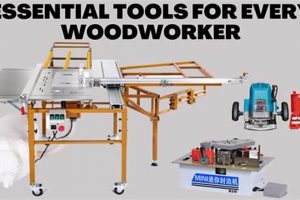
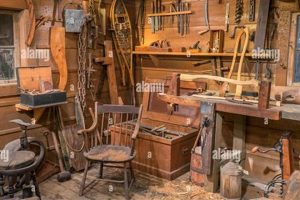
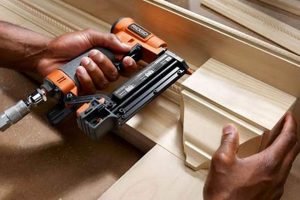
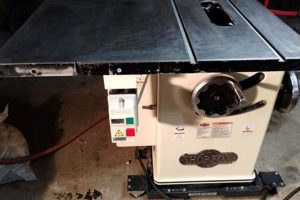
Implements designed for cutting, shaping, forming, joining, and finishing wood constitute essential equipment for construction, crafting, and artistic endeavors. This category encompasses a broad spectrum, ranging from manual hand tools, such as saws, chisels, and planes, to powered machinery including lathes, routers, and sanders. These diverse instruments facilitate the manipulation of wood to achieve desired forms and functions.
The efficacy of wood-based projects hinges on the availability and appropriate utilization of these implements. Their application spans centuries, underpinning architectural marvels, functional furniture, and intricate artistic creations. The correct choice and skillful handling of these items are crucial for precision, efficiency, and the overall quality of the finished product, contributing to structural integrity and aesthetic appeal.
The subsequent discussion will categorize specific instruments based on their primary function, exploring the varieties available within each grouping. Furthermore, safe operational practices and routine maintenance procedures vital for extending the lifespan and ensuring the continued effectiveness of this equipment will be addressed.
Essential Considerations for Woodworking Implements
The following tips provide critical guidance for selecting, utilizing, and maintaining a suite of instruments for wood manipulation. Adherence to these principles enhances project outcomes and ensures operational safety.
Tip 1: Selection Based on Project Requirements: Choose instruments specifically suited to the intended task. Fine detail work necessitates smaller, more precise hand implements, while large-scale construction benefits from the efficiency of power machinery.
Tip 2: Prioritize Quality over Cost: Investment in high-quality implements yields superior results and extended lifespan. Durable materials and precise manufacturing contribute to accuracy and minimize the need for frequent replacement.
Tip 3: Maintain Sharp Cutting Edges: A sharp edge is paramount for efficient and safe woodworking. Regularly hone chisels, plane irons, and saw blades to ensure clean cuts and reduce the risk of tool slippage.
Tip 4: Implement Proper Safety Protocols: Utilize appropriate personal protective equipment, including eye protection, hearing protection, and respiratory masks. Familiarize oneself with the operational guidelines for each instrument before use.
Tip 5: Ensure Adequate Workspace Illumination: Sufficient lighting is critical for precise material manipulation and hazard identification. Position light sources to minimize shadows and glare on the workpiece.
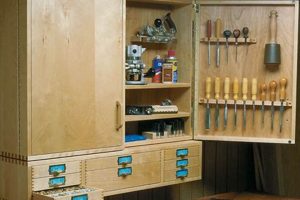
Tip 6: Store Implements Appropriately: Organized storage protects instrument blades from damage and facilitates efficient retrieval. Utilize toolboxes, racks, or designated storage areas to maintain a tidy and accessible workspace.
Tip 7: Regularly Inspect Implements for Damage: Periodically examine instrument handles, blades, and power cords for signs of wear or damage. Address any issues promptly to prevent accidents and maintain operational effectiveness.
Diligent attention to implement selection, maintenance, and safety practices results in higher-quality craftsmanship, improved efficiency, and a safer working environment. Mastering these fundamentals is crucial for successful woodworking endeavors.
The subsequent sections will provide a more detailed examination of specific categories of instruments, highlighting the nuances of their operation and maintenance.
1. Cutting
The division of wood material, or “Cutting,” is a primary function executed through a specific category of implements. The accuracy and efficiency of this process directly influence subsequent stages of woodworking, determining the dimensional precision and overall structural integrity of the final product.
- Hand Saws
Hand saws represent a class of manual cutting implement characterized by a toothed blade manipulated through reciprocal motion. Variations, such as crosscut saws for perpendicular-to-grain cuts and rip saws for parallel-to-grain cuts, exist. Their application extends to tasks requiring detailed control, material conservation, or in environments lacking electrical power.
- Power Saws
Electrically powered saws offer increased speed and efficiency in material sectioning. Circular saws, jigsaws, and band saws constitute common examples, each suited to specific cutting patterns and material thicknesses. Safe operation necessitates adherence to manufacturer guidelines and the use of appropriate safety equipment.
- Chisels
Chisels function as both cutting and shaping implements. Used in conjunction with a mallet or hand pressure, these tools permit the removal of small material quantities, facilitating the creation of joinery elements, intricate carvings, or the refinement of edges. Blade sharpness is critical for effective performance and user safety.
- Specialized Cutting Tools
This category encompasses implements designed for specific cutting applications. Examples include coping saws for curved cuts, fret saws for intricate designs, and scoring knives for precise marking prior to sawing. The selection of a specialized cutting implement optimizes efficiency and precision in specific tasks.
The aforementioned implement categories exemplify the diversity within “Cutting”. The selection of the appropriate cutting implement, coupled with proper technique, determines the quality of the initial material division, and significantly influencing the outcome of the overall woodworking project.
2. Shaping
The manipulation of wood into desired forms beyond simple division necessitates implements specifically designed for material removal and contour refinement, a process termed “Shaping.” The effectiveness of these implements directly correlates with the precision and aesthetic qualities achievable in woodworking projects. Inadequate control or improper tool selection during the shaping process invariably compromises the final outcome, resulting in dimensional inaccuracies or aesthetically undesirable forms. The shaping stage is, therefore, integral to realizing the intended design.
Planes, for example, represent a primary shaping tool. These implements, available in various configurations such as block planes for end-grain work and smoothing planes for surface refinement, precisely shave thin layers of wood, allowing for the creation of flat, even surfaces or subtly curved contours. Spoke shaves function similarly, but are specifically designed for shaping curved components like chair legs or boat hulls. Furthermore, rotary shaping implements, such as routers equipped with various bits, enable the creation of intricate profiles and decorative edges. The mastery of these shaping instruments is crucial for achieving sophisticated woodworking results.
In conclusion, shaping, achieved through a range of specialized implements, represents a critical juncture in woodworking. Accurate shaping is indispensable for achieving both functional integrity and visual appeal in finished pieces. The effective application of shaping implements, informed by an understanding of wood properties and shaping techniques, differentiates skilled craftsmanship from rudimentary construction. Understanding the relationship between shaping, wood properties, and instrument selection is fundamental for successful woodworking outcomes.
3. Joining

The process of “Joining” in woodworkingthe secure and often aesthetically considered connection of individual wood componentsis inherently dependent on a specific subset of implements. The structural integrity and visual appeal of any assembled woodworking project are directly related to the selection and proper utilization of tools designed for this purpose. A poorly executed joint, irrespective of the quality of materials or design, undermines the entire construction. Consider, for example, a dovetail joint in a drawer; the precision of the dovetail saw and chisels used to create the interlocking components directly affects the drawer’s strength and resistance to racking. Similarly, a mortise and tenon joint relies on accurate measurements and the proper use of mortise chisels and tenon saws for a secure and durable connection. The effectiveness of adhesives, another critical aspect of joining, is enhanced by surface preparation achieved with planes and scrapers, ensuring optimal bonding.
Clamps represent another essential category within the “Joining” arsenal. These implements apply consistent pressure during adhesive curing, guaranteeing a tight bond and preventing slippage. A wide variety of clamp types exist, each suited to specific joint configurations and workpiece geometries. Pipe clamps, bar clamps, and hand screws are common examples, each capable of exerting varying degrees of force. Mechanical fasteners, such as screws and nails, further augment joint strength and stability. The proper selection of screw or nail type, coupled with pre-drilling techniques employing drills and countersinks, minimizes wood splitting and ensures a flush, secure connection. Furthermore, specialized joining techniques, such as biscuit joining or dowel joining, rely on dedicated machinery and implements to create precise and robust bonds.
The link between “Joining” and woodworking implements is therefore inextricable. The selection of appropriate implements, combined with skillful execution, determines the longevity, stability, and aesthetic qualities of the final product. Mastery of joining techniques requires a thorough understanding of the properties of wood, the mechanics of joint construction, and the capabilities of the implements employed. Challenges in joining often stem from inaccurate measurements, improper tool maintenance, or a mismatch between the selected technique and the demands of the project. This understanding is a key component in the successful practice of woodworking.
4. Finishing

The process of applying protective and aesthetic coatings to wood surfaces, termed “Finishing,” relies heavily on the appropriate selection and application of specialized implements. The durability and appearance of finished woodworking projects are directly influenced by the effectiveness of these tools and the techniques employed.
- Sanding Implements
Achieving a smooth, even surface prior to coating application is crucial. Sanding implements, ranging from manual sanding blocks to powered orbital sanders, facilitate the removal of surface imperfections and create a uniform texture. The selection of appropriate grit levels and sanding techniques directly impacts the adhesion and appearance of subsequent coatings. Examples include using progressively finer grits of sandpaper to remove scratches and prepare for stain or varnish application. Ineffective sanding can lead to uneven coating absorption and visible surface defects.
- Application Tools
The application of coatings such as paints, stains, and varnishes requires specialized tools for even distribution and optimal finish quality. Brushes, rollers, and spray guns are common application methods, each suited to specific coating types and project requirements. Brush selection, for instance, depends on the viscosity and chemical properties of the coating, while spray guns demand careful adjustment for consistent atomization. Incorrect tool selection or application technique can result in brush strokes, drips, or uneven color distribution.
- Surface Preparation Tools
Prior to coating application, surface preparation is often necessary to remove contaminants and enhance adhesion. Scrapers, tack cloths, and cleaning solvents are employed to ensure a clean and receptive surface. Scraping removes old finishes or surface irregularities, tack cloths remove dust particles, and solvents degrease the wood surface. Inadequate surface preparation can lead to poor coating adhesion and premature finish failure.
- Specialized Finishing Tools
Particular finishing techniques require specialized implements. Grain filling, for example, necessitates the use of flexible filling knives or squeegees to force paste filler into open wood pores. Rubbing out a finish to achieve a high-gloss sheen requires the utilization of specialized abrasive compounds and polishing pads. These specialized tools enable the achievement of specific aesthetic effects and enhance the overall quality of the finished surface.
The effectiveness of “Finishing” hinges on the appropriate selection and skillful application of specialized implements. Proper surface preparation, coating application, and post-application techniques, facilitated by these tools, contribute to the aesthetic appeal and protective qualities of finished woodworking projects. Furthermore, safety tools are often required, like respirators for spray applications. The absence of any key part of this section is often the cause of subpar or unsafe applications of finishes.
5. Measuring

Accurate dimensional control, facilitated by instruments of “Measuring,” is paramount to all stages of woodworking. The creation of components meeting specified sizes and the precise alignment of joinery rely entirely on the accurate application of such tools. Without the ability to precisely determine dimensions, the outcome is invariably compromised, resulting in ill-fitting assemblies, structural instability, and deviations from the intended design. Consider, for instance, the construction of a cabinet. The dimensions of the cabinet’s carcass, shelves, and door must adhere to strict tolerances; any deviation affects the fit and function of all components. Similarly, in the creation of a dovetail joint, the angles and dimensions of the pins and tails must be meticulously measured and transferred to ensure a tight and secure connection. Therefore, the connection between “Measuring” and tools is not merely supplementary but fundamentally constitutive; measuring defines the parameters within which other tools are effectively employed.
Tools categorized under “Measuring” encompass a range of instruments designed to quantify dimensions, angles, and levels. Rules and tape measures provide linear measurements, while squares ensure perpendicularity and facilitate the layout of right angles. Bevel gauges transfer angles between surfaces, while levels and plumb bobs establish horizontal and vertical references. Calipers enable the precise measurement of internal and external dimensions, and marking gauges scribe parallel lines for accurate material removal. These tools, employed in concert, enable the translation of design specifications into physical forms with a high degree of precision. Accurate and skilled measuring greatly influences the output of the woodworking process. The skilled selection and application of suitable measuring tools are essential prerequisites for successful and high-quality woodwork.
In conclusion, “Measuring” constitutes an indispensable element within the framework of woodworking. Effective woodworking practice necessitates a thorough understanding of measuring principles and the proficient utilization of appropriate measuring implements. Inaccuracies introduced during the measurement phase cascade throughout the subsequent stages of the process, amplifying errors and ultimately compromising the integrity of the finished product. Moreover, it should be seen as essential that safety tools are used, such as protective eyewear. Thus, the capacity to accurately measure and transfer dimensions is fundamental to the achievement of success in woodworking pursuits.
Frequently Asked Questions
The following section addresses common inquiries regarding the function, selection, and maintenance of instruments employed in woodworking. Clarification of these points facilitates informed decision-making and promotes safe, efficient work practices.
Question 1: What differentiates a rip saw from a crosscut saw?
The distinction lies in blade tooth geometry. A rip saw features teeth designed to sever wood fibers along the grain, while a crosscut saw’s teeth are configured to sever fibers perpendicular to the grain. This difference in tooth geometry optimizes cutting efficiency for each respective application.
Question 2: Is it necessary to sharpen chisels frequently?
Yes, consistent sharpness is critical for safe and effective chisel operation. A dull chisel requires increased force, raising the risk of slippage and potential injury. Regular honing and sharpening maintain optimal cutting performance and minimize the exertion required.
Question 3: What safety precautions should be observed when using power sanders?
Eye protection is paramount to shield against airborne particles. Respiratory protection is advisable to prevent inhalation of fine dust. Hearing protection is recommended due to the noise generated by power sanding equipment. Additionally, securing the workpiece prevents movement and ensures controlled sanding.
Question 4: What is the purpose of a marking gauge?
A marking gauge serves to scribe a line parallel to an edge. This ensures consistent material removal when creating joinery or trimming components to a specific dimension. The accuracy of a marking gauge is crucial for achieving precise and repeatable results.
Question 5: How should adhesives be selected for woodworking projects?
Adhesive selection depends on the type of joint, the wood species, and the intended application. Factors to consider include open time, clamping pressure requirements, water resistance, and stainability. Consult adhesive manufacturers’ guidelines for specific recommendations.
Question 6: What is the function of a plane?
Planes are used for flattening, smoothing, and thicknessing wood. They work by shaving thin layers of wood off the surface of the material. Different planes are made for different purposes, such as smoothing planes, block planes, and jack planes.
This summary provides a concise overview of fundamental considerations related to “woodworking implements”. Addressing these points contributes to informed tool selection, safe work practices, and high-quality project outcomes.
The subsequent article sections will include a glossary of terms, providing definitions for specialized terminology encountered in woodworking.
Conclusion
This exploration of “what are woodworking tools” has delineated the diverse array of instruments crucial for successful wood manipulation. From cutting and shaping to joining, finishing, and measuring, specific implements facilitate each stage of the woodworking process. The appropriate selection, skillful utilization, and diligent maintenance of these tools are fundamental to achieving precision, durability, and aesthetic quality in woodworking projects.
The principles outlined herein provide a robust foundation for further exploration and mastery of woodworking techniques. A continued commitment to understanding the nuances of each tool and its application will foster craftsmanship, promote safety, and unlock the potential to create lasting and meaningful works from wood. The value of woodworking knowledge cannot be overstated.