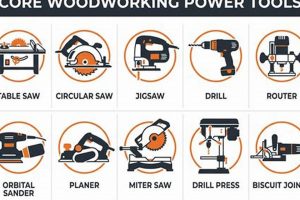
The term encompasses a range of implements designed to shape, cut, and join wood, adapted to be safely and effectively utilized by young individuals. These implements are often smaller, lighter, and incorporate enhanced safety features compared to those intended for adult use. For instance, a child’s saw might feature a blunted tip and a protective guard, or a hammer might be lighter with a larger striking face.
Introducing young people to the craft of woodworking fosters creativity, problem-solving skills, and hand-eye coordination. Historically, woodworking skills were essential for daily life, contributing to shelter construction, tool creation, and artistic expression. The safe and age-appropriate introduction to these crafts cultivates valuable life skills and an appreciation for craftsmanship.
The following sections will delve into specific types of age-appropriate implements, safety considerations crucial for youth involvement, and project ideas suitable for different skill levels.
Essential Guidance for Introducing Safe Woodworking Practices
Successful introduction of youth to woodworking necessitates careful consideration of safety, tool selection, and project suitability. The following guidelines aim to provide actionable insights for fostering a positive and safe learning environment.
Tip 1: Prioritize Safety Education. A thorough understanding of tool operation and safety protocols is paramount before any hands-on activity. Demonstrations and supervised practice sessions are crucial.
Tip 2: Select Age-Appropriate Implements. Use implements specifically designed for smaller hands and limited strength. These typically include reduced size and enhanced safety features, such as blade guards or rounded edges.
Tip 3: Implement Continuous Supervision. Active supervision is essential, particularly during initial learning phases. Guidance and timely intervention can prevent accidents and reinforce proper technique.
Tip 4: Emphasize Proper Work Holding. Securely clamping or holding workpieces prevents movement during cutting or shaping. This minimizes the risk of slippage and potential injury.
Tip 5: Encourage Use of Safety Gear. Safety glasses are non-negotiable, protecting eyes from flying debris. Additional protective gear, such as gloves, may be appropriate depending on the project.
Tip 6: Begin with Simple Projects. Start with projects that are straightforward and require minimal cutting or shaping. Gradual progression to more complex projects builds confidence and skill.
Tip 7: Maintain a Clean and Organized Workspace. A clutter-free environment minimizes trip hazards and ensures clear visibility of tools and materials. Implement a system for tool accountability.
Adherence to these guidelines minimizes the potential for injury and maximizes the educational benefits of woodworking. A structured and safety-conscious approach lays the foundation for a lifelong appreciation of the craft.
The subsequent discussion will focus on specific project ideas and resources designed to enhance the woodworking experience for young individuals.
1. Safety paramount

The phrase “Safety paramount” underscores the preeminent consideration when designing, selecting, and utilizing implements for young woodworkers. Integrating safety features directly influences the potential for injury and the overall success of a child’s woodworking experience. A blade guard on a saw, for example, directly mitigates the risk of accidental cuts. Similarly, rounded edges on chisels reduce the likelihood of puncture wounds. The implementation of such safety mechanisms directly correlates with a reduction in woodworking-related accidents among younger individuals.
The importance of prioritizing safety extends beyond mere physical protection. It cultivates a culture of responsibility and awareness within the woodworking environment. Introducing safety protocols from the outset establishes a foundation for careful practice and respect for the tools. Providing smaller, lighter implements, and ensuring adult supervision further supports the emphasis on a secure process. Real-world cases demonstrate that accidents often stem from neglecting established safety guidelines, resulting in preventable injuries. Effective and well-supervised woodworking programs exhibit far fewer incidents.
In summary, the phrase “Safety paramount” is not merely a suggestion, but an absolute requirement when engaging youth in woodworking. It necessitates the thoughtful design and selection of tools, the consistent application of safety protocols, and dedicated supervision. By maintaining an unwavering commitment to safety, educators and parents can ensure woodworking becomes a positive and enriching experience. This commitment to safety directly aligns with instilling valuable skills and promoting creativity in a low-risk environment.
2. Ergonomic design

Ergonomic design principles are crucial when adapting implements for young users. The physical capabilities of children differ significantly from adults, requiring modifications to tool size, shape, and weight to ensure comfortable and safe operation.
- Reduced Handle Diameter
Hand size directly influences grip strength and control. Reducing handle diameter allows smaller hands to maintain a secure grasp, preventing slippage and fatigue. Smaller diameters improve maneuverability and precision during tasks like sawing or carving. Real-world examples include specialized children’s chisels and saws with significantly narrower handles compared to their adult counterparts.
- Lightweight Construction
Muscle strength is a limiting factor for young woodworkers. Lightweight materials such as durable plastics or selectively used lightweight metals reduce the force required to operate tools, minimizing strain and fatigue. This enables children to work for longer periods without experiencing discomfort or compromising control. An example is a hammer with a hollow metal shaft or a saw with a lightweight polymer frame.
- Optimized Handle Angle
The angle of a tool’s handle significantly impacts wrist and arm posture. Ergonomic designs optimize handle angles to minimize wrist flexion or extension, reducing the risk of repetitive strain injuries. A curved handle on a coping saw, for instance, allows for a more natural wrist position during intricate cuts.
- Textured Grips
Secure grip is essential for maintaining control, especially when working with sharp implements. Textured surfaces, such as rubberized grips or molded patterns, enhance friction and prevent slippage, even with sweaty or oily hands. Examples include textured handles on knives, saws, and screwdrivers specifically designed for children.
These ergonomic considerations are integral to the development of woodworking tools that are both effective and safe for young users. Prioritizing ergonomic design fosters a positive introduction to the craft, promoting skill development and minimizing the risk of physical strain or injury. Incorporating ergonomic features transforms potentially hazardous instruments into accessible and engaging implements for children, encouraging exploration and creativity within a secure framework.
3. Age appropriateness

Age appropriateness is a central tenet in selecting implements intended for woodworking activities involving children. Tools designed without consideration for the physical and cognitive development stages of young users pose significant safety risks. For instance, a saw designed for adult use may be too heavy, have an unwieldy handle, and possess excessively sharp teeth, increasing the likelihood of accidents. Conversely, a tool explicitly designed for a specific age range takes into account factors such as hand size, grip strength, coordination levels, and comprehension abilities.
The implementation of age-appropriate tools directly impacts the effectiveness and enjoyment of woodworking for children. Smaller, lighter tools with blunted edges and simplified mechanisms allow for easier manipulation and control. This not only reduces the risk of injury but also fosters a sense of accomplishment and encourages continued engagement. Real-world examples include pre-cut wood kits with simplified assembly instructions and specialized tool sets with reduced-size hammers, saws, and screwdrivers designed for specific age brackets.
The practical significance of understanding age appropriateness extends beyond immediate safety concerns. It influences the development of fundamental motor skills, problem-solving abilities, and a positive attitude towards craftsmanship. Selecting tools that align with a child’s developmental stage facilitates a gradual progression of skills, building confidence and promoting a lifelong interest in woodworking. Ignoring this principle can lead to frustration, potential injury, and a negative perception of woodworking. Therefore, the careful consideration of age appropriateness is indispensable when introducing youth to the craft.
4. Material quality

Material quality constitutes a foundational aspect of implements designed for young woodworkers. The correlation between material selection and safety, durability, and overall user experience is direct and significant. Substandard materials increase the risk of tool failure, posing potential hazards to young users. Conversely, high-quality materials contribute to enhanced tool longevity, precision, and ease of use, facilitating a positive and productive woodworking experience. For instance, a saw crafted from tempered high-carbon steel maintains its sharpness longer and resists bending, providing cleaner cuts and improved safety compared to a saw constructed from lower-grade steel, which dulls quickly and is more prone to breakage.
The choice of materials extends beyond the tool’s functional components. Handle materials, such as hardwood or durable polymers, impact grip comfort and resistance to wear and tear. A well-crafted handle provides a secure and comfortable grip, reducing fatigue and improving control. Inferior handle materials, on the other hand, may splinter, crack, or become slippery, compromising safety and usability. Furthermore, the quality of fasteners, such as screws and rivets, used in tool construction directly affects the tool’s structural integrity. High-quality fasteners resist loosening or breaking under stress, ensuring the tool remains intact during use. For example, a poorly constructed hammer with a loose head poses an immediate safety risk.
In summation, the selection of materials for implements intended for young users directly influences safety, durability, and the overall woodworking experience. Prioritizing high-quality materials enhances tool performance, reduces the risk of accidents, and fosters a positive and enriching introduction to the craft. The investment in quality materials translates directly into safer, more effective tools that promote skill development and encourage a lifelong appreciation for woodworking. This understanding highlights the critical role of informed material selection in the responsible design and provision of resources for young artisans.
5. Project suitability

Project suitability serves as a critical determinant in the successful and safe introduction of youth to woodworking. The alignment between project complexity, tool selection, and the developmental stage of the young artisan significantly influences the learning experience and minimizes the potential for injury.
- Skill Level Compatibility
Projects must align with the demonstrated skill level of the child. Starting with overly complex tasks can lead to frustration and unsafe tool handling. Simpler projects, such as assembling pre-cut components or basic shaping, build confidence and establish fundamental skills. For example, constructing a simple birdhouse from pre-cut pieces is more suitable for a beginner than attempting intricate carving.
- Tool Appropriateness
The chosen project dictates the necessary implements. Introducing potentially hazardous tools prematurely increases the risk of accidents. A project requiring fine detail work necessitates specialized tools designed for precision and control. For instance, a beginner’s project involving simple cuts is better suited to a small, safe saw with a blade guard than a larger, more powerful saw.
- Time Commitment
Projects should be manageable within a reasonable timeframe. Lengthy or repetitive tasks can lead to fatigue and diminished focus, increasing the likelihood of errors. Smaller, more focused projects maintain engagement and allow for a sense of accomplishment within a single session. Building a small wooden car, for example, is more manageable than constructing a large piece of furniture.
- Material Complexity
The type and complexity of materials influence the difficulty of the project. Softer woods, such as pine or balsa, are easier to cut and shape, making them more suitable for beginners. More challenging materials, such as hardwoods, require greater strength and skill. A first project should involve simple softwood, rather than attempting to work with oak or maple.
These considerations highlight the imperative of carefully matching projects with the capabilities of young woodworkers. This tailored approach fosters a positive learning environment, promotes skill development, and minimizes the risks associated with handling woodworking implements. The selection of projects aligned with the children’s current abilities ensures a secure and productive woodworking experience.
6. Skill development

The integration of implements with woodworking activities for youth serves as a fundamental catalyst for skill development across multiple domains. Purposefully designed implements facilitate the acquisition of manual dexterity, problem-solving capabilities, and spatial reasoning abilities. The structured engagement with these tools provides a tangible medium for translating theoretical knowledge into practical competence.
- Fine Motor Skills
The manipulation of small tools, such as chisels, saws, and screwdrivers, directly enhances fine motor skills and hand-eye coordination. Precisely guiding a saw along a marked line, or carefully driving a screw into a pilot hole, requires controlled movements and focused attention. Repeated execution of these tasks strengthens neural pathways and refines motor control. The consistent application of these tools significantly improves dexterity.
- Spatial Reasoning
Woodworking inherently involves interpreting and manipulating three-dimensional forms. Visualizing how individual components fit together to create a finished product cultivates spatial reasoning abilities. Reading blueprints, translating two-dimensional drawings into physical objects, and adjusting for material thickness all contribute to this cognitive development. Successful project completion depends upon understanding spatial relationships.
- Problem-Solving Skills
Woodworking projects inevitably present challenges that demand creative solutions. Identifying and rectifying errors, adapting designs to account for material limitations, and troubleshooting tool malfunctions all require problem-solving skills. The process of overcoming these obstacles fosters resourcefulness and resilience. Each project becomes a learning experience that reinforces problem-solving strategies.
- Mathematical Concepts
Many woodworking tasks directly apply mathematical concepts, such as measurement, geometry, and proportions. Accurately measuring materials, calculating angles, and determining dimensions necessitate a practical understanding of these principles. Woodworking provides a context for applying abstract mathematical concepts to real-world situations. This tangible application reinforces learning and deepens comprehension.
The diverse skill set cultivated through woodworking activities underscores the value of providing youth with access to appropriate implements. These tools serve not merely as instruments for shaping wood, but as catalysts for cognitive and motor development. The structured engagement with these tools fosters a holistic skill set that benefits individuals across various disciplines. Skill development through woodworking promotes lifelong learning and adaptability.
Frequently Asked Questions
This section addresses common inquiries and misconceptions regarding the use of woodworking tools by young individuals. The aim is to provide clear, concise, and informative answers to promote safety and informed decision-making.
Question 1: At what age is a child typically ready to begin using woodworking tools?
The appropriate age varies significantly based on individual maturity, coordination, and attentiveness. Generally, children around the age of seven or eight may begin with basic tools under close supervision. Assessment of the child’s ability to follow instructions and demonstrate responsible behavior is crucial.
Question 2: What are the essential safety precautions when children use woodworking tools?
Essential precautions include constant adult supervision, the use of appropriate safety gear (safety glasses, gloves), a thorough understanding of tool operation, and a clutter-free workspace. Regular breaks and a clear set of rules are also crucial for maintaining focus and preventing accidents.
Question 3: What are some examples of age-appropriate woodworking tools for beginners?
Suitable starter implements include small, lightweight hammers, hand saws with blade guards, sandpaper blocks, and clamps. Avoid tools with sharp edges or complex mechanisms until the child has demonstrated proficiency with simpler implements.
Question 4: How should parents or educators introduce woodworking tools to children?
The introduction should begin with a comprehensive safety lesson covering the proper use and potential hazards of each tool. Demonstrations and supervised practice sessions are essential before allowing independent use. Emphasis should be placed on responsible behavior and adherence to safety protocols.
Question 5: What types of projects are suitable for children starting out in woodworking?
Begin with simple projects that require minimal cutting or shaping, such as assembling pre-cut kits or constructing basic geometric shapes. Gradually increase complexity as the child’s skills and confidence improve. Focus on projects that are achievable and rewarding to maintain engagement.
Question 6: Where can one find quality woodworking tools specifically designed for children?
Reputable hardware stores, woodworking supply retailers, and online marketplaces offer a range of tools designed for youth. Look for implements that meet safety standards and are specifically labeled as suitable for children. Read reviews and seek recommendations from experienced woodworkers.
The information provided in this FAQ section underscores the importance of prioritizing safety, age appropriateness, and proper instruction when introducing children to woodworking. A well-planned and supervised approach can foster creativity, skill development, and a lifelong appreciation for the craft.
The subsequent discussion will address advanced woodworking techniques and project ideas suitable for older and more experienced young woodworkers.
Conclusion
The preceding analysis underscores the multifaceted considerations inherent in selecting and utilizing woodworking tools for kids. Key aspects encompass safety, ergonomics, age appropriateness, material quality, project suitability, and the fostering of skill development. The effective integration of these factors is paramount in creating a safe and enriching learning environment.
Responsible introduction of young individuals to woodworking practices requires a steadfast commitment to safety protocols and a thoughtful selection of age-appropriate implements. The cultivation of craftsmanship skills through these activities holds the potential to instill valuable life lessons and foster a lifelong appreciation for the art of woodworking. It is imperative that practitioners and educators prioritize informed decision-making and responsible implementation in this endeavor.