Additive manufacturing devices capable of producing implements commonly utilized in carpentry represent a convergence of modern digital fabrication and traditional craft. These devices facilitate the creation of custom jigs, fixtures, templates, and even specialized cutting or shaping tools from a variety of materials, including durable polymers and composites. An example includes printing a custom-shaped sanding block tailored to a specific contoured surface.
The ability to rapidly prototype and manufacture custom solutions for woodworking offers numerous advantages. It reduces reliance on mass-produced, standardized tools, enabling woodworkers to create highly specific implements optimized for unique tasks. This adaptability can lead to improved efficiency, precision, and overall project quality. Historically, creating such specialized tools required extensive manual labor, a constraint that digital fabrication now alleviates.
The subsequent sections will explore specific applications of this technology in the creation of jigs and fixtures, delve into material considerations for durable and effective designs, and examine potential future developments that could further enhance the integration of digital fabrication into woodworking practices. The focus will remain on practical applications and achievable results within a professional woodworking context.
Tips for Leveraging Additive Manufacturing in Woodworking
Optimizing the utilization of 3D printing in woodworking requires careful consideration of design principles, material selection, and integration with existing workflows. The following tips provide guidance for achieving successful and practical results.
Tip 1: Prioritize Functional Design: Design iterations should focus on the tool’s intended purpose and ergonomic factors. Ensure designs account for stress points and potential wear during operation. Consider using finite element analysis (FEA) software to simulate tool performance and identify areas for reinforcement.
Tip 2: Select Appropriate Materials: Material choice is critical for tool longevity and performance. For jigs and fixtures, consider materials with high impact resistance and dimensional stability, such as ABS or PETG. For cutting tools, explore reinforced composites or investigate post-processing techniques to enhance durability.
Tip 3: Design for Printability: Optimize designs for additive manufacturing processes by minimizing overhangs and support structures. Orient parts strategically on the print bed to maximize strength and reduce material waste. Utilize infill patterns that provide sufficient structural integrity without excessive printing time or material consumption.
Tip 4: Iterate and Refine: Embrace an iterative design process. Print prototypes, test their functionality, and identify areas for improvement. Document design changes and performance data to track progress and inform future designs. Use digital calipers to accurately measure printed dimensions and compare them to the original design.
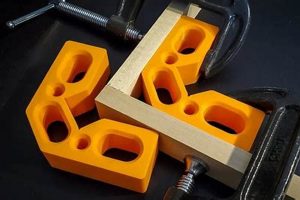
Tip 5: Integrate with Existing Tools: Design 3D printed tools to seamlessly integrate with existing woodworking equipment. Ensure compatibility with standard hardware, such as clamps, screws, and bolts. Consider designing modular components that can be easily swapped or replaced.
Tip 6: Consider Post-Processing: Explore post-processing techniques to enhance the surface finish, strength, and durability of 3D printed tools. Sanding, polishing, and coating can improve the tool’s aesthetic appeal and resistance to wear. Chemical smoothing can also be used to reduce surface roughness and improve dimensional accuracy.
Tip 7: Focus on Repeatable Accuracy: Precision is paramount in woodworking. Ensure that 3D printed jigs and fixtures provide consistent and repeatable results. Use alignment features and registration marks to ensure accurate positioning of workpieces. Regularly calibrate 3D printers to maintain dimensional accuracy.
These tips emphasize a practical approach to integrating additive manufacturing into woodworking, highlighting the importance of careful design, material selection, and iterative refinement. By adhering to these guidelines, woodworkers can effectively leverage 3D printing to create custom tools that enhance efficiency, precision, and overall project quality.
The next stage of this exploration will examine specific examples of 3D printed tools used in woodworking applications, further illustrating the benefits and limitations of this emerging technology.
1. Custom Jig Creation
The intersection of digital fabrication and woodworking enables the rapid and cost-effective creation of custom jigs. This capability allows woodworkers to overcome limitations imposed by standardized tooling and adapt to the unique geometries and requirements of specific projects. Custom jig creation, facilitated by additive manufacturing, represents a significant shift towards personalized and optimized woodworking processes.
- Enhanced Precision and Repeatability
3D printed jigs provide a means to achieve precise and repeatable cuts, joints, and assemblies. Unlike hand-fabricated jigs, additive manufacturing ensures dimensional accuracy and consistent performance across multiple iterations. For example, a jig designed for creating dovetail joints can be 3D printed to ensure that each joint is precisely aligned and consistently sized, reducing errors and rework.
- Geometric Complexity and Customization
Additive manufacturing allows for the creation of jigs with complex geometries that would be difficult or impossible to produce using traditional methods. This opens up possibilities for creating specialized jigs tailored to intricate shapes and contours. As an example, a custom jig can be designed to hold a uniquely curved piece of wood securely during routing or sanding operations, ensuring consistent results without damaging the workpiece.
- Rapid Prototyping and Iteration
The ability to quickly prototype and iterate on jig designs is a major advantage of using 3D printers. A design can be created in CAD software, printed, tested, and refined within a short timeframe. This iterative process allows for optimization of jig designs based on real-world performance, leading to more effective and user-friendly solutions. For instance, a prototype jig for mortise and tenon joinery can be quickly modified and reprinted to improve its clamping mechanism or adjust its alignment features.
- Material Optimization and Cost Reduction
While materials impact tool longevity, 3D printing can reduce costs associated with custom jig fabrication. It enables the use of specific materials where they are needed most, optimizing for both performance and cost. For instance, a jig might use a high-strength polymer for critical load-bearing components and a less expensive material for non-structural elements, lowering the overall cost without sacrificing functionality.
The ability to create custom jigs via digital fabrication offers woodworkers unparalleled control over their processes. It enhances precision, enables geometric complexity, facilitates rapid iteration, and optimizes material usage. This capability moves woodworking beyond reliance on standardized tools and towards a future where implements are tailored to the specific needs of each project and artisan.
2. Material Durability

Material durability is a critical factor in the effective utilization of 3D printed woodworking tools. The inherent properties of the chosen material directly impact the tool’s lifespan, its ability to withstand operational stresses, and its overall suitability for the intended woodworking task. For instance, a 3D-printed clamp constructed from a brittle polymer would likely fracture under pressure, rendering it useless. This underscores the need for careful consideration of material properties such as tensile strength, impact resistance, and resistance to environmental factors like moisture and UV exposure.
The selection process should balance performance requirements with the limitations of available materials and printing technology. Thermoplastics such as ABS (Acrylonitrile Butadiene Styrene) and PETG (Polyethylene Terephthalate Glycol-modified) are commonly used due to their relatively high strength and ease of printing. However, for tools subjected to high stress or abrasive conditions, reinforced composites or post-processing techniques may be necessary to enhance durability. Consider a 3D-printed router template; repeated use could wear down the edges if printed from a low-quality material. Utilizing a higher density polymer and potentially incorporating metal inserts at critical wear points can extend the template’s useful life, justifying the increased cost and complexity.
In summary, the successful application of additive manufacturing in woodworking hinges on prioritizing material durability. Careful consideration of material properties, coupled with appropriate design and post-processing techniques, is essential to creating 3D printed tools that are not only functional but also capable of withstanding the demands of a woodworking environment. Failure to address this critical aspect can lead to premature tool failure, increased costs, and ultimately, a diminished return on investment in digital fabrication technology.
3. Design Complexity

The capacity to realize intricate designs is a significant advantage offered by additive manufacturing within the realm of woodworking. This capability extends beyond simple geometric shapes, allowing for the creation of complex, optimized implements that enhance precision and efficiency. Design complexity, therefore, represents a pivotal consideration when integrating digital fabrication into woodworking practices.
- Internal Geometries and Lattice Structures
Additive manufacturing facilitates the creation of tools with complex internal geometries, including lattice structures that optimize strength-to-weight ratios. This allows for the design of lightweight yet robust jigs and fixtures. For example, a 3D printed clamp might incorporate a honeycomb-like internal structure to provide high clamping force while minimizing material usage and overall weight. This approach is impractical with traditional manufacturing methods.
- Integrated Functionality and Multi-Material Designs
The potential to integrate multiple functions into a single 3D printed tool is a direct result of design complexity. It also enables the utilization of multi-material designs, where different materials are strategically combined to optimize performance. Consider a 3D printed hand plane; it could incorporate a durable polymer body, a metal blade insert, and textured grips, all integrated into a single, cohesive design. Each material contributes specific properties to the tool’s overall functionality.
- Parametric Design and Algorithmic Optimization
Complex designs can be readily achieved and modified through parametric design and algorithmic optimization. This approach allows for the creation of tools that are precisely tailored to specific tasks or workpiece geometries. A 3D printed tenon jig, for example, could be parametrically designed to accommodate a range of tenon sizes, automatically adjusting its dimensions based on user input. This level of customization is difficult to achieve with traditional woodworking tools.
- Ergonomic Considerations and Customization
Additive manufacturing enables the creation of tools with optimized ergonomic designs, tailored to the individual user. Complex curves and contours can be easily incorporated, improving comfort and reducing strain during prolonged use. Custom handles, grips, and supports can be printed to match the woodworker’s hand size and preferred working style, enhancing both comfort and efficiency. Standardized tools often lack this level of personalization.
These facets of design complexity underscore the transformative potential of digital fabrication in woodworking. By embracing intricate geometries, integrated functionality, parametric design, and ergonomic considerations, woodworkers can leverage 3D printing to create tools that are not only highly functional but also precisely tailored to their individual needs and the demands of their craft.
4. Precision Enhancement

The integration of additive manufacturing into woodworking workflows directly facilitates precision enhancement. The ability to create jigs, fixtures, and tools with exact dimensional accuracy allows for improved consistency and repeatability in woodworking operations. This precision is a direct consequence of the digital design and manufacturing process, where computer-aided design (CAD) models are translated into physical objects with minimal deviation. For example, a 3D-printed dovetail jig can ensure accurate alignment and spacing of dovetail joints, surpassing the tolerances achievable with traditional hand-cut methods.
The improvement in precision extends to various woodworking tasks, including cutting, shaping, and assembly. Custom-designed templates produced through additive manufacturing enable precise routing and shaping of complex curves, ensuring uniformity across multiple workpieces. Similarly, fixtures designed to hold components during assembly contribute to accurate alignment and reduced error. Consider the creation of identical chair legs; a 3D-printed template can guarantee consistent shaping and dimensions across all four legs, enhancing the overall aesthetic and structural integrity of the chair.
In summary, precision enhancement represents a core benefit of incorporating additive manufacturing into woodworking. The ability to create tools and fixtures with high dimensional accuracy translates directly into improved consistency, repeatability, and overall quality in woodworking projects. While material selection and design considerations remain critical, the inherent precision afforded by 3D printing provides a significant advantage over traditional methods, enabling woodworkers to achieve results that were previously difficult or impossible to attain. This enhanced precision contributes to reduced waste, improved efficiency, and ultimately, a higher quality finished product.
5. Workflow Integration
Effective incorporation of additive manufacturing devices into existing woodworking processes is crucial for maximizing their utility. The creation of a 3D-printed tool is only one component; seamlessly integrating its design, fabrication, and application into the workflow determines its ultimate value. This integration requires careful assessment of current processes, identification of bottlenecks, and strategic application of 3D printing to address specific needs. For instance, if creating custom molding profiles consistently delays projects, incorporating 3D-printed molding templates into the routing process can significantly streamline the workflow, reducing setup time and improving accuracy.
Workflow integration also necessitates considerations for digital asset management and tool storage. CAD files for 3D-printed tools should be organized and readily accessible, facilitating efficient modification and replication. Furthermore, the physical storage of these tools needs to be considered to ensure they are easily located and protected from damage. A workshop that implements additive manufacturing may need to adapt its existing organizational systems to accommodate the unique characteristics of 3D-printed tools. This might involve creating custom storage racks designed specifically for jigs and fixtures or implementing a digital inventory system to track the location and availability of each tool.
Ultimately, successful integration of 3D printing into woodworking requires a holistic approach that considers the entire workflow, from design to application and storage. This involves careful planning, adaptation of existing processes, and a willingness to experiment and refine the workflow based on practical experience. Addressing these considerations can ensure that 3D-printed tools become a valuable asset, improving efficiency, precision, and overall project quality. Further optimization necessitates consideration of cost-effectiveness which influences the scale and nature of integration.
6. Cost Optimization
The economic viability of employing additive manufacturing in woodworking hinges on effective cost optimization strategies. While the initial investment in a 3D printer and associated materials can be substantial, the long-term cost benefits derive from reduced material waste, increased design flexibility, and decreased reliance on external tooling suppliers. A key consideration is the ability to produce customized jigs and fixtures on demand, eliminating the need to purchase expensive, specialized tools that may only be used for a single project. This on-demand fabrication also minimizes storage space requirements, further contributing to cost savings. For example, a small woodworking shop facing a unique project that requires a complex, custom-shaped router jig could print it in-house for a fraction of the cost of outsourcing its fabrication.
Material selection and print optimization play crucial roles in minimizing expenses. Printing with cost-effective polymers like PLA or PETG, where appropriate, can significantly reduce material costs compared to higher-performance but more expensive options. Moreover, optimizing print settings to minimize infill density and support structures reduces material usage and print time, both of which directly impact overall cost. An illustration of this principle is using a sparse infill pattern for a large-format jig that primarily serves as a guide or template rather than a structural component. Carefully considering the application and designing accordingly is critical for balancing performance with affordability.
In conclusion, the economic advantages of integrating additive manufacturing into woodworking depend on strategic cost optimization. By prioritizing on-demand fabrication, optimizing material usage, and streamlining workflow integration, woodworking businesses can realize tangible cost savings and enhance their competitiveness. Challenges such as material limitations and the initial investment in equipment require careful evaluation. However, the potential for long-term cost reduction and increased design flexibility makes 3D printing a compelling option for businesses seeking to improve efficiency and adaptability within the woodworking industry. This shift aligns with the broader trend of adopting digital fabrication technologies to enhance productivity and reduce costs across various manufacturing sectors.
Frequently Asked Questions
This section addresses common inquiries and misconceptions surrounding the use of additive manufacturing in woodworking, providing concise and informative answers.
Question 1: What types of woodworking tools can effectively be produced using additive manufacturing?
Additive manufacturing is well-suited for creating jigs, fixtures, templates, and specialized hand tools. These implements often benefit from customized designs and geometries achievable through 3D printing. Complex shapes, optimized for specific tasks, are readily produced. Cutting tools, however, require consideration of material durability and may necessitate specialized composites or post-processing techniques.
Question 2: Which materials are most appropriate for 3D-printed woodworking tools, considering durability and cost?
Thermoplastics such as ABS (Acrylonitrile Butadiene Styrene) and PETG (Polyethylene Terephthalate Glycol-modified) offer a balance of strength, printability, and cost-effectiveness for many applications. For tools requiring higher strength or wear resistance, reinforced composites or polymers like nylon may be more suitable. However, material selection must always be considered in the context of the specific application and budget constraints.
Question 3: How does the precision of 3D-printed tools compare to that of traditional woodworking tools?
The precision of 3D-printed tools is largely determined by the resolution and calibration of the 3D printer itself. When properly calibrated, additive manufacturing can achieve high levels of dimensional accuracy, often surpassing the tolerances achievable with hand-fabricated tools. However, it is important to account for potential material shrinkage during the printing process and to compensate for this in the design phase.
Question 4: Can additive manufacturing be cost-effective for small woodworking businesses or hobbyists?
The cost-effectiveness of additive manufacturing depends on the frequency with which custom tools are required. For businesses or hobbyists who regularly need specialized jigs or fixtures, 3D printing can offer significant cost savings compared to purchasing pre-made tools or outsourcing custom fabrication. The initial investment in a 3D printer must be weighed against these potential savings.
Question 5: What level of design skill is required to create functional 3D-printed woodworking tools?
While a basic understanding of CAD (Computer-Aided Design) software is necessary, complex design skills are not always required. Many pre-designed models for woodworking tools are available online, which can be downloaded and printed directly. Furthermore, user-friendly CAD software and online tutorials can facilitate the design of custom tools with relatively little prior experience.
Question 6: What are the limitations of using 3D-printed tools in woodworking?
The primary limitations of 3D-printed tools stem from material properties and manufacturing constraints. Thermoplastics may not be suitable for applications requiring high strength or heat resistance. Additionally, the layer-by-layer construction process of additive manufacturing can result in anisotropic material properties, meaning that the strength of the tool may vary depending on the direction of applied force. Finally, the print volume of a 3D printer limits the size of tools that can be produced.
The effective implementation of additive manufacturing in woodworking requires a thorough understanding of its capabilities and limitations. Careful consideration of material selection, design principles, and economic factors is essential for achieving successful and cost-effective results.
The next section will explore case studies of successful 3D-printed woodworking tools, providing real-world examples of their application and benefits.
Conclusion
This exploration of 3d printer woodworking tools has demonstrated a tangible intersection between additive manufacturing and traditional craftsmanship. The capacity to fabricate custom jigs, fixtures, and specialized implements offers woodworkers enhanced precision, design flexibility, and cost optimization. Material considerations and workflow integration remain critical aspects for successful implementation. The presented information serves as a resource for those seeking to leverage this technology effectively.
The integration of digital fabrication into woodworking represents a continuing evolution within the craft. Further research and development in materials science and printing technologies are poised to expand the applications and capabilities of 3d printer woodworking tools. Woodworkers are encouraged to consider the potential benefits and limitations of this technology to enhance their workflows and explore new avenues for innovation within their practices.
![Buy Woodworking Tools Sales Online - [Your Brand] | Step-by-Step Guides, Tools & Inspiration to Build Beautiful Wooden Decor on a Budget](https://woodfromhome.com/wp-content/uploads/2026/05/th-213-300x200.jpg "Buy Woodworking Tools Sales Online - [Your Brand] Step-by-Step Guides, Tools & Inspiration to Build Beautiful Wooden Decor on a Budget")