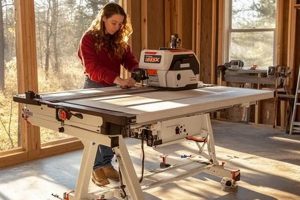
These implements, employed within woodworking practices, are designed to create precise, crescent-shaped recesses. These recesses subsequently accommodate small, football-shaped pieces of compressed wood, commonly known as biscuits. As an example, these tools are utilized to join two pieces of wood edge-to-edge, ensuring alignment and providing added surface area for adhesive bonding.
The significance of these instruments lies in their ability to simplify and strengthen woodworking joints. They offer improved accuracy compared to manual methods, particularly when aligning multiple components. Historically, the introduction of these tools marked a shift towards more efficient and reliable joinery techniques, contributing to the overall quality and durability of wood-based constructions.
The following discussion will delve into the various types of these tools, their operational characteristics, the selection criteria that should be considered, and the optimal methods for their effective application in diverse woodworking projects.
Operational Recommendations
The following guidelines offer insights into optimizing the utilization of these tools for enhanced woodworking outcomes.
Tip 1: Material Selection: Employ biscuits composed of wood compatible with the projects primary material. Discrepancies in wood type can lead to differential expansion or contraction, compromising joint integrity. Consider beech wood biscuits for hardwood applications, for example.
Tip 2: Precision Measurement: Accurately measure and mark the desired locations for biscuit insertion. Inconsistent spacing can result in misalignment. Utilize a marking gauge or combination square for precise measurements.
Tip 3: Cutter Depth Adjustment: Ensure the cutter depth is correctly adjusted to match the biscuit size. Overly deep cuts weaken the surrounding wood; insufficient depth compromises joint strength. Refer to the tool’s user manual for depth calibration.
Tip 4: Dust Management: Implement effective dust collection measures during operation. Accumulated sawdust can obstruct the cutting path and impact accuracy. Connect the tool to a vacuum system or utilize a dust collection port.
Tip 5: Adhesive Application: Apply a uniform layer of high-quality wood adhesive to both the biscuit and the inside surfaces of the cut recess. Inadequate adhesive distribution reduces joint strength. Use a small brush or applicator bottle for controlled application.
Tip 6: Clamping Procedure: Securely clamp the joined pieces immediately after biscuit insertion and adhesive application. Consistent clamping pressure ensures proper bond formation. Employ appropriate clamps for the material thickness and joint configuration.
Tip 7: Biscuit Orientation: Pay attention to the biscuit’s grain orientation. Orienting the biscuit’s grain perpendicular to the joint line can enhance strength in certain applications, resisting shear forces more effectively.
The diligent application of these recommendations will contribute to more reliable and durable woodworking assemblies.
The subsequent sections will address troubleshooting common operational challenges and explore advanced joinery techniques.
1. Alignment Precision

Alignment precision, in the context of these tools, is paramount to achieving structurally sound and aesthetically pleasing woodworking joints. It ensures that connected pieces are flush, level, and free from unintended offsets, which are crucial for the overall quality of the finished product.
- Consistent Cutter Depth
Maintaining a consistent cutter depth is critical for achieving precise alignment. Variations in depth lead to uneven biscuit placement, which can result in misaligned surfaces. Ensuring the tool’s depth setting is accurate and consistently applied is essential. For example, if one cut is slightly deeper than another, the joined pieces will not sit flush, requiring additional sanding or correction.
- Accurate Marking and Registration
Precise marking of the cut locations is integral to alignment precision. Inaccurate markings will translate into misaligned cuts and, consequently, misaligned joints. The use of accurate measuring tools, such as combination squares and marking gauges, is recommended to ensure precise registration. Imagine joining two cabinet doors; even a slight misalignment will be readily apparent and detract from the finished product.
- Tool Stability and Control
The stability and control of the tool during operation directly impact alignment. Jerky movements or insufficient pressure can cause the cutter to deviate from the intended path, resulting in misaligned cuts. Maintaining a firm grip and smooth, controlled movements are essential for achieving accurate results. This is particularly crucial when working with larger or heavier workpieces.
- Consistent Biscuit Placement
Ensuring the biscuit is fully seated and consistently placed within the cut recess contributes to alignment precision. If a biscuit is not fully inserted or is positioned at an angle, it can create an uneven surface. Applying even pressure when inserting the biscuit and ensuring it is flush with the surface of the cut is essential.
These interconnected facets underscore the importance of meticulous technique and proper tool maintenance for achieving optimal alignment precision when employing these woodworking instruments. Achieving this precision contributes significantly to the strength, durability, and visual appeal of wood joinery.
2. Joint Strength

The utilization of these tools directly influences the tensile and shear strength of wood joints. The primary mechanism by which these tools enhance joint integrity is through the introduction of a larger surface area for adhesive bonding. The compressed wood biscuits, when saturated with adhesive and inserted into precisely milled slots, expand within the joint, creating a mechanical interlock in addition to the adhesive bond. This composite structure distributes stress across a broader plane, mitigating localized stress concentrations that can lead to joint failure.
Consider a frame-and-panel construction scenario. Without the reinforcement afforded by these tools, the mitered corners of the frame would be inherently weak and susceptible to separation under stress. However, by incorporating biscuits into these corners, a significantly stronger joint is achieved. The biscuits not only provide increased surface area for adhesive but also mechanically resist racking forces, preventing the frame from distorting or collapsing. Similarly, in edge-to-edge joining of boards for tabletops, the use of these tools contributes to a flatter, more stable surface, minimizing the risk of cupping or warping over time. Their function in these applications demonstrates the practical significance of understanding the connection between their employment and resulting joint robustness.
In summary, the enhancement of joint strength is a crucial component of these tools application in woodworking. The resultant increase in bonding surface area and the mechanical interlocking provided by the biscuits significantly improves the durability and longevity of wood assemblies. While proper material selection, precise execution, and appropriate adhesive choice remain critical factors, understanding the fundamental contribution of these tools to joint robustness is essential for achieving high-quality woodworking outcomes. Improper application or the use of inferior materials can negate these benefits, highlighting the importance of adherence to best practices.
3. Cutter Type

The operational effectiveness of these tools is inextricably linked to the cutter type employed. The cutter is the active component responsible for creating the precise recess required for biscuit insertion. Variations in cutter design, material, and sharpness directly influence the quality of the resulting joint. A dull or poorly designed cutter, for example, will produce ragged edges and an inconsistent depth, compromising the accuracy of biscuit placement and, consequently, the overall strength of the joint. The selection of an appropriate cutter type for a specific application is therefore paramount to achieving optimal woodworking outcomes.
Different models utilize varied cutter designs. Some employ a single-blade system, while others feature a multi-blade configuration. Single-blade cutters, generally more economical, may require slower feed rates to maintain cut quality. Multi-blade systems, conversely, facilitate faster material removal and often produce cleaner cuts, particularly in hardwoods. The cutter’s material composition is another critical factor. High-speed steel (HSS) cutters offer a balance of durability and affordability, suitable for general woodworking applications. Carbide-tipped cutters, while more expensive, provide superior wear resistance and are better suited for demanding tasks involving abrasive materials or prolonged use. The profile of the cutter determines the shape of the recess, which must precisely match the intended biscuit size for a snug and secure fit. Any discrepancy between the cutter profile and biscuit dimensions can lead to joint instability.
In summation, the cutter type represents a vital component of these tools, directly impacting the precision, efficiency, and ultimately, the structural integrity of wood joints. A thorough understanding of cutter designs, material properties, and maintenance requirements is essential for maximizing the benefits of this woodworking technique. Challenges in cutter selection include balancing cost considerations with performance requirements and ensuring compatibility with the intended workpieces. Proper maintenance, including regular sharpening and cleaning, is equally important for preserving cutter performance and extending tool life.
4. Biscuit size

The relationship between biscuit size and these tools is fundamental to achieving a strong and accurate wood joint. Biscuit size dictates the dimensions of the cut required, and the tool’s cutter must be precisely matched to the biscuit size being used. Using an incorrectly sized biscuit results in either a loose fit, compromising joint strength, or requires forcing the biscuit into too small a recess, which can damage the wood or the biscuit itself. For instance, using a #20 biscuit with a cutter designed for a #10 biscuit will create a weak joint due to insufficient contact area.
These biscuits are commonly available in several standardized sizes, designated numerically (e.g., #0, #10, #20). Each number corresponds to specific dimensions. A #0 biscuit is physically smaller than a #20, and thus the cutter must create a correspondingly smaller recess. In face frame construction, where thinner stock is often employed, smaller biscuits (e.g., #0 or #10) are preferred to avoid compromising the structural integrity of the frame members. Conversely, in joining thicker pieces of lumber for a tabletop, larger biscuits (e.g., #20) are more appropriate as they provide a greater gluing surface area and contribute to a stronger, more durable joint. Ignoring these considerations can lead to joint failure, particularly under stress or in environments with fluctuating humidity levels.
In summary, biscuit size is a critical parameter when using these woodworking tools. The selection of the appropriate biscuit size must be carefully considered based on the dimensions of the stock being joined and the desired strength of the joint. A mismatch between biscuit size and cutter size negates the benefits of this joinery method. Understanding the standards and appropriate applications for different biscuit sizes is crucial for achieving successful and long-lasting woodworking results. Further investigation may include exploring advanced techniques involving biscuit placement for specialized joinery applications.
5. Wood compatibility

Wood compatibility exerts a significant influence on the long-term integrity of joints created using biscuit cutter woodworking tools. The fundamental concern arises from differing expansion and contraction rates among various wood species in response to changes in moisture content and temperature. Employing dissimilar woods in a joint, particularly in constrained applications, can generate internal stresses that weaken the adhesive bond and compromise the structural stability of the assembly. For example, joining a highly stable wood like mahogany to a less stable wood like pine with biscuits can lead to joint failure as the pine expands and contracts at a significantly higher rate than the mahogany. This differential movement places undue stress on the biscuits and adhesive, ultimately leading to cracking or separation.
The selection of wood for biscuits themselves is also crucial. Beechwood is commonly used for biscuit manufacturing due to its consistent density and dimensional stability. However, even when using beech biscuits, careful consideration must be given to the woods being joined. For instance, when constructing an outdoor project exposed to the elements, hardwoods with similar expansion coefficients should be paired to minimize stress on the biscuit joints. Furthermore, the adhesive used must also be compatible with all wood species involved. Some adhesives are formulated for specific wood types and may not provide adequate bond strength when used with others. Failure to consider these factors leads to a compromised joint, reducing the lifespan and structural integrity of the woodworking project.
In conclusion, wood compatibility is an indispensable component to consider when using biscuit cutter woodworking tools. Disregarding the varying properties of wood species, both for the workpieces and the biscuits, invites potential joint failure due to differential expansion and contraction. Careful selection of compatible wood species, along with appropriate adhesives and construction techniques, is essential for maximizing the longevity and structural performance of projects employing biscuit joinery. Neglecting this element introduces risk and ultimately undermines the intended benefits of the joinery method.
6. Adhesive selection
Adhesive selection is not merely incidental but rather integral to the successful implementation of these woodworking instruments. The adhesive functions as the primary bonding agent within the joint, and its characteristics directly influence the joint’s strength, durability, and resistance to environmental factors. The selection process necessitates careful consideration of several factors, including wood species, joint type, environmental conditions, and the adhesive’s open time and cure time. An inappropriate adhesive choice negates the mechanical advantages provided by the biscuits, leading to premature joint failure. For example, using a brittle adhesive with hardwoods subject to seasonal movement can result in cracking and bond separation.
The application of these tools creates an expanded surface area for adhesive bonding compared to traditional edge joining. This benefit is realized, however, only if the adhesive possesses sufficient gap-filling properties and appropriate viscosity to penetrate the wood fibers effectively. Polyvinyl acetate (PVA) adhesives, commonly employed in woodworking, offer good initial tack and bond strength but may be unsuitable for applications requiring water resistance. Polyurethane adhesives, on the other hand, exhibit superior water resistance and gap-filling capabilities, making them preferable for outdoor projects or high-moisture environments. Furthermore, epoxy resins offer exceptional strength and chemical resistance, ideal for demanding applications involving exotic hardwoods or situations where long-term durability is paramount. Each adhesive type presents unique advantages and disadvantages that must be carefully weighed against the specific requirements of the project.
In conclusion, the selection of an appropriate adhesive constitutes a critical decision when utilizing biscuit cutter woodworking tools. It directly influences the structural integrity and longevity of the finished product. Considerations must extend beyond simple bonding strength to encompass factors such as wood compatibility, environmental exposure, and the adhesive’s physical properties. Neglecting these considerations diminishes the effectiveness of the tool and compromises the overall quality of the woodworking endeavor. Further research into adhesive technologies and their specific applications within woodworking is recommended for optimal results.
7. Clamping pressure

Clamping pressure is an indispensable element in the successful application of these instruments. The adhesive requires consistent and uniform pressure during its curing phase to establish a robust bond between the wood surfaces and the compressed wood biscuit. Insufficient clamping pressure results in voids within the glue line, thereby weakening the joint and reducing its load-bearing capacity. Conversely, excessive clamping pressure can starve the joint of adhesive, leading to a similar reduction in strength. For example, when joining two hardwood boards edge-to-edge to create a tabletop, inadequate clamping allows gaps to form, preventing full contact between the wood and the adhesive-saturated biscuit. The result is a joint susceptible to separation under stress or environmental changes.
The optimal clamping pressure varies depending on the wood species, adhesive type, and joint configuration. Softer woods generally require less pressure to avoid crushing the wood fibers, while hardwoods necessitate greater pressure to ensure intimate contact. The adhesive manufacturer’s recommendations provide guidelines for appropriate clamping pressure ranges. Various clamping devices, including bar clamps, pipe clamps, and band clamps, can be employed to achieve the desired pressure distribution. Proper clamp placement is crucial to ensure uniform pressure across the entire joint surface. For instance, when assembling a frame, clamps should be positioned strategically to prevent racking or distortion during the adhesive curing process.
In summary, clamping pressure is a critical determinant of joint strength and longevity when employing biscuit cutter woodworking tools. Its proper application requires a balance between ensuring intimate contact between wood surfaces and avoiding adhesive starvation or wood damage. Adherence to adhesive manufacturer guidelines, careful clamp selection, and strategic clamp placement are essential for achieving optimal results. The challenges associated with maintaining uniform pressure, particularly on complex joint geometries, underscore the importance of understanding the principles of clamping and applying appropriate techniques. This understanding directly translates into more reliable and durable woodworking outcomes.
Frequently Asked Questions Regarding Biscuit Cutter Woodworking Tools
This section addresses common inquiries and misconceptions associated with the utilization of these woodworking implements.
Question 1: What constitutes the primary advantage of employing these tools over traditional joinery methods?
The principal benefit lies in the increased surface area for adhesive bonding, leading to enhanced joint strength and improved alignment accuracy during assembly. The resulting joints exhibit superior resistance to racking forces compared to simple butt joints.
Question 2: Are specific wood types better suited for use with these tools?
While these tools are adaptable to various wood species, consideration must be given to wood compatibility. Employing woods with similar expansion and contraction coefficients minimizes stress on the joint caused by fluctuations in humidity and temperature.
Question 3: Does the size of the biscuit significantly impact the strength of the joint?
Yes, the biscuit size directly correlates with the glue surface area. Larger biscuits provide greater bonding strength, particularly when joining thicker stock or in applications requiring high structural integrity.
Question 4: What type of adhesive is recommended for use with biscuit joints?
Polyvinyl acetate (PVA) adhesives are commonly employed, offering good initial tack and bond strength. However, polyurethane adhesives provide superior water resistance and gap-filling capabilities, making them suitable for outdoor applications.
Question 5: Is precise alignment critical when using biscuit cutter woodworking tools?
Absolutely. Accurate alignment ensures that the joined pieces are flush and free from offsets. Precise marking, consistent cutter depth, and proper tool control are essential for achieving optimal alignment.
Question 6: How should clamping pressure be managed to achieve a strong biscuit joint?
Consistent and uniform clamping pressure during the adhesive curing phase is crucial. Excessive pressure can starve the joint of adhesive, while insufficient pressure results in voids. Refer to the adhesive manufacturer’s recommendations for specific pressure ranges.
Effective application of these tools hinges on a comprehensive understanding of materials, techniques, and operational variables. The information presented addresses fundamental considerations for achieving successful woodworking outcomes.
The subsequent section will explore advanced applications and troubleshooting techniques associated with these tools.
Concluding Remarks on Biscuit Cutter Woodworking Tools
This exploration has underscored the critical parameters governing the effective utilization of biscuit cutter woodworking tools. From the precision required in cutter selection and depth adjustment to the careful consideration of wood compatibility and adhesive properties, each element contributes significantly to the strength and longevity of the resulting joints. Emphasis has been placed on the understanding of biscuit size, clamping pressure, and their respective roles in ensuring structural integrity. The discussed recommendations aim to equip practitioners with the knowledge to optimize their woodworking endeavors.
The continued advancement in joinery techniques necessitates a commitment to refining operational skills and embracing best practices. While biscuit cutter woodworking tools offer a demonstrably efficient method for achieving accurate and robust joints, their successful application hinges on a meticulous approach and a deep understanding of their underlying principles. The pursuit of knowledge and adherence to established guidelines will undoubtedly lead to improved craftsmanship and enduring wood-based constructions.