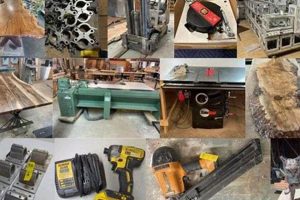
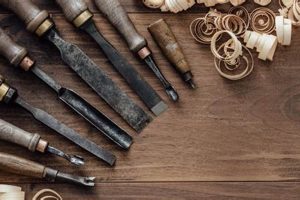
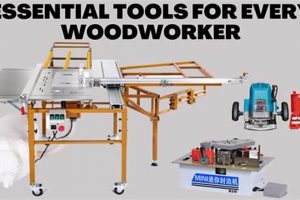
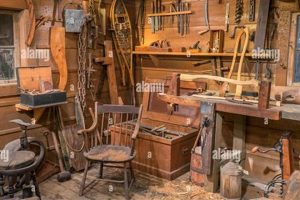
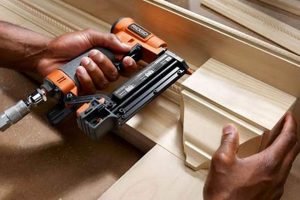
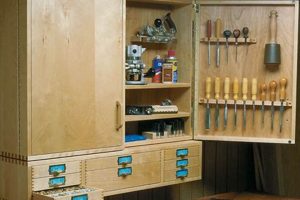
Instruments employed to shape, cut, join, and finish wood represent a fundamental aspect of the craft. These implements, ranging from simple hand-operated devices to complex power machinery, enable the transformation of raw timber into refined objects. A handsaw, for example, is utilized for manual cutting, while a power drill facilitates the creation of precise holes for joinery.
The selection and skillful application of these instruments are critical to the quality and efficiency of any woodworking project. The historical evolution of these instruments mirrors advancements in materials science and manufacturing techniques, leading to enhanced precision and productivity. Mastery of their use allows for the creation of durable, aesthetically pleasing, and functional items.
Subsequent sections will delve into specific categories, encompassing both manual and power-driven varieties, and exploring their applications within diverse woodworking disciplines. The discussion will also address essential maintenance procedures to ensure longevity and optimal performance.
Essential Usage Guidelines
The proper utilization of implements is paramount for achieving precision, safety, and desired outcomes in woodworking endeavors. Adhering to specific guidelines can significantly enhance the quality and longevity of finished projects, while also minimizing the risk of injury.
Tip 1: Sharpness is paramount. Dull edges require excessive force, increasing the likelihood of errors and accidents. Regular honing and sharpening of blades are essential for clean cuts and controlled operation.
Tip 2: Select the appropriate instrument for the task. Using a chisel as a screwdriver, for instance, risks damage to both the instrument and the workpiece. Refer to manufacturer guidelines for recommended applications.
Tip 3: Employ proper safety equipment. Eye protection, hearing protection, and dust masks are non-negotiable when operating power machinery. Ensure adherence to all relevant safety protocols.
Tip 4: Practice secure clamping techniques. Workpieces must be firmly secured to prevent movement during cutting or shaping operations. Utilize clamps appropriate for the size and shape of the material.
Tip 5: Maintain instruments diligently. Regular cleaning, lubrication, and proper storage are vital for preventing rust, corrosion, and premature wear. Consult manufacturer recommendations for specific maintenance procedures.
Tip 6: Understand grain direction. Cutting against the grain can lead to tear-out and splintering. Careful observation of grain orientation is crucial for achieving smooth, clean surfaces.
Tip 7: When using powered variants, use the correct speed. Some operations require high speed, while others, such as sanding, benefit from lower speeds to prevent burning the wood.
Implementing these guidelines contributes significantly to the creation of high-quality woodworking projects, reduces the risk of injury, and extends the lifespan of these essential implements. Consistent adherence to these principles ensures both safety and precision in all woodworking activities.
The subsequent section will explore specific applications of implements in various woodworking projects, providing detailed instructions and best practices for achieving optimal results.
1. Hand Tools

Hand tools represent a foundational category within the broader spectrum of implements employed in woodworking. Their enduring relevance stems from their capacity to provide tactile feedback, precision, and control, particularly in intricate or delicate operations. These manually operated instruments serve as direct extensions of the craftsperson’s skill, enabling a nuanced interaction with the material.
- Chisels and Planes: Shaping and Smoothing
Chisels, with their sharpened edges, are indispensable for shaping wood, creating joints, and removing waste material. Planes, both bench planes and specialty planes, are used to smooth surfaces, flatten boards, and create precise profiles. A cabinetmaker, for instance, relies on a sharp chisel to pare the tenon of a mortise and tenon joint, ensuring a snug and secure fit. Similarly, a smoothing plane is utilized to achieve a glass-like surface on a tabletop before finishing.
- Saws: Dividing and Shaping Material
Hand saws, including crosscut saws, rip saws, and backsaws, are essential for dividing wood and cutting it to size. The choice of saw depends on the type of cut being made a rip saw is designed for cutting along the grain, while a crosscut saw is used for cutting across the grain. A dovetail saw, a type of backsaw with fine teeth, is specifically designed for creating the intricate joinery in dovetail joints, commonly found in drawers and boxes.
- Measuring and Marking: Ensuring Accuracy
Accurate measurement and marking are critical for achieving precision in woodworking projects. Hand tools such as rulers, squares, marking gauges, and compasses are used to transfer dimensions from plans to the workpiece and to ensure that cuts and joints are square and true. A marking gauge, for example, is used to scribe a line parallel to the edge of a board, providing a consistent reference for cutting dovetails or rabbets.
- Boring and Fastening: Creating Holes and Joints
Braces and hand drills are employed to create holes for screws, dowels, and other fasteners. Screwdrivers are used to drive screws, securing joints and components. A brace and bit can be used to drill a large-diameter hole for a mortise, while a hand drill is suitable for smaller pilot holes. The selection of appropriate boring and fastening implements is essential for creating strong and durable joints.
The proficiency in using hand tools is an integral component of woodworking mastery. These implements, while seemingly simple, offer a direct connection to the craft, enabling a level of control and precision that is often unattainable with power tools. Their continued relevance in modern woodworking underscores their enduring value in shaping and crafting wood.
2. Power Tools

Power tools represent a significant advancement in woodworking implements, enhancing efficiency and precision across a broad range of tasks. Their integration into the woodworking process has transformed production capabilities and enabled the execution of complex designs with greater ease.
- Routers and Shapers: Edge Profiling and Shaping
Routers and shapers utilize high-speed rotating cutters to create intricate edge profiles, grooves, and decorative elements. Routers are typically handheld or table-mounted, offering versatility for various projects. Shapers, on the other hand, are stationary machines designed for more substantial and repetitive tasks. A cabinetmaker might employ a router to create a decorative edge on a tabletop or a shaper to produce consistent profiles on multiple cabinet doors. The precision and speed offered by these implements make them indispensable for achieving professional-grade results.
- Sanders: Surface Preparation and Finishing
Power sanders, including orbital sanders, belt sanders, and spindle sanders, streamline the process of surface preparation and finishing. Orbital sanders are used for general smoothing and removing imperfections, while belt sanders are more aggressive and suitable for rapid material removal. Spindle sanders are designed for sanding curved surfaces and intricate shapes. A woodworker might use a belt sander to flatten a rough board, followed by an orbital sander to achieve a smooth, paint-ready surface. The efficiency and consistency of power sanders significantly reduce the time and effort required for surface preparation.
- Saws: Precision Cutting and Material Division
Power saws, encompassing table saws, miter saws, band saws, and circular saws, provide efficient and accurate material division. Table saws are the workhorse of the shop, used for ripping boards and making precise crosscuts. Miter saws offer angled cuts for joinery and trim work. Band saws are ideal for cutting curves and intricate shapes. Circular saws provide portable cutting solutions for on-site applications. A furniture maker may employ a table saw to cut lumber to specific dimensions, a miter saw to create precise angles for a picture frame, and a band saw to shape curved legs for a table.
- Drills and Drivers: Hole Creation and Fastening
Power drills and drivers streamline the process of creating holes and driving fasteners. Drills are used to create pilot holes, countersink holes, and bore larger openings. Drivers, including impact drivers, provide increased torque for driving screws and bolts. A carpenter might use a drill to create pilot holes for screws when assembling a cabinet frame and an impact driver to secure the frame members with lag bolts. The speed and power of these implements significantly reduce the time and effort required for assembly.
The integration of power tools into woodworking has revolutionized the craft, enabling increased production speed, improved precision, and the execution of complex designs. While hand tools retain their importance for detailed work, power tools offer unparalleled efficiency and consistency for a wide range of woodworking tasks, solidifying their position as essential implements in the modern woodworking shop.
3. Measuring Instruments

The connection between measuring instruments and woodworking implements is fundamental, representing a causal relationship where the precision and accuracy of measurements directly influence the quality and outcome of any woodworking project. Inaccurate measurements inevitably lead to errors in cutting, shaping, and joining, resulting in structural weaknesses, aesthetic flaws, and ultimately, a compromised final product. The utilization of appropriate measuring instruments is not merely a procedural step but an integral component of skilled woodworking practice.
Consider, for example, the construction of a cabinet. If the dimensions of the cabinet carcass are not precisely measured and transferred to the wood, the resulting structure may be out of square, making it difficult to install doors and drawers correctly. Similarly, when cutting dovetail joints, accurate measurements are critical to ensure a snug fit and structural integrity. Calipers, micrometers, and precision squares are frequently used in high-end woodworking to achieve tolerances of less than a millimeter. The selection of measuring instruments depends on the required precision of the project.
In summary, the integration of precise measuring instruments is indispensable for achieving successful woodworking outcomes. While skilled craftsmanship plays a vital role, inaccurate measurements negate even the most refined techniques. Understanding the limitations and capabilities of different measuring instruments, coupled with meticulous application, remains a cornerstone of high-quality woodworking. Neglecting this aspect presents a significant challenge and a common source of errors, ultimately impacting the durability and aesthetic appeal of the finished product. The careful selection and skillful employment of measuring instruments are, therefore, intrinsically linked to the broader theme of mastering woodworking implements.
4. Sharpening equipment

The efficacy of any woodworking instrument predicated on a cutting edge is inextricably linked to the quality of its sharpening. Dull edges compromise precision, increase the risk of accidents, and diminish the overall quality of the work. Sharpening equipment, therefore, constitutes an indispensable component within the broader context of implements employed in woodworking.
- Whetstones and Honing Steels: Maintaining Edge Keenness
Whetstones, available in natural and synthetic materials with varying grits, are used to restore and refine cutting edges. Honing steels, typically made of hardened steel or ceramic, are employed to realign the edge between sharpening sessions. A woodworker uses a coarse whetstone to remove nicks and reshape a damaged chisel edge, followed by finer grits to achieve a razor-sharp finish. The regular use of a honing steel maintains the edge’s sharpness, extending the intervals between full sharpening sessions. The sharpness of the instrument directly correlates to the ease and cleanliness of the cut.
- Grinding Wheels: Initial Shaping and Repair
Grinding wheels, either powered or manually operated, serve to initially shape new tools or repair damaged edges. These wheels are typically made of abrasive materials such as aluminum oxide or silicon carbide. When a chisel has a severely damaged or rounded edge, a grinding wheel is employed to restore the proper bevel angle. However, grinding generates heat, which can alter the temper of the steel if not carefully controlled. Therefore, grinding is often followed by honing on whetstones to refine the edge and remove any heat-induced imperfections.
- Lapping Plates: Flattening Whetstones
Lapping plates, made of diamond or cast iron, are used to maintain the flatness of whetstones. Whetstones gradually wear unevenly with use, compromising their ability to produce flat, consistent bevels. A woodworker periodically uses a lapping plate with an abrasive slurry to flatten the surface of the whetstone, ensuring that it remains an accurate sharpening platform. A flat whetstone is essential for creating consistently sharp edges and maintaining the geometry of the tool’s bevel.
- Specialized Sharpening Jigs: Ensuring Consistent Angles
Specialized sharpening jigs are designed to hold woodworking tools at a consistent angle during the sharpening process. These jigs are particularly useful for sharpening chisels and plane irons, ensuring that the bevel angle remains uniform. A woodworker may use a sharpening jig to hold a chisel at a 30-degree angle while honing it on a whetstone, guaranteeing a consistent bevel and optimal cutting performance. These jigs assist in replicating results and removing any user error from the equation.
These facets of sharpening equipment underscore its integral role in the effective use of all woodworking implements relying on a cutting edge. Sharpness directly impacts both the quality of the cut and the safety of the operation, while meticulous maintenance through appropriate sharpening practices ensures prolonged instrument lifespan and performance. Consistent application of sharpening techniques remains indispensable for any practitioner seeking to achieve precision and excellence in woodworking.
5. Joinery

Joinery, the art and science of connecting pieces of wood, relies directly on a specific subset of implements designed for precision and structural integrity. The effectiveness of any joint is intrinsically linked to the appropriate selection and skillful application of these tools, representing a crucial intersection within the broader landscape of implements used in woodworking.
- Mortise and Tenon Joint: Strength Through Interlocking
The mortise and tenon joint, a classic example of robust joinery, requires tools such as mortise chisels, tenon saws, and marking gauges. The mortise chisel, characterized by its thick blade, is used to remove waste material from the mortise, while the tenon saw creates the precise cuts for the tenon. Marking gauges ensure accurate layout of both components, vital for a tight and secure fit. The success of this joint hinges on the precise execution facilitated by these implements.
- Dovetail Joint: Aesthetic and Structural Integrity
Dovetail joints, renowned for their strength and visual appeal, demand specialized implements such as dovetail saws, chisels, and marking knives. The dovetail saw, with its fine teeth and maneuverability, allows for the creation of the intricate dovetail pattern. Chisels are then used to remove waste material and refine the joint. Marking knives provide the necessary precision for laying out the dovetails. A properly executed dovetail joint showcases both the craftsman’s skill and the capability of the implements used.
- Lap Joint: Simple and Versatile Connection
Lap joints, characterized by overlapping pieces of wood, are often created using implements like saws, chisels, and planes. Saws are used to cut the overlapping sections, while chisels and planes refine the surfaces to ensure a flush fit. This type of joinery is frequently used in applications where strength is less critical than ease of construction and the tools are selected for their ability to efficiently remove material and create flat, even surfaces.
- Miter Joint: Angled Connections for Frames and Trim
Miter joints, used to create angled connections in frames and trim work, require precise cutting implements such as miter saws, miter boxes, and measuring tools. The miter saw, with its adjustable angle settings, ensures accurate cuts for creating seamless corners. Miter boxes, often used with hand saws, provide a guide for achieving precise angles. Measuring tools are crucial for determining the correct lengths of the pieces being joined. The effectiveness of a miter joint relies on the accuracy and repeatability offered by these implements.
These examples illustrate the direct dependency of joinery on the appropriate implements. The skillful selection and application of these tools dictate the strength, precision, and aesthetic qualities of the joints, ultimately influencing the durability and visual appeal of the finished woodworking project. Mastery of joinery, therefore, requires a thorough understanding of both the principles of joint design and the capabilities of the implements used to create them.
6. Finishing
The application of finishes represents the concluding stage in woodworking, a process intrinsically linked to a specific array of implements. The selection and skillful use of these tools directly influence the appearance, durability, and protective qualities of the final product.
- Sprayers: Uniform Coating Application
Sprayers, including HVLP (High Volume Low Pressure) and airless models, facilitate the uniform application of finishes such as lacquers, varnishes, and paints. HVLP sprayers, for example, minimize overspray and provide a fine, consistent finish on furniture, while airless sprayers offer greater material delivery for larger projects like cabinets. The proper selection and calibration of spraying equipment are essential for achieving a professional-grade finish free from drips, runs, and uneven coverage.
- Brushes and Pads: Controlled Finish Delivery
Brushes, available in natural and synthetic bristles, and application pads, such as foam and microfiber, allow for controlled application of finishes, particularly stains, oils, and polyurethanes. A high-quality brush ensures smooth, even coverage on intricate details, while application pads provide a lint-free finish on flat surfaces. The choice of brush or pad depends on the viscosity and application requirements of the specific finish.
- Sandpaper and Abrasives: Surface Preparation and Smoothing
Sandpaper, ranging from coarse to ultra-fine grits, and abrasive pads are indispensable for surface preparation and inter-coat smoothing. Sanding removes imperfections, creates a smooth base for finish adhesion, and knocks down raised grain. A progression of sandpaper grits, from coarse to fine, is used to achieve a flawless surface before the application of a final finish. Abrasive pads provide a gentler alternative for smoothing between coats of finish without aggressive material removal.
- Buffing and Polishing Wheels: Enhancing Sheen and Clarity
Buffing and polishing wheels, typically made of cloth or foam, are used to enhance the sheen and clarity of cured finishes. Buffing compounds, ranging from coarse to fine, remove swirl marks and imperfections, revealing a deep, lustrous finish. Polishing wheels, used with polishing compounds, further refine the surface, creating a mirror-like shine. These implements are commonly used on high-end furniture and musical instruments to achieve a flawless, professional-grade appearance.
The symbiotic relationship between finishing materials and the implements used to apply them underscores the importance of considering both aspects when aiming to achieve a high-quality result. Understanding the properties of various finishes, coupled with the skillful application of appropriate tools, ensures optimal protection, aesthetic appeal, and longevity of the finished woodworking project.
Frequently Asked Questions
This section addresses common inquiries regarding implements employed in the craft of woodworking, offering clarity on usage, maintenance, and selection criteria.
Question 1: What are the fundamental distinctions between hand tools and power tools in woodworking?
Hand tools rely on manual operation, offering precision and control for intricate tasks. Power tools utilize mechanical or electrical power, enhancing efficiency and speed for larger-scale operations. The choice depends on the specific requirements of the project and the desired level of control.
Question 2: How frequently should woodworking instruments requiring a sharp edge be sharpened?
Sharpening frequency depends on the type of wood being worked, the intensity of use, and the quality of the tool steel. A noticeable decline in cutting performance indicates the need for sharpening. Regular honing can extend the intervals between full sharpening sessions.
Question 3: What safety precautions are essential when using power implements in a woodworking environment?
Eye protection, hearing protection, and dust masks are mandatory. Workpieces must be securely clamped. Operators should be thoroughly familiar with the operating procedures and safety features of each power tool. Adherence to manufacturer’s guidelines is crucial.
Question 4: How does the selection of measuring implements impact the quality of woodworking joinery?
Precise measurements are crucial for tight-fitting and structurally sound joints. Inaccurate measurements lead to gaps, misalignment, and weakened connections. High-precision joinery necessitates the use of calipers, micrometers, and precision squares.
Question 5: What are the key considerations when choosing between different types of wood finishing sprayers?
HVLP (High Volume Low Pressure) sprayers are suitable for fine finishes with minimal overspray, while airless sprayers offer higher material delivery for larger surfaces. The viscosity of the finish and the size of the project dictate the appropriate sprayer type.
Question 6: How can the longevity and optimal performance of woodworking implements be ensured?
Regular cleaning, lubrication, and proper storage are essential. Cutting instruments should be kept sharp. Power implements should be maintained according to manufacturer’s recommendations. Avoid subjecting implements to excessive force or misuse.
Proper maintenance, diligent sharpening, and judicious selection of implements are all essential for safe, precise, and high-quality results.
The following section will conclude the examination of implements in woodworking.
Conclusion
The preceding examination of instruments fundamental to woodworking reveals a landscape characterized by both tradition and innovation. The instruments employed, ranging from hand-operated implements to advanced power machinery, directly influence the precision, efficiency, and aesthetic qualities of the finished product. This analysis underscores the critical relationship between instrument selection, proper maintenance, and skilled application.
Continued advancements in materials science and manufacturing techniques promise further refinements in implement design and functionality. The pursuit of excellence in woodworking necessitates a commitment to ongoing education, meticulous practice, and a thorough understanding of the capabilities and limitations of the diverse implements available to the modern practitioner. Mastery of these implements remains central to realizing the full potential of the craft.