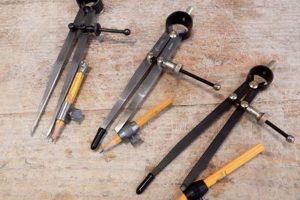
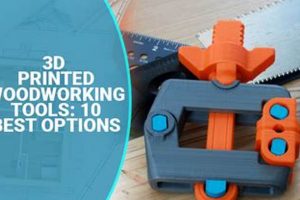
Instruments employed to determine dimensions, angles, and spatial relationships in the context of shaping wood constitute a critical component of the craft. These devices, encompassing rulers, squares, gauges, and protractors, among others, facilitate accurate marking, cutting, and assembly of wooden components. An example is a steel rule, which provides linear measurement for precise cuts, or a combination square, used to ensure perpendicularity between surfaces.
The precision afforded by these instruments directly impacts the quality and longevity of finished products. Accurate measurements minimize errors, reduce material waste, and enhance structural integrity. Historically, the evolution of these tools has paralleled advancements in woodworking techniques, allowing for increasingly complex and refined designs. The adoption of standardized units of measure, such as inches or millimeters, has further enhanced interoperability and consistency in woodworking projects.
Subsequent sections will delve into specific categories of devices, detailing their functionality, application, and appropriate usage. Focus will be given to tools used for linear measurement, angle determination, marking outlines, and assessing thickness and depth. Furthermore, advanced digital and laser-based technologies and how they have impacted the field will also be addressed.
Tips for Accurate Woodworking Measurement
Precise dimensioning is fundamental to successful woodworking projects. Employing proper techniques and maintaining measurement instruments ensures accuracy and minimizes errors in the final product.
Tip 1: Calibrate Instruments Regularly: Verify accuracy of squares, rules, and gauges against a known standard before each project. Small discrepancies can compound over multiple cuts, leading to significant errors.
Tip 2: Maintain Consistent Tension: When using a tape measure, apply consistent tension to avoid sag or stretch. This is particularly important when measuring longer distances. Use the “hook” at the end of the tape measure appropriately, either pushing for inside measurements or pulling for outside.
Tip 3: Prioritize Sharp Marking Tools: Employ sharp pencils or marking knives to create fine, visible lines. A dull marking implement will produce imprecise lines, introducing potential for inaccuracies.
Tip 4: Double-Check Critical Dimensions: Before committing to a cut, always verify measurements at least twice. This simple practice can prevent costly mistakes and material waste.
Tip 5: Consider Environmental Factors: Wood expands and contracts with changes in humidity. Account for this when working with hygroscopic materials, particularly in environments with fluctuating moisture levels. Allow the material to acclimatize to the workshop conditions before taking final measurements.
Tip 6: Utilize Reference Surfaces: When marking or measuring, use a known flat surface as a reference point. This will help ensure that measurements are taken accurately and consistently.
Tip 7: Understand Tool Limitations: Every measurement instrument has its limitations. Be aware of the potential for error inherent in each tool and select the most appropriate device for the task at hand. For example, a digital caliper provides greater precision than a standard ruler for small measurements.
Adhering to these tips will improve the precision and accuracy of woodworking projects, leading to enhanced quality and reduced material waste. Consistent and conscientious application of these practices will contribute to superior craftsmanship.
The subsequent section will discuss advanced instruments and techniques that offer even greater precision in woodworking measurement.
1. Precision
In woodworking, precision refers to the degree of accuracy and repeatability with which dimensions are determined and transferred. The selection and application of instruments directly impact the level of precision achievable in any project. Deviation from prescribed dimensions, even marginal errors, can accumulate and compromise the structural integrity, aesthetic appeal, and overall functionality of the final product.
- Instrument Calibration and Accuracy
Calibration is the process of ensuring that dimensioning instruments conform to accepted standards. Regular calibration is essential for maintaining accuracy, which directly affects the precision of measurements. A miscalibrated instrument introduces systematic errors, leading to inconsistencies and inaccuracies in the woodworking process. Example: A steel ruler with worn or faded markings will produce less accurate measurements compared to a laser distance meter, which offers greater resolution and reduced potential for parallax error.
- Resolution and Scale Increment
The resolution of an instrument refers to the smallest unit of measure it can reliably discern. A higher resolution enables finer measurements and greater precision. Scale increment refers to the spacing between markings on the dimensioning instrument; finer increments allow for more precise readings. For example, a digital caliper with a resolution of 0.01 mm offers greater precision than a standard ruler with millimeter increments. This is crucial when creating precise joints or fitting components to exacting tolerances.
- Material Stability and Thermal Expansion
Environmental conditions can influence the stability of instruments and the materials being measured. Temperature fluctuations can cause expansion or contraction, affecting the accuracy of measurements. High-quality instruments are manufactured from materials with low thermal expansion coefficients to minimize these effects. Similarly, wood itself is subject to dimensional changes due to variations in moisture content. Precision relies on understanding and mitigating these material properties through acclimatization and appropriate instrument selection. Example: Using an Invar scale, made of a low-expansion alloy, provides higher precision than a standard steel rule when measuring across temperature gradients.
- User Technique and Skill
Even with high-precision instruments, the user’s technique plays a significant role in achieving accurate measurements. Factors such as parallax error, consistent application of pressure, and proper alignment of the instrument can affect the results. Skilled users are trained to minimize these sources of error through careful observation and consistent methodology. Example: A novice woodworker may misread a vernier scale due to parallax, while an experienced user will position their eye directly perpendicular to the scale to obtain an accurate reading.
Achieving precision in woodworking necessitates a comprehensive approach encompassing instrument selection, calibration, material considerations, and user technique. The interconnectedness of these facets underscores the importance of understanding the limitations and capabilities of these devices in order to maximize their effectiveness and obtain superior results. Employing digital dimensioning instruments with high resolutions and automated data logging, paired with skilled operators familiar with best practices in measurement technique, maximizes precision.
2. Calibration

Calibration, the process of verifying and adjusting the accuracy of dimensioning instruments, is a cornerstone of precise woodworking. Its importance stems from the inherent imperfections present in manufacturing processes and the potential for wear and tear during usage. Regular calibration ensures that these instruments provide reliable and consistent measurements, minimizing errors and promoting quality craftsmanship.
- Standards Traceability
Calibration relies on traceability to recognized measurement standards, typically maintained by national metrology institutes. Instruments are compared against these standards, and any deviations are recorded and corrected. This ensures that measurements are consistent and comparable across different locations and time periods. In woodworking, this means that a measurement taken with a calibrated ruler in one workshop will correspond closely to the same measurement taken with a calibrated ruler in another. Without standards traceability, discrepancies can arise, leading to misaligned joints and dimensional inaccuracies.
- Frequency of Calibration
The frequency with which instruments must be calibrated depends on several factors, including the type of instrument, the frequency of use, and the criticality of the measurements being taken. High-precision instruments, such as digital calipers and angle finders, typically require more frequent calibration than simpler instruments like steel rulers. Instruments that are subjected to heavy use or exposed to harsh environments may also need more frequent attention. Establishing a calibration schedule is a proactive measure to maintain accuracy and prevent costly errors. An example is to calibrate a digital height gauge weekly in a high-production environment or quarterly in a small workshop.
- Calibration Methods
Different types of tools require different calibration methods. A steel ruler can be checked against a master gauge or a calibrated laser measurement system. A square can be verified using a precision reference square or a granite surface plate. Digital instruments often require specialized calibration equipment and software. It is important to use the appropriate calibration method for each instrument to ensure accurate results. In woodworking, a combination square is commonly calibrated by checking its accuracy against the edge of a known square and adjusting the blade until it is perfectly perpendicular.
- Impact of Environmental Factors
Temperature, humidity, and other environmental factors can influence the accuracy of dimensioning instruments. Thermal expansion, for example, can cause metal rulers to change in length. Moisture can affect the dimensions of wood, making it difficult to obtain accurate measurements. Calibration should ideally be performed under controlled environmental conditions to minimize these effects. When this is not possible, corrections may need to be applied to account for environmental variations. A skilled woodworker will allow materials to acclimatize and calibrate tools in an environment that matches the working conditions, ensuring more accurate results.
The impact of rigorous calibration on woodworking projects cannot be overstated. While seemingly tedious, it ensures that the underlying dimensional foundation of the work is reliable and trustworthy. Instruments that adhere to recognized standards for calibration ensure that woodworkers create pieces that adhere to their plans. This ultimately results in better quality, less wasted material, and greater personal satisfaction.
3. Durability

In the context of instruments for determining size and shape in woodworking, durability refers to the capacity of these implements to withstand the rigors of a workshop environment and maintain accuracy over extended periods of use. The investment in robust implements translates directly into reduced replacement costs and consistent measurement reliability, influencing the long-term efficiency and quality of woodworking projects.
- Material Composition and Resistance
The materials used in the construction of measurement implements directly impact their ability to withstand mechanical stress, chemical exposure, and environmental factors. High-carbon steel, hardened alloys, and stabilized polymers offer superior resistance to bending, corrosion, and impact damage, ensuring that dimensioning implements retain their shape and accuracy over prolonged use. For example, a rule crafted from spring-tempered steel resists deformation better than one made from softer metals, maintaining its precision even after repeated bending or accidental drops.
- Design and Structural Integrity
The physical design and internal construction of dimensioning implements contribute significantly to their overall durability. Reinforced frames, robust joint mechanisms, and protective coatings enhance resistance to stress and prevent premature failure. A combination square featuring a precisely machined and securely fastened head will maintain its perpendicularity better than one with a loosely fitted or poorly constructed head, ensuring consistent accuracy in layout and marking operations. Similarly, digital dimensioning implements benefit from sealed housings to protect internal electronics from dust and moisture ingress.
- Wear and Tear Resistance
Surfaces that are subject to frequent contact or friction, such as the edges of dimensioning implements or the scales on measuring tapes, must exhibit high wear resistance to maintain accuracy over time. Hardened surfaces, engraved markings, and protective coatings prevent the degradation of critical features, ensuring that these instruments continue to provide reliable measurements even after extensive use. For example, a marking knife with a hardened steel blade will maintain its sharpness longer than one with a softer blade, allowing for consistent and precise marking on wood surfaces.
- Environmental Resilience
Workshops can be harsh environments, exposing dimensioning implements to temperature fluctuations, humidity, and dust. Instruments designed for woodworking should be resilient to these factors, with features such as rust-resistant coatings, sealed mechanisms, and stable materials that minimize the effects of environmental conditions. A digital caliper with an IP rating for dust and water resistance will perform more reliably in a dusty or humid workshop than one without such protection, ensuring accurate measurements regardless of the environmental conditions.
The selection of durable measurement implements is a strategic decision that impacts the longevity, accuracy, and cost-effectiveness of woodworking projects. By choosing tools constructed from robust materials, designed for structural integrity, and resilient to environmental factors, woodworkers can ensure reliable performance and minimize the need for frequent replacements. Prioritizing durability translates into consistent measurement accuracy and enhanced efficiency in the workshop.
4. Versatility

The characteristic of versatility, concerning instruments for determining size and shape in woodworking, refers to the capacity of a single tool to perform multiple dimensioning-related tasks. The presence of versatility within a dimensioning implement reduces the number of tools a woodworker must possess, leading to greater efficiency, reduced clutter, and potentially lower costs. A direct consequence of a versatile tool is the simplification of workflows by obviating the need to switch between specialized instruments for different measurement tasks. For instance, a combination square, incorporating a ruler, square, protractor, and depth gauge, exemplifies versatility by enabling the user to measure lengths, verify right angles, mark angles, and determine the depth of recesses with a single instrument. This contrasts with needing separate instruments for each of these distinct operations.
Further analysis reveals that versatility is not merely about combining multiple functions but also about adapting to various scales and geometries. Consider a digital caliper capable of measuring both internal and external dimensions, depths, and steps. Such a device is not only versatile due to its multi-functionality but also because it can be applied to workpieces of different sizes and shapes. Similarly, a laser distance measurer can rapidly determine distances and areas in a workshop, serving as a substitute for a tape measure in many situations. Understanding the versatility of dimensioning instruments enables woodworkers to select tools that match the scope and complexity of their projects. A professional cabinetmaker, for example, might prioritize versatility in their dimensioning implements to handle the diverse range of tasks encountered in their trade, while a hobbyist might opt for simpler, less versatile tools suited to specific projects.
In conclusion, the consideration of versatility is a critical aspect of selecting dimensioning instruments for woodworking. It promotes efficiency, reduces tool clutter, and allows woodworkers to adapt to a wider range of project requirements. The challenge lies in balancing versatility with precision and specialized needs. By carefully evaluating the specific needs of their projects and the capabilities of various dimensioning implements, woodworkers can select tools that offer the optimal balance of versatility, accuracy, and durability, ultimately enhancing the quality and efficiency of their work.
5. Application
The effective application of instruments for determining size and shape in woodworking is intrinsically linked to the successful execution of any woodworking project. This connection stems from the fundamental need to translate design specifications into physical forms with precision and accuracy. The selection of an instrument is not arbitrary; rather, it is dictated by the specific task at hand, the material properties of the wood being worked, and the required level of precision. For example, the application of a simple measuring tape is suitable for rough dimensioning of stock, while a digital caliper becomes necessary for creating tight-fitting joinery with tolerances measured in fractions of a millimeter. Without appropriate application, even the most precise instruments are rendered ineffective, leading to inaccuracies and compromised structural integrity.
A direct result of a considered instrument application is the minimization of material waste and the reduction of rework. A woodworker employing a marking gauge to scribe consistent lines for mortise and tenon joints, for instance, ensures that all joints are of uniform size, reducing the need for shimming or adjustments during assembly. Conversely, haphazard or incorrect application, such as using a dull pencil to mark cut lines, can introduce cumulative errors that propagate throughout the project, leading to misaligned components and structural weakness. Furthermore, the proper application of these instruments extends beyond simple measurement; it encompasses the understanding of techniques such as compensating for saw kerf, accounting for wood movement, and correctly interpreting scale markings. Each of these elements contributes to the accuracy and reliability of the final product.
In conclusion, the correct application of instruments for determining size and shape in woodworking is not merely a procedural step; it is an essential element of the woodworking process that directly impacts the quality, accuracy, and longevity of the finished piece. While instruments themselves provide the means for precise dimensioning, the knowledge and skill required to apply them effectively determine whether a project succeeds or fails. The ongoing challenge for woodworkers is to continually refine their understanding of instrument capabilities and their application techniques, ensuring the consistent production of high-quality work.
Frequently Asked Questions
This section addresses common inquiries regarding instruments employed for dimensional determination within woodworking, offering clarity on their selection, maintenance, and application.
Question 1: What constitutes the most fundamental dimensioning implement for woodworking?
The steel rule, also known as a ruler, serves as a basic yet essential implement for linear measurement. Its simplicity and accuracy make it indispensable for various tasks, from marking cut lines to verifying dimensions.
Question 2: How does one ascertain the accuracy of a square?
The accuracy of a square can be verified by comparing it against a known straight edge or a precision-machined reference square. Any deviation indicates a potential misalignment requiring correction or replacement.
Question 3: What distinguishes a marking gauge from a standard ruler?
A marking gauge, unlike a ruler, is designed for scribing lines parallel to an edge. It maintains a consistent distance, ensuring uniform markings for joinery or decorative elements.
Question 4: How frequently should digital measuring devices be calibrated?
Digital measuring devices necessitate periodic calibration, the frequency depending on usage intensity and environmental conditions. Manufacturers’ recommendations should be followed to maintain optimal accuracy.
Question 5: Is there a method to compensate for saw kerf when dimensioning wood?
Saw kerf, the material removed by the saw blade, must be considered during layout. Marking cut lines slightly offset from the desired dimension compensates for this material loss, ensuring accurate final dimensions.
Question 6: What advantages do laser dimensioning devices offer in woodworking?
Laser dimensioning devices provide rapid and accurate measurements over long distances, reducing the potential for error associated with traditional measuring methods. They are particularly useful for large-scale projects or complex layouts.
In summation, appropriate tool selection, meticulous calibration, and keen attention to factors such as saw kerf contribute to accurate dimensioning and enhanced woodworking outcomes.
The succeeding segment will explore advanced woodworking techniques related to dimensioning.
Conclusion
The preceding discourse has detailed the critical role of instruments for determining size and shape in woodworking, underscoring the significance of precision, calibration, durability, versatility, and appropriate application. From rudimentary rules to sophisticated digital systems, these devices constitute the foundation upon which accurate and reliable woodworking projects are built. The selection and conscientious use of these tools are paramount to minimizing waste, ensuring structural integrity, and achieving aesthetic excellence.
Continued advancement in woodworking technology necessitates a perpetual refinement of understanding and technique in metrology. Woodworkers are encouraged to pursue ongoing education in measurement best practices and to adopt innovative solutions as they emerge. The ultimate success of any woodworking endeavor is inextricably linked to the precision afforded by these tools, solidifying their position as indispensable assets within the craft.