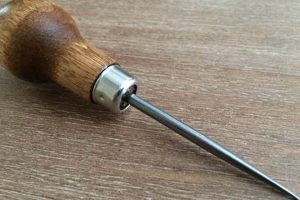
A hand tool employed in woodworking, particularly for transferring measurements, creating parallel lines, or marking cut lines with precision, consists of a sharp point or blade affixed to an adjustable beam or stock. Its primary function is to create a visible and accurate line on wood surfaces, serving as a guide for sawing, chiseling, or other woodworking operations. For example, it can precisely transfer the width of a mortise onto the corresponding tenon, ensuring a snug and accurate fit.
Accuracy in woodworking is paramount, and this instrument facilitates the achievement of precise dimensions and consistent results. Historically, the ability to create accurate joinery has been a cornerstone of quality woodworking, leading to stronger and more aesthetically pleasing finished products. The use of this marking implement helps eliminate errors caused by imprecise measuring or freehand marking, ultimately saving material and time.
Understanding the different types available, learning proper usage techniques, and appreciating its role in various woodworking applications are essential for any woodworker seeking to elevate the quality and precision of their craft. Further exploration will delve into these aspects, providing a comprehensive overview of this indispensable tool.
Woodworking Scribe Marking Tool
Optimizing the performance and longevity of a woodworking scribe marking tool requires adherence to specific best practices. These tips will ensure accurate marking and prolong the tool’s lifespan.
Tip 1: Selection of Appropriate Tool: Consider the specific task. A wheel marking gauge excels at marking along the grain, while a pin gauge is preferable for marking across the grain. The material being worked also influences the selection; softer woods may require less pressure.
Tip 2: Maintaining Sharpness: A dull marking point produces inaccurate and inconsistent lines. Regularly hone the point or blade using a fine sharpening stone to ensure a clean, crisp mark. The frequency of sharpening depends on the type of wood and the amount of use.
Tip 3: Consistent Pressure Application: Apply firm, even pressure when scribing a line. Inconsistent pressure leads to variations in line depth and potentially inaccurate cuts. Practice on scrap wood to develop a consistent hand.
Tip 4: Following the Grain: When possible, scribe with the grain of the wood. This minimizes the risk of tear-out and produces a cleaner, more defined line. Observe the wood’s grain pattern carefully before marking.
Tip 5: Proper Storage: Store the tool in a manner that protects the marking point from damage. A dedicated tool roll or box prevents accidental dulling or breakage. Avoid storing the tool with other items that could scratch or damage the point.
Tip 6: Avoid Excessive Pressure on Hardwoods: Hardwoods require precision but can be damaged by excessive force. Start with light pressure and gradually increase until a clear mark is achieved, preventing indentation beyond the scribe line.
Consistent implementation of these techniques leads to increased accuracy, reduced material waste, and enhanced quality in woodworking projects. Proper use and maintenance are key to maximizing the tool’s potential.
The following sections will explore various applications and advanced techniques related to woodworking scribe marking tools.
1. Precision

Precision is paramount in woodworking, serving as a fundamental determinant of the final product’s quality, structural integrity, and aesthetic appeal. A woodworking scribe marking tool directly facilitates the attainment of this precision, enabling the accurate transfer of measurements and the creation of consistent, repeatable lines.
- Measurement Transfer Accuracy
The primary function of a scribe marking tool is to transfer measurements accurately from a plan, template, or existing component to the workpiece. Inaccurate transfer leads to misaligned joinery, improperly sized parts, and overall dimensional errors in the final product. The tool’s design, with its finely adjustable beam and sharp marking point, minimizes parallax and other sources of error during this process. For example, when creating dovetail joints, accurate measurement transfer is crucial for achieving tight-fitting, aesthetically pleasing results.
- Parallel Line Creation
Many woodworking operations, such as creating grooves, rabbets, or mortises, require the creation of precise, parallel lines. A scribe marking tool allows for the consistent and accurate marking of these lines, ensuring that the resulting features are uniform and correctly positioned. Variations in line spacing or parallelism can lead to structural weaknesses or visual imperfections. Consider the creation of a series of evenly spaced grooves for a cabinet back; consistent parallel lines are essential for a professional finish.
- Repeatability and Consistency
Precision also encompasses the ability to repeat measurements and markings consistently across multiple workpieces or components. A woodworking scribe marking tool, when properly adjusted and used, allows for the creation of identical lines and measurements, ensuring uniformity and interchangeability. This is particularly important in mass production or when creating multiple matching items. A furniture maker producing a set of chairs, for instance, relies on repeatable accuracy to ensure all chairs match in dimensions and form.
- Minimizing Material Waste
Accurate marking directly reduces the amount of material wasted during the woodworking process. Precise scribing allows for accurate cuts, minimizing the need for corrections and adjustments that often result in discarded material. By reducing waste, a scribe marking tool contributes to cost savings and environmental sustainability. In a project requiring multiple precisely sized pieces, accurate marking from the outset can substantially reduce the amount of wood that ends up as scrap.
The relationship between precision and the woodworking scribe marking tool is therefore symbiotic. The tool enables the attainment of precise measurements and markings, which in turn leads to improved quality, reduced waste, and enhanced efficiency in woodworking projects. Accurate use of this tool is essential for achieving professional-level results and maximizing the value of materials and time.
2. Adjustability
The adjustability of a woodworking scribe marking tool is a critical factor determining its versatility and precision in various woodworking applications. This feature allows the user to set the tool to a specific dimension, enabling the accurate transfer of measurements, creation of parallel lines, and marking of cut lines. The absence of adjustability would limit the tool to a fixed dimension, severely restricting its utility in projects requiring diverse measurements. The ability to alter the setting is therefore directly linked to the tool’s effectiveness in producing accurate and repeatable results. For example, consider crafting a series of graduated drawers; the ability to precisely adjust the scribe marking tool for each drawer’s dimensions is essential for achieving a professional fit.
The mechanical design of the adjustment mechanism varies among different types of scribe marking tools. Some utilize a simple thumbscrew that locks the beam in place, while others employ more sophisticated micro-adjustment mechanisms for finer control. The precision of the adjustment mechanism directly influences the tool’s accuracy. A loose or poorly calibrated adjustment can introduce errors, negating the benefits of the tool’s inherent precision. Furthermore, the ease of adjustment is also a consideration; a tool that is difficult to adjust accurately and quickly can be cumbersome and time-consuming to use, especially when frequent changes in settings are required. An example of this is seen in complex joinery work, where numerous precise and variable measurements must be transferred accurately onto the workpiece.
In summary, adjustability is a defining characteristic of a functional and versatile woodworking scribe marking tool. Its presence allows for accurate and repeatable marking across a range of dimensions, while its absence significantly limits the tool’s applicability. The quality and design of the adjustment mechanism directly impact the tool’s precision and ease of use. The ability to adjust this tool is thus not merely an added feature but rather an integral component that dictates its usefulness in a variety of woodworking tasks.
3. Material

The material composition of a woodworking scribe marking tool directly influences its durability, accuracy, and suitability for various woodworking applications. The choice of material for the tool’s body, marking point, and adjustment mechanisms has a cascading effect on its performance and longevity. A substandard material can lead to premature wear, inaccurate markings, and ultimately, a compromised final product. Conversely, the utilization of high-quality materials ensures the tool withstands the rigors of frequent use while maintaining its precision. For example, a marking gauge with a hardened steel point and a brass body will generally outlast and outperform one constructed from softer metals.
Specifically, the marking point’s material dictates its ability to create clean, crisp lines on different wood species. Hardwoods, such as maple or oak, require a harder, more durable marking point material to prevent rapid dulling or deformation. High-carbon steel or carbide are often employed in such cases. The body material influences the tool’s overall stability and resistance to warping or bending under pressure, impacting the accuracy of the marked lines. Brass or stabilized wood are commonly used for the body due to their dimensional stability and resistance to corrosion. Adjustment mechanisms composed of high-quality steel or brass allow for smooth, precise adjustments and maintain their setting over time, preventing slippage and inaccuracies. Poor material choice leads to inconsistent results and increased potential for errors during the marking process.
In conclusion, the material makeup of a woodworking scribe marking tool is not merely an aesthetic consideration but a critical determinant of its functionality and long-term performance. Understanding the properties of different materials and their impact on the tool’s operation is essential for selecting a tool that meets the demands of the intended woodworking tasks. While cost considerations may influence material choices, prioritizing quality materials ultimately leads to a more reliable, accurate, and durable tool, contributing to improved project outcomes and reduced material waste. Further investigation should be undertaken on Point Sharpness to support the main point.
4. Point Sharpness

Point sharpness is a critical attribute of any woodworking scribe marking tool, directly influencing the accuracy and clarity of the lines it produces. The sharpness of the marking point dictates the tool’s ability to create a fine, distinct line that serves as a precise guide for subsequent woodworking operations. A dull point, conversely, results in a wider, less defined line, increasing the potential for errors and compromising the overall quality of the finished piece.
- Clarity and Precision of Markings
A sharp point creates a clear and precise line on the wood surface. This clarity is essential for accurate sawing, chiseling, and other woodworking tasks. A fine line allows the woodworker to align tools with greater precision, minimizing the risk of overcutting or undercutting. For instance, when cutting dovetails, a sharp marking point is crucial for creating clean, accurate lines that guide the saw, resulting in tight-fitting joints. A dull point produces a fuzzy, indistinct line, making accurate alignment difficult and leading to potential errors.
- Minimizing Tear-out and Fiber Damage
The sharpness of the marking point also affects the way it interacts with the wood fibers. A sharp point cleanly severs the fibers, minimizing tear-out and preventing damage to the surrounding wood. This is particularly important when working with delicate or figured woods, where tear-out can significantly detract from the finished appearance. A dull point, on the other hand, tends to crush or tear the fibers, creating a rough or splintered edge. This can necessitate additional sanding or cleanup, increasing the overall workload and potentially altering the dimensions of the piece.
- Consistent Line Depth and Visibility
A consistently sharp point ensures a uniform line depth and visibility across the entire length of the marking. Variations in line depth can create inconsistencies in the cut, leading to uneven surfaces or misaligned joints. A sharp point maintains a consistent pressure and angle of attack, resulting in a uniform line that is easy to see and follow. Conversely, a dull point requires increased pressure to create a visible line, leading to inconsistencies in depth and potentially damaging the wood surface.
- Extending Tool Lifespan and Reducing Maintenance
While counterintuitive, maintaining a sharp point can actually extend the lifespan of the marking tool. A sharp point requires less force to create a clear line, reducing the strain on the tool’s components. This, in turn, minimizes wear and tear and prolongs the tool’s overall lifespan. A dull point, however, requires increased force, putting stress on the tool and increasing the likelihood of damage or breakage. Regular honing or sharpening of the point is therefore essential for maintaining the tool’s performance and extending its longevity.
In summary, point sharpness is an indispensable characteristic of a woodworking scribe marking tool, directly impacting the accuracy, clarity, and consistency of its markings. Maintaining a sharp point is essential for achieving professional-level results, minimizing material waste, and extending the tool’s lifespan. The investment in sharpening tools and techniques is therefore a worthwhile endeavor for any woodworker seeking to elevate the quality of their craft.
5. Ergonomics

Ergonomics, the science of designing and arranging things so people can use them safely and efficiently, directly impacts the usability and effectiveness of a woodworking scribe marking tool. The design of the handle, the tool’s weight distribution, and the ease of adjustment mechanisms all contribute to the ergonomic profile of the instrument. Poor ergonomics can lead to discomfort, fatigue, and ultimately, reduced accuracy in marking. The repetitive nature of woodworking tasks involving scribing necessitates a tool that minimizes strain on the user’s hand, wrist, and arm. For instance, a tool with a handle that is too small or has sharp edges can cause discomfort and impede precise movements, leading to inaccurate markings and potentially causing repetitive stress injuries over time.
The weight and balance of the marking tool are equally crucial. A tool that is too heavy can cause fatigue, reducing control and increasing the likelihood of errors. Conversely, a tool that is too light may lack the stability needed for precise marking. A well-balanced tool allows for smoother, more controlled movements, contributing to greater accuracy. Adjustment mechanisms that are difficult to operate can also detract from the tool’s ergonomic value. Knobs or screws that require excessive force to tighten or loosen can strain the user’s hands and wrists, particularly during extended use. User testing and iterative design processes are essential to refine the ergonomic features of these tools, ensuring they are comfortable and easy to use for a wide range of hand sizes and grip strengths. A marking gauge that features a smoothly rotating and easily locking adjustment screw allows for rapid dimension alterations without unnecessary strain.
In conclusion, ergonomics is not merely a superficial design consideration but a fundamental aspect of a woodworking scribe marking tool’s functionality. A well-designed tool that prioritizes ergonomics enhances user comfort, reduces fatigue, and promotes accuracy in marking, ultimately contributing to higher quality woodworking projects. The long-term benefits of using an ergonomically designed tool, in terms of reduced risk of injury and improved productivity, far outweigh any potential increase in initial cost. Attention to ergonomic details should be paramount in the selection and design of any woodworking scribe marking tool.
6. Durability

Durability is a critical attribute of a woodworking scribe marking tool, directly impacting its lifespan and long-term performance. A robust construction ensures the tool withstands the rigors of regular use in a woodworking environment, maintaining accuracy and functionality over an extended period. A lack of durability results in premature wear, breakage, and a reduced ability to perform accurate markings, negating the tool’s intended purpose. For example, a marking gauge with a poorly constructed head or a weak stem is prone to damage from accidental drops or impacts, rendering it unusable or inaccurate. Therefore, the connection between durability and the tool’s utility is direct and consequential.
The choice of materials and the design of the tool both contribute significantly to its overall durability. High-quality materials, such as hardened steel for the marking point and brass or dense hardwoods for the stock, provide resistance to wear and tear. A well-designed tool minimizes stress points and incorporates robust construction techniques, such as reinforced joints and sturdy locking mechanisms. For instance, a mortise gauge with a precisely machined and well-secured fence will maintain its accuracy even after repeated use, while a poorly designed version may develop play in the fence, leading to inconsistent markings. Practical applications demand a tool capable of withstanding the demands of the woodworking shop, ensuring reliable and consistent performance for the long term. Investing in a durable tool ultimately leads to cost savings by avoiding frequent replacements and minimizing errors caused by unreliable equipment.
In summary, durability is an indispensable characteristic of a woodworking scribe marking tool, influencing its longevity, accuracy, and overall value. The selection of appropriate materials and a robust design are paramount in ensuring the tool withstands the challenges of the woodworking environment. While initial cost may be a factor, prioritizing durability proves to be a worthwhile investment, leading to consistent performance and reduced replacement costs in the long run. Addressing the challenge of identifying truly durable tools necessitates careful evaluation of materials, construction techniques, and user reviews, fostering a more informed and strategic approach to tool selection.
7. Application

The specific application dictates the selection and utilization of a woodworking scribe marking tool. Different woodworking tasks necessitate varying levels of precision, adjustability, and durability in the marking implement. The tool that proves ideal for transferring dimensions in delicate joinery might be unsuitable for marking rough lumber or creating deep grooves. This cause-and-effect relationship underscores the significance of matching the tool to the task. Application, therefore, is not merely a context for the tool’s use but an integral component influencing its selection and operational parameters. For example, a fine-point marking gauge is essential for creating precisely fitted dovetail joints, whereas a beam compass is better suited for scribing large circles or arcs on tabletops.
Diverse applications highlight the practical significance of understanding the interplay between the task and the tool. In cabinetmaking, where accuracy is paramount, precision marking gauges are crucial for creating consistent reveals and ensuring tight-fitting doors and drawers. Conversely, in timber framing, where larger, rougher components are common, a robust scribe marking tool with a large capacity is necessary for transferring measurements and marking cut lines on heavy timbers. The consequence of misapplying a tool, such as using a delicate marking gauge on rough-sawn lumber, often results in inaccurate markings, tool damage, and increased material waste. Properly chosen marking implements enhance efficiency, improve accuracy, and contribute to the overall quality of the finished product.
In summary, the application of a woodworking scribe marking tool is intrinsically linked to its selection, operation, and ultimate effectiveness. Recognizing this connection enables woodworkers to choose the appropriate tool for each task, maximizing precision, minimizing errors, and achieving superior results. While factors such as material, ergonomics, and durability remain important, the intended application serves as the primary determinant in selecting the most suitable tool for a given woodworking project. A comprehensive understanding of this relationship is therefore essential for all woodworkers seeking to optimize their craft.
Frequently Asked Questions
This section addresses common inquiries and misconceptions regarding woodworking scribe marking tools, providing concise and informative answers to enhance understanding and promote effective tool utilization.
Question 1: What is the primary advantage of using a woodworking scribe marking tool compared to a pencil?
A woodworking scribe marking tool offers superior precision compared to a pencil. The fine point creates a distinct, consistent line that is easier to follow for accurate cuts, particularly in joinery.
Question 2: Can any woodworking scribe marking tool be used on any type of wood?
No. The tool’s material and design should be considered in relation to the wood type. Hardwoods require more robust marking points than softwoods to maintain sharpness and prevent bending.
Question 3: How frequently should the marking point of a woodworking scribe marking tool be sharpened?
The frequency depends on usage and the hardness of the wood. The point should be sharpened whenever the lines become less distinct or require increased pressure to create a visible mark.
Question 4: Is there a significant difference between a wheel marking gauge and a pin marking gauge?
Yes. A wheel marking gauge is generally preferred for marking along the grain, while a pin marking gauge is often better suited for marking across the grain to minimize tear-out.
Question 5: What maintenance procedures are essential for preserving the accuracy of a woodworking scribe marking tool?
Regular sharpening, proper storage to protect the marking point, and periodic cleaning to remove debris are crucial for maintaining accuracy and extending the tool’s lifespan.
Question 6: How important is adjustability in a woodworking scribe marking tool?
Adjustability is paramount for versatility. The ability to precisely set the tool to a specific dimension enables accurate measurement transfer and the creation of consistent parallel lines, critical for various woodworking operations.
Understanding these key aspects of woodworking scribe marking tools enhances the woodworker’s ability to select, use, and maintain these instruments effectively, contributing to improved project outcomes.
The next section will explore advanced techniques and applications, building upon the foundational knowledge presented herein.
Woodworking Scribe Marking Tool
This exploration has detailed the essential attributes of the woodworking scribe marking tool, emphasizing precision, adjustability, material composition, point sharpness, ergonomics, durability, and application-specific considerations. The analysis underscores the instrument’s critical role in achieving accuracy, efficiency, and quality in woodworking endeavors, directly impacting the final product’s integrity and aesthetic value.
The continuous pursuit of woodworking excellence demands a thorough understanding and skillful utilization of this fundamental tool. Mastery of the woodworking scribe marking tool and its associated techniques remains an indispensable element for woodworkers striving to elevate their craft and achieve professional-level results.