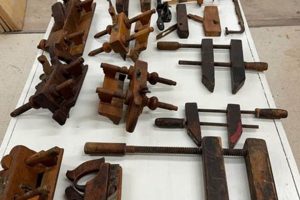
Equipment designed to perform a variety of functions in woodworking projects represents a significant investment for both hobbyists and professionals. These instruments consolidate several traditional tool capabilities into a single unit. For example, a combination machine might include a jointer, planer, saw, and shaper, enabling users to execute multiple operations with one piece of hardware.
The consolidation of functionality offers several advantages, including space conservation, reduced capital expenditure, and improved workflow efficiency. Historically, acquiring individual tools for each woodworking task represented a considerable financial burden. Multi-functional solutions mitigate this issue while also addressing limitations in workshop space, a common constraint for many woodworkers. They streamline processes, reducing setup time and facilitating smoother project progression.
The following sections will delve into specific types of these versatile instruments, examining their features, applications, and considerations for selection. Detailed analysis will be provided concerning accuracy, power, and safety aspects to guide informed purchasing decisions. Furthermore, maintenance procedures and best practices for optimal performance will be addressed.
Optimizing the Use of Multi Purpose Woodworking Tools
Effectively utilizing combination woodworking implements requires adherence to established procedures and a thorough understanding of the equipment’s capabilities. The following tips promote safe and efficient operation, extending tool life and improving project outcomes.
Tip 1: Prioritize Safety Training: Before operating any multi-functional woodworking implement, complete manufacturer-provided training and thoroughly review all safety manuals. Familiarize yourself with emergency stop procedures and proper personal protective equipment requirements.
Tip 2: Implement a Structured Maintenance Schedule: Adhere strictly to the manufacturer’s recommended maintenance schedule. This includes regular cleaning, lubrication, and inspection of all moving parts. Preventative maintenance minimizes downtime and ensures consistent performance.
Tip 3: Verify Accuracy Before Each Operation: Before initiating any cut or shaping operation, meticulously verify the alignment and calibration of the tool. Use precision measuring instruments to ensure accurate settings, minimizing errors and material waste.
Tip 4: Secure Workpiece Stabilization: Implement appropriate clamping or fixturing techniques to ensure the workpiece is securely stabilized during all operations. This prevents movement, reduces the risk of kickback, and improves the quality of the final product.
Tip 5: Utilize Proper Feed Rates and Cutting Depths: Adhere to recommended feed rates and cutting depths for the specific material being processed. Excessive force or aggressive cutting parameters can overload the motor, damage the tool, and compromise safety.
Tip 6: Choose the Right Tool Configuration: Before starting, carefully determine the optimal configuration for the task. Improper setup can lead to substandard results or even damage the machine.
Tip 7: Regularly Inspect Blades and Cutters: Routinely inspect blades and cutters for sharpness, damage, or wear. Dull or damaged tools compromise cut quality and increase the risk of accidents. Replace or sharpen as necessary.
Adherence to these recommendations maximizes the performance and longevity of multi-functional woodworking equipment while fostering a safe and efficient work environment. Consistent application of these principles translates to enhanced productivity and superior project outcomes.
The next section will explore the market’s leading options for users of “multi purpose woodworking tools”. It will provide a balanced analysis of their strengths and limitations to assist you in making the best tool purchasing decision.
1. Versatility

Versatility is a primary attribute associated with multi purpose woodworking tools. The capacity to perform a diverse array of functions within a single unit directly defines the tool’s utility and economic value. The level of versatility offered significantly influences its suitability for a given workshop and range of projects.
- Operational Range
Operational range defines the scope of woodworking tasks the tool can address. A versatile tool typically integrates functionalities such as sawing, planing, jointing, routing, and sanding. Equipment capable of handling multiple operations reduces the need for numerous individual tools, streamlining workflow and minimizing equipment footprint.
- Material Compatibility
Material compatibility refers to the tool’s capacity to process various wood types and thicknesses. Versatile tools can handle hardwoods, softwoods, and manufactured wood products like plywood and MDF. Adjustable settings and robust construction are crucial for accommodating different material properties without compromising accuracy or safety.
- Project Scalability
Project scalability is the tool’s ability to adapt to projects of varying sizes and complexities. Versatile tools offer adjustable parameters and optional accessories that enable them to handle small-scale hobby projects as well as larger, more demanding professional applications. This adaptability maximizes the return on investment.
- Configuration Flexibility
Configuration flexibility refers to the ease with which the tool can be reconfigured for different tasks. Quick and straightforward changeover mechanisms between functions are essential for maintaining efficiency. Tools with intuitive controls and easily interchangeable components minimize downtime and maximize productivity.
In summary, versatility in multi purpose woodworking tools directly correlates with operational efficiency, material adaptability, project scope, and user flexibility. Tools that maximize these aspects offer substantial advantages in terms of cost savings, space utilization, and workflow optimization within a woodworking environment.
2. Space Efficiency

Space efficiency is a critical attribute when evaluating multi purpose woodworking tools, driven by the principle that consolidating functionality reduces physical footprint. The demand for these integrated solutions arises primarily from limitations in available workspace, a common constraint in both amateur and professional woodworking settings. Acquiring individual tools for each woodworking task can quickly consume valuable floor space, rendering smaller workshops impractical for comprehensive projects. The integration of multiple functions into a single unit directly addresses this issue, effectively reducing the amount of floor area required to perform a variety of woodworking operations.
The impact of space efficiency is tangible in various real-world scenarios. For instance, a combination machine incorporating a jointer, planer, and table saw allows a woodworker to perform three distinct functions within the space typically occupied by a single, larger tool. This consolidation not only frees up floor space but also streamlines workflow by minimizing the distance between workstations. Urban workshops or home-based woodworking setups particularly benefit from this feature, as it maximizes usability within limited confines. Furthermore, the reduction in the number of individual machines translates to fewer dedicated power outlets and less complex dust collection setups, further optimizing space utilization.
In summary, space efficiency is inextricably linked to the utility and value proposition of multi purpose woodworking tools. The ability to consolidate functionality into a smaller footprint directly addresses the challenges posed by limited workspace, enhancing productivity and enabling woodworking activities in environments where individual, dedicated machines would be impractical. While versatile performance and cost savings are crucial considerations, the spatial advantage offered by these tools represents a fundamental benefit for a significant segment of the woodworking community.
3. Cost Reduction

The economic advantage presented by multi purpose woodworking tools is a significant factor in their adoption. This reduction in expenditure arises from several interconnected factors, impacting initial investment, operational overhead, and long-term financial planning.
- Initial Capital Expenditure
The primary cost reduction stems from the consolidation of multiple functionalities into a single machine. Instead of purchasing separate tools for jointing, planing, sawing, and shaping, one multi purpose unit fulfills these roles. This integrated approach substantially lowers the initial capital outlay required to equip a workshop, making woodworking more accessible to hobbyists and small businesses with limited budgets. Consider a scenario where acquiring individual tools amounts to \$10,000; a comparable multi purpose machine might be available for \$6,000, yielding immediate savings.
- Operational Cost Optimization
Multi purpose tools contribute to reduced operational expenses through decreased energy consumption and maintenance requirements. A single motor powers multiple functions, resulting in potentially lower energy bills compared to running several independent machines. Additionally, maintaining one consolidated unit generally requires fewer replacement parts and less specialized expertise than servicing a collection of individual tools, translating to reduced maintenance costs over the equipment’s lifespan.
- Space Optimization Savings
The spatial efficiency of multi purpose tools indirectly translates to cost savings. By requiring less floor space, workshops can operate within smaller premises, leading to reduced rental or mortgage costs. For home-based workshops, this can mean utilizing existing space more effectively, avoiding the need for costly expansions or dedicated outbuildings. The savings from reduced space requirements represent a long-term financial benefit accruing over the tool’s operational life.
- Time Efficiency and Labor Costs
Though not a direct monetary saving, increased time efficiency achieved through streamlined workflows indirectly contributes to cost reduction. The ability to transition between functions on a single machine without extensive setup changes saves valuable time, allowing for greater project throughput. For professional woodworkers, this increased efficiency can translate to higher billable hours and improved profitability, indirectly reducing labor costs per project.
The convergence of reduced capital investment, optimized operational costs, efficient space utilization, and improved time management underscores the comprehensive cost reduction associated with multi purpose woodworking tools. These factors collectively contribute to a more economically viable woodworking operation, benefiting both hobbyists and professionals alike.
4. Skill Requirement
The operation of multi purpose woodworking tools necessitates a higher degree of operator skill compared to single-function equipment. The consolidated nature of these machines demands proficiency in a range of woodworking techniques, as a single tool may perform functions typically executed by several specialized devices. Failure to acquire and apply the requisite skills can lead to diminished performance, compromised safety, and potential damage to both the workpiece and the equipment itself. For instance, setting up a combination machine to transition from jointing to planing requires a precise understanding of alignment and adjustment procedures, elements not necessarily encountered when operating dedicated single-purpose machinery.
Skill requirement manifests in several key areas. Firstly, a comprehensive understanding of woodworking principles is crucial, including knowledge of wood types, grain direction, and appropriate cutting parameters. Secondly, adeptness in precision measurement and setup is essential for achieving accurate and consistent results. Thirdly, familiarity with machine maintenance procedures is vital for ensuring safe and reliable operation. Consider the operation of a combination lathe/mill; the operator must possess knowledge of both turning and milling techniques, including tool selection, feed rates, and spindle speeds, to produce components that meet design specifications. Inadequate skill in any of these areas can result in material waste, inaccurate dimensions, and increased project completion time.
In summary, the effective and safe utilization of multi purpose woodworking tools is directly contingent upon the operator’s skill level. While these tools offer advantages in space efficiency and cost savings, their complexity demands a commitment to continuous learning and skill development. Woodworkers considering the acquisition of such equipment must realistically assess their current skill set and be prepared to invest time and effort in acquiring the necessary competencies to fully realize the potential of these versatile machines.
5. Maintenance Complexity

Maintenance complexity is a significant consideration when evaluating multi purpose woodworking tools. The integration of multiple functionalities within a single machine inherently increases the intricacy of maintenance procedures and the potential for specialized knowledge requirements. This complexity can impact the overall cost of ownership, downtime, and the expertise required to ensure optimal performance and longevity.
- Integrated System Diagnostics
Multi purpose machines possess interconnected systems; a malfunction in one area may affect others. Diagnosing the root cause of a problem can be more challenging due to the interdependence of components. For example, a malfunctioning motor might impact both the sawing and planing functions, requiring systematic troubleshooting to isolate the issue. This necessitates a deeper understanding of the tool’s overall architecture compared to maintaining a single-function machine.
- Specialized Component Access
The compact design of multi purpose tools often results in limited accessibility to internal components. Gaining access to specific parts for maintenance or repair may require disassembling other sections of the machine, increasing the time and effort involved. For instance, replacing a belt on a combination sander/buffer may necessitate removing multiple guards and panels, making the task significantly more complex than a simple belt replacement on a dedicated sander.
- Lubrication and Adjustment Interdependence
Maintaining proper lubrication and adjustments across various functions requires precise knowledge of the machine’s specifications. Lubrication points and adjustment mechanisms may be interconnected, meaning that improper maintenance in one area can negatively impact others. For example, over-lubricating the bearings in a jointer head may cause oil to contaminate the planer bed, affecting the quality of the planed surface. Therefore, following the manufacturer’s guidelines meticulously is crucial.
- Proprietary Parts and Service
Many multi purpose tools utilize proprietary parts, which may be difficult or expensive to acquire. Moreover, specialized service technicians may be required for certain repairs, increasing downtime and maintenance costs. This contrasts with single-function tools, where readily available generic parts and a wider range of repair options are often accessible. Manufacturers using proprietary parts and specialized service create an increased complexity of maintenance.
In summary, the maintenance complexity associated with multi purpose woodworking tools represents a trade-off between versatility and ease of upkeep. While these tools offer numerous advantages in terms of space efficiency and functionality, potential owners must carefully consider the increased demands on maintenance expertise and the potential for higher service costs. Understanding these factors is crucial for making an informed purchasing decision and ensuring the long-term viability of the tool.
Frequently Asked Questions About Multi Purpose Woodworking Tools
The following provides answers to commonly encountered questions regarding multi purpose woodworking tools, offering clarity on their capabilities, limitations, and best practices for utilization.
Question 1: What are the primary advantages of utilizing multi purpose woodworking tools?
The core benefits include reduced capital expenditure due to the consolidation of functionalities, optimized space utilization in workshops, and streamlined workflow through minimized tool changeover times.
Question 2: What are the limitations associated with multi purpose woodworking tools?
Drawbacks can include increased complexity in setup and maintenance, potential compromises in performance compared to dedicated single-function tools, and a steeper learning curve for effective operation.
Question 3: Is it more expensive to maintain multi purpose woodworking tools than single function alternatives?
Multi purpose units often require specialized maintenance expertise and proprietary parts, potentially leading to higher service costs compared to the simpler maintenance requirements of individual machines.
Question 4: Are multi purpose tools suitable for professional woodworking applications?
While capable of handling a range of professional tasks, multi purpose tools may not always match the precision, power, or specialized capabilities of dedicated industrial-grade equipment. Their suitability depends on the specific demands of the professional’s work.
Question 5: What safety precautions should be emphasized when using multi purpose woodworking tools?
Priority should be given to comprehensive safety training, adherence to manufacturer guidelines, the consistent use of personal protective equipment, and thorough inspection of all tool components before each operation.
Question 6: How does one optimize the lifespan of multi purpose woodworking equipment?
Longevity is maximized through consistent adherence to a structured maintenance schedule, proper lubrication, meticulous adjustment procedures, and prompt replacement of worn or damaged parts.
Understanding these frequently asked questions clarifies the multifaceted considerations involved in adopting multi purpose woodworking tools. These instruments represent a valuable option when space, cost, and functional integration are primary concerns, but thorough assessment of their inherent limitations and maintenance requirements is crucial.
The next section will provide a comprehensive conclusion, summarizing the advantages, disadvantages, and key decision factors related to multi purpose woodworking equipment.
Conclusion
The preceding analysis has elucidated the multifaceted nature of multi purpose woodworking tools. While offering undeniable advantages in spatial efficiency, capital expenditure reduction, and workflow streamlining, these instruments also present inherent limitations. Considerations regarding maintenance complexity, skill requirements, and potential compromises in performance relative to dedicated machinery must be carefully weighed. The judicious application of this technology hinges on a comprehensive understanding of both its capabilities and constraints.
Ultimately, the decision to integrate multi purpose woodworking tools into a workshop environment demands a rigorous assessment of specific needs and operational priorities. Prospective users are encouraged to conduct thorough evaluations, considering the trade-offs between versatility and specialization, to ensure an informed and effective implementation. Continued advancements in engineering and design may further refine the capabilities of these tools, potentially mitigating existing limitations and enhancing their overall utility in the future.