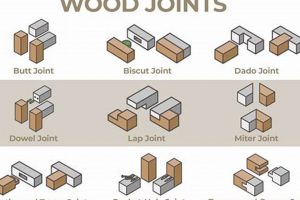
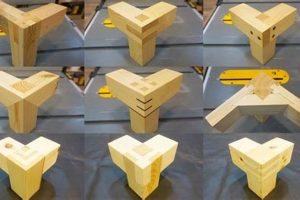
Methods of joining wood that rely solely on the shape and fit of the components, rather than mechanical connectors or chemical bonding agents, represent a foundational skill in woodworking. These techniques utilize precisely cut interlocking profiles to create strong and durable assemblies. Examples include dovetails, mortise and tenons, and various forms of lapped or shouldered joints.
These construction methods offer several advantages, including enhanced aesthetic appeal, increased joint strength due to the expanded glue surface when adhesives are used in conjunction, and a reduced reliance on potentially corrosive or environmentally harmful materials. Historically, these techniques were essential before the widespread availability of fasteners and synthetic glues, and they continue to be valued for their craftsmanship and longevity.
The following discussion will explore the principles behind effective joint design, the different types of interlocking joinery, and the tools and techniques required for their successful execution. Specific focus will be given to achieving accurate fits and maximizing structural integrity in the absence of extraneous connecting elements.
Essential Considerations for Interlocking Wood Joinery
Achieving robust and aesthetically pleasing connections through meticulously crafted joints requires adherence to fundamental principles. The following points offer guidance for successful implementation of such techniques.
Tip 1: Wood Selection and Grain Orientation: Choose wood species appropriate for the intended application. Consider grain direction relative to stress; align grain for optimal strength along load-bearing axes.
Tip 2: Precision Measurement and Marking: Accurate marking is paramount. Utilize sharp marking gauges, knives, and precise measuring tools to ensure tight-fitting joints. Discrepancies accumulate exponentially.
Tip 3: Sharp Tool Maintenance: Sharp tools are crucial for clean cuts and minimizing tear-out. Regularly hone and sharpen chisels, planes, and saws to maintain optimal performance. A dull tool increases error.
Tip 4: Test Cuts and Mock-Ups: Before committing to final workpieces, create test joints using scrap material. This allows for adjustments and refinement of technique, minimizing material waste.
Tip 5: Understanding Wood Movement: Account for wood’s natural expansion and contraction due to humidity changes. Design joints that accommodate movement without compromising structural integrity. This may involve strategically orienting grain or incorporating slight allowances.
Tip 6: Dry Fitting and Adjustment: Always dry-fit joints before final assembly. This allows for identifying and correcting any discrepancies or imperfections, ensuring a seamless and strong connection.
Tip 7: Clamping Strategies: Employ appropriate clamping pressure and techniques during assembly. Distribute pressure evenly to avoid distorting the joint or damaging the wood. Use cauls to protect delicate surfaces.
Mastering interlocking joinery techniques demands diligent practice and a thorough understanding of wood properties. By adhering to these guidelines, one can create durable and aesthetically pleasing wooden structures without relying on supplementary fasteners.
The subsequent sections will delve into the practical application of these considerations across various joint types, providing specific guidance for each method.
1. Joint Geometry

Joint geometry is fundamental to the efficacy of woodworking joints that forgo mechanical fasteners and adhesives. The shape and configuration of the interlocking components dictate the joint’s inherent strength, stability, and resistance to applied forces. A well-designed joint leverages geometric principles to maximize surface area contact, create mechanical interlocks, and distribute stress effectively.
- Surface Area and Glue Adhesion (When Applicable)
While this discussion focuses on joints without fasteners or adhesives, the principle of maximized surface area remains relevant. Even in the absence of glue, increased contact between surfaces contributes to friction and stability. In instances where minimal adhesive is used solely to prevent movement, a larger surface area allows for a more robust bond with less reliance on the adhesive’s strength alone. Geometric profiles like dovetails inherently offer more surface area compared to simple butt joints.
- Mechanical Interlock and Resistance to Tension
The primary purpose of joint geometry in this context is to create a mechanical interlock, preventing separation under tensile stress. Dovetails, mortise and tenons, and other interlocking joints achieve this by creating shapes that resist pulling forces. The geometry dictates the direction and magnitude of force the joint can withstand before failure. A tapered dovetail, for example, provides superior resistance to pullout compared to a straight-sided joint.
- Load Distribution and Stress Management
The design of a joint significantly impacts how loads are distributed across the assembled components. Sharp corners and abrupt transitions concentrate stress, making the joint prone to failure. Rounded corners and gradual transitions distribute stress more evenly. The geometry of a joint should consider the anticipated loads and be designed to minimize stress concentrations at vulnerable points. For instance, a well-proportioned mortise and tenon joint will distribute force along the entire length of the tenon, rather than concentrating it at the shoulder.
- Geometric Complexity and Precision Requirements
More complex joint geometries generally offer greater strength and stability, but they also demand higher levels of precision in their execution. Intricate joinery requires specialized tools, advanced skills, and meticulous attention to detail. The geometric complexity of a joint must be balanced against the available resources and skill level of the woodworker. A simple lap joint, while less strong than a dovetail, is easier to execute accurately and may be sufficient for certain applications.
The success of woodworking joints that rely on geometry hinges on a comprehensive understanding of these principles. A thoughtful approach to joint design, coupled with precise execution, allows for the creation of robust and enduring wooden structures without the need for external fasteners or adhesives. The study of joint geometry is therefore paramount to mastering traditional woodworking techniques and achieving structurally sound and aesthetically pleasing results.
2. Wood Properties
The inherent characteristics of wood species exert a profound influence on the design and performance of joinery that eschews fasteners and adhesives. Understanding wood properties is not merely academic; it is essential for predicting how a joint will behave under stress and over time. The interplay between wood’s physical and mechanical properties and the geometry of a joint determines its ultimate strength and stability. Different species exhibit varying degrees of hardness, density, elasticity, and moisture content, all of which directly impact the joint’s resistance to tension, compression, and shear forces. For instance, a tight-fitting mortise and tenon crafted from a stable, dense hardwood like oak will outperform the same joint executed in a softer, more pliable wood such as pine. This difference arises because the hardwood can better resist deformation under load and maintain a secure mechanical interlock.
Furthermore, wood’s anisotropic natureits tendency to shrink and swell differently along different grain orientationsdemands careful consideration when designing interlocking joinery. Joints must be engineered to accommodate these dimensional changes without compromising structural integrity. For example, when constructing a dovetail joint, the orientation of the grain in both the tail and pin components must be considered to prevent differential movement from weakening the joint. A common practice involves aligning the grain direction to minimize stress caused by seasonal moisture fluctuations. The selection of compatible wood species is also crucial; combining woods with vastly different expansion coefficients can lead to joint failure as one component shrinks or swells more than the other.
In summary, the successful implementation of woodworking joints without fasteners and adhesives necessitates a thorough appreciation of wood properties. By understanding how different species respond to environmental changes and applied forces, woodworkers can select appropriate materials and design joints that capitalize on wood’s strengths while mitigating its weaknesses. Disregarding these fundamental principles can result in unstable or short-lived structures, highlighting the critical importance of material knowledge in traditional woodworking techniques. The effective connection between wood property and woodworking joinery is one of balance and stability
3. Tool Precision

Tool precision constitutes a non-negotiable element in creating woodworking joints without fasteners and adhesives. The accuracy of the tools employed directly determines the fit and strength of the resulting joint. When mechanical fasteners or adhesives are absent, the joint relies solely on the exactness of its interlocking components. Minor deviations in measurements or imprecise cuts compromise the integrity of the joint, potentially leading to structural instability or premature failure. A poorly sharpened chisel, for example, can cause splintering or inaccurate shaping of a mortise, preventing a tight fit with the tenon. Similarly, a saw with a dull blade may wander off the marked line when cutting dovetails, resulting in gaps and a weakened joint. Therefore, maintaining sharp, well-calibrated tools is paramount to the successful execution of these joinery techniques.
The significance of tool precision extends beyond the initial cutting process. It encompasses the entire workflow, from accurately marking out the joint to ensuring the proper alignment of components during assembly. The use of precision measuring instruments, such as marking gauges and squares, is crucial for transferring dimensions accurately from the design to the workpiece. Furthermore, the careful setup and adjustment of power tools, such as routers and table saws, are essential for achieving consistent and repeatable results. In scenarios where tight tolerances are required, specialized tools like shoulder planes or rabbet planes are indispensable for fine-tuning the fit of a joint. The process of creating a snug-fitting dovetail, which relies entirely on the precision of saw cuts and chisel work, exemplifies the practical importance of tool accuracy.
In conclusion, tool precision is not merely a desirable attribute but a fundamental requirement for achieving robust and enduring woodworking joints without fasteners and adhesives. The effectiveness of these joinery methods depends directly on the accuracy and sharpness of the tools used, as well as the meticulous attention to detail throughout the entire process. By prioritizing tool maintenance, mastering precision techniques, and understanding the relationship between tool accuracy and joint integrity, woodworkers can create structures that exhibit both structural soundness and aesthetic appeal, relying solely on the strength of interlocking wood.
4. Assembly Technique

The assembly technique is critical to the ultimate success of woodworking joints devoid of fasteners and adhesives. Even the most precisely cut joint will fail if improperly assembled. The process involves more than simply fitting components together; it requires a strategic approach that accounts for wood properties, joint geometry, and potential stresses. A controlled and deliberate method is paramount to ensure proper alignment, prevent damage, and achieve the desired structural integrity. For instance, attempting to force an ill-fitting mortise and tenon joint can result in fractured tenon shoulders or a split mortise cheek, negating the benefits of accurate initial cuts. Similarly, uneven clamping pressure during the glue-up (when glue is minimally used to prevent movement) of a dovetail joint can distort the assembly, compromising its strength and appearance. Accurate assessment and strategy during the assembly process are therefore vital.
Proper assembly technique often involves a dry fitting stage where the joint is temporarily assembled without any adhesives or fasteners. This allows for identifying potential problems, making necessary adjustments, and refining the overall fit. During final assembly, careful consideration must be given to the sequence of operations. For complex assemblies, it is often beneficial to assemble sub-components separately before integrating them into the larger structure. Clamping pressure must be applied strategically, distributing force evenly across the joint surfaces. Protective cauls can be used to prevent clamp marks or damage to delicate edges. The use of mallets, hand screws and wedges assist to ensure stability as each component is added. These considerations all contribute to a strong, durable connection.
In conclusion, mastering the assembly technique is as essential as precise cutting for achieving robust woodworking joints without relying on fasteners and adhesives. A thoughtful, controlled approach, characterized by careful fitting, strategic clamping, and attention to detail, ensures that the joint functions as intended, providing long-term structural integrity. This understanding is practically significant because it highlights that the entire woodworking process, from design to assembly, is interconnected, and success depends on proficiency in each stage. Emphasis on each stage ensures a stable outcome.
5. Long-Term Stability

Long-term stability is a critical performance indicator for woodworking joints crafted without fasteners and adhesives. The absence of mechanical reinforcement places increased demands on the joint’s inherent design and construction, directly affecting its ability to withstand environmental fluctuations, stress, and prolonged use. Dimensional changes in wood, resulting from variations in humidity and temperature, can induce stress within the joint, potentially leading to loosening, cracking, or complete failure. The selected joint geometry, wood species, and execution precision collectively determine its capacity to maintain structural integrity over extended periods. For example, a poorly executed dovetail joint in a constantly changing climate may weaken as the wood expands and contracts, creating gaps between the tails and pins. In contrast, a properly designed and constructed mortise and tenon joint using a stable wood species exhibits greater resilience to these environmental stresses.
Careful consideration of wood properties and joinery techniques can significantly enhance long-term stability. Species selection plays a crucial role; hardwoods generally offer greater dimensional stability than softwoods, and certain species exhibit superior resistance to moisture absorption. Joinery design must accommodate wood movement; floating tenons or mortise-and-tenon joints with elongated mortises allow for expansion and contraction without compromising the joint’s integrity. Furthermore, precise execution minimizes stress concentrations, ensuring even load distribution across the joint surfaces. A well-fitted joint distributes stress effectively, while a poorly fitted joint concentrates stress at points of imperfection, accelerating degradation. These considerations apply equally to large-scale structural components and smaller, more intricate assemblies. The durability of historical timber-framed buildings, many of which rely solely on pegged mortise and tenon joints, provides tangible evidence of the long-term stability achievable through careful design and execution.
Ultimately, ensuring long-term stability in woodworking joints without fasteners and adhesives requires a holistic approach that integrates material selection, design principles, and precise craftsmanship. The challenges associated with accommodating wood movement and resisting environmental stresses necessitate a deep understanding of wood properties and joinery techniques. Failure to address these considerations can compromise the structural integrity of the project, resulting in costly repairs or premature failure. Therefore, prioritizing long-term stability is essential for creating durable and enduring wooden structures that stand the test of time.
Frequently Asked Questions
This section addresses common inquiries concerning the design, construction, and application of woodworking joints that rely solely on interlocking geometry for strength and stability. These answers aim to provide clarity on best practices and dispel potential misconceptions.
Question 1: What are the primary advantages of using woodworking joints without fasteners and adhesives?
Such joints offer enhanced aesthetic appeal, potential for increased long-term durability (when executed correctly), and reduced reliance on potentially corrosive or environmentally harmful materials. In certain applications, they allow for greater design flexibility and a more authentic representation of traditional craftsmanship.
Question 2: Which wood species are best suited for creating woodworking joints without fasteners and adhesives?
Dense hardwoods with tight grain patterns, such as oak, maple, and cherry, generally provide superior strength and stability. Softer woods like pine may be suitable for less demanding applications, provided the joint design compensates for their lower density and inherent pliability.
Question 3: How does wood movement affect the long-term performance of woodworking joints without fasteners and adhesives?
Wood expansion and contraction due to humidity fluctuations can induce significant stress within a joint. Properly designed joints accommodate this movement through the incorporation of floating tenons, elongated mortises, or strategic grain orientation to prevent cracking or loosening.
Question 4: What level of precision is required when creating woodworking joints without fasteners and adhesives?
A high degree of precision is essential for achieving a tight fit and maximizing joint strength. Deviations in measurements or inaccurate cuts can compromise the integrity of the joint, leading to premature failure. Sharp, well-maintained tools and meticulous execution are crucial.
Question 5: What are some common mistakes to avoid when constructing woodworking joints without fasteners and adhesives?
Common errors include inadequate planning for wood movement, imprecise cutting or marking, improper tool usage, forcing ill-fitting components, and neglecting the dry-fitting stage. Thorough preparation and careful execution are paramount to success.
Question 6: Are woodworking joints without fasteners and adhesives suitable for all types of woodworking projects?
While these joints can be employed in a wide range of applications, they may not be appropriate for projects requiring extreme strength or those subjected to high levels of stress or vibration. The specific demands of each project should be carefully evaluated to determine the suitability of this type of joinery.
The successful implementation of these techniques necessitates a comprehensive understanding of wood properties, joinery principles, and meticulous craftsmanship. Diligence and attention to detail are essential for creating robust and enduring structures.
The subsequent sections will delve into the practical application of these principles across various joint types, providing specific guidance for each method.
Conclusion
Woodworking joints without fasteners and adhesives represent a sophisticated and demanding discipline within the broader field of woodworking. This discussion has explored the critical elements necessary for achieving strong, durable, and aesthetically pleasing connections through interlocking geometry alone. The importance of wood selection, precise tool work, careful assembly techniques, and an understanding of long-term stability considerations has been emphasized. These factors collectively determine the success and longevity of structures built using these methods.
Mastery of woodworking joints without fasteners and adhesives demands continuous learning, diligent practice, and a commitment to precision. Further exploration of specific joint types and their applications, coupled with hands-on experience, will enable woodworkers to create enduring works that exemplify both craftsmanship and structural integrity. Such efforts contribute to the preservation and advancement of traditional woodworking skills and principles.