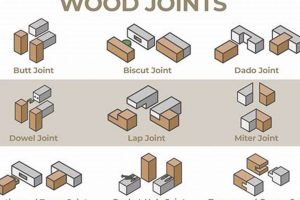
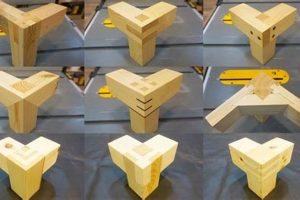
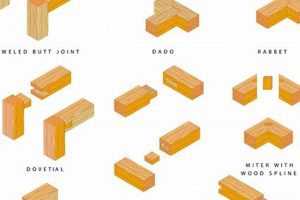
Connections between pieces of lumber or timber, vital to constructing stable and aesthetically pleasing wooden structures, encompass a broad range of techniques. These methods, varying in complexity and strength, enable the creation of furniture, buildings, and decorative objects. A basic example is the butt joint, where two surfaces are simply placed end-to-end and fastened. More intricate examples include mortise and tenon, dovetail, and mitered connections, each offering specific advantages for different applications.
The integrity of any woodwork project relies heavily on the quality of its joinery. Strong, well-executed connections ensure longevity, prevent structural failure, and contribute to the overall aesthetic appeal. Historically, artisans developed numerous sophisticated approaches to create robust and visually appealing constructions using minimal resources and leveraging the inherent properties of wood.
This article will explore several categories of these essential woodworking techniques, examining their properties, ideal use cases, and relevant considerations for selecting the appropriate method. Specific joint types, including those mentioned above, will be discussed in detail, along with considerations for adhesives and mechanical fasteners utilized in conjunction with traditional approaches.
Essential Tips for Woodworking Joints
Achieving strong and visually appealing wooden structures requires careful consideration of various joining techniques. The following tips offer guidance to improve the reliability and aesthetic quality of woodworking projects.
Tip 1: Proper Wood Selection: The choice of wood species significantly impacts joint strength. Hardwoods, such as oak and maple, provide superior resistance to stress compared to softwoods like pine and fir. Select appropriate material based on the expected load and environmental conditions.
Tip 2: Accurate Measurement and Cutting: Precision is paramount. Use sharp tools and accurate measuring instruments to ensure tight-fitting joints. Even minor discrepancies can compromise structural integrity and visual appeal. A dedicated marking gauge is highly recommended.
Tip 3: Dry Fitting Before Glue Application: Always assemble components without adhesive to confirm proper fit and alignment. This allows for corrections before permanent bonding and prevents potential issues that may arise once glue is applied.
Tip 4: Selection of Appropriate Adhesive: Different adhesives possess varying strengths and properties. Consider factors such as open time, clamping pressure requirements, and water resistance when selecting an adhesive. Polyurethane adhesives are well-suited for exterior applications.
Tip 5: Adequate Clamping Pressure: Sufficient clamping pressure is crucial for proper adhesive bonding. Use an appropriate number of clamps to ensure even distribution of force across the joint surfaces. Avoid over-tightening, which can starve the joint of adhesive.
Tip 6: Surface Preparation: Clean and prepare joint surfaces before applying adhesive. Remove any dust, debris, or oily residue that could interfere with bonding. A light sanding can improve adhesion on certain wood species.
Tip 7: Grain Direction Alignment: When possible, align the grain direction of adjoining pieces to minimize the effects of wood movement due to changes in humidity. This reduces the risk of stress cracks and joint failure.
Utilizing proper techniques, wood selection, and adhesive application will significantly enhance the strength, stability, and visual quality of woodworking projects. Mastery of these principles is critical for producing durable and aesthetically pleasing wooden structures.
The subsequent sections of this article will delve into specific examples of common woodworking connections and their practical applications.
1. Strength and Stability

The primary function of a woodworking joint is to create a structurally sound connection between two or more wooden elements. Strength, defined as the joint’s ability to withstand external forces without failure, and stability, the joint’s resistance to deformation under load, are therefore paramount. The selection of an appropriate method directly dictates the overall robustness of a finished piece. A poorly executed connection weakens the entire structure, increasing the risk of collapse or premature degradation. For example, a bookshelf constructed with inadequate joinery will be unable to support the intended weight, leading to sagging shelves and potential failure.
Several factors influence the strength and stability of a woodworking joint. These include the surface area of the bonded connection, the type and quality of adhesive used, the mechanical interlocking provided by the joint design itself, and the inherent properties of the wood species. A mortise and tenon joint, for example, offers superior strength compared to a simple butt joint due to its increased surface area and mechanical interlock. This makes it a preferred choice for structural elements like table legs or chair frames. Similarly, dovetail joints, renowned for their resistance to tensile forces, are frequently used in drawer construction to prevent separation under repeated use.
Understanding the relationship between strength, stability, and joint selection is crucial for successful woodworking. Careful consideration of the anticipated stresses, appropriate material selection, and precise execution are essential for creating durable and long-lasting wooden structures. Neglecting these factors compromises the integrity of the finished product, potentially resulting in safety hazards or functional limitations. Mastery of joinery techniques contributes significantly to the production of robust and reliable woodwork.
2. Precision of Fit

In woodworking, the degree to which components align and interface correctly is termed ‘Precision of Fit.’ Within the context of joinery, this aspect directly impacts the strength, stability, and aesthetic appeal of the finished construction. Minute deviations can lead to structural weaknesses, visual imperfections, and reduced longevity.
- Dimensional Accuracy
Dimensional accuracy refers to the conformance of component measurements to specified design values. When crafting a mortise and tenon, for example, the tenon’s thickness must precisely match the mortise’s width. Inaccurate measurements lead to a loose fit, compromising the joint’s load-bearing capacity. Conversely, an oversized tenon necessitates excessive force for assembly, potentially splitting the mortise walls.
- Surface Flatness and Smoothness
The flatness and smoothness of mating surfaces directly influence adhesive bonding. A warped or uneven surface creates gaps, reducing the contact area for the adhesive and weakening the bond. Prior to assembly, surfaces should be planed and sanded to ensure intimate contact. For example, when constructing a glued-up panel, any cupping or bowing in the individual boards will result in a structurally compromised joint.
- Angularity and Squareness
Accurate angles and squareness are critical for the overall geometry of the structure. Miter joints, in particular, require precise angular cuts to ensure a seamless transition between adjoining pieces. Inaccurate angles create visible gaps and disrupt the flow of the design. Similarly, ensuring squareness in frame construction prevents racking and maintains structural integrity.
- Consistency Across Repetitive Joints
In projects involving multiple identical joints, consistency is essential for a uniform and balanced structure. Minor variations in the fit of individual joints accumulate, leading to unevenness and structural imbalances. This is particularly important in frame-and-panel construction where variations in the mortise and tenon joints will be magnified across the panel.
These elements of precision directly correlate to the success of connections. Precise execution minimizes stress points, promotes uniform load distribution, and enhances the overall visual quality. Failure to prioritize accurate fit results in compromised structural performance, reduced lifespan, and aesthetic deficiencies. Achieving a high degree of precision demands skilled craftsmanship, appropriate tools, and meticulous attention to detail.
3. Adhesive Compatibility

Successful integration of joinery relies significantly on the proper selection of adhesive agents. The inherent properties of the chosen adhesive must complement both the type of wood used and the specific characteristics of the joint itself. Incompatibility can lead to weakened bonds, premature failure, and diminished structural integrity.
- Wood Species and Porosity
Different wood species exhibit varying levels of porosity, which directly affects adhesive penetration and bonding strength. For instance, dense hardwoods like maple require adhesives with gap-filling capabilities to compensate for limited penetration into the tight grain structure. Conversely, softwoods readily absorb adhesives, necessitating careful application to prevent over-saturation and subsequent weakening of the wood fibers. A poor adhesive choice may yield adequate initial bond strength in softwoods but degrade rapidly over time due to excessive moisture absorption.
- Joint Type and Surface Area
The configuration of the joint significantly influences the surface area available for adhesive bonding. Joints with larger contact areas, such as mortise and tenon, benefit from adhesives with longer open times, allowing ample opportunity for alignment and clamping. Conversely, intricate joints like dovetails, with complex geometries and restricted access, demand adhesives with faster setting times to prevent slippage during assembly. Furthermore, the type of stress the joint will endure should be considered; for example, joints subjected to shear stress often benefit from adhesives with higher shear strength.
- Environmental Factors
External environmental conditions, particularly humidity and temperature, exert considerable influence on adhesive performance. Water-based adhesives, for instance, may exhibit reduced bond strength in high-humidity environments, increasing the risk of joint failure. Conversely, solvent-based adhesives may become brittle and prone to cracking in extremely cold temperatures. Proper selection of an adhesive suitable for the intended environment is crucial for long-term durability and structural stability. Exterior applications necessitate water-resistant adhesives formulated to withstand prolonged exposure to moisture and UV radiation.
- Chemical Interactions and Compatibility
Consideration must be given to potential chemical interactions between the adhesive and any pre-existing finishes or preservatives applied to the wood. Certain chemical compounds can inhibit adhesive bonding, resulting in a compromised joint. It is advisable to perform compatibility testing on scrap material prior to final assembly to ensure proper adhesion. The pH level of the wood can also affect some adhesives; acidic woods can interfere with the curing of certain epoxy formulations.
In conclusion, the effective implementation of connections necessitates a thorough understanding of adhesive characteristics, wood properties, and environmental factors. Appropriate selection and application of adhesive agents contribute significantly to the strength, stability, and longevity of woodworking projects, mitigating the risk of premature failure and ensuring structural integrity over extended periods.
4. Wood Movement
Dimensional instability in wood, commonly referred to as “wood movement,” constitutes a significant consideration in woodworking, especially when selecting and executing joints. Wood is hygroscopic, meaning it absorbs and releases moisture from its surrounding environment. This moisture exchange causes the wood to expand and contract, primarily across the grain. Understanding and accommodating this inherent characteristic is crucial for creating stable and durable wooden structures. Improperly designed connections can lead to joint failure, warping, or cracking due to unmanaged wood movement.
- Tangential vs. Radial Shrinkage
Wood shrinks and swells anisotropically; tangential shrinkage (around the growth rings) is approximately twice as large as radial shrinkage (toward the pith). This differential shrinkage creates stress within wooden components, potentially compromising connections. For example, a wide panel glued directly to a frame with perpendicular grain orientation will likely crack or split due to the unequal rates of expansion and contraction. Selecting appropriate methods, such as floating tenons or breadboard ends, mitigates these stresses.
- Joint Orientation and Grain Direction
The orientation of the grain in relation to the connection significantly affects joint stability. Aligning grain direction in adjacent pieces minimizes the impact of wood movement. Conversely, opposing grain directions exacerbate stress. A miter joint with improperly aligned grain will exhibit a visible gap as the wood expands and contracts. Careful consideration of grain orientation during joint design and execution is critical for long-term structural integrity.
- Moisture Content Equilibrium (EMC)
Wood eventually reaches equilibrium with the moisture content of its environment, known as the Equilibrium Moisture Content (EMC). This value varies based on relative humidity and temperature. Joinery techniques should accommodate the expected range of EMC fluctuation. A joint constructed during periods of high humidity will shrink as the wood dries to a lower EMC, potentially creating a loose fit. Seasoning lumber adequately prior to construction is essential to minimize subsequent dimensional changes.
- Joint Design and Expansion Relief
Effective woodworking joints must incorporate design features that allow for expansion and contraction without compromising structural integrity. Mortise and tenon joints, for example, can be designed with elongated mortises or beveled tenons to accommodate wood movement. Similarly, floating tenons allow the tenon to move within the mortise, preventing stress build-up. Incorporating such expansion relief measures significantly reduces the risk of joint failure due to wood movement.
Failure to account for wood movement in connections results in structural instability and aesthetic defects. Skilled woodworking requires a comprehensive understanding of wood’s hygroscopic properties and the application of appropriate methods to create robust and long-lasting structures. This understanding is paramount for selecting and executing joints that accommodate dimensional changes without compromising integrity.
5. Aesthetic Integration

Aesthetic integration in woodworking refers to the seamless blending of structural connections with the overall visual design of a piece. The choice of method impacts not only the strength and stability but also the appearance, influencing the final aesthetic impression. Joints can be purposefully exposed as a design element, subtly concealed, or used to create patterns and visual interest.
- Joint Visibility and Concealment
The decision to expose or conceal a joint directly affects the aesthetic. Exposed dovetails, for instance, can serve as a hallmark of craftsmanship, showcasing the precision and skill involved. Conversely, concealed mortise and tenon joints offer a clean, minimalist aesthetic by hiding the structural connection. The choice depends on the desired visual style and the overall design intent. Shaker furniture, known for its simplicity, often utilizes concealed joints to maintain a clean, uncluttered appearance.
- Joint Detailing and Ornamentation
Joints can be embellished with decorative elements to enhance their visual appeal. Beading, chamfering, or carving can be incorporated into the design of a connection to add texture and visual interest. These details transform functional joints into decorative features, contributing to the overall aesthetic refinement of the piece. For example, a simple bridle joint can be elevated through the addition of subtle curves or decorative pegs, enhancing its visual impact.
- Joint Placement and Pattern Creation
Strategic placement can create visual patterns and rhythms that contribute to the design’s aesthetic coherence. Repeating patterns of exposed joints can establish visual continuity and create a sense of order. Alternating the orientation of joints or using different types can add visual complexity and interest. For instance, aligning joints with other design elements, such as grain patterns or material transitions, creates a harmonious and visually pleasing composition.
- Material Selection and Contrast
The selection of contrasting materials can accentuate joints and create visual emphasis. Using different wood species or incorporating contrasting inlays highlights the connection and adds visual depth. This approach allows the structural joint to become a focal point, showcasing the interplay of materials and textures. For example, using a dark wood for the tenon in a lighter wood mortise draws attention to the joint and creates a striking visual contrast.
The successful aesthetic integration of methods requires careful consideration of visual elements and design principles. Understanding how different approaches contribute to the overall aesthetic enables woodworkers to create pieces that are not only structurally sound but also visually compelling. The interplay between form and function is essential for achieving a harmonious and aesthetically pleasing result.
Frequently Asked Questions
This section addresses common inquiries regarding the selection, execution, and maintenance of woodworking connections, providing clarity on best practices and avoiding potential pitfalls.
Question 1: What factors determine the strength of a woodworking joint?
The strength of a woodworking joint depends on several key factors, including the surface area of the bonded connection, the type and quality of adhesive used, the mechanical interlocking provided by the joint design, and the inherent properties of the wood species. Each factor contributes to the joint’s overall resistance to stress and potential failure.
Question 2: How does wood movement affect woodworking joints, and what measures can be taken to mitigate its effects?
Wood movement, caused by changes in moisture content, leads to expansion and contraction. This affects joints by potentially causing stress, cracks, or looseness. Mitigating measures include selecting stable wood species, aligning grain direction, allowing for expansion gaps in joint design (e.g., floating tenons), and ensuring proper seasoning of lumber before construction.
Question 3: What are the key considerations when selecting an adhesive for a woodworking joint?
Key considerations include the wood species’ porosity, joint type, environmental conditions, and potential chemical interactions. Different adhesives offer varying degrees of strength, water resistance, and gap-filling capabilities. Selecting an appropriate adhesive ensures a durable and long-lasting bond, suited to the intended application.
Question 4: What level of precision is required in the execution of woodworking joints, and what tools are essential for achieving accuracy?
High precision is critical for strong, stable, and visually appealing joints. Minute deviations can compromise structural integrity. Essential tools include sharp chisels, accurate saws, measuring instruments (e.g., marking gauges, precision squares), and appropriate clamping devices.
Question 5: How does the choice of a woodworking joint affect the overall aesthetic of a project?
The choice of method directly influences the visual design. Joints can be exposed as a decorative element or subtly concealed. Design elements, such as beading or chamfering, further enhance their visual appeal. Material selection and contrasting colors can also accentuate or blend joints with the overall design.
Question 6: How can the long-term stability and integrity of woodworking joints be ensured?
Ensuring long-term stability involves selecting appropriate materials, executing joints with precision, using compatible adhesives, accommodating wood movement, and protecting the finished piece from extreme environmental conditions. Regular maintenance and inspections can also help identify and address potential issues before they escalate.
Mastering these aspects is critical to creating wooden structures that endure and maintain their aesthetic appeal over time.
The subsequent sections provide advanced insights into specific techniques and specialized applications.
Conclusion
This exploration of woodworking connections has underscored their fundamental role in crafting durable and aesthetically pleasing structures. The selection and execution of these connections demand a comprehensive understanding of wood properties, adhesive compatibility, and design principles. Factors such as joint strength, precision of fit, accommodation of wood movement, and aesthetic integration are paramount for achieving long-term stability and visual appeal.
Effective utilization of these techniques represents a critical skill for woodworkers seeking to create lasting, functional, and visually compelling pieces. Continued refinement of joinery practices and an ongoing commitment to mastering these principles remain essential for advancing the craft and ensuring the enduring quality of woodworking projects.