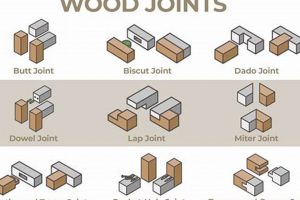
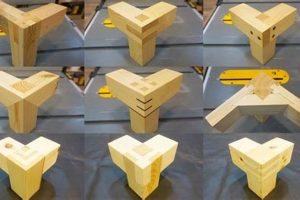
This method of joining wood utilizes cylindrical pins, typically made of wood, to align and reinforce the connection between two or more pieces. The process involves drilling precisely sized holes into the mating surfaces and inserting the pins, secured with adhesive, to create a strong and accurate bond. As an example, consider the construction of a table leg, where wooden cylinders are critical to secure the leg to the table’s apron, enhancing both the structural integrity and the aesthetic appeal of the finished piece.
The enduring popularity of this technique stems from its simplicity, strength, and ability to create clean, visually appealing connections. Historically, it has been employed in a wide range of applications, from furniture construction to cabinet making, providing a reliable alternative to more complex joinery methods. The alignment and reinforcement provided contribute significantly to the long-term durability and stability of woodworking projects. Moreover, the concealed nature of the connector in many applications allows for a refined and professional aesthetic.
Given this foundation, subsequent discussions will delve into the specific types of adhesives appropriate for this technique, the precise methods for drilling accurately aligned holes, and strategies for selecting the appropriate pin diameter and material for varying project requirements. Furthermore, the following will address the advantages and disadvantages of this technique compared to alternative joinery methods, such as mortise and tenon or dovetail joints.
Practical Advice for Effective Implementation
The following guidelines provide essential considerations for maximizing the strength and longevity of woodworking projects employing cylindrical pin connections. Precise execution is paramount for achieving optimal results.
Tip 1: Dowel Selection: Opt for pre-cut, fluted pins. The flutes allow excess adhesive and air to escape during insertion, promoting a stronger bond and preventing hydraulic lock. Choose pin material that complements the wood species being joined, considering factors like hardness and expansion coefficients.
Tip 2: Hole Precision: Employ a drill press with a jig to ensure consistent hole depth and perpendicularity to the surface. Inaccurate drilling leads to misalignment and weakened connections. Use a brad-point drill bit to minimize wandering and produce clean, accurate holes.
Tip 3: Adhesive Application: Apply wood glue liberally to the inside of the holes and to the surface of the pins before insertion. Ensure even coverage to maximize the bonding surface. Avoid over-application, as excess glue can impede proper pin seating.
Tip 4: Clamping Pressure: Apply consistent and even clamping pressure while the adhesive cures. Distribute the pressure across the entire joint to prevent warping or misalignment. Use cauls to protect the workpiece surface from clamp marks.
Tip 5: Proper Alignment: Prior to adhesive application, dry-fit the pieces with the pins to verify proper alignment. Make any necessary adjustments before the glue sets. Employ alignment aids or jigs to maintain accuracy during assembly.
Tip 6: Consider Grain Direction: When possible, orient the pins so that their grain direction runs perpendicular to the grain direction of the wood being joined. This enhances the overall strength and stability of the connection by resisting splitting.
Adhering to these principles results in a robust and aesthetically pleasing union, contributing significantly to the structural integrity and long-term performance of woodworking endeavors.
The ensuing sections will further explore advanced techniques and troubleshooting strategies for specific applications and challenges encountered when utilizing this essential woodworking technique.
1. Alignment

Within the context of woodworking involving cylindrical pin connections, alignment constitutes a foundational element determining the structural integrity and aesthetic quality of the finished piece. Precise alignment ensures that the stresses applied to the joint are evenly distributed, mitigating the risk of failure due to concentrated loads. For instance, in the construction of a bookcase, misaligned pins can lead to uneven weight distribution on the shelves, potentially causing warping or collapse over time. Conversely, properly aligned connections promote load sharing across all pins, resulting in a robust and stable structure.
Achieving accurate alignment necessitates careful planning and execution. The use of jigs and fixtures is often essential to guide the drilling process and ensure that corresponding holes in mating pieces are perfectly aligned. Clamping mechanisms must be employed to maintain this alignment during adhesive curing. Failure to address these considerations can result in joints that are not only structurally unsound but also visually unappealing, with noticeable gaps or offsets. In cabinet making, for example, even slight misalignment can create noticeable inconsistencies in door and drawer faces, detracting from the overall quality of the product.
In summary, alignment is not merely a superficial aspect of cylindrical pin joinery but rather a critical factor governing its strength, durability, and visual appeal. Challenges associated with maintaining alignment can be mitigated through the use of appropriate tools, careful planning, and meticulous execution. An understanding of its importance is paramount for anyone seeking to utilize this joinery method effectively, contributing to a higher standard of craftsmanship and the creation of long-lasting, functional pieces.
2. Adhesive

The selection and application of adhesive are critical determinants of a woodwork dowel joint’s strength and longevity. The adhesive functions as the primary bonding agent, transferring loads between the cylindrical pin and the surrounding wood fibers. Without proper adhesive selection, the mechanical advantage conferred by the pin is significantly diminished, resulting in a weakened joint prone to failure under stress. A common example is the use of polyvinyl acetate (PVA) glue in furniture construction. When subjected to moisture or excessive force, a joint relying solely on PVA may delaminate, leading to structural instability. Therefore, understanding the adhesive’s role is paramount for achieving a durable connection.
Considerations for adhesive selection extend beyond simple bond strength. Factors such as open time, cure time, viscosity, and moisture resistance must be carefully evaluated based on the specific application. In situations where immediate clamping is not feasible, a slow-setting epoxy adhesive may be preferable to allow for sufficient working time and precise alignment. Similarly, outdoor applications necessitate the use of water-resistant adhesives like polyurethane to prevent degradation from environmental exposure. In boat building, where water resistance is critical, epoxy resins are commonly employed to ensure long-term durability. This highlights the importance of matching adhesive properties to the intended use of the joint.
In conclusion, adhesive is an indispensable component of a woodwork dowel joint, serving as the critical link between the pin and the surrounding wood. The appropriate adhesive selection, coupled with proper application techniques, is essential for maximizing the joint’s strength, durability, and resistance to environmental factors. Failure to address these considerations can compromise the structural integrity of the woodworking project, potentially leading to costly repairs or complete failure. Thus, a thorough understanding of adhesives is vital for successful woodworking outcomes.
3. Diameter

The diameter of the cylindrical pin utilized in woodworking represents a critical parameter directly influencing the mechanical performance and long-term stability of the joint. Selection of an appropriate diameter necessitates a careful evaluation of the anticipated load, the material properties of the wood being joined, and the overall aesthetic considerations of the project.
- Shear Strength
Increasing the pin diameter generally corresponds to an increase in the joint’s resistance to shear forces. A larger diameter pin presents a greater cross-sectional area to resist forces acting parallel to the joint surface. In applications where the joint is subjected to significant shear stress, such as in the construction of a heavy table, selecting a pin with sufficient diameter is essential to prevent joint failure. However, excessively large diameters can weaken the surrounding wood by removing too much material.
- Material Displacement
The act of drilling a hole to accommodate the pin inevitably removes wood fiber, reducing the overall strength of the joined components. A larger diameter hole removes more material, potentially creating a stress concentration point. This is particularly relevant in thinner pieces of wood or when working with species prone to splitting. Therefore, the diameter must be balanced against the need to maintain the structural integrity of the surrounding material. For example, when joining thin cabinet doors, smaller diameter pins are preferred to minimize weakening the stile and rail.
- Adhesive Surface Area
While a larger diameter increases the contact area between the pin and the wood, it also increases the volume of adhesive required. Proper adhesive coverage is crucial for distributing stress and preventing voids that can weaken the joint. Insufficient adhesive, even with a large diameter pin, can lead to premature failure. A smaller diameter pin, with adequately applied adhesive, may provide superior strength compared to a larger pin with inconsistent adhesive coverage. Proper technique for the application of glue is extremely important to not have dry spots which will weaken the joint.
- Aesthetic Considerations
The diameter of the pin can also influence the aesthetic appearance of the finished piece, particularly when the pin is exposed or intended to be a visible design element. Larger diameter pins can create a more pronounced visual effect, while smaller pins offer a more subtle and concealed connection. The selection of diameter, in this case, becomes a deliberate design choice rather than solely a structural consideration. For example, in modern furniture designs, exposed pins of contrasting wood species may be used as a decorative accent, dictating the selection of a specific pin diameter.
In summary, the selection of the pin diameter within a woodworking project involves careful consideration of several competing factors. Optimizing the diameter requires balancing the need for sufficient shear strength with the potential for material displacement and adhesive coverage, while also accounting for aesthetic considerations. A thorough understanding of these relationships is essential for achieving a robust, durable, and visually appealing woodwork dowel joint.
4. Material

The selection of materials is a cornerstone in the effectiveness of a woodworking joint. The interplay between the pin material and the wood being joined dictates the joint’s strength, dimensional stability, and long-term durability. Disparate material properties can induce stress concentrations, leading to premature failure. A common example is using a hardwood pin in a softwood joint; the relative hardness of the pin can cause the surrounding softwood to compress or split under load. The effect of material choice, therefore, is a direct determinant of the joint’s performance, illustrating the cause-and-effect relationship between material selection and structural integrity. Understanding this connection is not merely theoretical; it has concrete implications for the longevity and safety of woodworking projects.
Practical application highlights the importance of informed material selection. For instance, when constructing outdoor furniture, the use of moisture-resistant wood, such as cedar or teak, in conjunction with pins made from a similarly resistant material, such as locust or coated hardwood, is crucial. Combining dissimilar materials with differing expansion coefficients can result in joint distortion or failure due to seasonal changes in humidity and temperature. Another practical example is when one is joining plywood materials, which is the use of a pin that will be able to hold the glue, because some material are more prone to not sticking with the glue.
In summary, the material composition of both the pin and the surrounding wood are critical factors governing the overall efficacy of a woodworking joint. Proper material selection necessitates a careful consideration of mechanical properties, environmental conditions, and aesthetic requirements. Ignoring this critical aspect can lead to structurally compromised joints, underscoring the practical significance of a deep understanding of material science in woodworking applications.
5. Precision

In the context of cylindrical pin joinery, precision is not merely a desirable attribute but rather a fundamental requirement for achieving structural integrity and aesthetic quality. Deviations from precise execution manifest directly in the strength and longevity of the joint, with even minor errors potentially leading to catastrophic failure. Consider the case of drilling the holes to accommodate the cylindrical pins. If the holes are not perfectly aligned, the pins will be forced to bear uneven loads, creating stress concentrations that can weaken the joint over time. Similarly, if the hole diameters are not precisely matched to the pin diameters, either a loose fit or excessive binding may occur. A loose fit compromises the bond strength of the adhesive, while excessive binding can lead to splitting of the wood during assembly. These are the direct effects of the precision and tolerances involved in creating cylindrical pin joints.
To illustrate the practical significance of precision, consider the construction of a frame for a glass-paneled door. Accurate alignment of the cylindrical pin holes is essential for ensuring that the frame members are perfectly square and that the glass panel fits snugly within the frame. Any misalignment will not only compromise the structural integrity of the door but also create unsightly gaps that detract from its aesthetic appeal. The importance of precision extends beyond simple alignment. Consistent hole depth is equally critical, as variations in depth can affect the amount of adhesive coverage and create uneven stress distribution. Achieving this level of precision typically necessitates the use of specialized tools, such as drill presses with adjustable stops and self-centering doweling jigs, ensuring that the holes are drilled to the correct depth and at the correct angle. These tools reduce the risk of human error and maintain consistency across multiple joints.
In summary, precision is an indispensable component of successful cylindrical pin joinery. The use of precision tools, adherence to rigorous measurement standards, and careful execution are essential for minimizing the risks of misalignment, improper fit, and structural failure. While achieving perfect precision may be unattainable in practice, striving for it through the use of appropriate techniques and tools will significantly enhance the strength, durability, and aesthetic quality of any woodworking project employing this joinery method. The practical significance of this understanding cannot be overstated, as it directly impacts the safety, longevity, and visual appeal of the finished product.
Frequently Asked Questions
The following addresses common inquiries regarding the technique, aiming to provide clear and concise answers based on established woodworking principles.
Question 1: What is the primary advantage of employing this method over screws or nails?
The method offers superior aesthetic qualities, as the connectors are concealed. It also provides enhanced joint strength due to the increased surface area for adhesive bonding, distributing stress more evenly than point-fastening methods.
Question 2: What factors determine the appropriate diameter and length of the cylindrical pin for a given joint?
The anticipated load, the thickness of the materials being joined, and the wood species are key considerations. A general guideline is to select a diameter approximately one-third the thickness of the thinnest piece being joined. The length should allow for adequate penetration into both pieces.
Question 3: Are specific wood species better suited for cylindrical pins?
Hardwoods, such as maple, birch, or oak, are generally preferred due to their increased strength and resistance to compression. However, the pin material should be compatible with the wood being joined to minimize differential expansion and contraction.
Question 4: What type of adhesive is recommended?
Polyvinyl acetate (PVA) glue is suitable for many applications, providing adequate strength and ease of use. However, for joints subjected to moisture or stress, polyurethane or epoxy adhesives may be more appropriate.
Question 5: How can one ensure accurate alignment when drilling the pin holes?
The use of a drill press with a doweling jig is highly recommended. The jig guides the drill bit precisely, ensuring that the holes are aligned correctly in both pieces being joined.
Question 6: What are some common mistakes to avoid?
Common errors include using undersized pins, neglecting to provide adequate adhesive coverage, and failing to properly clamp the joint during the curing process. Overdrilling the pin holes can also weaken the joint.
Proper execution requires careful attention to detail and adherence to established woodworking principles. By addressing these common questions, a foundation is provided for successful application of this technique.
The next discussion will delve into advanced techniques, exploring specialized applications and innovative uses for this versatile method.
Woodwork Dowel Joint
This exploration has illuminated the multifaceted nature of the technique. From the critical importance of precise alignment and judicious adhesive selection to the careful consideration of material properties and pin diameter, each element contributes significantly to the strength, durability, and aesthetic quality of the final product. The information presented underscores the need for a comprehensive understanding of the principles governing this method to ensure successful implementation and long-term performance.
The continued relevance of the technique in both traditional and contemporary woodworking contexts highlights its enduring value as a reliable and versatile joinery solution. Further research and innovation within this area, particularly concerning advanced materials and techniques, promise to expand its applicability and enhance its performance in increasingly demanding applications. A commitment to mastering these principles will undoubtedly contribute to the creation of high-quality, lasting woodworking projects, preserving the legacy of craftsmanship for generations to come.