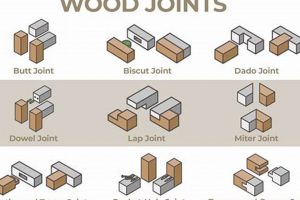
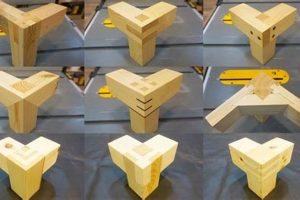
A finger joint, also known as a comb joint, represents a woodworking technique that joins two pieces of wood together by using a series of interlocking, precisely cut “fingers.” These fingers, resembling intermeshing teeth, are glued together to create a strong, visually appealing bond. The effectiveness of this joint arises from the increased glue surface area compared to a simple butt joint.
The utilization of the joint provides enhanced structural integrity, making it suitable for applications requiring significant strength and durability, such as drawer boxes, frames, and long boards. Its inherent strength derives from the mechanical interlocking of the fingers, distributing stress and minimizing the risk of failure. Historically, finger joints have been employed in situations where long, continuous pieces of lumber are required but not readily available, enabling the creation of extended lengths from shorter segments. This technique remains highly relevant in contemporary woodworking practices, offering both functional and aesthetic advantages.
The subsequent sections will detail the process of creating the joint, outlining the necessary tools and techniques, from marking and cutting to assembly and finishing. The discussion will cover variations in finger joint construction and offer best practices for achieving precise and robust results.
Essential Considerations for Finger Joint Construction
Achieving a successful finger joint requires meticulous attention to detail and adherence to specific techniques. The following tips provide guidance for ensuring a strong and aesthetically pleasing result.
Tip 1: Wood Selection: Choose wood species with compatible hardness and grain patterns. Dissimilar densities can lead to uneven wear and potential joint failure over time.
Tip 2: Precision Measurement: Accurate measurements are paramount. Use a precise measuring tool, such as a digital caliper, to ensure consistent finger width and spacing. Inaccurate measurements will result in a weak joint.
Tip 3: Blade Sharpness: Employ a sharp saw blade. A dull blade can cause splintering and tear-out, compromising the integrity of the fingers. A dedicated finger joint jig is highly recommended.
Tip 4: Consistent Cutting Depth: Maintain a consistent cutting depth. Irregular depths will create uneven fingers, hindering proper interlocking and glue adhesion. Use a stop block or depth gauge.
Tip 5: Test Cuts: Perform test cuts on scrap wood of the same thickness and species. This allows for fine-tuning of the jig setup and ensures a perfect fit before committing to the final pieces.
Tip 6: Glue Application: Apply glue evenly and generously to all mating surfaces. Adequate glue coverage is crucial for maximum bond strength. Consider using a slow-setting glue to allow for ample working time.
Tip 7: Clamping Pressure: Apply sufficient clamping pressure to ensure tight contact between the fingers. Avoid over-clamping, which can squeeze out excessive glue and weaken the joint. Clamps should be evenly distributed.
Tip 8: Dry Fit Before Gluing: Always dry-fit the joint before applying glue. This step reveals any potential issues with the fit and allows for corrections before the final assembly. Any adjustments should be made at this stage.
By adhering to these guidelines, woodworkers can significantly increase the likelihood of creating strong, visually appealing, and long-lasting finger joints. These considerations are essential for projects demanding both structural integrity and aesthetic appeal.
With a grasp of these essential tips, the process of crafting this essential woodworking joint becomes more manageable and predictable. The next section will explore common mistakes to avoid.
1. Accuracy

In the realm of woodworking, accuracy serves as a cornerstone for achieving functional and aesthetically pleasing results, particularly when constructing finger joints. The precision with which measurements are taken and cuts are executed directly influences the strength, fit, and overall quality of the joint. Deviations from accuracy can compromise the joint’s integrity, leading to structural weaknesses and visual imperfections.
- Measurement Precision
Accurate measurements are paramount for determining the width and spacing of the fingers. Inconsistent measurements result in mismatched fingers that do not interlock correctly, diminishing the joint’s strength and requiring additional corrective measures. For example, a measurement error of even a fraction of a millimeter can accumulate across multiple fingers, creating a significant gap in the assembled joint.
- Consistent Cutting Depth
Maintaining a uniform cutting depth is essential for ensuring that the fingers have equal length and engage fully. Variations in cutting depth can create uneven stress distribution within the joint, weakening its resistance to load. A finger that is too short may not contribute significantly to the joint’s strength, while a finger that is too long may interfere with proper assembly.
- Precise Angular Alignment
Accurate angular alignment during cutting guarantees that the fingers are perpendicular to the workpiece and parallel to each other. Misaligned fingers can introduce twisting forces within the joint, which can lead to premature failure. Correct angular alignment is also critical for achieving a visually appealing result, as misaligned fingers create an irregular and unprofessional appearance.
- Jig Calibration and Setup
The accuracy of the finger joint is intimately connected to the precision of the jig or setup used to create the joint. The jig guides the cutting tool and determines the dimensions and spacing of the fingers. Improper calibration or setup of the jig introduces systematic errors in the joint, diminishing its strength and accuracy. Regular inspection and adjustment of the jig are essential for maintaining consistent and reliable results.
The facets of accuracy in finger joint construction are not isolated elements; they are interdependent and contribute collectively to the overall success of the joint. A lapse in any one area can negate the benefits of precision in others. Mastering the principles of accuracy is crucial for creating finger joints that are both structurally sound and visually refined. By adhering to precise measurements, maintaining consistent cutting depths, ensuring accurate angular alignment, and utilizing properly calibrated jigs, woodworkers can consistently achieve high-quality finger joints that meet the demands of diverse woodworking applications.
2. Wood selection

Wood selection directly influences the success and longevity of a finger joint. The properties inherent in different wood species impact the joint’s strength, stability, and aesthetic characteristics. A primary consideration is the wood’s hardness and density. For instance, joining hardwoods like oak or maple yields a significantly stronger joint compared to using softwoods such as pine. This disparity arises from the denser fiber structure of hardwoods, which provides greater resistance to shearing and pulling forces. In applications requiring high structural integrity, such as load-bearing frames, opting for a hardwood is a critical step in how to make a finger joint in woodwork.
Furthermore, the wood’s grain pattern plays a vital role. Straight-grained wood is generally preferred, as it allows for cleaner, more predictable cuts during the creation of the fingers. Highly figured wood, while visually appealing, can present challenges in achieving precise and consistent finger dimensions. The presence of knots or excessive grain irregularities near the joint location should be avoided, as these can compromise the joint’s structural integrity. An example of this is using knotty pine for a drawer box; the knots could weaken the fingers or prevent a tight glue bond. Additionally, moisture content is paramount; lumber must be properly seasoned to minimize warping or shrinking after the joint is assembled. Unseasoned wood can lead to joint failure as the wood dries and distorts.
In summary, appropriate wood selection is an integral component of the woodworking process. Consideration of factors such as hardness, grain pattern, and moisture content dictates the final product’s durability and visual appeal. Selecting the proper material ensures a robust, visually appealing joint that meets the demands of its intended application, transforming the abstract knowledge into concrete woodworking proficiency. The failure to carefully consider this aspect can undermine even the most skilled joint-making efforts.
3. Jig setup

The successful execution of a finger joint relies heavily on the precision and accuracy of the jig used to guide the cutting process. A well-configured jig ensures consistent finger dimensions and alignment, contributing directly to the joint’s strength and aesthetic appeal. Inadequate jig setup introduces errors that accumulate, compromising the integrity of the completed joint.
- Spacing and Alignment
The jig dictates the spacing between fingers and their alignment relative to the workpiece. Incorrect spacing results in a joint where fingers do not interlock properly, diminishing the glue surface area and overall strength. Misalignment can create stress points, leading to premature joint failure under load. Accurate jig calibration ensures uniformity across all fingers, maximizing the joint’s structural integrity.
- Cutting Depth Control
A properly set-up jig provides a mechanism for controlling the depth of each cut, ensuring that all fingers are of equal length. Variations in finger length compromise the joint’s mechanical interlock and can lead to uneven stress distribution. The jig should facilitate precise and repeatable depth adjustments to achieve consistent finger dimensions.
- Workpiece Registration and Stability
The jig must securely hold the workpiece in place during the cutting operation, preventing movement or vibration that can introduce errors. Proper workpiece registration ensures that each finger is cut in the correct location and orientation. A stable jig platform minimizes the risk of accidental slippage, maintaining cut precision.
- Safety Features
An appropriately designed jig incorporates safety features that protect the user from the cutting tool. Guards and secure clamping mechanisms reduce the risk of injury and contribute to a controlled and predictable cutting process. These safety features are essential for ensuring operator well-being and maintaining consistent cut quality.
The connection between precise jig setup and a successful finger joint is undeniable. By addressing the critical elements of spacing, depth control, workpiece stability, and safety, woodworkers can leverage the jig as a tool to achieve consistent, accurate, and structurally sound joints. This detailed approach translates directly to increased project durability and visual quality.
4. Cutting technique
The cutting technique employed is paramount to the creation of a robust and visually appealing finger joint. It directly influences the precision of the fingers, impacting the joint’s mechanical strength and overall aesthetic quality. Inadequate cutting techniques lead to inaccuracies, such as uneven finger lengths, inconsistent widths, or ragged edges, all of which compromise the integrity of the joint. For example, using a dull blade or feeding the workpiece too quickly through a router will result in splintering and tear-out, weakening the fingers and reducing the glue surface area. Proper cutting technique necessitates a sharp, appropriate blade and a steady, controlled feed rate. Applying these skills, when learning how to make a finger joint in woodwork, directly produces clean, precisely dimensioned fingers, ensuring a tight and secure fit.
Beyond the choice of tooling, the specific method employed during the cutting process is critical. Whether using a table saw with a dedicated finger joint jig, a router table with a specialized bit, or even hand tools like a dovetail saw and chisel, the operator’s skill in executing consistent and accurate cuts determines the joint’s ultimate success. A common error involves failing to maintain consistent pressure on the workpiece during the cutting process, resulting in variations in finger depth or width. Similarly, hesitating or pausing mid-cut can leave visible marks or imperfections on the finger surfaces. Mastery of the cutting technique requires practice and a keen awareness of the tool’s behavior and the material’s response. A practical example involves carefully aligning the workpiece with the jig’s guide and maintaining a constant, even pressure while advancing the wood through the blade. This consistent execution is crucial for generating uniform, interlocking fingers that maximize the joint’s strength.
In summary, the cutting technique is an inseparable element of the entire finger joint creation process. It is not merely a step but a skill requiring deliberate practice and meticulous attention to detail. Through appropriate tool selection, controlled feed rates, and consistent execution, woodworkers can achieve the precision necessary for a strong, aesthetically pleasing finger joint. Neglecting proper cutting techniques inevitably results in compromised joint integrity and diminished project quality.
5. Glue application
Glue application represents a critical component of how to make a finger joint in woodwork. Its efficacy directly influences the joint’s structural integrity and long-term durability. Inadequate glue application results in a weakened bond, increasing the susceptibility to joint failure under stress. Conversely, a thorough and uniform application of adhesive maximizes the surface area contact between the interlocked fingers, creating a robust and resilient connection. The adhesive acts as a mechanical interlock and creates a chemical bond, further strengthening the joint.
The type of glue employed also significantly impacts the joint’s performance. For instance, Polyvinyl Acetate (PVA) glues are commonly used for general woodworking due to their ease of application and adequate strength for many applications. However, for situations demanding greater moisture resistance or higher shear strength, epoxy or polyurethane-based adhesives may be more appropriate. Moreover, proper preparation of the surfaces to be joined is essential. Clean, dry wood promotes optimal glue adhesion. The presence of dust, oil, or other contaminants hinders the glue’s ability to penetrate the wood fibers, reducing the bond strength. An example of poor preparation leading to joint failure is a finger joint constructed with sawdust left on the mating surfaces; the glue adheres to the sawdust rather than the wood, resulting in a weak and brittle connection.
In conclusion, the glue application process is not merely a supplementary step but an integral determinant of the finger joint’s success. Careful attention to adhesive selection, surface preparation, and uniform application techniques contributes directly to a strong, lasting, and reliable wood joint. Neglecting these considerations undermines the structural integrity, regardless of the precision employed in other construction phases. Therefore, understanding and implementing proper gluing practices is fundamental in woodwork when attempting to create finger joints.
6. Clamping pressure

Clamping pressure constitutes a critical variable in achieving a structurally sound and aesthetically pleasing finger joint. The application of adequate and evenly distributed force during the glue-curing phase facilitates optimal adhesion between the interlocked fingers, contributing directly to the joint’s overall strength and longevity. Insufficient or uneven clamping pressure compromises the bond, leading to potential joint failure under stress.
- Achieving Intimate Contact
The primary role of clamping pressure is to ensure intimate contact between all mating surfaces of the finger joint. This close contact is essential for the glue to effectively bond the wood fibers together. Without sufficient pressure, gaps may form, reducing the glue surface area and creating weak points within the joint. For example, if a clamp is not positioned directly over a finger, the glue may not fully penetrate the joint at that point, resulting in a weaker bond compared to other areas.
- Uniform Pressure Distribution
Evenly distributed clamping pressure is crucial for preventing localized stress concentrations within the joint. Uneven pressure can cause some fingers to be compressed more than others, leading to variations in bond strength and potential warping of the joint. This is particularly relevant in larger finger joints, where multiple clamps are required to ensure uniform pressure across the entire joint surface. Imagine clamping a long finger joint with a single clamp in the center; the ends may not receive sufficient pressure, resulting in a weaker bond at the extremities.
- Glue Line Thickness Control
Appropriate clamping pressure helps control the thickness of the glue line within the joint. Excessive pressure can squeeze out too much glue, resulting in a starved joint with insufficient adhesive. Conversely, insufficient pressure may result in an overly thick glue line, which can be weaker and more prone to creep over time. The ideal glue line is thin and uniform, providing maximum bond strength without compromising the joint’s structural integrity. Experience demonstrates the importance of using the correct amount of clamping pressure.
- Preventing Joint Movement During Curing
Clamping pressure also serves to prevent any movement or shifting of the joint components during the glue-curing process. Even slight movements can disrupt the bond and create weaknesses within the joint. This is especially important when working with complex finger joint configurations or when using fast-setting glues that provide limited working time. Securing the joint with adequate clamping pressure minimizes the risk of such disturbances, ensuring a strong and reliable bond. Consider how any movement during the curing of wood will drastically reduce its durability
In conclusion, the application of appropriate clamping pressure is not merely a supplemental step but an integral aspect of how to make a finger joint in woodwork. It directly impacts the joint’s structural integrity, glue line thickness, and overall stability. Applying proper clamping techniques helps to ensure a strong, durable, and visually appealing joint that meets the demands of its intended purpose. Ignoring this vital step inevitably results in a compromised joint.
7. Finishing

Finishing serves as the culmination of the finger joint construction process, directly impacting the joint’s aesthetic appeal, durability, and resistance to environmental factors. While the structural integrity of the joint is established through accurate cutting, proper gluing, and adequate clamping, the finishing stage provides a protective barrier and enhances the wood’s natural beauty. A poorly executed finish can detract from even the most skillfully crafted joint, rendering it vulnerable to moisture damage, scratches, and discoloration. For example, a finger-jointed tabletop left unfinished in a humid environment is susceptible to warping and swelling, ultimately compromising the joint’s integrity.
The choice of finishing product should align with the intended application and the wood species used. Oil-based finishes, such as linseed or tung oil, penetrate the wood fibers, enhancing the grain and providing a natural look. However, they offer limited protection against abrasion and moisture. Polyurethane finishes, on the other hand, create a durable, water-resistant surface, making them suitable for high-traffic areas and outdoor applications. The application technique also plays a crucial role. Proper sanding ensures a smooth surface for the finish to adhere to, while multiple thin coats provide better protection and a more uniform appearance than a single thick coat. Failing to properly sand the joint before applying finish can result in visible imperfections and uneven color absorption.
In summary, finishing is not merely a cosmetic enhancement but an essential component of a complete finger joint construction project. The selection of an appropriate finish, combined with meticulous surface preparation and application techniques, safeguards the joint against environmental damage and enhances its long-term durability. By recognizing the integral role of finishing, woodworkers can ensure that their finger joints not only possess structural soundness but also stand the test of time. The finishing process is not the end, but a continuation in the lifespan of a woodworking project.
Frequently Asked Questions about Finger Joints
This section addresses common inquiries regarding the creation and application of finger joints in woodworking, providing concise and informative answers.
Question 1: What distinguishes a finger joint from other woodworking joints?
A finger joint is distinguished by its series of interlocking “fingers” that significantly increase the glue surface area, resulting in a stronger bond compared to simpler joints such as butt joints. The mechanical interlocking of the fingers adds structural integrity.
Question 2: What types of wood are best suited for finger joint construction?
Hardwoods such as oak, maple, and cherry are generally preferred due to their increased density and strength. Softwoods can be used, but the resulting joint will be less durable. Straight-grained wood is ideal for precise cuts.
Question 3: Is specialized equipment required to create a finger joint?
While finger joints can be crafted using hand tools, specialized equipment such as a table saw with a finger joint jig or a router table with a finger joint bit greatly enhances accuracy and efficiency. Jigs are highly recommended.
Question 4: How does clamping pressure affect the quality of a finger joint?
Adequate and evenly distributed clamping pressure ensures intimate contact between the fingers during glue curing, maximizing bond strength. Insufficient or uneven pressure can lead to a weak or distorted joint.
Question 5: What are common mistakes to avoid when making a finger joint?
Common mistakes include inaccurate measurements, dull cutting tools, uneven glue application, insufficient clamping pressure, and using wood with excessive moisture content. Performing test cuts on scrap material is crucial.
Question 6: How can the visual appearance of a finger joint be enhanced?
The visual appearance can be enhanced through careful wood selection, precise cutting, and a well-executed finish. Sanding the joint smooth and applying a stain or clear coat appropriate for the wood species can improve the aesthetic appeal.
In summary, achieving success in finger joint construction involves meticulous attention to detail, adherence to proper techniques, and the use of appropriate materials and equipment. Understanding these key elements contributes to the creation of strong, durable, and visually appealing wood joints.
With a comprehensive understanding of finger joints and their creation, one can now consider advanced techniques and applications.
Conclusion
The preceding discussion has detailed the multifaceted process of how to make a finger joint in woodwork. From wood selection and jig setup to cutting techniques, glue application, clamping pressure, and finishing, each stage contributes critically to the joint’s ultimate strength, durability, and visual appeal. Mastering these elements is essential for achieving consistently high-quality results.
The significance of understanding how to make a finger joint in woodwork extends beyond mere craftsmanship. It encompasses an appreciation for structural integrity, aesthetic design, and the enduring nature of well-executed woodworking. Continued exploration and refinement of these techniques will undoubtedly yield even more innovative and robust applications in the future. Consider further experimentation with different materials and joint variations to expand the possibilities of woodwork.