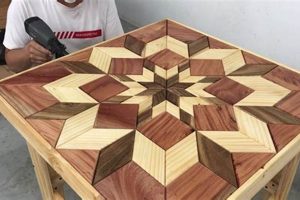
The concept encompasses a range of creative projects involving the manipulation of wood to produce decorative or functional items. These ventures span from simple, beginner-friendly constructions like wooden coasters and small boxes, to more intricate undertakings such as carved sculptures or assembled furniture. The defining characteristic lies in the application of woodworking techniques to achieve an aesthetically pleasing or practically useful end product.
The pursuit of such projects fosters creativity, problem-solving abilities, and fine motor skills. Historically, these activities have served as both a means of self-expression and a source of functional objects for daily life. The enduring appeal lies in the tangible result of transforming raw material into something valuable and unique.
The following sections will delve into specific project categories, outlining the tools, materials, and techniques typically employed. The aim is to provide a foundation for individuals interested in exploring the diverse possibilities offered by engaging in the creation of wooden objects.
Guidance for Woodworking Endeavors
This section offers practical guidance to optimize outcomes and minimize challenges when undertaking woodworking projects. Adherence to these suggestions can improve efficiency, safety, and the overall quality of the finished product.
Tip 1: Prioritize Material Selection: Wood type significantly impacts the project’s aesthetic and structural integrity. Softer woods, like pine, are easier to work with but less durable. Hardwoods, such as oak or maple, offer greater strength and visual appeal, but require more effort to shape.
Tip 2: Emphasize Accurate Measurement and Marking: Precise measurements and clear markings are essential to avoid errors during cutting and assembly. Use a sharp pencil, a reliable measuring tape, and a square to ensure accuracy.
Tip 3: Master Fundamental Cutting Techniques: Proficiency in basic cuts, such as ripping and crosscutting, is crucial for achieving desired dimensions and shapes. Practice these techniques on scrap wood before working on the final project.
Tip 4: Employ Appropriate Joinery Methods: The chosen joinery method affects the strength and appearance of the project. Consider the project’s purpose and the wood’s properties when selecting joints like dovetails, mortise and tenon, or simple butt joints.
Tip 5: Apply Sanding and Finishing with Care: Proper sanding prepares the wood surface for finishing, enhancing its smoothness and revealing the grain. Apply finishes evenly, following the manufacturer’s instructions, to protect the wood and achieve the desired aesthetic.
Tip 6: Focus on Safety Protocols: Woodworking involves potential hazards. Always wear safety glasses, hearing protection, and a dust mask. Ensure all tools are in good working order and used according to their intended purpose. Understand and adhere to all safety guidelines before operating any power equipment.
Tip 7: Start Small and Simple: For novice woodworkers, it is beneficial to start with simpler projects. Beginning with a small box or a simple shelf allows you to master basic techniques without being overwhelmed by complexity.
By carefully considering the selection of materials, practicing precise techniques, prioritizing safety, and initiating projects suitable to one’s skill level, woodworkers can experience gratifying results and create lasting, functional art.
The subsequent section will explore the integration of sustainability practices within the crafting process, promoting resource conservation.
1. Design Complexity

The level of intricacy in a design fundamentally dictates the requirements and challenges encountered in woodworking projects. Design complexity influences material selection, joinery techniques, tooling needs, and the time investment necessary for completion.
- Number of Components
A design with a high component count typically demands more precise cutting and assembly. Each additional piece introduces opportunities for error, requiring a greater focus on accuracy. Complex furniture pieces, such as cabinets with multiple drawers and doors, exemplify this facet.
- Intricacy of Shapes
Designs featuring curved lines, complex angles, or non-uniform shapes necessitate specialized tools and techniques. Achieving accurate and clean cuts on intricate shapes often requires templates, jigs, and advanced skills in carving or shaping wood.
- Joinery Requirements
The design dictates the necessary joinery methods. Simple designs may suffice with basic butt joints or screws, while complex structures may require stronger and more visually appealing joints like dovetails or mortise-and-tenon. The chosen joinery must adequately support the structure and aesthetic of the piece.
- Surface Detail and Embellishments
Designs incorporating carving, inlays, or other decorative elements increase the complexity of the project. These details require specialized tools and a high level of artistic skill. The addition of such embellishments can significantly extend the completion time and skill requirement.
In summary, the design complexity of a woodworking endeavor directly impacts the skills, tools, and time commitment required. Careful consideration of these elements is essential for successful project planning and execution, enabling the creation of aesthetically pleasing and structurally sound items.
2. Wood Selection

The selection of wood is a foundational decision directly influencing the success of woodworking projects. The inherent properties of different wood types including density, grain pattern, color, and workability determine the suitability for specific crafts. For instance, a delicate carving benefits from the fine grain and soft texture of basswood, allowing for intricate detail without splintering. Conversely, a load-bearing component of a chair requires the strength and durability of a hardwood like oak or maple. The choice of an inappropriate wood can lead to structural failure, aesthetic shortcomings, or increased difficulty during the crafting process. The connection between wood selection and project success is, therefore, a cause-and-effect relationship directly tied to the functional and aesthetic requirements of the intended project.
The practical significance of understanding this connection is evident in various woodworking applications. Cabinetmakers, for example, carefully consider wood species based on factors like stain absorption, resistance to warping in humid environments, and the desired visual appeal. Softwoods like pine, while economical, may be less resistant to scratches and dents, rendering them unsuitable for high-traffic surfaces. Similarly, instrument makers meticulously choose woods based on their tonal qualities; spruce is often favored for soundboards due to its resonance, while ebony is preferred for fingerboards due to its hardness and smooth texture. These are not arbitrary choices but rather calculated decisions to achieve optimal performance and longevity.
In summary, the choice of wood is not merely a cosmetic decision; it is a critical component affecting the structural integrity, aesthetic outcome, and long-term durability of woodworking endeavors. Misunderstanding this principle can lead to project failure and wasted resources. Mastery of wood selection principles enables informed decision-making, fostering successful crafting outcomes aligned with specific requirements and desired results. Further exploration into the nuances of wood properties and their interaction with various woodworking techniques is crucial for advancing proficiency in the craft.
3. Joinery Methods

The selection and execution of joinery methods represent a critical juncture in woodworking projects, directly influencing structural integrity, aesthetic appeal, and the overall longevity of the crafted item. The chosen joint must be appropriate for the intended application, considering factors such as load bearing requirements, material properties, and the desired visual outcome.
- Mortise and Tenon Joints
This traditional technique, involving a projecting tenon fitting snugly into a mortise (hole), provides exceptional strength and resistance to racking forces. Frequently employed in furniture construction, such as chair and table legs, mortise and tenon joints are valued for their durability and aesthetic appeal, often visible as a design element.
- Dovetail Joints
Characterized by interlocking, fan-shaped tenons and mortises, dovetail joints offer superior tensile strength, making them ideal for drawer construction and situations requiring resistance to pulling forces. The visible dovetails are often regarded as a mark of craftsmanship, adding visual interest to the piece.
- Lap Joints
Lap joints involve overlapping two pieces of wood and securing them with adhesive or fasteners. While simpler to execute than mortise and tenon or dovetail joints, they provide a substantial gluing surface, resulting in a strong connection suitable for various applications, including frame construction and panel assemblies.
- Butt Joints
Butt joints are the simplest form of joinery, involving butting two pieces of wood end-to-end and securing them with fasteners or adhesive. While quick and easy to create, butt joints are the weakest form of joinery and are typically reinforced with additional support elements or used in non-load-bearing applications, such as box construction or decorative trim.
The successful integration of joinery techniques within woodworking endeavors necessitates a comprehensive understanding of each joint’s strengths and limitations. Careful consideration of these factors allows for the creation of durable, aesthetically pleasing objects that withstand the test of time, exemplifying the art and science inherent in fine woodworking.
4. Finishing Techniques
Finishing techniques represent a critical phase in woodworking endeavors, directly affecting the visual appeal, tactile quality, and long-term preservation of the crafted object. The application of a finish is not merely a cosmetic step but a functional necessity that protects the wood from moisture, UV damage, scratches, and other environmental factors. Different woodworking designs and the intended use of the final product dictate appropriate finishing approaches. For example, a dining table finish must withstand repeated cleaning and contact with food, necessitating a durable and non-toxic sealant. Conversely, a decorative carving may benefit from a finish that enhances the wood’s natural grain and color without adding significant surface thickness.
Consider the application of oil-based finishes, often chosen to accentuate the wood’s inherent beauty and provide a warm, lustrous sheen. This approach is suited for projects where showcasing the wood grain is paramount. Alternatively, polyurethane finishes offer exceptional durability and resistance to wear and tear, making them ideal for surfaces subjected to heavy use. Painted finishes provide an opportunity for stylistic expression, allowing for the integration of color and texture. However, achieving a flawless painted surface requires meticulous preparation, including sanding and priming, to ensure proper adhesion and a smooth, uniform appearance. The selection of an inappropriate finish can compromise the structural integrity of the wood, detract from the intended aesthetic, or necessitate costly repairs.
In summation, the effective application of finishing techniques is integral to the successful realization of woodworking objectives. Knowledge of various finishing methods, their respective properties, and their compatibility with different wood species is essential for achieving the desired aesthetic outcome while ensuring the longevity and functional integrity of the completed piece. The ultimate success hinges on a thorough understanding of materials science, careful execution, and a commitment to achieving a high-quality, enduring finish.
5. Tool Proficiency

The correlation between tool proficiency and successful realization of woodworking projects is demonstrably strong. Mastery of hand and power tools directly influences the precision, efficiency, and safety of woodworking processes, enabling the creation of complex and aesthetically refined objects. Inadequate tool skills can lead to inaccuracies, material waste, and potential physical harm.
- Precision and Accuracy
Proficient tool handling enables the attainment of precise measurements and cuts, essential for accurate joinery and adherence to design specifications. Skilled use of measuring tools, saws, chisels, and planes ensures components fit together seamlessly, resulting in structurally sound and visually appealing finished products. Lack of proficiency leads to misaligned joints, uneven surfaces, and compromised structural integrity.
- Efficiency and Speed
Experience with woodworking tools enhances workflow efficiency and reduces project completion time. Skilled tool operators can execute tasks with greater speed and accuracy, minimizing errors and maximizing material utilization. Inefficient tool handling results in slower progress, increased material waste, and potential project delays.
- Safety and Risk Mitigation
Comprehensive understanding of tool operation and safety protocols is paramount to preventing accidents and injuries. Skilled woodworkers are adept at recognizing and mitigating potential hazards associated with power tools and sharp implements. Insufficient knowledge of safety procedures can result in cuts, lacerations, eye injuries, and other serious accidents.
- Versatility and Adaptability
Proficiency with a diverse range of woodworking tools expands the range of possible projects and designs. Skilled craftspeople can adapt to various woodworking challenges and implement creative solutions using available tools and techniques. Limited tool skills restrict the scope of achievable projects and hinder the ability to overcome unforeseen obstacles.
In conclusion, tool proficiency serves as a foundational element in successful woodworking endeavors. It directly impacts precision, efficiency, safety, and versatility, enabling the creation of high-quality, structurally sound, and aesthetically pleasing objects. Continuous skill development and a commitment to safe tool operation are essential for aspiring and experienced woodworkers alike.
6. Safety Practices

The execution of woodworking projects, irrespective of scale or complexity, is intrinsically linked to adherence to rigorous safety practices. A deficiency in safety protocols directly correlates with an increased risk of injury and compromised project outcomes. Woodworking tools, both manual and powered, present inherent hazards, including lacerations, abrasions, and potential for more severe trauma. A cause-and-effect relationship exists between the consistent implementation of safety measures and the minimization of such risks. Safety glasses, for instance, mitigate the potential for eye injuries resulting from flying debris, while hearing protection reduces the risk of long-term auditory damage caused by prolonged exposure to loud machinery. The importance of these practices is underscored by the fact that non-compliance frequently results in preventable accidents.
Real-life examples frequently highlight the consequences of neglecting safety. Instances of individuals failing to secure workpieces properly, leading to kickback from power saws, are common. Similarly, inadequate dust collection exposes woodworkers to hazardous airborne particles, increasing the risk of respiratory illness. The practical significance of understanding these risks translates directly into the implementation of preventative measures. Workspaces should be well-ventilated, equipped with appropriate dust collection systems, and maintained in an organized manner to prevent tripping hazards. Furthermore, understanding the limitations of each tool and employing them within their intended operational parameters is crucial for minimizing the likelihood of accidents. Regular maintenance and inspection of equipment are also essential components of a comprehensive safety regimen.
In conclusion, safety practices are not merely ancillary considerations but integral components of successful woodworking endeavors. Prioritizing safety through consistent adherence to established protocols minimizes the risk of injury and promotes a productive and sustainable working environment. While challenges in maintaining constant vigilance exist, the benefits of a safety-conscious approach far outweigh the perceived inconveniences. A proactive stance on safety ultimately contributes to the longevity and enjoyment of the woodworking craft.
7. Project Scale

Project scale, encompassing dimensions, complexity, and resource allocation, fundamentally influences the execution and outcome of woodworking endeavors. A direct correlation exists between the size and intricacy of a project and the required skill set, tooling, and time investment. Smaller-scale projects, such as boxes or picture frames, serve as entry points for novice woodworkers, allowing them to develop fundamental skills in cutting, joining, and finishing without the overwhelming demands of larger, more complex undertakings. Conversely, large-scale projects, such as furniture construction or architectural millwork, necessitate advanced techniques, specialized equipment, and meticulous planning to ensure structural integrity and aesthetic coherence. The inherent cause-and-effect relationship dictates that accurate assessment of project scope is crucial for effective resource management and successful completion. An underestimated project scale can lead to material shortages, inadequate tooling, and ultimately, project failure.
The practical significance of understanding project scale is evident in various woodworking contexts. A cabinetmaker embarking on a kitchen remodel must accurately measure and account for the dimensions of each cabinet, drawer, and panel to ensure proper fit and functionality. An artist creating a large-scale sculpture must consider the structural properties of the wood, employing appropriate joinery and support systems to prevent warping or collapse. In both cases, a thorough understanding of project scale informs every decision, from material selection to assembly techniques. Examples of misjudged project scale abound, ranging from improperly sized furniture pieces that disrupt spatial harmony to structurally unsound constructions that pose safety hazards. The accurate assessment of a woodworking projects physical requirements is a foundational skill with direct implications for both functional utility and aesthetic success.
In summary, project scale is a critical determinant in the planning and execution of woodworking projects. Accurate assessment of dimensions, complexity, and resource needs is essential for effective resource management, skill development, and project success. While challenges in accurately estimating project scope may arise, the benefits of careful planning far outweigh the risks associated with underestimation. Recognizing the importance of project scale enables woodworkers to approach their craft with greater confidence and achieve results that are both structurally sound and aesthetically pleasing, contributing to the enduring value and utility of their creations.
Frequently Asked Questions About Woodworking Craft Ideas
The following addresses common inquiries regarding the conceptualization and execution of woodworking projects. These clarifications are intended to provide a foundation for informed decision-making.
Question 1: What is the initial step in pursuing woodworking projects?
The initial step involves defining the project’s purpose and scope. This includes determining the intended function, size, and aesthetic style of the finished piece. A clear understanding of these parameters informs subsequent decisions regarding material selection, design, and construction techniques.
Question 2: What tools are essential for beginners in woodworking?
Essential tools for beginners encompass a combination of hand and power tools. Core implements include a measuring tape, combination square, hand saw, chisels, a smoothing plane, and a drill. As skills develop, additional tools such as a jigsaw, router, and sander may be acquired.
Question 3: How does wood selection influence the outcome of woodworking projects?
Wood selection exerts a significant influence on both the structural integrity and aesthetic appeal of woodworking projects. Different wood species possess varying levels of strength, durability, and visual characteristics. Selecting appropriate wood is essential for ensuring the project’s longevity and achieving the desired appearance.
Question 4: What are the key considerations for safe woodworking practices?
Key considerations for safe woodworking include wearing appropriate personal protective equipment, such as safety glasses, hearing protection, and a dust mask. Furthermore, ensuring tools are in good working order, understanding their proper operation, and maintaining a clean and organized workspace are critical for preventing accidents.
Question 5: How can beginners minimize material waste in woodworking projects?
Beginners can minimize material waste by carefully planning cuts, utilizing templates, and practicing on scrap wood. Accurate measurement and marking, coupled with a deliberate approach to cutting, reduces the likelihood of errors and maximizes material utilization.
Question 6: What are the most common challenges encountered by beginner woodworkers, and how can they be addressed?
Common challenges for beginners include imprecise cuts, difficulty with joinery, and achieving a smooth finish. These challenges can be addressed through practice, seeking guidance from experienced woodworkers, and utilizing online resources to learn fundamental techniques.
These FAQs provide a basic understanding of common woodworking considerations. However, continued learning and hands-on experience remain essential for developing proficiency in the craft.
The succeeding section will outline relevant resources for further exploration into the world of wooden crafts.
Conclusion
This discourse has explored the diverse realm of woodworking craft ideas, examining the essential elements that contribute to successful project execution. From material selection and joinery techniques to finishing methods and safety protocols, each facet plays a critical role in shaping the outcome. The significance of tool proficiency and accurate project scaling has also been underscored, highlighting the practical skills required for effective craftsmanship.
The pursuit of woodworking, therefore, extends beyond mere recreation. It necessitates a comprehensive understanding of material properties, engineering principles, and artistic design. Individuals seeking to engage in woodworking craft ideas are encouraged to approach the craft with diligence, emphasizing safety, continuous learning, and a commitment to achieving excellence in both form and function. The enduring appeal of woodworking lies not only in the creation of tangible objects but also in the development of valuable skills and a deep appreciation for the art and science of transforming raw materials into enduring works.