



![Best Woodworking Clamping Table [Guide] Workbench Clamp](data:image/svg+xml;base64,PHN2ZyB4bWxucz0iaHR0cDovL3d3dy53My5vcmcvMjAwMC9zdmciIHdpZHRoPSI0NzQiIGhlaWdodD0iMTAwIiB2aWV3Qm94PSIwIDAgNDc0IDEwMCI+PHJlY3Qgd2lkdGg9IjEwMCUiIGhlaWdodD0iMTAwJSIgc3R5bGU9ImZpbGw6I2NmZDRkYjtmaWxsLW9wYWNpdHk6IDAuMTsiLz48L3N2Zz4= "Best Woodworking Clamping Table [Guide] Workbench Clamp Step-by-Step Guides, Tools & Inspiration to Build Beautiful Wooden Decor on a Budget")
A specialized workbench designed to secure workpieces firmly during assembly, joinery, or finishing processes. These surfaces incorporate features like integrated clamping mechanisms, dog holes for bench dogs, and a robust, flat surface to facilitate accurate and stable workpiece positioning. An example is a flat surface with a grid of holes compatible with various hold-down clamps, vises, and jigs.
The utility of such a surface is multi-faceted. It provides stability and precision, crucial for accurate cuts and joinery. Historically, woodworkers relied on simpler clamping methods; the modern iteration, however, significantly enhances workflow efficiency and reduces the risk of errors. The presence of integrated clamping and a consistent surface plane also improves safety by minimizing workpiece movement during tool operations.
The following sections will explore different types of these surfaces, factors to consider when selecting one, essential accessories, and maintenance tips to ensure longevity and optimal performance.
Essential Usage Guidance
The following tips outline best practices for maximizing the utility and lifespan of a workpiece securing surface, ensuring precise and efficient woodworking projects.
Tip 1: Secure Fixture Selection: Employ appropriate clamping accessories for the task. Over-tightening can damage both the workpiece and the integrated clamping mechanisms. Consider the shape and size of the material to select the optimal hold-down method.
Tip 2: Consistent Surface Maintenance: Regularly clean the work surface to prevent debris accumulation. Wood shavings and glue residue can compromise the flatness and clamping effectiveness. A wax coating can minimize glue adhesion and simplify cleaning.
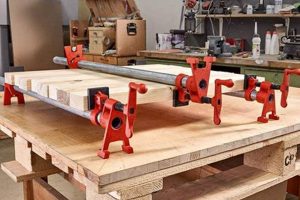
Tip 3: Distribute Clamping Force Evenly: When securing large or irregular workpieces, use multiple clamps to distribute force uniformly. This prevents warping or distortion during glue-ups or machining operations. Bench dogs and strategically placed clamps offer balanced support.
Tip 4: Utilize Bench Dog Placement Strategically: Employ bench dogs in conjunction with clamps to secure material against the surface and edge simultaneously. This approach is especially beneficial when working with thin stock or performing edge routing operations.
Tip 5: Check for Flatness Regularly: Use a straightedge and feeler gauges to verify the surface remains flat and true. Deviations can impact the accuracy of cuts and joinery. Minor adjustments can be made to the supporting structure to compensate for settling.
Tip 6: Protect the Surface During Aggressive Operations: When using chisels or other potentially damaging tools directly on the secured piece, use a sacrificial layer to protect the primary surface. This prevents dents and gouges that could affect future operations.
These guidelines help to maintain the integrity of the equipment, contribute to improved project accuracy, and enhance the overall efficiency of woodworking processes.
The subsequent section will address troubleshooting common issues encountered with such work surfaces and offering practical solutions.
1. Surface Flatness

Surface flatness is a fundamental characteristic dictating the performance of a woodworking clamping table. Deviations from a perfectly planar surface directly impact the accuracy of joinery, assembly, and finishing operations. A non-flat surface introduces errors in measurements, affects the alignment of components, and compromises the overall structural integrity of projects completed on the table. The degree to which a surface approaches true flatness is a primary determinant of the quality and precision achievable.
The relationship between surface flatness and the effectiveness of a clamping table is exemplified in tasks such as assembling cabinet face frames or constructing large panels. If the table surface is not flat, the assembled frame or panel will inherit this non-flatness, potentially leading to racking or instability. Similarly, when applying edge banding or performing routing operations, a non-flat surface can cause uneven results, requiring additional corrective measures. In cases involving the use of precision measuring tools like squares or levels, an inaccurate surface renders these tools ineffective, further compounding errors.
Maintaining surface flatness requires careful construction, material selection, and ongoing maintenance. Periodic checks with a precision straightedge and feeler gauges are essential for identifying and correcting any deviations. The consequences of neglecting surface flatness are manifest in diminished project quality, increased rework, and ultimately, a reduction in the efficiency of woodworking operations. A flat and true surface is therefore a critical prerequisite for realizing the full potential of a woodworking clamping table.
2. Clamping Versatility

Clamping versatility is a crucial attribute that defines the utility of a woodworking clamping table. The ability to accommodate a wide range of clamping configurations directly influences the types of projects that can be undertaken and the efficiency with which they can be executed. This adaptability is determined by factors inherent in the table’s design and the availability of compatible accessories.
- Integrated Clamping Systems
Many tables incorporate built-in clamping mechanisms, such as T-tracks, cam clamps, or vises. These integrated systems offer convenient and rapid workpiece securing. For example, a T-track system allows for the attachment of jigs, fences, and specialized clamps, enabling complex joinery operations that would be difficult to perform on a standard workbench.
- Dog Hole Compatibility
The presence of regularly spaced dog holes facilitates the use of bench dogs and hold-down clamps. This arrangement allows for secure clamping of workpieces of varying shapes and sizes. An application of dog hole clamping is the secure edge jointing of long boards using hold-down clamps placed along the edge, ensuring a tight seam for gluing.
- Accessory Availability
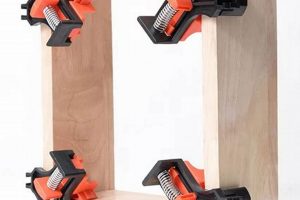
The range of available clamping accessories significantly impacts a table’s versatility. Accessories may include specialized clamps for dovetails, miter joints, or edge banding. The compatibility of the clamping table with a wide range of aftermarket accessories expands its capabilities and allows for customization to specific woodworking needs. An example is the use of a right-angle clamp attachment for accurately assembling square frames or boxes.
- Adjustability and Adaptability
The ability to adjust clamp positions and adapt to different workpiece geometries is essential. This may involve repositioning clamps along T-tracks, utilizing shims or spacers to accommodate irregular shapes, or employing custom-built clamping jigs. Adaptability ensures that the clamping table can accommodate a diverse range of woodworking tasks, from small craft projects to large-scale furniture construction.
In summary, clamping versatility enhances a woodworking clamping table’s ability to securely hold workpieces of various sizes and shapes. This adaptability improves workflow efficiency, increases project accuracy, and allows for a wider range of woodworking techniques to be employed.
3. Structural Rigidity

The term “structural rigidity,” as it pertains to a woodworking clamping table, denotes the table’s capacity to resist deformation under applied loads. This characteristic is not merely a desirable attribute; it is a foundational requirement for the table to perform its intended function effectively. The connection between structural rigidity and the utility of the table is direct: insufficient rigidity leads to workpiece instability, compromised accuracy in joinery and assembly, and ultimately, diminished project quality.
A lack of structural rigidity manifests in several ways. The table surface may deflect or vibrate during sanding, routing, or planing operations. This movement introduces inaccuracies, particularly when working with precision instruments or attempting to achieve tight-fitting joints. For instance, if a large panel is clamped to a table that flexes under pressure, the resulting glue-up may exhibit uneven surfaces or internal stresses, potentially leading to long-term structural failure. Similarly, when using the table as a reference surface for measuring or cutting, any deflection compromises the accuracy of the measurements and cuts, propagating errors throughout the project. Proper material selection and design elements, such as reinforced frames and robust leg assemblies, are crucial for achieving the necessary structural integrity.
In conclusion, structural rigidity constitutes an indispensable component of a woodworking clamping table. It is not simply a matter of preventing table wobble; it is about ensuring the accuracy, stability, and overall quality of the woodworking processes performed upon it. Addressing structural weaknesses in the table’s design and construction presents a significant challenge, requiring a balance between material cost, weight, and performance. However, the consequences of neglecting this aspect far outweigh the challenges involved in achieving a structurally sound and reliable table.
4. Dog Hole Configuration
Dog hole configuration represents a crucial design element influencing the utility and adaptability of a woodworking clamping table. The arrangement, spacing, and diameter of these holes directly determine the range of clamping options and the efficiency of securing workpieces. A well-considered configuration facilitates versatile clamping setups, accommodating diverse project requirements, while a poorly designed arrangement limits functionality and increases setup time. The dog hole system, in essence, is a primary interface between the table and the clamping accessories used to hold the wood.
The impact of dog hole configuration is evident in numerous woodworking tasks. For example, edge-gluing long boards requires the placement of multiple hold-down clamps along the edges to apply even pressure. A grid of dog holes allows for the strategic placement of these clamps, ensuring a tight and uniform glue line. Conversely, widely spaced holes necessitate the use of longer clamps or the addition of auxiliary clamping supports, increasing complexity and potentially compromising accuracy. Similarly, when using bench dogs to secure workpieces against a fence for routing or shaping operations, a closely spaced dog hole pattern provides greater flexibility in positioning the fence and optimizing workpiece stability. Inadequate dog hole spacing can hinder these operations, forcing compromises in workpiece positioning or clamping pressure.
In summary, dog hole configuration is intrinsically linked to the performance of a woodworking clamping table. It dictates the available clamping options, influences setup efficiency, and ultimately affects the accuracy and quality of finished projects. Consideration of hole spacing, diameter, and pattern is paramount in selecting or designing a clamping table that meets the specific needs of the woodworker. The effective utilization of dog holes, combined with appropriate clamping accessories, significantly enhances the versatility and functionality of the table, contributing to improved workflow and higher-quality results.
5. Material Durability
Material durability, defined as the ability of a material to withstand wear, pressure, or damage over time, is paramount in the construction of a woodworking clamping table. The service life, performance consistency, and overall value of this tool are intrinsically linked to the durability of the materials used in its fabrication.
- Surface Material Resistance
The table surface is subject to repeated impact, abrasion, and exposure to adhesives, solvents, and finishes. Durable surface materials, such as high-density polyethylene (HDPE) or hardened steel, resist scratching, denting, and chemical degradation. A surface constructed from lower-grade materials is susceptible to damage, compromising flatness and creating uneven surfaces that hinder precise clamping and woodworking operations. For instance, a softwood surface would quickly exhibit wear marks and indentations, negatively affecting project accuracy.
- Frame and Leg Stability
The frame and legs bear the weight of the table itself, along with the workpieces and clamping forces applied during projects. Materials with high tensile strength and resistance to bending, such as steel or hardwoods like maple or beech, are essential for maintaining structural integrity. A frame constructed from weaker materials may deform under load, resulting in instability and reduced clamping effectiveness. An example includes a steel frame capable of withstanding significant weight without deflection, ensuring consistent clamping pressure across the table surface.
- Clamping Mechanism Longevity
Integrated clamping mechanisms, such as vises, T-tracks, and cam clamps, are subject to frequent use and stress. Durable materials, such as hardened steel or aluminum alloys, are necessary to withstand repeated tightening and loosening cycles without failure. A clamping mechanism fabricated from weaker materials may wear out quickly, requiring frequent repairs or replacements, ultimately diminishing the table’s overall value. A steel vise, for example, ensures consistent clamping force and long-term reliability.
- Resistance to Environmental Factors
Woodworking environments often involve exposure to humidity, temperature fluctuations, and dust. Materials used in the table’s construction must resist warping, corrosion, and degradation due to these environmental factors. Treated wood or powder-coated steel components offer enhanced protection against moisture and rust. A table constructed without consideration for environmental resistance may deteriorate over time, compromising its structural integrity and functionality. Properly sealed hardwood or powder-coated metal frameworks effectively mitigate these potential degradation issues.
These facets underscore that the material composition of a woodworking clamping table significantly influences its performance, longevity, and utility. The strategic selection of durable materials ensures that the table can withstand the rigors of woodworking, providing a stable and reliable platform for various projects and applications.
Frequently Asked Questions Regarding Woodworking Clamping Tables
The following section addresses common inquiries and misconceptions concerning the selection, usage, and maintenance of woodworking clamping tables.
Question 1: What distinguishes a woodworking clamping table from a standard workbench?
A standard workbench typically lacks integrated clamping mechanisms and a precision surface designed for secure workpiece holding. A woodworking clamping table incorporates features such as dog holes, T-tracks, or built-in vises, specifically engineered to facilitate accurate and repeatable clamping operations.
Question 2: Is surface flatness a critical attribute, and if so, what tolerances are considered acceptable?
Surface flatness is indeed paramount for precision woodworking. Deviations exceeding 0.01 inches over a span of 24 inches can introduce inaccuracies in joinery and assembly. Regular monitoring and correction of surface deviations are essential for maintaining accuracy.
Question 3: What are the primary factors to consider when selecting a clamping table for specific woodworking applications?
Critical factors include the table’s structural rigidity, clamping versatility, surface material durability, and dog hole configuration. Consideration should be given to the types of projects anticipated and the clamping requirements they entail.
Question 4: How does dog hole spacing affect the clamping capabilities of a woodworking table?
Closer dog hole spacing provides greater flexibility in clamp placement, accommodating a wider range of workpiece sizes and shapes. A tighter grid allows for more secure and uniform clamping pressure, minimizing the risk of workpiece movement during operations.
Question 5: What maintenance procedures are recommended to ensure the longevity and performance of a clamping table?
Regular cleaning to remove debris, periodic checks for surface flatness, and lubrication of clamping mechanisms are essential. Surface treatments, such as wax coatings, can minimize glue adhesion and facilitate cleaning. Promptly addressing any structural issues prevents further degradation.
Question 6: Can a woodworking clamping table improve project accuracy and efficiency?
A properly designed and maintained clamping table enhances both accuracy and efficiency. The ability to securely hold workpieces facilitates precise cuts, joinery, and assembly, reducing errors and minimizing rework. Integrated clamping systems streamline workflow and improve overall productivity.
In conclusion, selecting and maintaining a woodworking clamping table requires careful consideration of its design features, material properties, and specific application requirements. A well-chosen and properly maintained table provides a stable and reliable platform for achieving precision and efficiency in woodworking operations.
The subsequent section will delve into advanced techniques and specialized clamping applications utilizing these versatile work surfaces.
Woodworking Clamping Table
This exploration has illuminated the critical facets of the woodworking clamping table, underscoring its significance in precision woodworking. Discussions encompassed the essential attributes of surface flatness, clamping versatility, structural rigidity, dog hole configuration, and material durability. Practical guidance regarding usage, maintenance, and troubleshooting further emphasized the practical application of this fundamental tool.
The mastery of woodworking techniques hinges upon the appropriate utilization of equipment. A properly selected and maintained woodworking clamping table represents a foundational investment, facilitating enhanced accuracy, efficiency, and safety in woodworking endeavors. Continued advancements in design and materials will undoubtedly further refine the capabilities of this essential instrument, solidifying its role in both professional and hobbyist woodworking environments.
![Top-Rated: Best Quick Clamps for Woodworking Projects [2024] | Step-by-Step Guides, Tools & Inspiration to Build Beautiful Wooden Decor on a Budget](https://woodfromhome.com/wp-content/uploads/2026/04/th-264-300x200.jpg "Top-Rated: Best Quick Clamps for Woodworking Projects [2024] Step-by-Step Guides, Tools & Inspiration to Build Beautiful Wooden Decor on a Budget")