



These tools, essential for securely holding wood pieces together during assembly, are designed for both amateur and professional use. They employ a mechanism to apply and maintain pressure, ensuring accurate alignment and strong bonds, vital for constructing furniture, cabinetry, and various woodworking projects. A craftsman might use these to keep a table leg firmly in place while the adhesive cures, guaranteeing a robust and lasting joint.
The value of these devices lies in their capacity to provide consistent, reliable force, preventing movement and minimizing errors during the crucial stages of fabrication. Their widespread adoption is rooted in a long history of joinery where precise fastening techniques are paramount. Over time, advancements in material science and mechanical engineering have led to enhanced durability, ease of use, and increased clamping pressure, making them indispensable across diverse woodworking disciplines.
The subsequent sections will delve into the different types available, considerations for selecting the appropriate tool for a given task, and best practices for their effective application and maintenance.
Essential Usage Guidelines
The following recommendations enhance the effectiveness and lifespan of these essential woodworking tools.
Tip 1: Match the Clamp to the Task. Select the appropriate style and size based on the dimensions and material of the workpiece. Over-clamping can damage delicate wood, while under-clamping compromises joint strength.
Tip 2: Employ Protective Barriers. Implement cauls or pads between the jaws and the wood surface. This distributes pressure evenly and prevents indentation or marring, especially when working with softwoods.
Tip 3: Stagger Clamp Placement. Position clamps strategically to distribute pressure uniformly along the joint. This minimizes stress concentrations and ensures a consistent glue line. Avoid excessive spacing, which can lead to gaps.
Tip 4: Maintain Cleanliness. Regularly clean the threads and moving parts to ensure smooth operation. Remove adhesive residue and sawdust promptly to prevent binding or corrosion.
Tip 5: Inspect Regularly. Periodically examine the tool for signs of wear or damage, such as bent bars, stripped threads, or cracked handles. Replace components as necessary to maintain safety and performance.
Tip 6: Lubricate Moving Parts. Apply a light coating of oil or grease to the threads and pivot points to reduce friction and extend the tool’s lifespan. This also facilitates easier tightening and loosening.
Adhering to these guidelines ensures optimal performance, prevents damage to workpieces, and prolongs the service life of these indispensable woodworking tools. Careful attention to detail in application and maintenance is paramount for achieving superior results.
The subsequent section will address common troubleshooting scenarios and their solutions.
1. Pressure Distribution

Pressure distribution is a critical factor in the effective use of woodworking clamps. The uniform application of force across the joint surfaces being bonded is paramount for achieving strong and lasting connections. Uneven distribution can lead to weakened joints, material deformation, and ultimately, project failure.
- Jaw Design and Surface Area
The design of the clamp jaws directly influences how pressure is distributed. Clamps with larger surface areas provide more even pressure compared to those with smaller contact points. The use of pivoting jaws or pads allows the clamp to conform to slightly uneven surfaces, mitigating pressure concentrations. These design features are essential for preventing localized stress that can damage the wood fibers.
- Clamp Placement and Spacing
The strategic placement and spacing of the holding devices is a key determinant of pressure uniformity. Applying too few holding devices or positioning them unevenly will result in inconsistent pressure across the joint. Proper technique involves distributing these tools at regular intervals to ensure consistent clamping force along the entire length of the joint. Close attention to these details is especially important when dealing with larger or more complex assemblies.
- Material Compatibility and Protective Measures
Different wood species exhibit varying degrees of compressibility and susceptibility to damage under pressure. Softer woods require careful consideration to prevent indentation or crushing. Utilizing protective cauls or pads between the clamp jaws and the workpiece helps to distribute pressure more evenly and minimize the risk of damage. The choice of protective material and its thickness should be tailored to the specific wood being worked with.
- Clamp Type and Mechanism
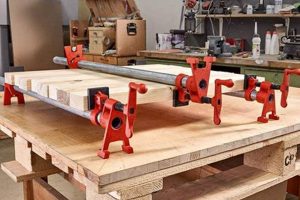
The type of holding device employed significantly affects the distribution of force. Bar clamps, for example, distribute pressure along a linear path, while pipe clamps offer greater versatility in accommodating curved or irregular shapes. The clamping mechanism itself, whether screw-type, lever-action, or ratchet-based, influences the consistency and control of the applied force. Selecting the appropriate clamp type for a given application is essential for achieving optimal pressure distribution.
Proper consideration of these factors related to pressure distribution is crucial when utilizing woodworking clamps. By understanding the interplay between jaw design, clamp placement, material compatibility, and clamp type, woodworkers can ensure uniform pressure, prevent material damage, and achieve strong, reliable joints. Skillful management of these elements is a hallmark of quality craftsmanship.
2. Material Compatibility
The selection of appropriate clamping devices must consider the inherent properties of the materials being joined. Incompatible pairings between the clamp’s construction and the workpiece can lead to damage, deformation, or compromised joint integrity. The interaction between clamp materials and the wood being worked upon is therefore a crucial consideration.
- Steel Clamp Jaws and Softwoods
The high hardness and rigidity of steel clamp jaws, common in many models, presents a risk when clamping softwoods like pine, cedar, or fir. Direct contact can easily indent or crush the wood fibers, leaving unsightly marks and potentially weakening the joint. This necessitates the use of protective padding or cauls to distribute the clamping force and prevent damage. Failure to account for this interaction can compromise the aesthetic and structural integrity of the finished piece.
- Galvanic Corrosion with Wet Wood
When clamping green or partially dried wood, the elevated moisture content creates a conducive environment for galvanic corrosion. The dissimilar metals in the clamp assembly (steel screws, iron bars) can react with the wood’s acidic compounds, leading to rust formation and degradation of the clamp. This is particularly relevant in outdoor woodworking applications. Applying a protective coating to the clamp and ensuring proper ventilation during drying can mitigate this issue.
- Resin Buildup and Clamp Function
Certain wood species, notably those high in resin content like pine and some hardwoods, can cause a buildup of sticky residue on the clamp threads and jaws. This resin buildup impairs the clamp’s smooth operation, reducing its clamping force and making adjustments difficult. Regular cleaning with appropriate solvents is required to maintain optimal functionality. Neglecting this aspect results in reduced efficiency and potential damage to the clamp mechanism.
- Compatibility with Finishes
Clamps, particularly those with rubber or plastic components, can interact negatively with certain wood finishes. Solvents or chemicals in the finish can soften or degrade the clamp’s materials, leading to discoloration or structural weakening. Conversely, some clamp materials can leave marks or residues on freshly finished surfaces. Testing compatibility on an inconspicuous area is recommended before using clamps on finished pieces. Choosing clamps with inert materials or using protective barriers is also a viable strategy.
The interplay between material properties and the clamping device is a critical factor in achieving successful woodworking outcomes. Awareness of potential incompatibilities and the implementation of appropriate preventative measures, such as protective padding, regular cleaning, and careful finish selection, are essential for preserving both the integrity of the workpiece and the functionality of the clamping tool. The selection of these devices should not solely focus on clamping force, but also on the materials that will come into contact with the wood.
3. Thread Durability

The longevity and effectiveness of Irwin woodworking clamps are intrinsically linked to the durability of their threaded components. The threads, typically found on the spindle or screw mechanism, are responsible for translating rotational force into clamping pressure. Their failure directly translates to a loss of clamping force, slippage, or complete inoperability. The specific materials used in thread construction, the precision of their machining, and the protective coatings applied significantly influence their resistance to wear, corrosion, and deformation under load. For instance, a clamp used daily in a professional workshop is subjected to constant stress and repeated tightening cycles, making thread durability a paramount concern.
Several factors contribute to thread degradation. Excessive tightening beyond the clamp’s specified load limit can cause thread stripping or deformation. Exposure to moisture and corrosive substances, common in woodworking environments, leads to rust and pitting, weakening the threads. The accumulation of sawdust and adhesive within the threads hinders smooth operation, increasing friction and accelerating wear. Regular cleaning and lubrication are essential preventive measures to mitigate these effects. A clamp with well-maintained, robust threads provides consistent and reliable clamping force, crucial for accurate joinery and secure bonding. Conversely, a clamp with compromised threads poses a safety risk and undermines the quality of the woodworking project.
In summary, thread durability is a fundamental attribute determining the overall performance and lifespan of Irwin woodworking clamps. Its importance cannot be overstated, as it directly impacts clamping force, operational reliability, and user safety. Prioritizing clamps constructed with high-quality materials and implementing proactive maintenance practices are essential for maximizing the value and longevity of these essential woodworking tools. The financial implications of replacing clamps frequently due to thread failure also underscores the practical significance of selecting models with robust thread design.
4. Jaw Alignment
Jaw alignment, a crucial characteristic of woodworking clamps, directly influences the precision and quality of bonded joints. In the context of these holding devices, proper jaw alignment ensures that the clamping force is distributed evenly across the surfaces being joined. Misalignment can result in uneven pressure, leading to gaps, weak bonds, and structural instability. This is especially critical when assembling complex structures or working with hardwoods where precise fit is paramount. For instance, a cabinet face frame constructed with misaligned clamps may exhibit uneven reveals or gaps at the joints, compromising its aesthetic appeal and structural integrity. Therefore, the engineering and manufacturing of these tools must prioritize jaw alignment to ensure consistent and reliable clamping performance.
The connection between jaw alignment and clamping effectiveness is particularly evident when dealing with angled or irregular workpieces. A clamp with well-aligned jaws can accommodate slight variations in the material’s surface without compromising the uniformity of the clamping force. This adaptability is essential in scenarios such as assembling dovetail joints or securing curved components. Conversely, a clamp with poor jaw alignment may exert undue pressure on one area while leaving other areas inadequately clamped, potentially causing damage to the workpiece or resulting in a substandard bond. This highlights the need for users to inspect and maintain the jaw alignment of their tools regularly, addressing any discrepancies promptly to prevent adverse outcomes.
In conclusion, jaw alignment is not merely a superficial feature but a fundamental determinant of woodworking clamp performance. Its impact extends to the strength, precision, and overall quality of the finished product. Recognizing the significance of jaw alignment, coupled with proper inspection and maintenance practices, enables woodworkers to maximize the utility of these holding devices and achieve superior results. The long-term durability and reliability of assembled projects are directly correlated to the alignment and effectiveness of the clamps used during the bonding process.
5. Release Mechanism

The release mechanism on woodworking clamps is a critical component, directly influencing efficiency and safety in woodworking processes. It dictates how quickly and easily a clamp can be disengaged from the workpiece after the adhesive has cured or the assembly is secured. A well-designed release mechanism enhances productivity, reduces the risk of damage to the wood, and improves the overall user experience.
- Quick-Release Levers and Speed of Operation
Certain woodworking clamps incorporate quick-release levers, allowing for rapid disengagement without the need for extensive unscrewing. This feature is particularly beneficial in production environments where time is of the essence. For example, a cabinetmaker assembling multiple units can significantly reduce cycle times by employing clamps with quick-release mechanisms. However, the speed of operation must be balanced with the security of the clamp during the holding phase to prevent premature release and potential joint failure.
- Thread Pitch and Ease of Disengagement
The thread pitch on the screw mechanism of a woodworking clamp directly affects the ease with which it can be loosened. A coarser thread pitch allows for faster adjustment but may require more force to tighten, while a finer thread pitch provides greater clamping force and control but necessitates more rotations to release. A carpenter working with delicate wood may prefer a finer thread pitch for precise pressure control, while a furniture maker assembling larger pieces may prioritize the speed of release afforded by a coarser thread.
- Ergonomic Handles and Reduced User Fatigue
The design of the clamp handle plays a crucial role in the ease of disengagement. Ergonomic handles, often featuring contoured shapes and non-slip surfaces, reduce user fatigue and improve grip, enabling more efficient loosening of the clamp. A cabinet installer, for instance, who spends hours tightening and loosening clamps, will benefit from handles designed to minimize strain and maximize comfort. Proper handle design also contributes to safety by reducing the risk of slippage and potential injury.
- Locking Mechanisms and Prevention of Accidental Release
Some advanced woodworking clamps incorporate locking mechanisms to prevent accidental release during the clamping process. These mechanisms provide an additional layer of security, ensuring that the clamp remains engaged until intentionally disengaged. This feature is particularly valuable when working with heavy or irregularly shaped objects where premature release could pose a safety hazard or damage the workpiece. A luthier, for example, constructing a guitar soundboard may rely on locking mechanisms to maintain consistent pressure and prevent slippage during the delicate gluing process.
The efficiency, safety, and user experience associated with woodworking clamps are profoundly influenced by the design and functionality of their release mechanisms. The selection of a particular clamp should therefore consider the trade-offs between speed, precision, ergonomics, and safety, taking into account the specific demands of the woodworking task at hand.
6. Ergonomic Design
Ergonomic design, when applied to woodworking clamps, transcends mere aesthetics, directly affecting user efficiency, reducing physical strain, and enhancing overall productivity. The interaction between the tool and the user’s body is optimized to minimize discomfort and the risk of repetitive strain injuries.
- Handle Design and Grip Comfort
The handle of an Irwin woodworking clamp is a primary interface between the user and the tool. Ergonomic handles are shaped to conform to the natural contours of the hand, reducing pressure points and enabling a secure grip. Materials with non-slip properties further enhance control, especially when applying significant clamping force. Poor handle design can lead to hand fatigue, reduced grip strength, and an increased risk of slippage, potentially damaging the workpiece or causing injury.
- Weight Distribution and Balance
The distribution of weight within the clamp significantly impacts its usability, particularly during prolonged use. A well-balanced clamp minimizes wrist and arm strain, allowing the user to maintain control and apply consistent pressure. Clamps that are disproportionately weighted at one end require greater effort to stabilize, increasing fatigue and reducing precision. Ergonomic design seeks to optimize weight distribution for ease of handling and reduced physical stress.
- Clamping Force and Mechanical Advantage
Ergonomic design principles are also applied to the mechanical aspects of the clamping mechanism. The force required to achieve the desired clamping pressure should be minimized through efficient lever systems and thread designs. A clamp that requires excessive force to operate can lead to muscle strain and fatigue. Optimized mechanical advantage allows users to apply the necessary pressure with minimal exertion, enhancing both comfort and control.
- Adjustability and Adaptability
Ergonomic design considers the diverse range of hand sizes and grip preferences among users. Adjustable features, such as handle positions or jaw configurations, allow the clamp to be customized for individual comfort and optimal performance. This adaptability is particularly important in professional woodworking environments where multiple users may share the same tools. A clamp that can be easily adjusted to accommodate different users promotes efficiency and reduces the risk of musculoskeletal issues.
In summary, ergonomic design in Irwin woodworking clamps represents a comprehensive approach that considers the physical interaction between the tool and the user. By optimizing handle design, weight distribution, clamping force, and adjustability, these clamps enhance user comfort, reduce fatigue, and improve overall woodworking efficiency. These features ultimately contribute to higher quality workmanship and a safer working environment. Prioritizing ergonomic considerations is crucial for professionals and hobbyists alike, ensuring that these essential tools support rather than hinder the creative process.
Frequently Asked Questions
The following questions address common inquiries concerning the selection, application, and maintenance of these essential woodworking tools.
Question 1: What determines the appropriate clamping force for a given woodworking project?
The optimal clamping force is contingent upon the wood species, adhesive type, and joint configuration. Softwoods require less force to avoid compression damage, while hardwoods necessitate greater pressure for secure bonding. Adhesive manufacturers typically specify recommended clamping pressures. Complex joinery often benefits from increased force to ensure tight contact across all surfaces.
Question 2: How can one prevent staining or indentation when clamping delicate wood surfaces?
Protective cauls or pads, crafted from softer materials such as cork, leather, or softwood scraps, should be interposed between the clamp jaws and the workpiece. These distribute the clamping force evenly, minimizing the risk of indentation or discoloration. The selection of caul material should correspond to the wood’s sensitivity.
Question 3: What is the recommended cleaning and lubrication regimen for maintaining optimal clamp performance?
After each use, clamps should be thoroughly cleaned to remove adhesive residue, sawdust, and other debris. Threads should be lubricated periodically with a light machine oil or silicone lubricant to ensure smooth operation and prevent corrosion. Avoid using lubricants that attract dust or dry out, leaving a sticky residue.
Question 4: How should one assess the integrity of a clamp before use to ensure safety and prevent project failures?
Prior to application, clamps should be visually inspected for signs of damage, including bent bars, stripped threads, cracked handles, or deformed jaws. Moving parts should be checked for smooth operation. Any clamp exhibiting signs of compromise should be removed from service until repaired or replaced.
Question 5: Can these woodworking clamps be used for metalworking applications?
These clamps are primarily designed for woodworking. While they may be suitable for light-duty metalworking tasks, prolonged or heavy use with metal can damage the threads or distort the jaws. Metalworking applications generally require clamps specifically engineered for higher forces and greater durability.
Question 6: How can one address the issue of clamps slipping or sliding during the clamping process?
Slippage can be mitigated by ensuring that the clamp jaws are clean and free of grease or oil. Applying a thin layer of non-slip material, such as rubberized coating or textured tape, to the jaw faces can improve grip. Additionally, employing strategically placed stops or supports can prevent lateral movement.
Effective clamp utilization requires careful attention to these factors, ensuring safe and successful woodworking projects.
The subsequent section will provide a comparative analysis of different types.
Concluding Remarks
This exploration has underscored the critical role of Irwin woodworking clamps in achieving precision, strength, and durability in woodworking endeavors. The discussion has illuminated aspects from pressure distribution and material compatibility to thread durability, jaw alignment, release mechanisms, and ergonomic design. Practical guidelines for usage and maintenance have been presented, addressing common challenges and ensuring optimal tool performance. A deeper understanding of these elements allows for informed clamp selection and efficient application, contributing to project success.
The significance of reliable holding devices extends beyond mere functionality, influencing the quality, longevity, and safety of woodworking projects. Continued adherence to best practices and advancements in clamp technology will further elevate the craft, enabling woodworkers to achieve even greater precision and artistry in their work. The information imparted serves as a foundation for responsible tool stewardship and a commitment to excellence in woodworking practices.
![Top-Rated: Best Quick Clamps for Woodworking Projects [2024] | Step-by-Step Guides, Tools & Inspiration to Build Beautiful Wooden Decor on a Budget](https://woodfromhome.com/wp-content/uploads/2026/04/th-264-300x200.jpg "Top-Rated: Best Quick Clamps for Woodworking Projects [2024] Step-by-Step Guides, Tools & Inspiration to Build Beautiful Wooden Decor on a Budget")