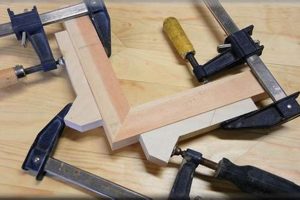
Spring clamps, essential tools in woodworking, provide temporary holding pressure for joining components while adhesives cure or fasteners are applied. These clamps, typically constructed with spring steel or durable plastic, offer a quick and convenient method for securing workpieces, particularly in situations requiring rapid adjustments or where access is limited. For example, a woodworker might utilize spring clamps to hold mitered corners of a picture frame together as glue sets.
The utility of these clamping devices stems from their ease of use, affordability, and suitability for a variety of woodworking tasks. Their simple mechanism allows for one-handed operation, increasing efficiency and reducing the need for extensive setup time. Historically, spring clamps evolved from simpler holding mechanisms and have become indispensable for both amateur and professional woodworkers, contributing to improved project accuracy and speed.
Selecting appropriate clamping devices necessitates considering factors such as clamping force, jaw capacity, material composition, and ergonomic design. Understanding these aspects enables woodworkers to choose the most effective tools for specific applications, ensuring successful project outcomes. The subsequent sections will delve into a detailed evaluation of these attributes and highlight exemplary options available to meet diverse woodworking needs.
Tips on Selecting Effective Clamping Tools
This section provides guidance on selecting appropriate clamping tools for woodworking applications. Consideration of these factors will lead to improved project outcomes and increased efficiency.
Tip 1: Evaluate Clamping Force: Assess the necessary clamping pressure for the specific woodworking task. Delicate projects require minimal force to avoid damage, while larger assemblies necessitate higher pressure for secure bonding.
Tip 2: Determine Jaw Capacity: Ensure the chosen clamping device possesses sufficient jaw opening to accommodate the thickness of the materials being joined. Measure the thickest combined dimension of the workpieces before selecting a tool.
Tip 3: Consider Material Composition: Opt for clamping tools constructed from durable materials such as spring steel or reinforced plastic to withstand repeated use and maintain consistent clamping pressure. Avoid clamps with brittle or easily damaged components.
Tip 4: Assess Ergonomic Design: Select clamping tools with comfortable handles and easy-to-operate mechanisms to minimize hand fatigue during extended use. Ergonomic designs enhance efficiency and reduce the risk of strain injuries.
Tip 5: Inspect Pad Quality: Examine the quality and composition of the pads that contact the workpiece. Non-marring pads prevent indentations and scratches on finished surfaces. Replace damaged or worn pads to maintain optimal performance.
Tip 6: Test Spring Tension: Prior to purchase, test the spring tension to ensure it provides adequate clamping force without being excessively difficult to operate. Consistent spring tension is crucial for reliable performance.
Tip 7: Consider Throat Depth: For applications requiring clamping pressure further from the edge of the workpiece, choose clamping tools with a sufficient throat depth to reach the desired location.
Adhering to these recommendations will facilitate the selection of robust and suitable clamping tools, ultimately enhancing the quality and efficiency of woodworking projects.
The subsequent sections will present a comprehensive overview of various clamping tool brands and models, allowing for a comparative analysis based on the outlined criteria.
1. Clamping Pressure

Clamping pressure, defined as the force exerted by a clamping device to hold workpieces together, constitutes a critical factor in the successful execution of woodworking projects. The selection of a spring clamp that delivers appropriate clamping pressure is integral to achieving strong, durable bonds and preventing workpiece damage.
- Achieving Optimal Bond Strength
Insufficient clamping pressure can result in weak adhesive bonds, leading to joint failure over time. Conversely, excessive pressure can deform or damage softer woods, leaving visible indentations. Optimal clamping pressure ensures consistent contact between mating surfaces, promoting maximum adhesive strength and preventing structural weakness. An example is the use of a spring clamp with moderate pressure to secure delicate trim, ensuring proper adhesion without marring the wood.
- Material Compatibility Considerations
Different wood species possess varying degrees of density and hardness. Softwoods, such as pine or cedar, require lower clamping pressure compared to hardwoods like oak or maple. Selecting a spring clamp with adjustable pressure capabilities allows for accommodating a range of wood types without risking damage. This adaptability is paramount in woodworking applications involving mixed materials.
- Spring Clamp Design and Pressure Output
The design of a spring clamp directly influences its clamping pressure output. Clamps employing stronger springs generate higher pressure, while those with weaker springs exert less force. Evaluating the spring mechanism and its corresponding pressure rating is essential when choosing clamps for specific tasks. For instance, clamps with coil springs often deliver higher pressure compared to those utilizing leaf springs.
- Ensuring Uniform Pressure Distribution
Even distribution of clamping pressure across the joint is vital for consistent bond strength. Spring clamps with wide, flat jaws or pivoting pads help distribute force evenly, minimizing localized pressure points that could damage the workpiece. Failure to distribute pressure uniformly can lead to uneven glue lines and potential joint failure. Example using wide clamp faces on a large surface area of a tabletop glue-up.
The selection of spring clamps necessitates careful consideration of clamping pressure in relation to the specific wood species, adhesive type, and project requirements. Understanding these nuances ensures that the chosen clamps provide adequate holding force without compromising the integrity of the workpiece, ultimately contributing to a superior finished product. The proper application of clamping force is essential when selecting from the best spring clamps for woodworking.
2. Jaw Opening

Jaw opening, the maximum distance between the clamping surfaces of a spring clamp, directly influences the range of applications for which the tool is suitable. Proper consideration of jaw opening ensures that a spring clamp can effectively secure workpieces of varying thicknesses, contributing to the overall efficacy of woodworking projects.
- Material Thickness Accommodation
The primary function of jaw opening is to accommodate different material thicknesses. A clamp with an insufficient jaw opening cannot be used to secure thicker workpieces, limiting its utility. Conversely, a clamp with an excessively large jaw opening may be cumbersome to use on thinner materials. Selection of a spring clamp with a jaw opening that matches the typical material thicknesses encountered in a specific woodworking context is essential. For example, a clamp with a smaller jaw opening would be suitable for securing thin veneer, while a larger jaw opening is needed for thicker lumber.
- Joint Configuration Compatibility
The configuration of a joint, such as a mitered corner or a butt joint, affects the required jaw opening. Mitered corners, for instance, often necessitate clamps with a larger jaw opening to accommodate the angled surfaces. Failure to account for joint configuration can result in an inability to properly secure the workpieces during the adhesive curing process. The selection of spring clamps should be guided by the common joint types employed in a given woodworking operation.
- Influence on Clamping Force Distribution
The jaw opening can indirectly influence the distribution of clamping force. When a clamp is used at or near its maximum jaw opening capacity, the clamping force may be reduced. Conversely, using a clamp well below its maximum capacity can result in excessive force concentration, potentially damaging the workpiece. Understanding the relationship between jaw opening and clamping force is crucial for achieving consistent and reliable results.
- Ergonomic Considerations and Accessibility
The design of the clamp and the size of its jaw opening can impact accessibility in confined spaces. A clamp with a smaller profile and a strategically designed jaw can be easier to maneuver in tight corners or hard-to-reach areas. Ergonomic factors related to jaw opening contribute to overall usability and efficiency in various woodworking scenarios.
The selection of “best spring clamps for woodworking” hinges significantly on the appropriate jaw opening. Careful assessment of material thickness, joint configuration, clamping force dynamics, and ergonomic considerations ensures that the chosen clamps are well-suited for the intended applications, ultimately enhancing the quality and efficiency of woodworking endeavors. This selection must be appropriate for the given task.
3. Material Durability
Material durability is a pivotal attribute determining the longevity and performance consistency of spring clamps used in woodworking. The capacity of a clamp to withstand repeated stress, environmental factors, and mechanical wear directly influences its suitability for demanding woodworking applications. Selecting spring clamps constructed from durable materials is paramount for ensuring reliable and consistent clamping force over an extended service life.
- Steel Composition and Tempering
Spring clamps fabricated from high-carbon steel alloys exhibit enhanced strength and resistance to deformation. The tempering process, a heat treatment method, further optimizes the steel’s hardness and elasticity, improving its ability to maintain clamping pressure over time. Clamps lacking appropriate steel composition or tempering are prone to fatigue and premature failure under repeated stress. An example of this would be clamps constructed with a high-carbon steel alloy, providing a better clamping force.
- Corrosion Resistance
Woodworking environments often expose tools to moisture, adhesives, and wood treatments, all of which can contribute to corrosion. Spring clamps with protective coatings, such as zinc plating or powder coating, exhibit enhanced resistance to rust and corrosion. This protection extends the lifespan of the clamp and ensures consistent performance, even in challenging conditions. For instance, stainless steel spring clamps are highly corrosion-resistant and suitable for use with treated lumber.
- Handle and Grip Construction
The handles and grips of spring clamps are subject to frequent handling and mechanical stress. Durable handle materials, such as reinforced nylon or fiberglass-filled polymers, provide resistance to cracking, chipping, and abrasion. Ergonomic handle designs with textured surfaces enhance grip and minimize slippage, even with prolonged use. A well-constructed handle improves user control and reduces the risk of accidents.
- Spring Mechanism Integrity
The spring mechanism is the core component responsible for generating clamping force. High-quality spring steel, precision winding, and appropriate heat treatment are essential for ensuring consistent and reliable spring performance. Spring mechanisms prone to fatigue or breakage will compromise the clamping force and render the tool ineffective. A spring that maintains its tension and original form can be considered durable.
These facets of material durability significantly impact the overall value and performance of spring clamps in woodworking. The “best spring clamps for woodworking” will feature robust construction, corrosion resistance, durable handles, and reliable spring mechanisms, ensuring they withstand the rigors of frequent use and maintain consistent clamping force throughout their service life. A clamp that fails due to poor material choices reduces efficiency and increases project costs over time. Careful consideration of material durability is therefore essential when selecting spring clamps for any woodworking application.
4. Ergonomic Design
Ergonomic design, the practice of tailoring tools and environments to fit the user, is a crucial determinant of efficiency, safety, and comfort in woodworking. Its integration into spring clamp design directly impacts user experience and productivity, influencing the selection of optimal clamping devices.
- Handle Shape and Grip Material
Handle shape and grip material are primary ergonomic considerations. Contoured handles that conform to the natural shape of the hand reduce strain and fatigue during prolonged use. Grip materials, such as non-slip rubber or textured polymers, enhance control and prevent slippage, even in wet or oily conditions. Spring clamps with poorly designed handles can lead to hand cramps and reduced clamping precision. For instance, a handle with finger grooves allows for a firm, controlled grip even with gloves.
- Activation Mechanism Accessibility
The accessibility of the clamp’s activation mechanism, such as the spring release or locking mechanism, is critical for ease of use. Mechanisms that require excessive force or awkward hand movements can increase the risk of strain injuries. Ergonomically designed clamps feature activation mechanisms that are easily accessible and require minimal effort to operate, facilitating efficient and comfortable use. A spring release that can be operated with one hand allows for quick adjustments and workpiece placement.
- Weight and Balance Distribution
The overall weight and balance distribution of a spring clamp influence user fatigue and control. Excessively heavy or poorly balanced clamps can strain the wrist and forearm, particularly during repetitive tasks. Ergonomically designed clamps distribute weight evenly and minimize overall weight, reducing user fatigue and improving maneuverability. For example, utilizing lightweight materials in the clamp’s construction allows for prolonged use without excessive strain.
- Force Required for Operation
The amount of force required to open and close a spring clamp significantly impacts user comfort and efficiency. Clamps requiring excessive force can lead to muscle fatigue and reduced clamping speed. Ergonomic designs aim to minimize the force needed for operation while maintaining adequate clamping pressure, allowing for comfortable and efficient use over extended periods. Clamps with lever-assisted mechanisms reduce the force needed to open the jaws, making them suitable for users with limited hand strength.
The facets of ergonomic design significantly contribute to the selection of the “best spring clamps for woodworking”. Clamps incorporating thoughtfully designed handles, accessible activation mechanisms, balanced weight distribution, and minimal operating force enhance user comfort, reduce fatigue, and improve overall efficiency in woodworking applications. Spring clamps lacking ergonomic features can lead to discomfort, reduced productivity, and an increased risk of injury. Careful consideration of ergonomic factors is essential when choosing clamping devices for any woodworking task.
5. Pad Quality
Pad quality, pertaining to the material, design, and condition of the contact points between the clamp and the workpiece, constitutes a critical element of superior spring clamps. Inferior pad quality directly precipitates workpiece damage, compromises clamping pressure distribution, and ultimately undermines the integrity of the finished product. Consequently, selection of spring clamps with high-quality pads is essential for achieving professional woodworking results.
The material composition of pads influences their non-marring properties. Pads crafted from soft, compliant materials like non-marking rubber or cork effectively prevent indentations and scratches on delicate wood surfaces. Conversely, rigid or abrasive pads can inflict irreparable damage, especially on softwoods or pre-finished surfaces. Pad design impacts the distribution of clamping force. Pads with a broad, flat surface area distribute pressure evenly, minimizing the risk of localized damage. In contrast, small or uneven pads concentrate force, potentially causing indentations. Maintaining pad condition is crucial. Worn, torn, or contaminated pads lose their protective qualities and can transfer debris or contaminants to the workpiece. Regular inspection and replacement of damaged pads are imperative for preserving workpiece integrity.
Recognizing the significance of pad quality is fundamental for informed spring clamp selection. Clamps advertised as “best spring clamps for woodworking” must demonstrably feature high-quality pads that safeguard the workpiece. Woodworkers should prioritize clamps with durable, non-marring pads, inspect them regularly, and replace them as needed to ensure optimal clamping performance and prevent damage. Neglecting pad quality directly jeopardizes the quality of the finished product, reinforcing its indispensable role in achieving superior woodworking results.
6. Throat Depth
Throat depth, defined as the distance from the clamping face to the clamp’s spine, directly influences a spring clamp’s capacity to secure workpieces away from their edges. Within the context of woodworking, projects often necessitate clamping pressure at locations remote from the perimeter, thereby establishing throat depth as a crucial performance parameter. Adequate throat depth allows application of force to the center of panels during glue-ups or to secure components recessed within a larger assembly. Insufficient depth renders a spring clamp unsuitable for these applications, limiting its versatility and potentially compromising project integrity.
Examples illustrating the importance of throat depth are abundant in woodworking. When attaching a support cleat to the interior face of a cabinet side panel, for instance, significant throat depth is essential to apply clamping pressure at the point of adhesion. Similarly, securing a decorative inlay near the center of a tabletop requires clamps with the reach to apply uniform pressure across the inlay’s surface. Selection of devices without appropriate throat depth results in uneven bonding, potential gaps, or compromised structural integrity. The practical significance of understanding this parameter resides in the enhanced project scope achievable with clamps possessing sufficient reach, enabling the execution of more complex and demanding woodworking tasks.
Effective evaluation of throat depth requirements is a critical component of selecting “best spring clamps for woodworking”. The practical challenges associated with limited throat depth are mitigated by understanding the project’s dimensional requirements and subsequently selecting spring clamps with adequate reach. Neglecting this aspect limits the application of spring clamps, reduces project versatility, and ultimately increases the likelihood of project failure due to inadequate clamping pressure. Careful consideration of throat depth is essential to ensuring successful outcomes across a wide spectrum of woodworking applications.
Frequently Asked Questions
This section addresses common inquiries regarding spring clamps, clarifying their appropriate uses and limitations within woodworking.
Question 1: What constitutes a “best” spring clamp for woodworking applications?
The designation of “best” is subjective and contingent upon specific woodworking tasks. However, universally desirable attributes include robust clamping force, ample jaw opening for accommodating various material thicknesses, durable construction to withstand repeated use, ergonomic design for user comfort, and non-marring pads to protect workpieces from damage.
Question 2: How does one determine the necessary clamping force for a given woodworking project?
Clamping force requirements are dictated by the wood species, adhesive type, and joint configuration. Softer woods and delicate assemblies necessitate less clamping pressure than hardwoods and structural joints. Adhesive manufacturers typically specify optimal clamping pressure ranges. Experimentation on scrap material is advisable to ascertain appropriate force levels.
Question 3: Are spring clamps suitable for all woodworking applications?
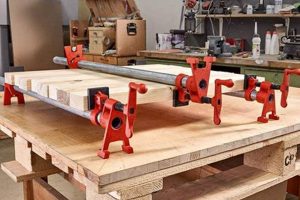
Spring clamps are well-suited for temporary holding, quick adjustments, and situations where rapid clamping is essential. However, they may lack the sustained and uniform pressure required for large-scale glue-ups or structural joints demanding high tensile strength. Bar clamps or pipe clamps are often more appropriate for such applications.
Question 4: What materials are commonly used in the construction of spring clamps, and how do these materials impact performance?
Spring clamps are typically fabricated from spring steel or reinforced plastic. Spring steel provides superior clamping force and durability, while plastic offers lighter weight and corrosion resistance. The choice of material should reflect the intended use and environmental conditions. For instance, stainless steel clamps are preferable for humid environments.
Question 5: How should spring clamps be maintained to ensure optimal performance and longevity?
Regular cleaning to remove adhesive residue and sawdust is essential. Lubricating moving parts with a dry lubricant helps prevent corrosion and ensures smooth operation. Inspecting pads for wear or damage and replacing them as needed preserves workpiece integrity. Proper storage in a dry environment minimizes the risk of rust and degradation.
Question 6: Can spring clamps effectively secure mitered corners?
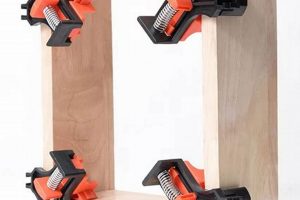
Spring clamps can be utilized to secure mitered corners, particularly for smaller projects like picture frames. However, specialized miter clamps or band clamps may provide more precise alignment and uniform pressure distribution, especially for larger or more complex mitered assemblies.
Selecting appropriate spring clamps and employing proper clamping techniques are critical for achieving high-quality woodworking results. Understanding the limitations of spring clamps and choosing alternative clamping methods when necessary is equally important.
The following section provides a detailed comparison of specific spring clamp models available on the market.
Conclusion
This exploration of spring clamps in woodworking has underscored the significance of clamping pressure, jaw opening, material durability, ergonomic design, pad quality, and throat depth in determining optimal tool selection. Understanding these factors is paramount for achieving successful woodworking outcomes. Variations in material composition, project scale, and environmental conditions necessitate careful evaluation of clamp attributes to ensure proper functionality and project integrity.
The informed application of these principles elevates the standard of woodworking projects and minimizes the potential for material waste or structural compromise. Future endeavors should prioritize rigorous assessment of project-specific clamping requirements, alongside continuous evaluation of emerging spring clamp technologies, to facilitate ever-improving standards of craftsmanship and long-term project stability.
![Top-Rated: Best Quick Clamps for Woodworking Projects [2024] | Step-by-Step Guides, Tools & Inspiration to Build Beautiful Wooden Decor on a Budget](https://woodfromhome.com/wp-content/uploads/2026/04/th-264-300x200.jpg "Top-Rated: Best Quick Clamps for Woodworking Projects [2024] Step-by-Step Guides, Tools & Inspiration to Build Beautiful Wooden Decor on a Budget")