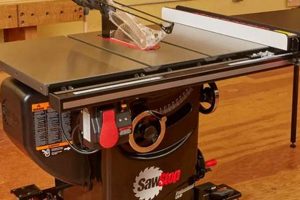
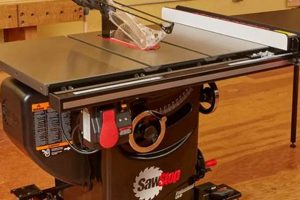
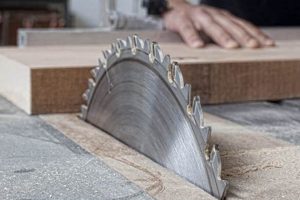
A woodworking bench integrated with a table saw represents a hybrid workstation. This setup combines the stability and functionality of a traditional woodworking bench with the precision cutting capabilities of a table saw. These integrated systems are typically constructed from sturdy materials like hardwood or reinforced plywood, providing a stable platform for both general woodworking tasks and precision sawing operations. The designs for these systems encompass a variety of configurations, from simple bench tops with a saw mounted flush to the surface to more elaborate designs incorporating dust collection, outfeed support, and integrated clamping systems.
The primary advantage of such a workstation lies in its space-saving nature. In smaller workshops, combining these two essential pieces of equipment into a single unit optimizes the available footprint. Furthermore, the integration enhances workflow efficiency, allowing for seamless transitions between preparation, cutting, and assembly. Historically, woodworkers often customized their benches to accommodate various tools; the modern integrated workbench/table saw builds on this tradition, offering a more refined and purpose-built solution.
Considerations when evaluating designs involve assessing the table saw’s mounting mechanism, ensuring a flush and stable surface. Dust collection integration is also important for maintaining a cleaner and healthier work environment. The plans detail the bench’s overall dimensions, material list, and step-by-step instructions, guiding the construction process from initial framing to final assembly. These plans frequently include options for customization, allowing woodworkers to adapt the design to suit their specific needs and available space.
Construction and Utilization Tips
Effective construction and utilization of plans for a woodworking bench integrated with a table saw require careful consideration of several key factors. Adherence to these guidelines ensures a functional, safe, and efficient workspace.
Tip 1: Material Selection is Crucial: Opt for high-quality hardwood or multi-layered plywood. The selected material must withstand constant vibration from the table saw and the general wear and tear associated with woodworking.
Tip 2: Prioritize a Perfectly Level Surface: The workbench surface and the table saw table must be coplanar. Even slight discrepancies can introduce inaccuracies in cuts and compromise safety.
Tip 3: Dust Collection Integration is Essential: Incorporate a dedicated dust collection system directly into the bench design. This minimizes airborne particles, promoting a healthier work environment and improving visibility.
Tip 4: Implement a Robust Clamping System: Integrated clamps, such as dog holes and bench vises, significantly enhance the workbench’s utility. These systems secure workpieces during cutting and assembly, improving precision and safety.
Tip 5: Reinforce High-Stress Areas: Pay particular attention to reinforcing the areas surrounding the table saw mounting point. These areas are subject to increased stress during operation and require additional support.
Tip 6: Plan for Outfeed Support: Insufficient outfeed support can lead to inaccurate cuts, particularly with longer workpieces. Design a fold-down or adjustable outfeed table to provide consistent support.
Tip 7: Secure and Safe Electrical Wiring: All electrical wiring must be concealed and protected. Use appropriate gauge wire and ensure proper grounding to prevent electrical hazards.
Adhering to these construction and utilization considerations fosters a safer, more accurate, and more efficient woodworking environment. Careful planning and execution of the chosen design translate directly into increased productivity and improved project quality.
Moving forward, consider exploring advanced features such as motorized lifts and integrated power tool controls to further enhance the functionality of the combined woodworking bench and table saw setup.
1. Ergonomic Height

Ergonomic height is a critical consideration within designs for a woodworking bench integrated with a table saw. This dimension directly influences the user’s posture, reach, and overall comfort during operation. An improperly designed height can induce strain, fatigue, and potential long-term musculoskeletal issues. Effective “woodworking bench with table saw plans” prioritize this aspect, specifying a height that minimizes bending or overreaching, thereby promoting a more efficient and safer workflow. For example, designs frequently reference common table saw heights and adjust the bench structure to align the saw table with the user’s natural waist level. A woodworking bench that is too low forces the user to hunch over, creating back pain. Conversely, a bench that is too high requires constant reaching, straining shoulder muscles.
The determination of optimal ergonomic height involves considering the average height of the intended users. Plans often include adjustable leg mechanisms, allowing for fine-tuning the bench height to suit individual preferences and anatomical variations. Furthermore, the design may incorporate a slight recess around the table saw area, further optimizing the relationship between the user and the cutting surface. This design feature enables closer proximity to the workpiece, enhancing control and precision during cutting operations. The consequence of neglecting ergonomic considerations in woodworking bench designs includes reduced productivity, increased risk of injury, and diminished user satisfaction. A practical application demonstrating the importance of ergonomic height is evident in professional woodworking shops, where custom-built benches are prevalent. These benches are specifically tailored to the individual woodworker, ensuring maximum comfort and efficiency.
In summary, ergonomic height is an indispensable element within “woodworking bench with table saw plans.” Its proper implementation directly impacts user well-being, efficiency, and the quality of the woodworking process. Challenges in achieving optimal ergonomic height often stem from variations in user height and the inherent constraints of combining a table saw with a woodworking bench. However, these challenges can be effectively addressed through adjustable designs, careful consideration of saw table height, and a focus on individual user needs. A design that prioritizes ergonomics can transform a standard woodworking setup into a safe, and comfortable workspace.
2. Dust Management

Effective dust management is intrinsically linked to the design and implementation of woodworking bench with table saw plans. The operation of a table saw generates substantial amounts of fine particulate matter, posing potential health risks and hindering visibility. Consequently, plans for such integrated workstations must prioritize efficient dust extraction and containment. Poor dust management leads to respiratory irritation, allergic reactions, and potential long-term health complications for the woodworker. Moreover, accumulated sawdust reduces the efficiency of tools, obscures cut lines, and increases the risk of fire. Therefore, the inclusion of a robust dust collection system is not merely an add-on feature but a fundamental design requirement.
Integrated dust collection in woodworking bench with table saw plans typically involves a combination of features. These include a shroud or enclosure surrounding the saw blade to capture dust at the source, a port for connecting to a shop vacuum or dust collector, and strategically placed baffles to direct airflow. Designs may also incorporate internal ducting within the bench structure to optimize dust removal. A practical example is seen in benches featuring a sloped floor beneath the table saw, directing sawdust towards the collection port. Another design consideration involves the material used for the dust collection components. Smooth, non-porous materials minimize friction and prevent dust accumulation within the system. Furthermore, the size and configuration of the collection port must be compatible with commonly available dust collection equipment. Some plans incorporate blast gates to control airflow to different sections of the bench, further enhancing the efficiency of the dust removal process.
In conclusion, dust management is a critical, non-negotiable aspect of woodworking bench with table saw plans. Neglecting this element compromises both the health of the woodworker and the overall efficiency of the workshop. Successful designs integrate efficient dust collection systems that capture particulate matter at the source, minimizing airborne dust and promoting a cleaner, safer work environment. Challenges in implementing effective dust management often arise from space constraints and the need to balance functionality with aesthetic considerations. However, these challenges can be overcome through careful planning and innovative design solutions. These features can lead to a safer and more efficient woodworking process.
3. Structural Integrity
Structural integrity, within the context of woodworking bench with table saw plans, represents a foundational element governing the workstation’s safety, stability, and longevity. It directly influences the accuracy of cuts, the mitigation of vibrations, and the overall user experience. Plans failing to prioritize structural integrity risk catastrophic failure under load, compromising safety and potentially damaging the table saw. The inherent vibration generated by a table saw necessitates a robust frame and work surface capable of absorbing and dissipating these forces. This stability translates directly into cleaner, more precise cuts. The bench’s frame acts as the primary load-bearing component, and its design and construction materials must adequately support the combined weight of the table saw, workpieces, and any applied downward pressure during use.
Practical application of these principles is evident in various design choices. Mortise-and-tenon joinery, for example, offers superior strength and resistance to racking compared to simpler butt joints. Similarly, the strategic placement of cross braces and aprons reinforces the frame, preventing warping and flexing. Examples of this can be found in heavy-duty workbenches utilized in professional woodworking shops, where the frame is often constructed from thick, seasoned hardwoods. The materials selection must consider the intended load and the anticipated operating environment. Softwoods, while less expensive, may lack the necessary stiffness and resistance to deformation under prolonged stress. The workbench top, typically constructed from laminated hardwoods or engineered wood products, serves as a stable and flat surface for supporting the table saw and workpieces.
The design, construction materials, and joinery method determines the structural integrity of woodworking bench with table saw plans. A compromised structure can result in inaccurate cuts, instability, and potential failure under load. Mitigating these risks requires careful planning, proper materials selection, and meticulous construction practices. Overcoming these challenges results in a safe, durable, and effective woodworking station that enhances both the quality and safety of woodworking projects.
4. Integrated Power

Integrated power, in the context of woodworking bench with table saw plans, refers to the strategic incorporation of electrical outlets, switches, and wiring directly into the bench design. This integration provides a centralized and readily accessible power source for the table saw and other auxiliary tools, streamlining workflow and enhancing safety. The absence of integrated power necessitates the use of extension cords, which can create tripping hazards and clutter the workspace. Plans neglecting this aspect often lead to inefficient setups and increased risk of electrical accidents. The inclusion of strategically positioned outlets eliminates the need for excessive cord management, freeing up valuable workspace and reducing the likelihood of accidental disconnections during operation.
Designs commonly incorporate a master power switch, allowing for simultaneous control of the table saw and connected accessories, such as dust collectors. This feature enhances safety by enabling rapid shutdown in emergency situations. Furthermore, integrated power strips with overload protection safeguard against electrical surges and prevent damage to equipment. Real-world examples include professional woodworking benches equipped with multiple outlets, dedicated circuits for high-amperage tools, and recessed power panels to prevent accidental contact. Consider a workbench equipped with a foot-operated power switch; this allows the woodworker to quickly shut off the table saw while keeping both hands free to control the workpiece. This level of integration demonstrates the practical significance of thoughtfully planned power distribution within a woodworking station.
Proper implementation of integrated power within woodworking bench with table saw plans requires adherence to electrical codes and safety standards. This includes using appropriate gauge wiring, properly grounding all components, and installing GFCI (Ground Fault Circuit Interrupter) outlets in areas prone to moisture. Addressing these electrical considerations from the outset minimizes the risk of fire, shock, and equipment failure. Integrating power increases the convenience and safety of woodworking tasks by ensuring electricity access is near work area. Therefore, integrated power is an essential component of a well-designed woodworking bench integrated with a table saw.
5. Dimensional Accuracy
Dimensional accuracy constitutes a pivotal element within woodworking bench with table saw plans, influencing the overall precision and functionality of the resulting workstation. The correlation between precise measurements and a well-executed bench design is direct: deviations from specified dimensions can cascade into structural instability, misalignment of components, and ultimately, compromised cutting performance. Woodworking operations relying on a table saw demand exacting measurements, making dimensional accuracy a non-negotiable aspect of the planning and construction process. For example, a benchtop that is not perfectly square to the saw blade will inevitably produce inaccurate cuts, negating the inherent precision of the table saw itself. The plans, therefore, must provide clear and unambiguous dimensional specifications for all components, including the frame, work surface, and integrated accessories.
The practical application of dimensional accuracy manifests throughout the construction process. Fabricating the frame requires precise cuts to ensure that all elements are square and plumb. The dimensions of the table saw mounting platform must precisely match the saw’s footprint to achieve a flush and stable installation. Even seemingly minor discrepancies, such as a few millimeters of deviation, can accumulate and lead to significant problems during assembly. Further, integrating components like dust collection ports or power outlets necessitates accurately sized openings to ensure a seamless and functional fit. In professional woodworking settings, stringent quality control measures are implemented to verify dimensional accuracy at each stage of construction, utilizing precision measuring tools and techniques. Consider a scenario where the workbench top is slightly warped due to inaccurate cutting of the underlying frame components; this deformation would directly impact the table saw’s ability to produce clean and consistent cuts.
In summary, dimensional accuracy is an indispensable attribute of well-conceived woodworking bench with table saw plans. Precise measurements translate into a stable, functional, and safe workstation, enhancing the precision of woodworking operations. The challenges associated with achieving dimensional accuracy can be mitigated through meticulous planning, the use of quality measuring tools, and adherence to established construction techniques. Accurate dimensions are not just a matter of aesthetics; they are fundamentally linked to the performance and safety of the woodworking bench.
Frequently Asked Questions about Woodworking Bench with Table Saw Plans
The following addresses common inquiries regarding woodworking bench integrated with table saw designs. These questions are intended to clarify misconceptions and provide information.
Question 1: What is the minimum space requirement for a woodworking bench incorporating a table saw?
The required footprint varies depending on the specific design and the table saw’s dimensions. However, expect a minimum area of approximately 6 feet by 4 feet to accommodate both the bench and provide adequate workspace. Folding or modular designs can mitigate space constraints.
Question 2: Is it necessary to reinforce the workbench frame to accommodate the table saw’s weight and vibration?
Reinforcement is essential. The workbench frame must be capable of withstanding the table saw’s weight and the vibrations generated during operation. Failure to provide adequate support can compromise safety and accuracy. Consider using thicker lumber, cross braces, and robust joinery techniques.
Question 3: How can dust collection be effectively integrated into a woodworking bench with a table saw?
Effective dust collection involves capturing dust at the source. Incorporate a shroud around the saw blade, connect a shop vacuum or dust collector to a dedicated port, and utilize internal baffling to direct airflow. Sealing gaps and optimizing airflow are also beneficial.
Question 4: What safety precautions should be considered when constructing a woodworking bench with an integrated table saw?
Safety precautions include proper electrical wiring, grounding all components, using GFCI outlets, and ensuring the table saw is securely mounted. Always wear appropriate safety gear, such as eye protection and hearing protection, when operating the table saw. Review and understand the table saw’s manual before operation.
Question 5: Are there specific table saw models that are better suited for integration into a woodworking bench?
Contractor-style and jobsite table saws are often favored due to their smaller size and portability. However, any table saw can be integrated, provided the bench design is tailored to accommodate its dimensions and weight. Consider the saw’s dust collection port compatibility and ease of mounting.
Question 6: Can a woodworking bench with a table saw be easily moved or transported?
The portability depends on the design and construction materials. A heavy-duty bench constructed from solid hardwoods may be difficult to move. However, designs incorporating casters or modular construction can facilitate relocation. Consider the bench’s weight and dimensions when assessing its portability.
These FAQs provide a starting point for understanding essential considerations related to woodworking benches incorporating table saws. Thoroughly review all plans and instructions before commencing construction.
The next section will address various plan customization options.
Conclusion
Effective woodworking demands both versatility and precision. Woodworking bench with table saw plans represent an attempt to consolidate these requirements into a single, functional unit. The preceding exploration has highlighted critical considerations pertaining to design, construction, safety, and efficiency. Adherence to these guidelines is paramount in realizing a workstation that is not only productive but also safe and ergonomically sound.
The integration of a table saw within a woodworking bench presents inherent challenges. However, thoughtful design and meticulous execution can transform these challenges into opportunities for enhanced workflow and optimized space utilization. Woodworking bench with table saw plans serve as a blueprint for achieving this synthesis, empowering woodworkers to elevate their craft and maximize their potential. Continued advancements in design and construction techniques promise further refinement and innovation in this realm.