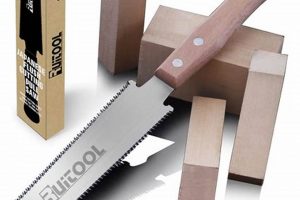
These circular cutting tools are essential components in woodworking, designed for use with a stationary power tool to perform precise cuts on wood stock. These blades are manufactured in a range of sizes and tooth configurations to suit various materials and cutting tasks. For instance, a blade with fewer, larger teeth may be suitable for ripping lumber, while one with more numerous, smaller teeth might be better for crosscutting hardwoods.
The selection of an appropriate cutting disc significantly impacts the quality and efficiency of woodworking projects. Using the correct type can result in cleaner cuts, reduce the likelihood of splintering, and improve overall project accuracy. Their development has paralleled advancements in both woodworking machinery and materials, contributing to increased precision and safety in wood processing.
Understanding the different types, their ideal applications, safety considerations, and maintenance practices will enable woodworkers to achieve optimal results. The subsequent sections will detail these aspects, providing a comprehensive overview of this critical element within woodworking.
Essential Guidance
The following guidelines aim to optimize performance and longevity while ensuring operator safety when utilizing these cutting implements.
Tip 1: Select the Appropriate Blade: Match the blade’s tooth configuration and material to the specific woodworking task. A combination blade may suffice for general work, but specialized blades for ripping or crosscutting hardwoods offer superior results.
Tip 2: Inspect Before Use: Thoroughly examine the blade for any signs of damage, such as missing or chipped teeth, cracks, or warping. A damaged blade can compromise cut quality and pose a significant safety risk.
Tip 3: Use Proper Stabilizers: Ensure the saw’s stabilizers, such as riving knives and splitters, are correctly installed and adjusted. These components prevent kickback and improve cut stability.
Tip 4: Maintain Sharpness: Dull blades require increased force, leading to potential kickback and reduced cut quality. Sharpen or replace the blade when resistance increases or cut edges become rough.
Tip 5: Control Feed Rate: Feed the wood at a steady and controlled pace. Avoid forcing the wood through the blade, which can cause the motor to stall or the blade to bind.
Tip 6: Wear Safety Gear: Always wear appropriate safety gear, including safety glasses, hearing protection, and a dust mask, to protect against potential hazards during operation.
Tip 7: Clean and Store Properly: After each use, clean the blade with a brush to remove sawdust and resin buildup. Store it in a dry location in its original packaging or a protective case to prevent damage and corrosion.
Adhering to these guidelines will not only enhance the precision and efficiency of woodworking projects but also significantly improve user safety.
The subsequent discussion will address blade maintenance and replacement procedures, further contributing to comprehensive understanding and responsible usage.
1. Blade Tooth Geometry

Blade tooth geometry is a defining characteristic influencing the performance of woodworking blades, directly impacting the quality, speed, and suitability of the tool for specific cutting tasks. The shape, angle, and arrangement of the teeth determine how the blade interacts with the wood, dictating the type of cut achievable and the finish quality.
- Tooth Angle and Rake
The tooth angle, specifically the rake angle, affects the aggressiveness of the cut. A positive rake angle is typically used for ripping, pulling the wood into the blade for faster material removal. A negative or neutral rake angle is often employed for crosscutting, reducing splintering and creating a smoother edge. The selection of an appropriate rake angle contributes directly to the efficiency and precision of the cut.
- Tooth Grind
Different tooth grinds are optimized for specific applications. A flat-top grind (FTG) is common for ripping lumber, providing efficient material removal. An alternate top bevel (ATB) grind creates a cleaner cut when crosscutting hardwoods and plywood. A triple chip grind (TCG) is often used for cutting abrasive materials like laminates. Choosing the correct tooth grind significantly improves the cut quality and blade lifespan.
- Tooth Set
The tooth set refers to the alternating offset of the teeth, which creates a kerf (the width of the cut) wider than the blade’s body. This clearance prevents the blade from binding within the wood. An alternating top bevel (ATB) set is a common configuration. Proper tooth set minimizes friction and heat buildup, contributing to smoother cutting and reducing the risk of kickback.
- Tooth Count and Spacing
The number of teeth and their spacing affect the cut’s smoothness and speed. Blades with fewer teeth are generally used for ripping, allowing for faster material removal but potentially resulting in a rougher edge. Blades with more teeth are better suited for crosscutting, producing a smoother finish but cutting more slowly. Choosing an appropriate tooth count is crucial for balancing cut speed and finish quality.
Understanding the relationship between tooth geometry and woodworking tasks enables informed blade selection, optimizing cutting performance, and ensuring safety in woodworking operations. Ignoring these considerations can lead to inefficient cutting, poor finish quality, and increased risk of accidents. The correct blade maximizes efficiency and safety in woodworking projects.
2. Kerf Width Impact
The width of the kerf, the channel created by a cutting blade, significantly influences the efficiency, precision, and material yield in woodworking applications. The kerf width directly relates to the design and function of components used with a stationary saw, impacting material wastage and the overall performance of woodworking tasks.
- Material Waste
A wider kerf removes more material during each cut, leading to increased waste, particularly crucial in projects utilizing expensive hardwoods or where precise dimensions are paramount. Utilizing thin-kerf blades minimizes material loss, increasing the number of usable pieces from a given stock. Thinner blades can be particularly beneficial in high-volume production settings where even slight reductions in waste accumulate into substantial material savings.
- Power Requirements
Blades with a wider kerf demand more power from the saw motor due to the increased material being removed. This increased demand can strain smaller or less powerful saws, potentially leading to motor overheating or reduced cutting speed. Thin-kerf blades reduce the load on the motor, allowing for smoother operation, especially when processing dense hardwoods. In industrial settings, optimized kerf width contributes to energy efficiency and reduced equipment wear.
- Cut Quality
The kerf width, in conjunction with the blade’s tooth geometry and set, impacts the smoothness and cleanliness of the cut. Wider kerfs can sometimes produce a rougher edge, requiring additional sanding or finishing. Precise control of the kerf, especially with specialized blades, enables the attainment of cleaner edges, reducing post-processing requirements and improving the aesthetic quality of finished projects. This aspect is particularly relevant in fine woodworking applications.
- Blade Stability
While thin-kerf blades offer advantages in material conservation and power reduction, they can be more susceptible to deflection or vibration, especially when cutting thick stock. This instability can compromise cut accuracy and increase the risk of kickback. Conversely, blades with a wider kerf tend to be more rigid and stable, offering enhanced control and reducing vibration when processing thicker materials. Selecting the appropriate kerf width requires balancing material waste reduction with the need for adequate blade stability.
The optimal kerf width represents a balance between material efficiency, power demands, cut quality, and blade stability. Careful consideration of these factors, tailored to the specific woodworking task and material being processed, is essential for maximizing productivity and achieving desired results.
3. Material Composition Variance

Material composition variance in the context of woodworking blades refers to the diverse range of materials used in their construction, each offering unique properties that influence cutting performance, durability, and suitability for specific woodworking tasks. The choice of materials is a critical factor in determining a blade’s effectiveness and longevity.
- Steel Grades and Hardness
The core body of most blades consists of steel, with varying grades affecting hardness, flexibility, and resistance to deformation. Higher-grade steel alloys provide increased durability and maintain blade flatness under stress, essential for accurate cuts. For instance, high-speed steel (HSS) is often used for its heat resistance, enabling it to maintain its hardness at high cutting speeds. Conversely, lower-grade steel may be more prone to warping or losing its edge, diminishing cut quality and potentially posing safety risks.
- Carbide Composition and Application
Carbide tips, brazed onto the blade teeth, are a common feature due to their exceptional hardness and wear resistance. However, the composition of the carbide itself can vary significantly, affecting its performance on different materials. Some carbide formulations are optimized for cutting hardwoods, offering superior edge retention, while others are designed for softer woods or abrasive materials like plywood and laminates. The type of carbide directly influences the blade’s ability to maintain a sharp cutting edge and resist wear.
- Bonding Agents and Brazing Material
The method and material used to bond the carbide tips to the steel body are crucial for the blade’s structural integrity. High-quality brazing materials, such as silver alloys, ensure a strong and durable bond that can withstand the stresses of high-speed cutting. Weak or poorly applied brazing can lead to carbide tips breaking off during use, posing a safety hazard and rendering the blade ineffective. The choice of bonding agents directly affects the blade’s ability to withstand mechanical stress and temperature fluctuations.
- Coatings and Surface Treatments
Surface treatments and coatings can enhance the performance and lifespan of woodworking blades. Coatings like Teflon reduce friction, minimizing heat buildup and improving cutting efficiency. Other treatments can increase corrosion resistance or improve the blade’s ability to resist pitch and resin buildup. The application of appropriate coatings contributes to smoother cutting, reduced maintenance, and extended blade life. For example, a non-stick coating can be valuable when working with resinous woods.
In conclusion, variations in material composition have a direct and substantial impact on its cutting ability, durability, and safety. Understanding these variances allows woodworkers to select the optimal tool for each task, maximizing efficiency and minimizing the risk of damage or injury.
4. Arbor Hole Dimension

The arbor hole dimension represents a critical specification for woodworking circular saw blades, determining compatibility with stationary woodworking power tools. Precision in this dimension is paramount to ensure safe and accurate operation. A mismatch can lead to hazardous conditions and compromised cut quality.
- Standardization and Interchangeability
Industry standards define common arbor hole sizes, promoting interchangeability across different saw models and brands. Adherence to these standards facilitates the selection of appropriate blades and ensures compatibility with a wide range of equipment. Deviation from standard dimensions can restrict blade options and potentially damage equipment. In North America, a 5/8-inch arbor is commonplace, whereas European saws often use a 30mm arbor. Compatibility is fundamental for interchangeability.
- Mounting Security and Stability
A precisely sized arbor hole is essential for secure blade mounting. An undersized hole will prevent proper installation, while an oversized hole can result in blade wobble, vibration, and potential slippage during operation. Secure mounting minimizes vibration and reduces the risk of the blade becoming detached during use, which is crucial for safety. Vibration would lead to wobbly and dangerous experience to the user.
- Concentricity and Cut Accuracy
Concentricity, the degree to which the arbor hole is centered within the blade, directly impacts cut accuracy. An off-center arbor hole causes the blade to deviate from its intended cutting path, resulting in inaccurate cuts and inconsistent kerf width. Precise concentricity is particularly important for applications requiring tight tolerances, such as joinery and cabinetry. This is essential for precision.
- Adaptation and Reduction Bushings
In some instances, it may be necessary to use a blade with an arbor hole size that differs from the saw’s arbor. Reduction bushings, also known as arbor adapters, allow the use of blades with larger arbor holes on saws with smaller arbors. However, the use of bushings should be approached with caution, ensuring that the bushing is properly sized and installed to maintain stability and concentricity. Use appropriate equipment for the task. Improperly installing would damage equipment.
Precise adherence to specified arbor hole dimensions is fundamental for ensuring safe, accurate, and efficient woodworking operations. Careful attention to this detail minimizes the risk of equipment damage, enhances cut quality, and promotes operator safety. Understanding the nuances of arbor hole dimensions and the impact on operational parameters is crucial for efficient woodworking.
5. Optimal Rotation Speed

Optimal rotation speed, measured in revolutions per minute (RPM), constitutes a critical operational parameter directly influencing the performance and lifespan of woodworking blades. The correct RPM ensures efficient material removal, minimizes heat buildup, and contributes to a cleaner cut. Operating outside the recommended speed range can lead to detrimental effects, ranging from reduced cut quality to catastrophic blade failure. For example, operating a blade designed for 4,000 RPM at 6,000 RPM can generate excessive heat, potentially warping the blade and causing carbide tips to detach, presenting a significant safety hazard. Adherence to the manufacturer’s specified RPM range is, therefore, non-negotiable for safe and effective operation.
The relationship between blade diameter, tooth geometry, and material being cut necessitates careful selection of the appropriate speed. Larger-diameter blades typically require lower RPMs to maintain an optimal cutting speed (measured in surface feet per minute or SFM). Similarly, blades designed for cutting hardwoods often benefit from slightly lower speeds to minimize heat generation and prevent burning. Conversely, blades intended for softer woods might operate effectively at higher speeds. The optimal speed is not a fixed value but rather a dynamic parameter that needs to be adjusted based on these interconnected factors. Consider the example of cutting plywood: a higher tooth count blade at a moderate RPM often produces a cleaner, less splintered edge than a lower tooth count blade at a higher RPM.
In summary, maintaining optimal rotation speed is integral to the safe and effective operation of woodworking equipment. Deviation from recommended speeds compromises cut quality, reduces blade lifespan, and increases the risk of accidents. A thorough understanding of the interplay between blade specifications, material properties, and RPM is essential for achieving consistent and predictable results in woodworking endeavors. Failure to appreciate this connection leads to suboptimal performance and potentially dangerous working conditions.
Frequently Asked Questions
The subsequent section addresses common inquiries regarding woodworking blades to enhance comprehension and promote responsible usage. The answers provided emphasize safety, efficiency, and optimal blade performance.
Question 1: How frequently should woodworking blades be sharpened?
Sharpening frequency depends on several factors, including the type of wood being cut, the frequency of use, and the blade’s initial quality. A noticeable decrease in cutting efficiency, burning of the wood, or increased vibration are indicators that sharpening or replacement is necessary. Regular inspection of the blade’s teeth can also reveal signs of dullness or damage, prompting timely maintenance.
Question 2: Can any blade be used for any type of wood?
No. Blades are designed with specific tooth geometries, tooth counts, and materials optimized for certain types of wood. Using an inappropriate blade can result in poor cut quality, increased risk of kickback, and damage to the blade. Selection should be based on the wood’s hardness, density, and grain direction.
Question 3: What safety precautions are essential when using blades?
Safety glasses, hearing protection, and dust masks are imperative. Ensure the blade is securely mounted and properly aligned. Employ the saw’s safety features, such as blade guards, riving knives, and push sticks. Never reach over or behind a rotating blade. Disconnect power before performing maintenance or blade changes. Always review equipment safety procedures before commencing any task.
Question 4: What causes a blade to overheat and warp?
Overheating can result from excessive feed rates, using a dull blade, or cutting materials for which the blade is not designed. Heat buildup can cause the blade to warp, compromising cut accuracy and potentially leading to blade failure. Ensuring proper lubrication, appropriate feed rates, and selecting the right blade for the task are crucial to mitigate this issue.
Question 5: How should blades be stored to prevent damage and corrosion?
Store the component in a dry, clean environment away from excessive humidity. Use a blade case or protective covering to prevent physical damage and corrosion. Avoid storing blades in direct contact with each other to prevent chipping of the teeth. Applying a thin layer of rust preventative can further prolong the blade’s lifespan.
Question 6: Is it possible to resharpen carbide-tipped blades?
Yes, carbide-tipped blades can be resharpened multiple times by qualified professionals using specialized grinding equipment. Attempting to sharpen carbide tips without the proper equipment and expertise can damage the blade. Resharpening restores the blade’s cutting efficiency and extends its usable lifespan.
These frequently asked questions provide insights into key considerations for efficient and safe usage. Adhering to these recommendations will promote optimal performance and extend the lifespan of essential components.
The next section explores emerging trends in cutting tool technology.
Conclusion
This exposition has detailed key aspects relating to woodworking table saw blades. Understanding blade geometry, kerf width impact, material composition, arbor hole dimensions, and optimal rotation speed is critical for achieving precision and safety in woodworking endeavors. Proper selection, maintenance, and adherence to safety protocols are paramount for optimizing performance and extending the lifespan of this essential tool.
Continued diligence in staying informed about advancements in blade technology and woodworking best practices is vital for maintaining operational efficiency and ensuring safe working conditions. Responsible utilization contributes to both project success and the longevity of valuable equipment.

![Best Types of Electric Saws for Woodworking [Guide] | Step-by-Step Guides, Tools & Inspiration to Build Beautiful Wooden Decor on a Budget](https://woodfromhome.com/wp-content/uploads/2026/04/th-207-300x200.jpg "Best Types of Electric Saws for Woodworking [Guide] Step-by-Step Guides, Tools & Inspiration to Build Beautiful Wooden Decor on a Budget")