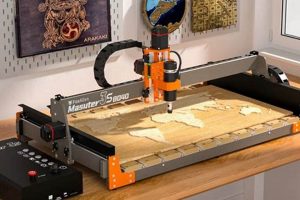
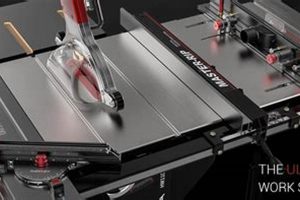
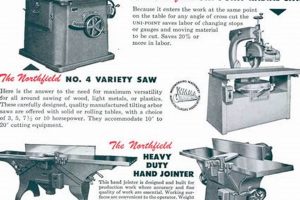
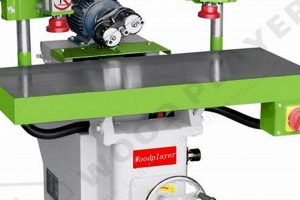
Multifunctional woodworking equipment integrates several distinct operations into a single unit. These machines typically consolidate functions such as sawing, jointing, planing, and sometimes routing or mortising. As an illustration, a single apparatus might serve as both a table saw for ripping and crosscutting lumber and a jointer for creating flat, square edges on boards.
Employing this type of integrated machinery provides several advantages. It saves shop space, a critical factor for hobbyists or small professional workshops. It can also offer a cost-effective solution compared to purchasing individual machines for each task. Historically, such equipment has evolved from basic, manually operated tools to sophisticated, power-driven units, reflecting advancements in manufacturing technology and the increasing demands for efficiency and precision in woodworking.
The following sections will delve into specific aspects of these machines, covering their operational principles, safety considerations, maintenance procedures, and criteria for selecting the most suitable unit for particular woodworking applications.
Essential Guidance for Integrated Woodworking Machinery
The effective and safe utilization of multifunctional woodworking equipment requires careful consideration. The following guidelines are designed to optimize performance and ensure operator well-being.
Tip 1: Thoroughly Review the Machine’s Manual: Prior to operation, comprehensive understanding of the manufacturer’s instructions is paramount. This includes procedures for setup, adjustment, safe operating practices, and routine maintenance.
Tip 2: Prioritize Safety Equipment: Always use appropriate safety gear, including eye protection, hearing protection, and a dust mask or respirator. Ensure that machine guards are in place and functioning correctly before commencing work.
Tip 3: Calibrate Regularly: Precision is crucial. Regularly calibrate all functions of the machine to ensure accurate cuts and joints. Utilize precision measuring tools and follow the machine’s calibration procedures.
Tip 4: Implement Effective Dust Collection: Integrated woodworking machinery produces significant sawdust. A dedicated dust collection system is essential for maintaining a clean and safe work environment and for preventing respiratory issues.
Tip 5: Utilize Appropriate Feed Rates: Avoid forcing material through the machine. Use consistent and appropriate feed rates to prevent kickback, splintering, and motor overload. Adjust feed rates according to the material being processed.
Tip 6: Regularly Inspect and Maintain Blades and Cutters: Sharp blades and cutters are essential for clean, accurate cuts and reduce the risk of kickback. Routinely inspect for damage, sharpness and proper alignment. Sharpen or replace as needed.
Tip 7: Secure Workpiece Clamping: Ensure that workpieces are securely clamped or supported to prevent movement during operation. This is particularly important when performing operations such as routing or shaping.
Adherence to these tips will contribute to improved efficiency, accuracy, and, most importantly, safety when working with integrated woodworking machinery. These guidelines enable one to exploit the full potential of these versatile machines.
The subsequent sections will address in detail the selection criteria, operational nuances, and advanced techniques associated with maximizing the benefits of integrated woodworking equipment.
1. Space Optimization

Space optimization is a critical consideration in woodworking, particularly for hobbyists and smaller professional workshops. Integrated woodworking machinery directly addresses spatial constraints by consolidating multiple functionalities into a single unit, thereby reducing the footprint of required equipment.
- Reduced Equipment Footprint
The primary advantage is the tangible reduction in the floor space occupied by woodworking equipment. Instead of dedicating areas to individual machines for sawing, jointing, planing, etc., all functionalities are contained within a single machine frame. This is particularly relevant where shop dimensions are limited, allowing for more efficient use of available area.
- Improved Workflow Efficiency
By minimizing the distance between different operations, workflow efficiency can be improved. The user can transition from one process to another without having to move between separate machines. This streamlined process reduces setup time and contributes to increased overall productivity within the workspace.
- Storage Space Reduction
Less equipment equates to reduced storage needs. Accessory items like fences, jigs, and blades are similarly consolidated. This helps maintain a tidy work area. It also enhances safety by decreasing potential tripping hazards and maintaining a clear workspace.
- Increased Shop Versatility
Freed-up space contributes to greater workshop versatility. The area saved can be repurposed for additional storage, assembly work, or other specialized woodworking tasks. This leads to an enhanced overall capacity for diverse projects within the same footprint.
Ultimately, the reduced footprint achieved with integrated woodworking machinery directly translates to more effective use of available space, improved workflow dynamics, and greater overall operational efficiency in a woodworking environment. This optimization of spatial resources makes these machines an attractive option for constrained workspaces.
2. Versatility

Versatility forms a cornerstone of the value proposition associated with integrated woodworking machinery. The capacity to perform multiple functions within a single apparatus fundamentally defines its appeal, serving as a primary driver for adoption, particularly within space-constrained environments. The integration of operations such as sawing, jointing, planing, and sometimes even routing or mortising directly translates to a reduced need for multiple, dedicated machines. This functional consolidation not only saves space, but also streamlines workflow processes. For example, a craftsman constructing cabinetry might utilize the saw function for dimensioning raw lumber, transition to the jointer function for creating a flat reference surface, and subsequently employ the planer for achieving consistent thickness across the workpiece, all without the need to relocate the material or adjust multiple machine setups. This demonstrates a direct cause-and-effect relationship between the integrated design and the enhancement of workflow efficiency.
The importance of versatility extends beyond mere convenience. The capacity to perform diverse tasks with a single machine significantly broadens the range of projects that can be undertaken within a given workspace. A small shop, for instance, equipped with such machinery, can effectively handle projects ranging from basic furniture construction to intricate joinery, expanding its potential revenue streams without incurring the capital expenditure associated with acquiring multiple specialized machines. Furthermore, versatility fosters experimentation and innovation. By providing ready access to various woodworking operations, the craftsman can explore new techniques and design possibilities, unbound by the limitations of a single-function shop.
In summary, versatility is not simply an added feature; it is an intrinsic characteristic that shapes the operational dynamics and economic viability of integrated woodworking machinery. While potential challenges related to operational complexity and precision trade-offs warrant careful consideration, the enhanced functionality and adaptability offered by such equipment underscore its significance within the realm of woodworking. Its versatility enhances operational scope and productive output.
3. Cost-Effectiveness

The argument for cost-effectiveness in combination machine woodworking hinges primarily on the principle of consolidated capital expenditure. Rather than investing in several standalone machines a table saw, jointer, planer, and potentially others a single, integrated unit addresses multiple machining requirements. This reduction in initial outlay is particularly relevant for startups, small businesses, or hobbyists operating with constrained budgets. For example, acquiring individual high-quality machines for each function might necessitate an investment of $10,000 or more. A comparable integrated machine, while potentially offering slightly reduced performance in individual operations, could be obtained for a fraction of this cost, representing a significant upfront saving. Furthermore, reduced shipping costs associated with purchasing one unit versus several contribute to overall savings. Cost-effectiveness’s importance lies in lowering the barrier to entry into woodworking. It enables individuals or businesses with limited capital to establish a functional workshop.
Beyond the initial purchase price, cost-effectiveness extends to operational expenses. While a single, larger dust collection system might be required, the cost is generally less than what would be needed for several smaller individual dust collections systems. Electricity consumption may be slightly reduced due to the use of a single motor versus multiple. Maintenance costs, too, can be lower, as there is only one machine to service and maintain. However, it is crucial to acknowledge the potential for higher repair costs should a critical component fail, rendering the entire machine inoperable. In such scenarios, the single point of failure inherent in a combination machine could disrupt workflow and incur substantial repair expenses. The practical significance is the need to consider both upfront and ongoing expenses. It’s also important to consider potential repair needs before committing to the purchase of any machine.
In conclusion, while combination machines offer considerable initial cost savings, the overall cost-effectiveness depends upon careful consideration of operational needs, potential maintenance expenses, and the acceptable level of performance trade-offs relative to dedicated machines. The decision to invest in an integrated machine should be based on a comprehensive assessment of immediate budgetary constraints, long-term operational requirements, and the potential risks associated with a single point of failure. There are also other factors which should be considered such as operational complexity and precision.
4. Operational Complexity
Combination woodworking machines, while offering space and cost advantages, inherently introduce a degree of operational complexity. This arises from the integration of multiple functions into a single unit, necessitating a more intricate setup and adjustment process compared to dedicated machines. For instance, transitioning from sawing to jointing requires repositioning fences, adjusting table heights, and potentially swapping cutter heads. This process demands a thorough understanding of the machine’s mechanics and the specific requirements of each operation. A lack of familiarity can lead to inaccurate cuts, damaged workpieces, or, in extreme cases, operator injury. Therefore, operational complexity constitutes a critical component impacting both the efficiency and safety of combination machine woodworking. The importance of this element is further emphasized by the manufacturer’s documentation, which details specific safety protocols and setup procedures for each function. A failure to adhere to these guidelines amplifies the risk of accidents and subpar results.
Practical applications reveal the challenges. Consider a small cabinet shop utilizing a combination machine to produce cabinet doors. The operator must precisely calibrate the saw for accurate dimensions, then reconfigure the machine for jointing to create perfectly square edges, and finally, adjust for planing to achieve consistent material thickness. Each transition necessitates a recalibration and test cuts to ensure accuracy. If the operator lacks experience or fails to properly adjust the machine between operations, the resulting cabinet doors may be misaligned, leading to rework or material waste. In a similar vein, maintaining operational competence requires ongoing training and familiarization. Woodworkers must develop proficiency in setting up and adjusting each function, as well as troubleshooting common issues such as vibration, blade alignment, and feed rate optimization. Furthermore, operational complexity frequently translates to increased setup time, particularly for less experienced users.
In summary, the operational complexity of combination woodworking machines presents both a challenge and an opportunity. While the initial learning curve may be steeper than with dedicated machines, proficiency unlocks the full potential of these versatile units. Addressing operational complexity necessitates a commitment to thorough training, meticulous setup procedures, and a proactive approach to maintenance and troubleshooting. Mastering these aspects is essential for maximizing the benefits of combination machines while mitigating the risks associated with their inherent complexity. By embracing a structured approach to learning and operation, woodworkers can confidently navigate the intricacies of these machines and produce high-quality results.
5. Precision Trade-offs

Combination machine woodworking, by its very nature, necessitates acceptance of certain precision trade-offs compared to dedicated machines. The integration of multiple functions into a single platform invariably leads to compromises in the design and execution of individual operations. A table saw that is part of a combination machine, for instance, might not possess the same level of vibration dampening or fence accuracy as a standalone, professional-grade table saw. Similarly, the jointer function may have a shorter bed length, limiting its capacity to effectively flatten longer boards. The root cause of these trade-offs stems from the need to balance cost, size, and operational complexity within a single unit. The importance of recognizing these limitations lies in setting realistic expectations and adapting woodworking techniques accordingly. A craftsman expecting the same level of precision from a combination machine as from dedicated equipment is likely to encounter frustration and potentially compromise the quality of the finished product. Real-life examples include cabinetmakers who experience difficulty achieving perfectly square cuts on combination machines due to fence deflection or furniture makers who find it challenging to flatten long boards accurately because of the short jointer bed. Understanding these trade-offs is of practical significance, as it allows users to optimize their workflow and employ supplementary techniques to mitigate the inherent limitations of the equipment.
Further analysis reveals that precision trade-offs manifest differently across various combination machines. Lower-priced units typically exhibit more pronounced compromises, while higher-end models often incorporate features designed to minimize these limitations. For instance, some higher-end machines feature robust fences with micro-adjustment capabilities or longer jointer beds to enhance accuracy. However, even with these improvements, the fundamental principle of compromise remains. Practical applications involve selecting appropriate joinery methods to compensate for potential inaccuracies. Rather than relying solely on perfectly square cuts achieved directly from the saw, woodworkers might employ techniques such as hand-planing or shimming to refine joints and ensure precise alignment. Similarly, when flattening longer boards, they might utilize winding sticks or other methods to check for twist and correct any imperfections introduced by the shorter jointer bed. The skill of the woodworker, therefore, becomes a crucial factor in mitigating the precision trade-offs inherent in combination machines.
In conclusion, the concept of precision trade-offs is an unavoidable aspect of combination machine woodworking. Recognizing these limitations, understanding their underlying causes, and adapting woodworking techniques accordingly are essential for achieving satisfactory results. While combination machines offer undeniable advantages in terms of space and cost, their use demands a nuanced understanding of their limitations and a willingness to employ supplementary methods to ensure accuracy. The challenge lies in balancing the convenience and cost-effectiveness of combination machines with the need for precise woodworking, ultimately requiring a strategic approach to project planning and execution. This understanding serves as a crucial element in achieving success and quality in combination machine woodworking projects.
Frequently Asked Questions
The following questions address common concerns and misconceptions regarding integrated woodworking machinery, providing concise and informative answers.
Question 1: What are the primary advantages of using integrated woodworking machinery?
These machines offer space optimization, cost-effectiveness, and versatility by consolidating multiple functions into a single unit. This is especially beneficial for smaller workshops or hobbyists with limited space and budgets.
Question 2: What are the main disadvantages of integrated woodworking machinery?
Disadvantages include potential operational complexity, precision trade-offs compared to dedicated machines, and the risk of a single point of failure disrupting multiple operations.
Question 3: How does one mitigate the precision trade-offs associated with integrated woodworking machinery?
Mitigation strategies involve employing supplementary techniques, such as hand-planing or shimming, selecting appropriate joinery methods, and opting for higher-end models with features designed to enhance accuracy.
Question 4: What safety considerations are paramount when operating integrated woodworking machinery?
Prioritize thorough review of the machine’s manual, consistent use of appropriate safety equipment (eye, ear, respiratory protection), regular calibration, effective dust collection, and adherence to recommended feed rates.
Question 5: Is a dedicated dust collection system essential for integrated woodworking machinery?
A dedicated dust collection system is highly recommended due to the substantial amount of sawdust generated. This helps maintain a clean and safe work environment and reduces the risk of respiratory problems.
Question 6: What maintenance procedures are critical for ensuring the longevity of integrated woodworking machinery?
Regular inspection and maintenance of blades and cutters, proper lubrication of moving parts, adherence to the manufacturer’s recommended maintenance schedule, and prompt repair of any malfunctions are essential.
Integrated woodworking machinery offers a viable solution for optimizing space and budget, but necessitates careful consideration of operational demands and safety protocols to fully realize its potential.
The following article section will address advanced tips and techniques for maximizing the performance and longevity of integrated woodworking equipment.
Combination Machine Woodworking
This article has explored the multifaceted nature of combination machine woodworking, outlining its inherent advantages in space optimization and cost-effectiveness. The analysis also addressed the inevitable trade-offs in precision, the increased operational complexity, and the critical safety considerations associated with these integrated units. Effective employment of this equipment necessitates a comprehensive understanding of its capabilities, limitations, and the implementation of proper maintenance and safety protocols. The selection of appropriate woodworking techniques and supplementary methods is also paramount to achieving desired outcomes.
The prudent adoption of combination machine woodworking requires a thorough assessment of individual woodworking needs, budgetary constraints, and the acceptable level of compromise in precision. Careful consideration of these factors, combined with a commitment to ongoing learning and meticulous operation, will determine the successful integration of this technology into any woodworking endeavor. The future of combination machine woodworking lies in technological advancements that address current limitations and enhance the operational efficiency and precision of these versatile machines.