![Best Woodworking CNC Milling Machine Guide [2024]](data:image/svg+xml;base64,PHN2ZyB4bWxucz0iaHR0cDovL3d3dy53My5vcmcvMjAwMC9zdmciIHdpZHRoPSI0NzQiIGhlaWdodD0iNzIiIHZpZXdCb3g9IjAgMCA0NzQgNzIiPjxyZWN0IHdpZHRoPSIxMDAlIiBoZWlnaHQ9IjEwMCUiIHN0eWxlPSJmaWxsOiNjZmQ0ZGI7ZmlsbC1vcGFjaXR5OiAwLjE7Ii8+PC9zdmc+ "Best Woodworking CNC Milling Machine Guide [2024] Step-by-Step Guides, Tools & Inspiration to Build Beautiful Wooden Decor on a Budget")
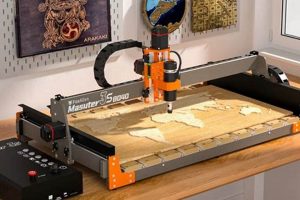
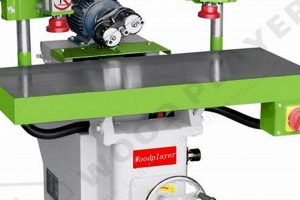
A digitally controlled subtractive manufacturing device utilized in woodworking, it employs rotary cutting tools to remove material from a wooden workpiece according to a pre-programmed design. This process allows for the creation of intricate shapes, precise cuts, and repeatable parts, significantly expanding the possibilities beyond traditional woodworking techniques. Examples of its application range from crafting complex furniture components to producing decorative carvings and architectural millwork.
This technology offers several key advantages, including enhanced accuracy, increased production speed, and the ability to execute designs of high complexity that would be difficult or impossible to achieve manually. Its historical significance lies in the automation and precision it brings to the craft, allowing woodworkers to focus on design and finishing while minimizing the time and skill required for intricate cutting operations. This advancement has revolutionized the woodworking industry, enabling greater efficiency and creative freedom.
Further exploration of this technology will encompass its various components, operational principles, software interfaces, and the diverse range of applications across different woodworking sectors. Subsequent sections will delve into specific considerations for material selection, tooling choices, maintenance procedures, and safety protocols associated with its operation.
Operation and Maintenance Tips
Effective and safe utilization of this equipment necessitates adherence to specific operational guidelines and regular maintenance practices. The following tips provide crucial information for optimizing performance and prolonging the lifespan of the machine.
Tip 1: Material Selection: Consider wood density and grain direction. Denser hardwoods, such as maple or oak, require slower feed rates and sharper tools compared to softwoods like pine. Improper material selection can lead to tool breakage or poor surface finish.
Tip 2: Tooling Selection: Employ appropriate cutters for the task. V-bits are suitable for engraving, while end mills are preferred for pocketing and profiling. Using the wrong tool can result in inefficient material removal and increased wear.
Tip 3: Secure Workholding: Ensure the workpiece is firmly clamped or secured to the table. Insufficient workholding can cause vibration, inaccurate cuts, and potential damage to the machine or workpiece.
Tip 4: Optimized Feed Rates and Speeds: Adjust feed rates and spindle speeds based on the material, tool, and cut depth. Excessive feed rates can overload the tool, while insufficient speeds may cause burning or chattering.
Tip 5: Regular Cleaning: Remove sawdust and debris after each use. Accumulated dust can interfere with the machine’s cooling system and potentially lead to overheating or malfunctions.
Tip 6: Lubrication: Maintain proper lubrication of moving parts. Consistent lubrication reduces friction, minimizes wear, and ensures smooth operation.
Tip 7: Calibration Checks: Periodically verify the machine’s calibration. Regular calibration checks ensure accurate positioning and prevent deviations in cut dimensions.
Tip 8: Software Updates: Keep the control software updated to the latest version. Updates often include bug fixes, performance improvements, and compatibility enhancements.
Adhering to these tips will contribute to a safe, efficient, and prolonged operational lifespan of this equipment, maximizing its utility and minimizing potential issues.
The concluding section will provide a summary of the key benefits and future trends in this rapidly evolving field.
1. Precision Cutting

Precision cutting is a cornerstone capability intrinsically linked to woodworking subtractive manufacturing devices. It represents a fundamental advantage over traditional woodworking methods, directly impacting the quality, accuracy, and complexity of finished products.
- Dimensional Accuracy
Dimensional accuracy refers to the ability of the machine to consistently produce parts within specified tolerances. This precision is achieved through closed-loop feedback systems that monitor and correct the position of the cutting tool in real-time. For example, in furniture manufacturing, precise joinery relies on accurate cuts for seamless assembly and structural integrity. Inaccurate cuts lead to gaps, weak joints, and overall compromised quality. The utilization of woodworking subtractive manufacturing devices mitigates these issues, providing repeatable dimensional accuracy.
- Surface Finish Quality
The surface finish quality of a machined wooden part directly impacts its aesthetic appeal and functional performance. The machines are capable of generating smooth, consistent surfaces with minimal imperfections, reducing the need for extensive sanding or finishing. For instance, in crafting intricate carvings or decorative panels, a fine surface finish highlights the details and ensures a visually appealing result. Conventional methods often struggle to achieve the same level of smoothness and consistency, particularly on complex geometries.
- Complex Geometry Execution
Woodworking subtractive manufacturing devices excel in executing complex geometries and intricate designs that are challenging or impossible to create manually. The ability to follow pre-programmed toolpaths with precision enables the production of curved surfaces, intricate patterns, and unique shapes. An example would be producing a cabriole leg for a chair, with its compound curves and refined details. The machine can accurately carve the leg to the specified dimensions, providing a level of detail and consistency that is difficult to achieve with hand tools alone.
- Repeatability and Consistency
Repeatability and consistency are critical for mass production and ensuring uniformity across multiple parts. Once a program is established, a woodworking subtractive manufacturing device can repeatedly produce identical parts with minimal variation. This capability is particularly valuable in manufacturing furniture components, architectural millwork, or any application requiring multiple identical pieces. The consistency achieved minimizes waste and reduces the need for manual adjustments, resulting in higher efficiency and lower production costs.
These facets of precision cutting highlight the transformative impact of woodworking subtractive manufacturing devices on the woodworking industry. By delivering dimensional accuracy, superior surface finish, complex geometry execution, and exceptional repeatability, this technology empowers woodworkers to produce high-quality, intricate, and consistent products, pushing the boundaries of what is achievable.
2. Automated Operation

Automated operation represents a key characteristic of woodworking subtractive manufacturing devices, fundamentally altering workflow, productivity, and the skill set required for woodworking tasks. It allows for reduced manual intervention and increased efficiency.
- Reduced Labor Costs
Automated operation directly translates to decreased labor requirements. Once a design is programmed, the machine operates independently, requiring minimal supervision. This reduces the need for skilled operators to perform repetitive cutting tasks. The financial implications include lower payroll expenses and the ability to reallocate human resources to other areas such as design or finishing.
- Increased Production Speed
Automated processes inherently lead to accelerated production cycles. The machine operates at consistent speeds and feeds, unaffected by fatigue or variations in skill. The continuous operation allows for higher throughput compared to manual methods. For instance, large-scale furniture manufacturers can significantly increase their output by utilizing the machines, shortening lead times and meeting customer demands more effectively.
- Minimized Human Error
The reliance on pre-programmed instructions minimizes the potential for human error during the cutting process. Manual woodworking is susceptible to inaccuracies stemming from fatigue, miscalculations, or inconsistencies in technique. Automated operation ensures precise and repeatable results, reducing waste and improving the overall quality of the finished product.
- Enhanced Safety
Automating the cutting process enhances workplace safety by minimizing operator exposure to hazardous tools and materials. Manual woodworking involves inherent risks, such as accidental cuts or exposure to dust and fumes. Automating these processes reduces the likelihood of accidents and creates a safer working environment.
The facets of automated operation highlight the transformative impact of woodworking subtractive manufacturing devices on the woodworking industry. By reducing labor costs, increasing production speed, minimizing human error, and enhancing safety, this technology streamlines processes and enables woodworkers to operate more efficiently and effectively.
3. Material Versatility

Material versatility, as it pertains to woodworking subtractive manufacturing devices, signifies the capacity to process a diverse range of wood species and related materials with varying densities, grain structures, and physical characteristics. This capability expands the design possibilities and broadens the application spectrum of the equipment.
- Hardwood Processing
Hardwoods, such as oak, maple, and cherry, present challenges due to their density and interlocked grain patterns. The rigidity and power of the machinery allow for precise cutting and shaping of these materials, enabling the creation of durable furniture components and intricate carvings. Proper tooling and optimized cutting parameters are critical to prevent burning or splintering. This ability facilitates the use of premium hardwoods for high-value applications.
- Softwood Processing
Softwoods, including pine, fir, and cedar, are generally easier to machine due to their lower density. These materials are commonly used for structural components, molding, and decorative elements. The precision control of these devices allows for efficient processing of softwoods with minimal material waste, contributing to cost-effectiveness in large-scale production environments. Specific tooling configurations are employed to prevent tear-out and ensure a clean surface finish.
- Engineered Wood Products
Beyond solid wood, the equipment can process engineered wood products such as plywood, MDF (Medium-Density Fiberboard), and particleboard. These materials offer dimensional stability and consistent properties, making them suitable for various applications, including cabinet construction and furniture manufacturing. Optimized cutting parameters and specialized tooling are necessary to minimize chipping and ensure clean edges when machining these composite materials.
- Acrylic and Composites
With appropriate modifications and tooling, some woodworking subtractive manufacturing devices can process acrylic sheets and wood-based composites. These materials offer unique aesthetic and functional properties, expanding the possibilities for design and application. Machining acrylic requires careful control of cutting speed and feed rate to prevent melting or cracking. Composites necessitate specialized tooling to minimize delamination and maintain structural integrity.
The adaptability to process a spectrum of materials underscores the versatility and utility of woodworking subtractive manufacturing devices. This capability enables manufacturers and woodworkers to select the optimal material for a given application, considering factors such as cost, durability, aesthetics, and structural requirements. The ability to handle hardwoods, softwoods, engineered wood products, and even select non-wood materials enhances the value and flexibility of the machinery in a variety of woodworking contexts.
4. Complex Designs

The capacity to execute complex designs is intrinsically linked to the functionality of woodworking subtractive manufacturing devices. These machines facilitate the creation of intricate patterns, curved surfaces, and three-dimensional shapes that would be exceedingly difficult, if not impossible, to achieve through traditional woodworking methods. This capability stems directly from the precision control offered by computer numerical control, allowing for precise movements of the cutting tool along programmed toolpaths. The resultant effect is a significant expansion of the design possibilities available to woodworkers and manufacturers. A practical example lies in the creation of ornate furniture details or custom architectural millwork. Without the accuracy and repeatability of these machines, replicating such designs consistently would be a significant challenge.
Further exemplifying this connection is the production of complex joinery. Traditional woodworking joints, while strong, are often limited in their geometric complexity. The equipment enables the creation of interlocking joints with intricate profiles, enhancing both the structural integrity and aesthetic appeal of the finished piece. The machines find use in creating complex inlays, carvings, and sculpted components, adding unique artistic dimensions to woodworking projects. Moreover, the capacity to handle complex designs is not merely aesthetic; it directly influences functionality. The ergonomic design of custom chair backs, the aerodynamic profiles of wooden propellers, and the acoustically optimized shapes of musical instruments are all examples where complex geometry is crucial for performance, and such precision is enabled by the technology.
In summary, the relationship between complex designs and woodworking subtractive manufacturing devices is characterized by a symbiotic enhancement. These machines serve as the enabling technology that transforms complex design concepts into tangible realities. While challenges remain in terms of programming complexity and the selection of appropriate tooling, the expanded design freedom and precision that these machines offer have fundamentally altered the landscape of woodworking, from artistic expression to functional design.
5. Production Speed

Production speed, defined as the rate at which components or finished goods are manufactured, is significantly enhanced through the utilization of woodworking subtractive manufacturing devices. The inherent automation and precision offered by these machines contribute directly to accelerated production cycles and increased throughput in woodworking operations.
- Reduced Setup Time
Traditional woodworking often requires extensive setup for each component, including template creation, jig fabrication, and manual machine adjustments. These subtractive manufacturing devices, once programmed, minimize setup time for subsequent identical parts. The digital workflow streamlines the process, allowing for rapid transitions between different designs or batch sizes. This efficiency is particularly valuable in environments where custom orders or small-batch production are common.
- Consistent Cutting Speed
Manual woodworking operations are subject to variations in cutting speed due to operator fatigue or skill differences. These machines maintain a consistent cutting speed throughout the entire production run, maximizing material removal rates while minimizing the risk of errors. This consistency translates directly to predictable cycle times and improved overall production efficiency.
- Multi-Axis Machining Capabilities
Many devices feature multi-axis capabilities, allowing for simultaneous movements of the cutting tool along multiple axes. This capability reduces the need for multiple setups and manual repositioning of the workpiece, further accelerating the manufacturing process. Complex three-dimensional shapes can be created in a single operation, minimizing handling time and improving accuracy.
- Automated Material Handling
The integration of automated material handling systems with these machines can further enhance production speed. Robotic loaders and unloaders can automatically transfer workpieces to and from the machine, eliminating manual handling and minimizing downtime between cycles. This integration is particularly beneficial in high-volume production environments.
The enhancements in production speed facilitated by woodworking subtractive manufacturing devices enable woodworkers and manufacturers to meet increasing demands, reduce lead times, and improve overall operational efficiency. The combined effects of reduced setup time, consistent cutting speed, multi-axis machining capabilities, and automated material handling contribute to a significant increase in throughput compared to traditional woodworking methods, underscoring the value of these machines in modern woodworking operations.
Frequently Asked Questions
This section addresses common inquiries regarding woodworking subtractive manufacturing devices, providing concise and informative responses to clarify key aspects of their operation, capabilities, and applications.
Question 1: What is the typical level of maintenance required for a woodworking subtractive manufacturing device?
Routine maintenance includes regular cleaning to remove sawdust and debris, lubrication of moving parts, inspection of cutting tools for wear, and periodic calibration checks. The frequency of these tasks depends on usage intensity and environmental conditions. Neglecting maintenance can lead to reduced performance and premature equipment failure.
Question 2: What safety precautions are essential when operating a woodworking subtractive manufacturing device?
Mandatory safety measures include wearing appropriate personal protective equipment (PPE) such as safety glasses and hearing protection, ensuring proper dust collection to minimize airborne particulate exposure, and adhering to lockout/tagout procedures during maintenance or tool changes. Operators must be thoroughly trained on machine operation and emergency shutdown procedures.
Question 3: What types of software are typically used to program a woodworking subtractive manufacturing device?
Commonly used software includes CAD (Computer-Aided Design) programs for creating designs, CAM (Computer-Aided Manufacturing) programs for generating toolpaths, and control software for operating the machine. Compatibility between these software components is crucial for seamless workflow. Specialized software may be required for specific applications or advanced machining techniques.
Question 4: What factors influence the precision and accuracy of a woodworking subtractive manufacturing device?
Precision and accuracy are affected by several factors, including machine rigidity, spindle quality, calibration, tool selection, and the quality of the control system. Environmental factors such as temperature fluctuations can also influence performance. Regular calibration and proper maintenance are essential to maintain optimal precision.
Question 5: What are the primary limitations of using a woodworking subtractive manufacturing device?
Limitations include the initial investment cost, the requirement for skilled operators, the potential for material waste, and the inability to create certain internal features without additional setups. The size and geometry of the workpiece may also be constrained by the machine’s work envelope.
Question 6: What is the expected lifespan of a woodworking subtractive manufacturing device?
The lifespan depends on usage intensity, maintenance practices, and the quality of the machine. With proper care and maintenance, a well-built machine can provide reliable service for many years. Component replacement and upgrades may be necessary over time to maintain optimal performance.
Understanding these factors can assist potential users in making informed decisions about the acquisition and operation of woodworking subtractive manufacturing devices, maximizing their benefits while mitigating potential drawbacks.
The subsequent section will delve into the future trends and emerging technologies in the field of woodworking subtractive manufacturing.
Conclusion
This exploration has detailed the multifaceted capabilities of woodworking cnc milling machines, encompassing precision cutting, automated operation, material versatility, complex design execution, and enhanced production speed. These attributes collectively redefine the landscape of modern woodworking, enabling unprecedented levels of accuracy, efficiency, and design complexity. Understanding the intricacies of operation, maintenance, safety protocols, and software interfaces is paramount for maximizing the benefits and minimizing the risks associated with this technology.
The continued advancement of woodworking cnc milling machine technology promises further innovation in the field. As the industry progresses, the adoption of these machines will become increasingly critical for maintaining competitiveness and achieving superior quality in woodworking applications. Prudent investment in training and ongoing education will be essential for woodworkers and manufacturers seeking to harness the full potential of this transformative technology.