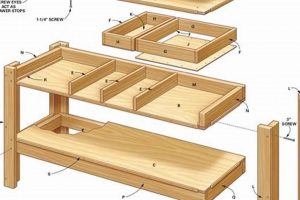
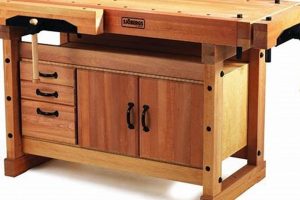
Documents detailing the construction of compact work surfaces designed for woodworking are readily available. These schematics provide precise measurements, material lists, and step-by-step instructions for building a miniature workbench. An example would be a set of instructions outlining the assembly of a bench measuring 36 inches long, 24 inches wide, and 34 inches high, specifically tailored for a limited workspace.
Such designs are important due to their space-saving properties and suitability for smaller workshops or hobbyist environments. Historically, larger, more elaborate workbenches were the standard. However, as living spaces become more compact and the need for portable or easily storable work surfaces increases, smaller versions have gained popularity, offering functionality without sacrificing excessive room. The benefits include improved organization, enhanced safety, and increased efficiency when undertaking woodworking projects.
The following discussion will address the selection of appropriate materials, various design considerations, essential tool requirements, and construction techniques applicable to building a miniature woodworking surface. Attention will be given to optimizing available space and ensuring the final product meets specific project needs.
Construction Advice
The subsequent recommendations provide guidance for individuals embarking on the construction of a compact woodworking station. Adherence to these principles will contribute to a more successful and efficient building process.
Tip 1: Material Selection: Prioritize hardwoods such as maple or beech for the benchtop to ensure durability and resistance to wear. Softwoods can be utilized for the base structure if cost is a concern, but reinforcement may be necessary.
Tip 2: Benchtop Thickness: Maintain a minimum benchtop thickness of 1.5 inches to provide sufficient mass for stability during woodworking operations. A thicker benchtop reduces vibration and enhances clamping effectiveness.
Tip 3: Joint Construction: Employ robust joinery techniques, such as mortise and tenon or dovetail joints, to assemble the bench’s frame. These joints provide superior strength and longevity compared to simpler screw-and-glue connections.
Tip 4: Leg Placement and Design: Position the legs of the bench to maximize stability and minimize racking. Angled legs or a splayed design can significantly improve lateral stability.
Tip 5: Vise Integration: Incorporate a vise into the design from the outset. A front vise and a tail vise can greatly expand the bench’s functionality. Ensure the benchtop is reinforced in the vise mounting areas.
Tip 6: Tool Storage Considerations: Integrate storage solutions, such as drawers or shelves, into the bench design to optimize workspace organization. Consider the types and sizes of tools to be stored when planning storage compartments.
Tip 7: Surface Finish: Apply a durable finish to the benchtop to protect it from moisture and abrasion. A simple oil finish or a few coats of varnish are suitable options. Avoid finishes that will interfere with glue adhesion.
These guidelines serve to improve the construction quality and overall utility of the woodworking station. Careful consideration of these aspects contributes to a more satisfying and functional end product.
The concluding section will summarize key design elements and offer recommendations for maintaining the finished woodworking surface.
1. Space Optimization
Space optimization is a paramount consideration when developing woodworking structures for confined environments. The principles of efficient space utilization directly influence the design and functionality of such benches. The subsequent facets detail critical components of space optimization in this context.
- Fold-Away or Collapsible Designs
These designs enable the bench to be stowed when not in use, thereby maximizing available floor area. Examples include benches with hinged legs or folding tabletops. The implication is a reduction in the bench’s permanent footprint, making it suitable for workshops that double as other functional spaces.
- Integrated Storage Solutions
Incorporating drawers, shelves, or vertical tool storage within the bench’s structure eliminates the need for separate storage units. Examples include built-in tool racks and drawers beneath the benchtop. The implication is a reduction in clutter and improved organization within the limited workspace.
- Multi-Purpose Functionality
Designing the bench to serve multiple functions, such as a work surface and assembly table, reduces the need for additional equipment. Examples include benches with adjustable height or integrated clamping systems. The implication is increased versatility and efficient use of the available area.
- Compact Footprint
Minimizing the overall dimensions of the bench without compromising its structural integrity is essential. This involves careful consideration of the benchtop size and leg placement. The implication is a less intrusive presence within the workspace, allowing for easier maneuverability and access to other tools and equipment.
These facets demonstrate that space optimization is not merely about reducing the size of a woodworking bench; it is about intelligent design that maximizes functionality within a limited area. These designs not only facilitate woodworking tasks but also contribute to a more organized and efficient workspace.
2. Structural Integrity

Structural integrity represents a crucial aspect of small woodworking bench designs, directly affecting the bench’s usability and lifespan. The connection is causal: inadequate structural integrity leads to instability, reduced weight capacity, and ultimately, premature failure of the bench. Robust construction methods, material selection, and joint design form the cornerstone of structural soundness. For instance, employing mortise-and-tenon joints, rather than simple butt joints secured with screws, increases the bench’s resistance to racking forces. Similarly, a benchtop constructed from hardwood offers greater resistance to deflection under load compared to one made from softwood. The practical significance lies in the ability to perform woodworking tasks safely and accurately. A stable platform is essential for operations like planing, sawing, and joinery, minimizing the risk of workpiece slippage or bench movement that can compromise precision.
Further emphasizing this point, the specific dimensions and proportions of the bench play a significant role. A design that scales down a larger workbench without appropriately adjusting material thicknesses or joinery methods is inherently flawed. Consider a small bench intended for light-duty tasks versus one designed for heavier operations. The latter would require thicker legs, a more substantial apron, and potentially internal bracing to prevent deformation under load. The placement of these structural elements is also critical; legs positioned too close together, or an apron that is too narrow, will compromise the bench’s overall rigidity. Case studies involving failed workbench designs consistently highlight inadequate joinery, undersized support members, and inappropriate material choices as primary contributing factors.
In conclusion, the correlation between structural integrity and small woodworking bench design is undeniable. Failure to adequately address structural considerations renders the bench unsafe, unreliable, and ultimately unsuitable for its intended purpose. Prioritizing robust joinery, appropriate material selection, and thoughtful design are essential for creating a compact woodworking surface that offers lasting performance and stability. The understanding of these principles allows woodworkers to create structures that are not only space-efficient but also safe and durable.
3. Tool Integration

Tool integration, within the framework of compact woodworking stations, constitutes a critical design consideration. The efficient organization and accessibility of tools directly impact workflow, safety, and overall productivity in a limited workspace. Prioritizing tool integration enhances the utility and practicality of any small woodworking bench design.
- Integrated Vises
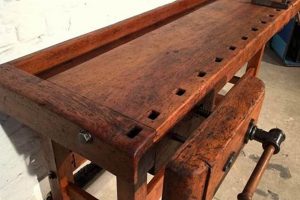
The inclusion of one or more vises, such as a face vise or a tail vise, transforms the bench into a versatile clamping station. A face vise secures workpieces for edge work, while a tail vise, in conjunction with bench dogs, facilitates clamping wider boards. Their implementation eliminates the need for separate clamping fixtures, conserving space and streamlining workflow.
- Built-in Tool Storage
Incorporating drawers, shelves, or dedicated compartments for hand tools keeps essential implements readily accessible and prevents clutter. Drawers can house chisels, planes, and measuring tools, while shelves accommodate larger items. A well-organized storage system reduces search time and minimizes the risk of misplaced or damaged tools.
- Dog Holes and Bench Dogs
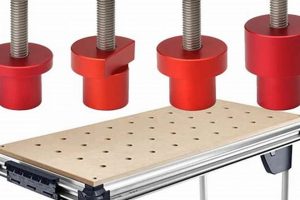
Drilling a series of holes (dog holes) in the benchtop allows for the use of bench dogs small pegs that provide secure clamping points. This system enables the efficient clamping of workpieces of varying shapes and sizes. The arrangement of dog holes determines the clamping flexibility, with closely spaced holes offering finer adjustments.
- Power Tool Mounts
Designing the bench to accommodate power tools, such as a router or a small bench grinder, extends its functionality. This could involve creating a dedicated shelf or a recessed area for a specific tool. Securing power tools to the bench enhances stability and safety during operation, particularly in confined spaces.
These integrated features demonstrate that a well-designed small woodworking bench can function as a comprehensive workstation. The strategic placement of vises, storage compartments, and clamping systems enhances efficiency and optimizes the use of limited space, making it easier to execute woodworking projects with precision and safety.
4. Ergonomic Design
Ergonomic design, when applied to small woodworking bench plans, directly influences user comfort, reduces the risk of musculoskeletal strain, and enhances overall productivity. The workbench, despite its reduced size, must accommodate the user’s physical dimensions and working posture. Workbench height, for example, must allow for comfortable work without excessive bending or reaching. A bench that is too low forces the user to stoop, leading to back pain; conversely, a bench that is too high causes shoulder and neck strain. Real-world instances of poorly designed benches frequently result in chronic pain and reduced efficiency. The practical significance lies in the creation of a workspace that is both functional and conducive to long-term physical well-being.
Further aspects of ergonomic integration include the consideration of reach distances, the positioning of tools, and the ease of access to frequently used items. A small workbench requires careful planning to ensure that all necessary tools and materials are within easy reach, minimizing unnecessary movements and preventing awkward postures. For instance, integrating tool storage within arm’s reach eliminates the need to constantly turn or stretch, thereby reducing strain. The bench’s surface should also be designed to minimize sharp edges or protrusions that could cause discomfort or injury. A well-executed ergonomic design promotes a natural and fluid workflow, reducing fatigue and improving the quality of work.
In conclusion, the inclusion of ergonomic principles in small woodworking bench plans is not merely a matter of comfort; it is an investment in the user’s health and productivity. Addressing factors such as bench height, reach distances, and tool accessibility creates a workspace that minimizes physical strain and maximizes efficiency. While challenges may arise in accommodating ergonomic considerations within a limited space, the benefits in terms of user well-being and output quality are undeniable.
5. Material Efficiency
Material efficiency, within the context of small woodworking bench designs, represents a critical factor influencing cost, sustainability, and overall project feasibility. The limited dimensions inherent in these designs necessitate careful planning and precise execution to minimize waste and maximize resource utilization. The connection is causal: inefficient material usage directly translates into increased material costs, greater environmental impact, and potentially compromised structural integrity due to the need for piecing together smaller, less robust elements. Real-life examples of inefficient designs include plans that call for standard lumber sizes with significant offcuts or those that fail to optimize the layout of components to minimize waste from sheet goods. The practical significance of understanding this lies in the ability to create a functional, durable, and cost-effective bench using readily available materials with minimal environmental footprint.
Further analysis reveals that material efficiency considerations often dictate the selection of specific design features and construction techniques. For instance, utilizing joinery methods that minimize material loss, such as mortise-and-tenon joints sized appropriately for the dimensions of the bench components, is preferable to relying solely on screw-and-glue construction that may necessitate thicker, more substantial lumber. Similarly, employing nested layouts when cutting parts from sheet materials, such as plywood or MDF, significantly reduces waste by strategically positioning components to minimize the space between them. Examples include optimizing the cutting layout for the benchtop, legs, and apron to fit within a single sheet of plywood with minimal scrap. These practical applications demonstrate a direct correlation between thoughtful design and reduced material consumption.
In conclusion, material efficiency forms an integral component of successful small woodworking bench plans. Addressing this aspect not only reduces project costs and minimizes environmental impact but also fosters a more responsible and sustainable approach to woodworking. Challenges may arise in balancing material efficiency with structural requirements and aesthetic considerations; however, prioritizing careful planning, precise execution, and informed material selection ultimately leads to a superior and more ecologically sound end product.
Frequently Asked Questions
The following addresses common inquiries regarding the design, construction, and utilization of miniature woodworking benches.
Question 1: What are the primary benefits of constructing a woodworking bench of reduced dimensions?
Reduced dimensions translate to space savings, making these benches suitable for smaller workshops or multi-purpose rooms. They also offer increased portability and are often more economical to build due to lower material requirements.
Question 2: What is the minimum recommended size for a compact woodworking bench to remain functional?
While the specific dimensions depend on the intended use, a benchtop measuring approximately 36 inches in length and 24 inches in width is generally considered the minimum for basic woodworking tasks. Height should be tailored to the individual user for ergonomic considerations.
Question 3: What are the essential features to include in a small woodworking bench design?
Essential features include a sturdy benchtop, a robust frame, integrated clamping options (such as a vise or dog holes), and consideration for tool storage. The specific features should align with the user’s project requirements and woodworking style.
Question 4: What materials are most suitable for constructing a compact woodworking bench?
Hardwoods, such as maple or beech, are recommended for the benchtop due to their durability and resistance to wear. Softwoods, such as pine or fir, can be used for the frame but may require additional reinforcement. Plywood or MDF can also be utilized for specific components, such as shelving or drawer boxes.
Question 5: How can stability be ensured in a smaller woodworking bench design?
Stability can be enhanced through the use of robust joinery techniques (e.g., mortise and tenon), strategically placed bracing, and a sufficient benchtop thickness. Ensuring the bench’s legs are securely attached and properly aligned is also crucial.
Question 6: What are some common mistakes to avoid when building a small woodworking bench?
Common mistakes include using inadequate materials, neglecting proper joinery techniques, failing to consider ergonomic factors, and neglecting to incorporate sufficient clamping options. Overlooking the importance of a stable and level base is also a frequent error.
In summary, careful planning, appropriate material selection, and attention to detail are essential for constructing a functional and durable compact woodworking surface.
The subsequent discussion will address advanced design considerations for specialized woodworking tasks.
Small Woodworking Bench Plans
The preceding discourse has systematically explored the critical elements of “small woodworking bench plans.” Emphasis has been placed on optimizing space, ensuring structural integrity, integrating tools efficiently, adhering to ergonomic principles, and utilizing materials effectively. The construction of a functional and durable compact woodworking surface demands careful consideration of these interconnected aspects. The absence of any one element compromises the overall utility and longevity of the resultant structure.
The enduring relevance of thoughtfully designed “small woodworking bench plans” stems from the persistent need for adaptable workspaces in increasingly space-constrained environments. Individuals engaged in woodworking activities are encouraged to meticulously evaluate the aforementioned principles, thereby maximizing the potential of their limited space and fostering precision in their craft. The continued development and refinement of these plans will undoubtedly facilitate greater accessibility and innovation within the woodworking community.