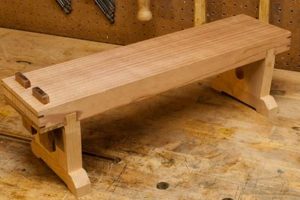
A stable, dedicated surface is fundamental for precise and efficient crafting with wood. Such platforms are generally constructed with robust materials and designed to withstand the rigors of various operations, from sawing and planing to joinery and assembly. These provide a secure and level area, promoting accuracy and minimizing movement during detailed tasks.
The utilization of a purpose-built workstation enhances both the quality and the speed of production. A well-designed station contributes to improved ergonomics, reducing strain and fatigue on the user. Historically, these structures have evolved from simple supports to sophisticated systems incorporating vises, dog holes, and tool storage, reflecting a commitment to optimizing the work process.
The subsequent sections will detail the different types available, factors to consider when selecting one, essential features to look for, and finally, a discussion on optimizing a workshop setup for maximum productivity and safety.
Essential Considerations for the Woodworker’s Surface
Selecting and utilizing an appropriate structure profoundly impacts the quality and efficiency of woodworking endeavors. The following guidelines provide insight into optimizing the choice and application of this crucial workshop component.
Tip 1: Prioritize Stability. The primary function is to provide a rigid and unwavering surface. Consider designs with substantial legs and cross-bracing to minimize movement during demanding tasks like planing.
Tip 2: Evaluate Surface Flatness. An uneven worktop will compromise accuracy. Before purchasing or constructing, ensure the surface is as level as possible. Minor imperfections can be addressed with hand planing.
Tip 3: Incorporate Workholding Mechanisms. Vises are invaluable for securing workpieces. Consider models with quick-release mechanisms for efficient workflow. Dog holes, in conjunction with bench dogs, offer additional clamping options.
Tip 4: Optimize Height for Ergonomics. The appropriate height minimizes strain and maximizes control. A height allowing the user to work comfortably with slightly bent elbows is generally recommended. Consider an adjustable model to accommodate various users and tasks.
Tip 5: Integrate Tool Storage. Keeping frequently used tools within easy reach reduces downtime and enhances productivity. Explore designs with built-in drawers, shelves, or tool wells.
Tip 6: Consider Portability. If space is limited or if the user anticipates working in multiple locations, a portable design is beneficial. Folding models or those with integrated wheels offer increased mobility.
Tip 7: Choose Durable Materials. Hardwoods like maple or beech offer excellent resistance to wear and tear. Softwoods can be suitable for lighter use, but require more frequent maintenance.
Investing in or constructing a well-designed structure is a strategic decision that yields significant returns in terms of accuracy, efficiency, and user comfort. Careful consideration of the above factors will contribute to a more productive and enjoyable woodworking experience.
The concluding section will offer guidance on maintaining and customizing these structures to further optimize the woodworking environment.
1. Stability

Within the context of woodworking platforms, stability transcends a mere attribute; it is a foundational requirement dictating the precision and safety of woodworking operations. The connection between these structures and stability is causal: a stable platform facilitates accurate cuts, prevents tool slippage, and mitigates the risk of workpiece movement during machining. Conversely, instability introduces imprecision, increases the potential for injury, and undermines the overall quality of the finished product.
Consider, for example, the act of hand planing a long board. If the supporting structure lacks sufficient rigidity, it may flex or vibrate under the force of the plane, resulting in an uneven surface. Similarly, mortise and tenon joinery demands absolute immobility of the workpiece; any movement during the chiseling process can lead to inaccurate cuts and compromised joint strength. In both scenarios, the absence of stability directly impairs the woodworking process, highlighting its practical significance.
In conclusion, stability represents a critical parameter in the design and selection of woodworking platforms. While other features such as workholding and surface area are undoubtedly important, they are secondary to the fundamental requirement of a rigid and unwavering support structure. Achieving adequate stability often necessitates the use of heavy, dense materials, robust joinery, and well-considered structural design. Overlooking this fundamental aspect can lead to frustration, inaccuracy, and potentially hazardous working conditions.
2. Workholding

Workholding represents an integral component of any effective woodworking station. These specialized mechanisms, such as vises, clamps, and bench dogs, function to secure workpieces in a stable and accessible position during various operations. The direct consequence of inadequate workholding is compromised precision, increased risk of material damage, and potential for personal injury. A securely held workpiece facilitates controlled application of tools, minimizing vibration and slippage, leading to more accurate cuts, smoother finishes, and safer practices.
Consider the task of cutting dovetails by hand. A loose or improperly supported board will shift under the saw or chisel, resulting in inaccurate joinery and a weakened structure. Conversely, when a workpiece is firmly secured within a vise or held against bench dogs, the user can focus on executing precise cuts without the distraction of workpiece movement. Similarly, during sanding or routing operations, secure workholding prevents the piece from sliding or vibrating, ensuring a consistent and uniform finish. Different tasks demand varied workholding solutions, highlighting the importance of selecting mechanisms appropriate for the specific application. The availability of diverse and effective workholding options directly expands the versatility and efficiency of the workstation.
In summary, the relationship between a workbench and workholding is symbiotic. A robust workbench provides a stable foundation for secure workholding, while effective workholding enables precise and controlled woodworking operations. The absence of reliable workholding undermines the utility of even the most well-constructed structure. Investing in quality workholding mechanisms is, therefore, a critical consideration for any woodworker seeking to achieve accuracy, efficiency, and safety in their craft. The next step involves integrating the other aspects to ensure the overall usefulness of the benches for woodworking.
3. Surface Flatness

Surface flatness is a critical attribute of woodworking platforms, directly impacting the accuracy and quality of projects undertaken. A non-planar surface introduces errors in dimensioning, joinery, and assembly, ultimately compromising the structural integrity and aesthetic appeal of the finished piece.
- Accuracy in Dimensioning
A flat surface provides a reliable reference for measuring and marking stock. When a surface is uneven, measurements become inconsistent, leading to inaccurate cuts. This is particularly crucial when milling lumber to precise thicknesses or widths. For instance, if a board rests on a non-planar workbench during planing, the resultant thickness will vary, deviating from the intended dimension and potentially requiring corrective measures.
- Facilitating Precise Joinery
Many woodworking joints, such as mortise and tenon or dovetails, demand tight tolerances and accurate alignment. A flat surface ensures that components mate correctly during assembly. An uneven surface can induce warping or misalignment in the joint, weakening its structural integrity and affecting the overall appearance. The absence of a planar work surface necessitates shimming or other corrective techniques, adding time and complexity to the joinery process.
- Ensuring Level Assembly
During the assembly phase, a flat surface is essential for constructing level and square structures. When assembling a cabinet or a frame, an uneven workbench can introduce racking or twisting, compromising the stability and functionality of the piece. Correcting these issues often requires disassembly and adjustment, adding considerable time and effort to the project.
- Promoting Consistent Tool Performance
The performance of hand tools, such as planes and chisels, is directly influenced by the flatness of the supporting surface. When planing, an uneven surface can cause the tool to chatter or dig in, resulting in an inconsistent finish. Similarly, when chiseling, an unstable surface can lead to inaccurate cuts and increased risk of injury. A planar work surface allows for smooth and controlled tool movements, enhancing efficiency and precision.
In summary, surface flatness is not merely a cosmetic detail but a fundamental requirement for woodworking platforms. It underpins the accuracy of dimensioning, facilitates precise joinery, ensures level assembly, and promotes consistent tool performance. A workbench with a truly flat surface is an investment in quality, efficiency, and ultimately, the success of woodworking endeavors. Maintaining this flatness over time requires careful material selection, proper construction techniques, and ongoing maintenance practices.
4. Ergonomic Height

The height of a woodworking platform directly influences a user’s posture, reach, and applied force during various tasks. An improperly sized structure compels a woodworker to adopt unnatural and often strained positions, leading to musculoskeletal discomfort and reduced efficiency. The relationship is causal: a well-designed structure with an appropriate height minimizes physical stress, while an unsuitable height precipitates fatigue and potential injury. The optimal height facilitates comfortable and efficient work by aligning the workpiece with the user’s natural working plane, minimizing reaching or stooping.
Consider the act of hand planing. If the structure is too low, the user must stoop, placing undue strain on the back and shoulders. Conversely, if it’s too high, the user’s shoulders elevate excessively, limiting leverage and increasing fatigue in the arms. A structure at the correct height allows the user to apply force efficiently, utilizing body weight and minimizing strain. Similarly, when performing detailed joinery, the proper height allows the user to maintain a clear line of sight and steady hand position, enhancing accuracy and reducing the risk of errors. Adjustable-height structures offer adaptability to various tasks and user physiques, enhancing the versatility and long-term usability of the woodworking station.
In conclusion, ergonomic height is not merely a convenience but a critical factor in optimizing the functionality and safety of woodworking platforms. The selection or construction of a structure with an appropriate height is a proactive measure to mitigate musculoskeletal strain and enhance productivity. The challenge lies in determining the ideal height for individual users and tasks, often requiring experimentation and adjustment. The long-term benefits of prioritizing ergonomics far outweigh the initial effort, contributing to a more sustainable and enjoyable woodworking practice.
5. Material Durability

Material durability directly dictates the lifespan, stability, and overall utility of woodworking platforms. The connection between material selection and performance is causal: robust, durable materials withstand the constant stresses of woodworking operations, while inferior materials degrade, compromising the platform’s structural integrity and functionality. A woodworking platform constructed from durable materials provides a stable and reliable surface for executing tasks, ensuring precision and minimizing the risk of accidents. The long-term cost-effectiveness of investing in durable materials surpasses the initial savings associated with less robust alternatives, due to reduced repair frequency and extended operational lifespan.
Examples of durable materials commonly employed in platform construction include hardwoods such as maple, beech, and oak. These dense woods exhibit exceptional resistance to wear, impact, and moisture absorption, making them suitable for demanding environments. Conversely, softwoods, while more readily available and less expensive, are prone to denting, scratching, and warping, requiring more frequent maintenance and eventual replacement. Real-world illustrations of material durability’s significance abound: a platform constructed from kiln-dried maple can endure decades of heavy use with minimal degradation, while a platform constructed from untreated pine may exhibit significant wear and instability within a few years. Understanding the material properties and their impact on long-term performance is thus paramount.
The practical significance of prioritizing material durability extends beyond cost savings and structural integrity. A stable, reliable platform enhances user safety by minimizing the risk of collapse or unexpected movement during operation. It also contributes to improved workflow efficiency by reducing the need for constant adjustments or repairs. The selection of durable materials for platform construction represents a strategic investment in both the quality of woodworking operations and the long-term sustainability of the workshop. The key takeaway is to choose materials that will stand the test of time and heavy usage, which, in turn, adds value and safety to the whole woodworking operations.
Frequently Asked Questions
The following questions address common inquiries regarding the selection, utilization, and maintenance of dedicated woodworking surfaces.
Question 1: What is the minimum acceptable size for a woodworking platform?
The optimal size depends on the types of projects undertaken. However, a surface of at least 60 inches in length and 24 inches in width is generally recommended for accommodating a range of woodworking tasks.
Question 2: How does one ensure a newly constructed woodworking platform is sufficiently flat?
Upon completion of construction, the surface should be checked with a straightedge and a feeler gauge. Any deviations from planarity can be addressed through careful hand planing or shimming.
Question 3: What is the recommended height for a woodworking platform designed for hand tool use?
A height that positions the user’s elbow slightly above the surface when standing is generally considered optimal. This allows for efficient application of force during planing and other hand tool operations.
Question 4: What types of wood are best suited for constructing a robust and durable woodworking platform?
Hardwoods such as maple, beech, and oak are preferred due to their density, resistance to wear, and stability. Softwoods may be used for lighter-duty applications but require more frequent maintenance.
Question 5: How should one maintain the flatness of a woodworking platform over time?
Regular cleaning and occasional flattening with hand planes are essential. The surface should also be protected from excessive moisture and temperature fluctuations, which can cause warping.
Question 6: What are the essential workholding accessories that should be included with a woodworking platform?
A vise (or multiple vises) is indispensable for securing workpieces. Bench dogs and holdfasts provide additional clamping options and enhance versatility.
A well-chosen and properly maintained woodworking platform is a cornerstone of any efficient and productive workshop. By addressing these frequently asked questions, woodworkers can make informed decisions and optimize their working environment.
The subsequent section provides guidance on customizing and upgrading a woodworking platform to meet specific needs and preferences.
Conclusion
This article has explored the multifaceted role of sturdy surfaces in the sphere of woodworking. It detailed the necessity of stability, appropriate work-holding, surface flatness, and ergonomic height considerations when selecting or constructing suitable workstations. These attributes, paired with durable material choices, collectively define a functional and efficient work environment. Adherence to these principles ensures not only precision in craftsmanship but also promotes user safety and long-term productivity.
The information contained herein serves as a foundation for informed decision-making. A dedicated, well-considered work surface is an investment in the craft, yielding returns in accuracy, efficiency, and overall enjoyment of woodworking. It is, therefore, incumbent upon practitioners to carefully evaluate their needs and resources when procuring or creating these essential pieces of workshop equipment, recognizing their profound impact on the quality and longevity of their woodworking pursuits.