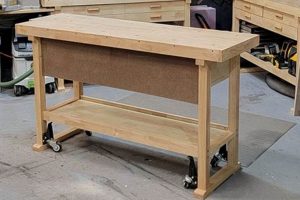
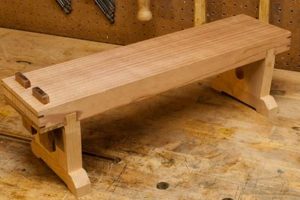
Mobility solutions for stationary work surfaces, specifically in the realm of woodworking, often involve the integration of wheeled mechanisms that elevate the bench above the floor. These mechanisms provide the ability to relocate the otherwise fixed workbench within a workshop setting. An example would be a set of retractable, load-bearing wheels affixed to the legs of a large workbench, allowing it to be easily moved for cleaning or reorganization, then locked into place for stability during use.
The incorporation of these mobile elements offers enhanced flexibility and efficiency in workshop environments. They facilitate adaptation to changing project needs, optimized space utilization, and improved workflow. Historically, the challenge of moving heavy workbenches led to cumbersome methods. The introduction of effective mobility solutions marks a significant advancement, addressing ergonomic concerns and improving the overall productivity of woodworking tasks.
The following sections will examine various types of these mobility devices, explore factors to consider when selecting the appropriate solution for a woodworking bench, and outline best practices for installation and maintenance.
Tips for Selecting and Using Mobility Solutions for Woodworking Benches
The selection and implementation of mobility solutions for woodworking benches necessitate careful consideration to ensure both functionality and safety. The following tips provide guidance for optimizing the use of these devices.
Tip 1: Load Capacity Assessment: Accurately determine the total weight of the workbench, including any tools and materials typically stored on it. Select a mobility solution with a load capacity that significantly exceeds this calculated weight to ensure safe and reliable operation. An under-rated mechanism can lead to failure and potential injury.
Tip 2: Locking Mechanism Verification: Prioritize solutions equipped with robust and easily engageable locking mechanisms. The locking system should effectively prevent movement during woodworking activities. Test the locking mechanism thoroughly before commencing any work that involves significant force or precision.
Tip 3: Wheel Material Selection: Consider the flooring material in the workshop. Harder wheels may be suitable for smooth concrete surfaces, while softer rubber or polyurethane wheels are preferable for protecting delicate or uneven floors. Choose wheel materials resistant to common workshop solvents and debris.
Tip 4: Mounting Hardware Inspection: Verify the suitability and strength of the included mounting hardware. If the provided hardware appears inadequate, replace it with higher-quality alternatives that are appropriately sized and rated for the application. Improperly secured mechanisms can detach under load.
Tip 5: Clearance Considerations: Ensure adequate clearance between the base of the workbench and the floor when the mobility solution is engaged. Insufficient clearance can impede movement or cause the workbench to drag on the floor. Consider the height adjustability of the mechanism to accommodate variations in flooring.
Tip 6: Regular Maintenance: Periodically inspect the mobility solution for signs of wear, corrosion, or loose hardware. Lubricate moving parts as needed and promptly replace any damaged components. Proactive maintenance extends the lifespan and ensures the continued safe operation of the devices.
Tip 7: Controlled Movement Practices: When relocating the workbench, exercise caution and control. Avoid abrupt starts and stops, and be mindful of potential obstacles in the path. A slow and deliberate approach minimizes the risk of accidents and damage.
Proper selection, installation, and maintenance of mobility solutions contribute to a safer and more efficient woodworking environment. These considerations should be integrated into standard workshop practices.
The following section will provide specific product recommendations and case studies illustrating successful applications of these mobility devices in diverse woodworking settings.
1. Load Capacity Rating

The load capacity rating is a critical specification for casters intended for woodworking benches. It dictates the maximum weight the casters can safely support, influencing both the functionality and the safety of the bench. Failure to adhere to appropriate load capacity guidelines can result in caster failure, instability, and potential injury.
- Individual Caster Capacity
The stated load capacity typically refers to the weight each individual caster can bear. A set of four casters, each rated for 150 lbs, ostensibly provides a total capacity of 600 lbs. However, weight distribution is rarely perfectly even. Therefore, derating the total capacity by a factor (e.g., 25%) is a prudent safety measure to accommodate uneven loads and dynamic forces. For example, a 600 lb theoretical capacity would be realistically considered safe for a 450 lb bench.
- Dynamic vs. Static Load
Load capacity ratings often distinguish between static and dynamic loads. Static load refers to the maximum weight the casters can support when the bench is stationary. Dynamic load, which is always lower, considers the added stress from movement and impact. Woodworking benches are often subjected to dynamic loads during material handling or tool operation. Selecting casters rated for the anticipated dynamic load is essential to prevent premature failure. Ignoring dynamic load considerations could lead to caster collapse under normal usage conditions.
- Material Properties and Caster Construction
The load capacity is inherently linked to the materials used in caster construction. High-strength steel or reinforced polymers are commonly employed for heavy-duty applications. Wheel diameter, bearing type, and swivel mechanism design also contribute to the overall load-bearing capability. Casters with larger diameter wheels and robust bearings tend to offer higher load capacities. The overall caster construction quality dictates its capacity under stress.
- Consequences of Overloading
Exceeding the load capacity rating of casters poses significant risks. Overloading can lead to wheel deformation, bearing failure, or even structural collapse of the caster assembly. This can result in workbench instability, difficulty in movement, and potential safety hazards. Regular inspection of casters for signs of overload, such as flattened wheels or bent axles, is critical for maintaining a safe woodworking environment.
The interplay between individual caster capacity, the consideration of dynamic versus static loads, the impact of material properties, and the consequences of overloading underscore the significance of carefully evaluating the load capacity rating when selecting casters for a woodworking bench. Proper load management directly correlates with the longevity, functionality, and safety of the workbench and its mobility system.
2. Wheel Material Durability
The durability of wheel materials constitutes a pivotal consideration in the selection of casters for woodworking benches. The chosen material directly impacts the caster’s lifespan, performance, and suitability for the specific demands of a woodworking environment.
- Resistance to Abrasive Wear
Woodworking environments are inherently abrasive, with sawdust, wood chips, and other debris present on the floor. Wheel materials must exhibit high resistance to abrasive wear to prevent premature degradation and maintain rolling efficiency. Materials such as polyurethane and high-durometer rubber offer superior abrasion resistance compared to softer materials like standard rubber. Premature wear leads to reduced load capacity, increased rolling resistance, and eventual caster failure.
- Chemical Compatibility
Workshops often involve the use of various chemicals, including solvents, finishes, and adhesives. Wheel materials must be chemically inert to prevent swelling, cracking, or degradation upon exposure to these substances. Polyurethane, being resistant to many chemicals, is frequently chosen in such environments. Chemical degradation compromises structural integrity, leading to unsafe operating conditions.
- Load-Bearing Capacity Retention
Over time, some wheel materials experience a reduction in their load-bearing capacity due to creep or compression set. This phenomenon occurs when the material deforms permanently under constant load. High-quality materials like phenolic resin or forged steel minimize these effects, ensuring consistent load support throughout the caster’s lifespan. Reduced load capacity leads to potential caster failure and workbench instability.
- Impact Resistance and Deformation
Woodworking benches are often subjected to impacts and sudden load changes. Wheel materials must possess adequate impact resistance to prevent cracking, chipping, or permanent deformation. Materials with high resilience, such as certain types of nylon or reinforced composites, can withstand these stresses more effectively. Damage from impact compromises rolling smoothness and can lead to premature caster replacement.
The interconnectedness of abrasive wear resistance, chemical compatibility, load-bearing capacity retention, and impact resistance collectively determines the long-term durability of caster wheels. In the context of woodworking benches, selecting wheel materials that address these factors ensures reliable performance, extended service life, and a safer working environment.
3. Locking Mechanism Security
The security of the locking mechanism is a paramount attribute in casters designed for woodworking benches. It directly influences the stability of the workbench during operation and, consequently, the safety and precision of woodworking tasks. An inadequate locking mechanism introduces the risk of unintended workbench movement, potentially leading to workpiece damage, tool mishaps, or personal injury. For instance, a bench used for intricate joinery requiring high stability and precision risks shifting if the caster locking system is unreliable. This can ruin the wood piece or, even worse, cause severe damage if someone uses power tools at the time of the uncontrolled movement.
The effectiveness of a locking mechanism is determined by several factors. These factors include the design of the locking system (e.g., brake type, engagement force), the materials used in its construction (e.g., steel, reinforced polymers), and the precision of its manufacturing. A robust locking mechanism should provide positive engagement, preventing both swivel and wheel rotation. Moreover, the mechanism should be easily operable and resistant to wear and tear, ensuring consistent performance over time. An example includes casters with dual-locking mechanisms, securing both the wheel and the swivel, offering greater stability than single-locking designs, particularly for heavier workbenches or those subjected to significant lateral forces.
In conclusion, the security of the locking mechanism is not merely a desirable feature but a fundamental requirement for casters used on woodworking benches. It mitigates risks associated with unintended movement, enabling woodworkers to perform their tasks with greater confidence and accuracy. Selecting casters with robust and reliable locking mechanisms is an investment in safety, precision, and the overall quality of woodworking projects. The cost increase for higher quality casters is negligible when compared with the cost in material and health if an accident were to happen.
4. Mounting Hardware Strength

The strength of the mounting hardware directly correlates with the overall integrity and stability of a woodworking bench equipped with casters. Inadequate mounting hardware compromises the casters’ ability to effectively support the bench and resist forces encountered during use, jeopardizing both safety and functionality.
- Bolt Grade and Material Composition
The grade of bolts employed significantly influences the holding power of the caster assembly. Higher-grade bolts, manufactured from stronger alloys, exhibit superior tensile strength and shear resistance. For instance, Grade 8 bolts surpass the capabilities of Grade 5 bolts in resisting deformation under stress. The selection of appropriate bolt grades, coupled with compatible washers and nuts, is critical for distributing load effectively and preventing premature failure of the fasteners. Using low-grade bolts on heavy workbenches results in early wear on the bolts and eventually on the casters.
- Plate Thickness and Material Yield Strength
The mounting plate, which affixes the caster to the workbench leg, must possess sufficient thickness and material yield strength to withstand bending and distortion. Thicker steel plates with higher yield strength offer greater resistance to deformation under load. Insufficient plate thickness leads to flexing and eventual failure of the mounting point, causing instability and potential caster detachment. A thin steel plate would bend or even break if a heavier item drops from the workbench over the caster.
- Weld Integrity and Penetration (if applicable)
In caster designs incorporating welded components, the integrity of the welds directly impacts the overall strength of the assembly. Proper weld penetration and consistent bead quality are essential for ensuring a robust connection between the mounting plate and the caster body. Insufficient weld penetration creates weak points that are susceptible to cracking or complete failure under stress. Welding must be done correctly and by trained professional to withstand the weight and workload.
- Hole Placement and Distribution
The placement and distribution of mounting holes influence the stress concentration points on the mounting plate and the workbench leg. Optimally positioned holes distribute the load evenly, minimizing stress concentrations that could lead to premature failure. Poorly placed holes, particularly those located too close to the edge of the plate, create weak points that are prone to cracking or tearing under load. The amount of bolts and hole placement will determine the strength of the assembly.
The collective influence of bolt grade, plate thickness, weld integrity, and hole placement underscores the importance of carefully evaluating mounting hardware strength when selecting casters for a woodworking bench. Prioritizing robust mounting hardware ensures a secure and stable platform, minimizing the risk of accidents and enhancing the overall efficiency and safety of woodworking tasks.
5. Clearance Height Adjustment
Clearance height adjustment, in the context of woodworking benches equipped with casters, refers to the ability to modify the vertical distance between the workbench’s base and the floor. This adjustability plays a crucial role in optimizing the bench’s mobility, stability, and overall usability within a diverse range of workshop environments.
- Leveling on Uneven Surfaces
Workshop floors are often imperfect, exhibiting variations in levelness due to settling, construction irregularities, or wear and tear. Adjustable casters permit the user to compensate for these irregularities, ensuring that the workbench sits level and stable even on uneven surfaces. Without this adjustment, the bench may wobble, making precise woodworking tasks difficult and potentially hazardous. For instance, a bench used for assembling delicate furniture components requires a perfectly level surface to prevent misalignment or structural weaknesses.
- Adaptability to Varying Floor Types
Workshops may transition between different flooring types, such as concrete, tile, or wood. Each flooring material possesses unique characteristics in terms of texture, friction, and susceptibility to damage. Adjustable casters allow the user to modify the bench’s ground clearance to accommodate these differences. Higher clearance may be necessary on rough or uneven surfaces to prevent the casters from snagging or binding. Conversely, lower clearance may be desirable on smooth surfaces to minimize bench movement and maintain stability. A workbench used in a shared workspace might need to be adjusted when moved from a concrete floor to a wooden floor to maintain stability and protect the wooden floor from scratches.
- Compensation for Caster Wear or Replacement
Over time, caster wheels may experience wear or deformation, leading to a reduction in their effective diameter. Adjustable casters enable the user to compensate for this wear, maintaining the desired bench height and levelness. Similarly, if casters are replaced with models of slightly different dimensions, the adjustability feature allows for fine-tuning the bench’s height to match the user’s ergonomic preferences. This ensures continued comfort and efficiency during prolonged woodworking sessions. As casters age and their wheels wear down, height adjustability restores the workbench to its original ergonomic height, preventing back strain and promoting proper posture.
- Optimizing Ergonomics and Workflow
The ideal height of a workbench is highly dependent on the user’s stature and the specific woodworking tasks being performed. Adjustable casters provide the flexibility to fine-tune the bench height, optimizing the user’s posture and reducing strain on the back, shoulders, and arms. A higher bench setting may be preferable for tasks involving power tools or standing work, while a lower setting may be more suitable for detailed handwork or sitting operations. Adjusting the height of the workbench allows woodworkers to customize their workspace based on each tasks.
The discussed facets highlight the significant role of clearance height adjustment in maximizing the utility and versatility of woodworking benches equipped with casters. The ability to adapt to uneven surfaces, accommodate varying floor types, compensate for caster wear, and optimize ergonomics contributes to a more efficient, comfortable, and safer woodworking environment. In essence, clearance height adjustment empowers the woodworker to tailor the bench to the specific demands of the task at hand, promoting precision, productivity, and well-being.
6. Retraction/Extension Ease

Retraction/Extension Ease, concerning casters for woodworking benches, dictates the convenience and efficiency with which the bench transitions between a mobile and a stationary state. This aspect is critical in dynamic workshop environments requiring frequent rearrangement or adaptation of workspaces. The ease of operation directly impacts workflow efficiency and user ergonomics.
- Leverage and Mechanical Advantage
The design of the retraction/extension mechanism directly influences the force required for operation. Mechanisms employing leverage, such as cam-over designs or geared systems, reduce the user’s effort. Conversely, designs requiring direct lifting or pushing necessitate greater physical exertion. A system with poor mechanical advantage translates to increased user fatigue and reduced willingness to reposition the bench. The ergonomic design of the engagement point (lever or pedal) is also relevant, as it influences comfort and reduces the risk of strain.
- Engagement System Reliability
The engagement system must reliably lock the casters in both retracted and extended positions. A system prone to slippage or incomplete engagement introduces instability and poses a safety hazard. The engagement mechanisms components should be constructed from durable materials resistant to wear and corrosion, ensuring consistent performance over time. A system with a positive locking action, providing audible or tactile feedback upon engagement, enhances user confidence.
- Accessibility and Foot Activation
The location and accessibility of the retraction/extension mechanism are crucial. Systems operable via foot pedals offer hands-free operation, facilitating workflow. Mechanisms positioned in obstructed locations or requiring awkward body postures introduce inconvenience and reduce efficiency. Furthermore, the mechanism should be readily identifiable and easily located even in cluttered workshop environments. The design of the retraction/extension must consider the different types of shoes and boots someone might wear at the woodworking bench and still be easy to engage.
- Maintenance Requirements
The ease of retraction/extension is intimately linked to the long-term maintenance needs of the system. Mechanisms requiring frequent lubrication or adjustment due to wear and tear diminish the overall convenience. Designs incorporating sealed bearings or self-lubricating components minimize maintenance requirements. The accessibility of components for inspection and replacement is also a factor, as it influences the ease of repair and the overall lifespan of the system. A properly sealed and maintained system allows for consistent operation in abrasive woodworking settings.
The interplay of leverage, reliability, accessibility, and maintenance significantly impacts the practical utility of casters for woodworking benches. Systems prioritizing retraction/extension ease enhance workshop efficiency and promote ergonomic well-being by minimizing physical strain and maximizing workflow flexibility. Failure to address these considerations compromises the intended benefits of mobility solutions in woodworking environments.
Frequently Asked Questions
This section addresses common inquiries regarding the selection, application, and maintenance of casters used in conjunction with woodworking benches. The information provided aims to clarify key considerations for optimizing bench mobility and stability.
Question 1: What is the recommended load capacity for casters on a woodworking bench?
The appropriate load capacity depends on the total weight of the workbench, including the bench itself, tools stored on the bench, and materials being worked upon. It is advisable to select casters with a combined load capacity that exceeds the estimated maximum weight by a safety factor of at least 25%. This buffer accounts for uneven weight distribution and dynamic forces encountered during use. Neglecting this safety factor can lead to premature caster failure and potential instability.
Question 2: Which wheel materials are most suitable for woodworking bench casters?
Polyurethane wheels are generally recommended due to their durability, resistance to abrasion from sawdust and debris, and non-marking properties on various floor surfaces. Harder compounds are preferred for smooth concrete floors, while softer compounds may be more appropriate for delicate or uneven floors. Rubber wheels are another option, but may exhibit lower abrasion resistance and a tendency to leave marks on some surfaces. The selection should balance durability with floor protection.
Question 3: How important is the locking mechanism on woodworking bench casters?
A reliable locking mechanism is critical for ensuring workbench stability during use. The locking mechanism should effectively prevent both wheel rotation and swivel movement. Dual-locking casters, which secure both functions, provide superior stability compared to single-locking models. The locking mechanism should be easily engaged and disengaged, and constructed from durable materials to withstand repeated use. A secure locking mechanism is paramount for safety and precision during woodworking tasks.
Question 4: What type of mounting hardware is required for attaching casters to a woodworking bench?
The mounting hardware should be appropriately sized and rated for the weight of the workbench and the anticipated loads. High-grade bolts, such as Grade 8, are recommended for their superior strength and resistance to shear forces. Washers should be used to distribute the load evenly and prevent damage to the mounting surface. The mounting plate on the caster should be sufficiently thick and constructed from durable materials to prevent bending or distortion. Inadequate mounting hardware can lead to caster detachment and bench instability.
Question 5: Is clearance height adjustment a necessary feature for woodworking bench casters?
Clearance height adjustment is beneficial for leveling the workbench on uneven surfaces and adapting to different flooring types. Adjustable casters allow the user to fine-tune the bench height, ensuring a stable and level work surface. This feature is particularly useful in workshops with variations in floor levelness or when the bench is moved between different locations. Furthermore, height adjustment can compensate for caster wear or replacement, maintaining the desired ergonomic working height.
Question 6: How should woodworking bench casters be maintained?
Regular maintenance is essential for ensuring the longevity and proper function of woodworking bench casters. This includes periodic inspection for signs of wear, corrosion, or loose hardware. Moving parts should be lubricated as needed to maintain smooth operation. Damaged or worn components should be promptly replaced. Proper maintenance extends the lifespan of the casters and ensures continued safe and reliable performance.
In summary, careful consideration of load capacity, wheel material, locking mechanism, mounting hardware, clearance height adjustment, and regular maintenance are crucial for selecting and utilizing woodworking bench casters effectively. Adhering to these guidelines enhances workbench stability, mobility, and overall safety.
The subsequent section will explore specific product recommendations and case studies, providing practical examples of caster applications in diverse woodworking settings.
Conclusion
The preceding sections have detailed the multifaceted considerations surrounding the integration of casters for woodworking bench applications. Load capacity, material durability, locking mechanism security, mounting hardware strength, clearance height adjustment, and retraction/extension ease emerge as key determinants in the successful deployment of these mobility solutions. Careful evaluation of these factors, aligned with the specific demands of the woodworking environment, directly impacts workbench stability, maneuverability, and user safety.
The responsible selection and implementation of casters for woodworking bench configurations represent a commitment to operational efficiency and ergonomic well-being. It is incumbent upon woodworking professionals and enthusiasts to prioritize informed decision-making to reap the full benefits of these technologies and to mitigate potential risks. Further research and adherence to best practices are encouraged to ensure optimal outcomes.