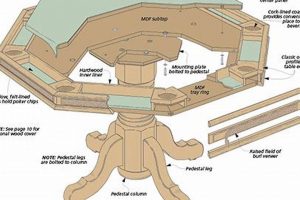
A robust and versatile workstation designed for woodworking activities serves as a central element in any serious woodworker’s shop. This specialized furniture provides a stable and spacious surface for a multitude of tasks, ranging from initial material preparation to intricate joinery and finishing. For example, a craftsman might utilize this surface to accurately cut lumber to specified dimensions, assemble complex cabinetry components, or apply protective coatings to a finished piece.
Such a crucial workspace offers significant advantages, including enhanced precision, improved efficiency, and a safer working environment. Historically, these dedicated areas have evolved from simple workbenches to sophisticated systems incorporating features like integrated clamping mechanisms, precision measuring devices, and dust collection capabilities. These advancements streamline workflows, minimize errors, and promote a cleaner, healthier workspace. The presence of such a central hub can significantly impact both the quality and speed of project completion.
The following discussion will explore various aspects of optimizing a woodworker’s central workspace, including considerations for size and material selection, essential features and accessories, and methods for customization to meet specific needs. Attention will also be given to strategies for maintaining and organizing this important area to maximize its utility and longevity.
Enhancing the Central Woodworking Workspace
Optimizing the primary woodworking surface is crucial for efficiency and precision. These suggestions address key aspects of configuration and usage, promoting a productive and safe working environment.
Tip 1: Prioritize a Solid Foundation: Construct or acquire a surface with substantial weight and rigidity. A stable foundation minimizes vibration and movement, resulting in more accurate cuts and joinery. For instance, consider a thick hardwood top supported by a robust base.
Tip 2: Implement a Versatile Clamping System: Integrate various clamping methods directly into the structure. Dog holes, T-tracks, and face vices expand clamping capabilities, securing workpieces from multiple angles. This reduces reliance on handheld clamps, freeing up hands for precise work.
Tip 3: Incorporate Integrated Measuring Tools: Install accurate rulers, scales, or digital readouts to improve measurement precision and reduce the need for separate measuring devices. Having these tools readily available streamlines workflows and minimizes errors.
Tip 4: Optimize Lighting Conditions: Install adjustable task lighting that provides focused illumination on the work area. Adequate lighting reduces eye strain and enhances visibility, especially during intricate operations. Consider LED fixtures with adjustable color temperature for optimal clarity.
Tip 5: Plan for Efficient Dust Management: Integrate a dust collection system directly into the surface or position it for easy access. A shop vacuum with a hose attachment or a dedicated dust extraction system can significantly reduce airborne particulate matter, promoting a healthier environment.
Tip 6: Designate Specific Zones: Segment the surface into dedicated areas for different tasks. Separate zones for cutting, assembly, and finishing minimize cross-contamination and promote a more organized workflow. Clearly defined boundaries enhance efficiency and reduce the risk of errors.
Tip 7: Consider Ergonomic Factors: Adjust the height of the surface to suit the user’s stature and working style. An ergonomically appropriate height reduces strain on the back, shoulders, and wrists, promoting comfort and long-term well-being. Experiment with different heights to find the optimal setting.
Implementing these enhancements to a central woodworking station elevates project quality, improves workflow, and promotes safety. Careful consideration of these points yields a functional and efficient workspace.
The subsequent sections will delve into specific material choices and customization options, further optimizing the core woodworking area.
1. Stability

Stability, in the context of a woodworking workspace, directly influences the precision and safety of all operations performed. An unstable surface introduces inaccuracies, increases the risk of tool slippage, and ultimately compromises the quality of the finished product. Therefore, achieving optimal stability is paramount in defining an exemplary woodworking surface.
- Mass and Inertia
The mass of the surface and its supporting structure provides inertia, resisting movement during operations. A heavier structure absorbs vibrations from power tools like routers and sanders, preventing them from affecting the workpiece. For instance, a workbench constructed with thick hardwood timbers and a substantial metal base will exhibit superior stability compared to a lighter, less robust alternative. This reduction in vibration leads to cleaner cuts and more precise joinery.
- Rigidity of Construction
The rigidity of the joints and materials used in construction directly contributes to overall stability. Weak or flexible joints allow for unwanted movement and deflection under load. Proper joinery techniques, such as mortise-and-tenon joints or dovetail joints, combined with high-quality adhesives, are essential for creating a rigid and stable structure. Consider a tabletop constructed from multiple boards glued together; if the glue joints are weak, the tabletop will flex and warp over time, compromising its stability and usability.
- Floor Contact and Leveling
Consistent and even contact with the floor is crucial for preventing rocking or wobbling. Uneven floors can introduce instability, even in a well-constructed surface. Adjustable feet or shims allow for precise leveling, ensuring that the workbench remains stable regardless of the floor’s imperfections. A surface that rocks even slightly will make precision work significantly more challenging and increase the risk of accidents.
- Vibration Dampening
Materials with good vibration-dampening properties, such as dense hardwoods or specialized rubber feet, can further enhance stability. These materials absorb and dissipate vibrations, minimizing their impact on the workpiece and the user. Incorporating vibration-dampening elements can lead to reduced fatigue and improved accuracy, particularly during prolonged use of power tools. For example, using a rubber mat under the surface, or rubber-padded feet, helps absorb the vibration.
In conclusion, stability is a cornerstone of a practical woodworking surface. By addressing the factors of mass, rigidity, floor contact, and vibration dampening, one can significantly enhance the performance of any woodworking area, resulting in improved precision, safety, and overall work quality. Stability isn’t just a desirable feature; it’s a fundamental requirement.
2. Versatility

Versatility, in the context of a woodworking workspace, refers to its adaptability to accommodate a wide spectrum of tasks and project types. A truly effective woodworking area transcends the limitations of a single-purpose station, transforming into a dynamic hub capable of supporting diverse activities ranging from delicate carving to heavy-duty construction.
- Adaptable Clamping Configurations
A versatile woodworking surface features a range of integrated clamping options. This includes, but is not limited to, dog holes, T-tracks, and face vises strategically positioned to secure workpieces of various shapes and sizes. For example, a woodworker might use dog holes in conjunction with bench dogs to secure a long board for edge jointing, while simultaneously employing a face vise to hold a smaller piece for detail work. The ability to quickly and easily adapt the clamping configuration significantly enhances efficiency and reduces the need for specialized jigs.
- Adjustable Height and Configuration
The capacity to adjust the height of the working surface is paramount for accommodating different users and tasks. A surface that is too low or too high can lead to discomfort and strain, reducing productivity and increasing the risk of injury. Similarly, the ability to reconfigure the surface with add-ons or modular components allows for customization to suit specific project requirements. A surface might be lowered for tasks requiring greater stability, such as hand planing, or raised for tasks requiring more reach, such as assembling tall cabinets.
- Integrated Tool Storage and Accessibility
A versatile woodworking station incorporates readily accessible storage solutions for tools and materials. This includes drawers, shelves, and racks designed to keep essential items within easy reach, minimizing downtime and improving workflow. Consider a design that includes integrated storage for hand tools, power tools, and measuring devices, allowing the woodworker to transition seamlessly between different operations without having to constantly search for the necessary equipment. This reduces clutter and promotes a more organized and efficient workspace.
- Material Compatibility and Durability
The surface material of a versatile woodworking area must be compatible with a wide range of materials and processes. It should be durable enough to withstand the rigors of daily use, resistant to damage from solvents and adhesives, and easy to clean. A solid hardwood top, for example, offers a durable and versatile surface that can withstand heavy impacts and resist warping. It can also be easily refinished or repaired if damaged, ensuring a long lifespan for the workspace.
Ultimately, the versatility of a woodworking surface is a measure of its ability to adapt to the evolving needs of the woodworker. By incorporating adaptable clamping, adjustable configurations, integrated storage, and durable materials, the workstation becomes a dynamic tool capable of supporting a wide range of projects and techniques. This adaptability transforms it from a mere work surface into a central hub for creativity and craftsmanship.
3. Clamping

Clamping represents a fundamental function intrinsically linked to a woodworking surface’s utility. The capacity to securely hold workpieces in place during cutting, shaping, and assembly processes directly influences the accuracy and quality of the finished product. An inability to properly clamp materials leads to movement, misalignment, and ultimately, compromised joinery. Consequently, the effectiveness of a central woodworking surface is inextricably tied to its clamping capabilities.
The relationship between clamping and the station’s effectiveness manifests in numerous practical applications. Consider, for example, the process of cutting dovetail joints. Precise clamping is essential to maintain the workpiece’s stability while the intricate cuts are made. Without a reliable clamping system, the workpiece might shift, resulting in inaccurate cuts and ill-fitting joints. Similarly, during glue-ups, adequate clamping pressure ensures proper adhesion between mating surfaces. The woodworking surface itself, therefore, becomes an integral component of the clamping system. Integrated clamping features, such as dog holes, T-tracks, and vises, extend the clamping possibilities, enabling the secure positioning of complex or unusually shaped components. These elements transform a simple surface into a versatile clamping apparatus.
In conclusion, the capacity for secure and adaptable clamping is not merely a desirable feature of a woodworking surface; it is a prerequisite for its effective utilization. The ability to precisely hold workpieces during various operations directly influences project accuracy, quality, and safety. The understanding of this critical connection is paramount when designing, selecting, or optimizing a woodworking workstation. An investment in robust and versatile clamping capabilities will invariably yield enhanced productivity and superior craftsmanship.
4. Durability

The longevity and resilience of a woodworking surface are fundamentally linked to its classification as an “ultimate woodworking table”. Durability directly impacts the economic viability and consistent performance of the workspace. A fragile or poorly constructed surface necessitates frequent repairs or replacement, incurring additional costs and disrupting workflows. The ability to withstand the rigors of daily use, including impacts, abrasions, and exposure to chemicals, is a primary determinant of its long-term value. For instance, a surface crafted from inferior materials may exhibit warping, cracking, or delamination under typical woodworking conditions, rendering it unsuitable for precise operations.
The selection of materials significantly influences the workspace’s ability to endure. Hardwoods like maple, beech, or birch are commonly favored for their resistance to wear and tear. These materials, when properly sealed and maintained, provide a robust surface capable of withstanding the impacts of tools and the abrasion of workpieces. Conversely, softer woods or composite materials may exhibit premature wear, necessitating frequent refinishing or replacement. Furthermore, the construction techniques employed play a crucial role in determining the overall durability. Solid joinery, reinforced corners, and a stable base contribute to a structure that can withstand the stresses of heavy use. A woodworking station constructed with robust joinery can withstand the weight and impact of equipment and materials.
In summary, durability is not merely a desirable attribute of a woodworking station; it is an essential component of its overall utility and economic value. A surface designed and constructed with durability in mind provides a reliable and consistent platform for woodworking activities, minimizing downtime and maximizing long-term return on investment. The selection of appropriate materials, combined with sound construction techniques, ensures that the workspace will endure the demands of daily use, contributing to a productive and efficient woodworking environment.
5. Ergonomics

The integration of ergonomic principles into the design and setup of a woodworking area directly affects user well-being, productivity, and long-term physical health. A work area that disregards these principles can lead to musculoskeletal disorders, fatigue, and decreased efficiency. An “ultimate woodworking table”, therefore, necessitates careful consideration of ergonomic factors to optimize user comfort and performance. For instance, a workspace positioned too low requires constant bending, straining the back and neck. Conversely, a surface positioned too high forces users to raise their shoulders, leading to shoulder and arm fatigue. These seemingly minor issues accumulate over time, potentially resulting in chronic pain and reduced work capacity. Consequently, the absence of ergonomic considerations can significantly diminish the practicality and usefulness of even the most robust or feature-rich station.
The incorporation of adjustable height mechanisms exemplifies a practical application of ergonomic principles. Such features enable users to customize the work surface to their individual height and working preferences, minimizing strain on the back, shoulders, and wrists. Similarly, the strategic placement of tools and materials within easy reach reduces unnecessary reaching and twisting, further mitigating the risk of injury. Integrated storage solutions, designed with ergonomic accessibility in mind, contribute to a more comfortable and efficient workflow. A well-designed clamping system also promotes ergonomic practices, allowing users to secure workpieces with minimal physical exertion. These features enhance comfort and efficiency, allowing the woodworker to focus on the task at hand rather than struggling with awkward postures or excessive physical strain.
In summary, the connection between ergonomics and a productive woodworking workspace is undeniable. A station designed with ergonomic principles in mind promotes user comfort, prevents injuries, and enhances overall work quality. Adjustable height, strategic tool placement, and ergonomic clamping systems contribute to a safer and more efficient working environment. A work area that prioritizes ergonomic design transcends the limitations of a mere surface, becoming a tool for promoting long-term health and maximizing woodworking capabilities. The ultimate woodworking table, therefore, inherently embodies ergonomic considerations as a foundational element.
6. Organization

Organization is a cornerstone of an efficient and safe woodworking environment, inextricably linked to the concept of an “ultimate woodworking table.” The effective arrangement and accessibility of tools, materials, and project components directly impact workflow, minimize wasted time, and reduce the risk of accidents. Disorganization, conversely, leads to delays, errors, and potential injuries. The “ultimate woodworking table,” therefore, inherently incorporates features and design principles that promote and facilitate effective organization. A chaotic work area, cluttered with misplaced tools and scattered materials, impedes progress, increases the likelihood of mistakes, and creates a hazardous environment. Locating a specific tool becomes a time-consuming ordeal, and the risk of tripping over misplaced objects is significantly increased. A disorganized station undermines the very purpose of a dedicated woodworking area.
The practical application of organizational principles manifests in various ways. Integrated storage solutions, such as drawers, shelves, and racks, provide designated locations for tools and materials, ensuring they are readily accessible when needed. A well-designed system might incorporate labeled bins for hardware, tool-specific holders, and dedicated spaces for works-in-progress. The implementation of a shadow board, where the outline of each tool is traced onto the wall, further enhances organization by providing a visual cue for proper placement. Furthermore, the physical layout of the work surface can be optimized to support organizational efficiency. Designating specific zones for different tasks, such as cutting, assembly, and finishing, minimizes cross-contamination and promotes a more streamlined workflow. A clear understanding of organizational principles allows the woodworker to design and implement a system that maximizes efficiency and minimizes the risk of accidents. For example, a system that keeps sharp tools safely stored and easily accessible prevents injuries and minimizes downtime.
In conclusion, organization is not merely a desirable feature but a fundamental requirement of an effective woodworking space. The “ultimate woodworking table” inherently incorporates organizational features that promote efficiency, safety, and overall productivity. Challenges remain in maintaining organization over time, requiring consistent effort and adherence to established systems. However, the benefits of a well-organized station far outweigh the effort required. By prioritizing organization, woodworkers can create a more productive, safer, and more enjoyable working environment. The effective implementation of organizational principles transforms a simple work surface into a truly invaluable asset.
7. Precision

Precision constitutes a critical attribute of any woodworking endeavor, directly influencing the quality and integrity of the final product. In the context of a woodworking station, precision transcends mere dimensional accuracy, encompassing the stability, repeatability, and overall control afforded to the craftsman. The effectiveness of the “ultimate woodworking table” hinges significantly on its capacity to facilitate and enhance precision in every stage of the woodworking process.
- Surface Flatness and Stability
A flat and stable work surface serves as the foundation for precise measurements and cuts. Any deviation from flatness introduces error, compounding inaccuracies throughout the project. For example, if the surface exhibits warping or cupping, measurements taken across its length will be skewed, leading to misaligned joinery and compromised structural integrity. The “ultimate woodworking table” necessitates a meticulously flattened and structurally sound surface capable of maintaining its integrity under load, ensuring that all measurements and cuts are performed with the highest degree of accuracy. High precision equipment cannot be operated effectively without surface flatness and stability.
- Integrated Measuring and Referencing Systems
The incorporation of precise measuring and referencing systems directly into the work surface enhances accuracy and repeatability. Embedded scales, T-tracks for precise positioning, and integrated fences provide reliable reference points for cutting and shaping operations. For instance, a built-in miter gauge track enables the execution of precise angle cuts, eliminating the potential for error associated with handheld measuring devices. The “ultimate woodworking table” integrates these systems to minimize cumulative errors and enhance the overall precision of woodworking tasks.
- Clamping Rigidity and Stability
Secure and stable clamping is essential for maintaining workpiece position during machining operations. Any movement or vibration of the workpiece compromises accuracy, resulting in imprecise cuts and misaligned joinery. Integrated clamping systems, such as robust vises and strategically placed dog holes, provide secure and repeatable clamping, minimizing the risk of workpiece movement. The “ultimate woodworking table” is equipped with clamping systems designed to maintain absolute workpiece stability, even under the force of power tools, thereby ensuring dimensional accuracy and minimizing material waste.
- Tool Mounting and Alignment
The ability to securely mount and precisely align tools to the work surface is crucial for achieving consistent and accurate results. Jigs, fences, and specialized mounting hardware ensure that tools are properly oriented and aligned with the workpiece, minimizing the potential for error. The “ultimate woodworking table” incorporates provisions for tool mounting and alignment, ensuring that tools are positioned precisely and securely, enabling the execution of complex operations with a high degree of accuracy and repeatability. Precision can be achieved through jigs and specialized mounting tools.
The multifaceted connection between precision and a high-quality woodworking station emphasizes the significance of surface quality, integrated measurement systems, clamping stability, and accurate tool mounting. These elements combine to create a workspace that promotes accuracy, minimizes errors, and enables the creation of woodworking projects with exceptional precision. The “ultimate woodworking table” is therefore not merely a surface, but rather a carefully engineered system designed to support and enhance the precision of every woodworking task.
Frequently Asked Questions
The following addresses common inquiries regarding the selection, utilization, and maintenance of a high-quality woodworking station.
Question 1: What distinguishes a premium woodworking table from a standard workbench?
A premium woodworking table incorporates features designed to enhance precision, stability, and versatility beyond those typically found in a standard workbench. This includes a meticulously flattened surface, integrated clamping systems, adjustable height options, and provisions for tool mounting and storage.
Question 2: What considerations are paramount when selecting the material for a woodworking table surface?
The optimal surface material exhibits durability, stability, and resistance to wear and tear. Hardwoods like maple or beech are often favored for their robustness and longevity. Surface material influences operational accuracy and product lifespan.
Question 3: How does the integration of clamping systems enhance the functionality of a woodworking table?
Integrated clamping systems, such as dog holes, T-tracks, and vises, provide secure and adaptable clamping options for workpieces of varying shapes and sizes. Precise clamping promotes accuracy and safety during machining and assembly operations.
Question 4: How is ergonomic design incorporated into a premium woodworking table?
Ergonomic design considerations include adjustable height mechanisms, strategically placed tool storage, and features that minimize strain and promote user comfort. Ergonomic design leads to reduced user fatigue and enhanced long-term health.
Question 5: What maintenance procedures are recommended for preserving the integrity of a woodworking table?
Regular maintenance includes cleaning the surface, applying protective finishes, and inspecting for signs of wear or damage. Adhering to a maintenance schedule ensures the long-term durability and performance of the woodworking table.
Question 6: How does the presence of integrated storage solutions contribute to an efficient woodworking environment?
Integrated storage solutions provide designated locations for tools, materials, and project components, minimizing clutter and promoting accessibility. Organized storage minimizes wasted time and enhances overall workflow efficiency.
In summary, a premium woodworking table embodies a holistic approach to woodworking, incorporating features that enhance precision, stability, ergonomics, and organization. It is designed to provide a robust, versatile, and user-friendly platform for a wide range of woodworking tasks.
The subsequent section will provide an overview of specific case studies, demonstrating the practical applications of the ‘ultimate woodworking table’ across diverse woodworking projects.
Conclusion
The preceding discussion has explored the multifaceted characteristics that define a superior woodworking station. Elements such as stability, versatility, clamping capability, durability, ergonomic design, organization, and precision have been examined, each contributing significantly to the overall utility and value of the workspace. The integration of these features elevates a standard workbench to a dynamic and effective tool for a wide range of woodworking applications.
The ‘ultimate woodworking table’ transcends the limitations of a mere surface, becoming a foundation for craftsmanship and a facilitator of precision. Continued development and refinement of woodworking stations will undoubtedly lead to even greater efficiency, safety, and creative potential within the woodworking discipline. Therefore, careful consideration of the principles outlined herein is paramount for both the professional woodworker and the serious hobbyist seeking to optimize their working environment.