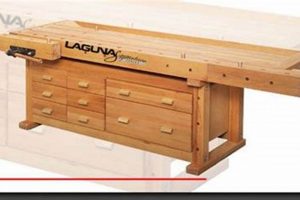
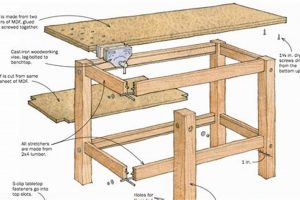
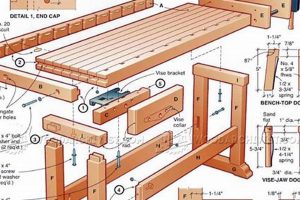
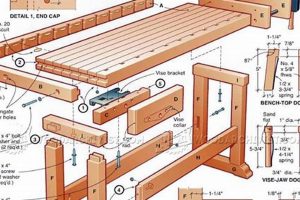
A designated station for supporting, securing, and manipulating wood during various fabrication processes is essential for quality woodworking. It typically comprises a sturdy frame, a flat work surface, and mechanisms for holding material in place, such as vises and dog holes. For example, this surface provides a stable platform for activities ranging from sawing and planing to joinery and assembly.
The presence of a suitable work area significantly enhances accuracy, safety, and efficiency in woodworking projects. It enables controlled movements and minimizes the risk of material slippage or damage. Historically, these work surfaces have evolved from simple, makeshift supports to specialized tools designed to accommodate specific woodworking techniques, thereby increasing precision and decreasing project completion time.
This exposition will delve into the specific techniques for securing workpieces, employing integrated holding mechanisms, and optimizing the workspace for various tasks. Furthermore, it will outline the appropriate maintenance practices for ensuring the long-term functionality and reliability of the station.
Essential Usage Techniques
Optimizing the functionality of a woodworking station involves adhering to several crucial guidelines that enhance precision and safety.
Tip 1: Secure Workpieces Firmly: Prior to commencing any operation, ensure the workpiece is adequately secured. Utilize vises, clamps, or bench dogs to prevent movement during sawing, planing, or routing. Insufficient securing can result in inaccurate cuts and potential injury.
Tip 2: Utilize Bench Dogs Effectively: Bench dogs, in conjunction with a vise, provide a versatile method for holding larger pieces. Position the dogs strategically to maximize holding power and prevent flexing of the material.
Tip 3: Adjust Vise Pressure Appropriately: Avoid over-tightening the vise, which can damage the workpiece or the vise itself. Apply only the necessary pressure to maintain a secure hold without causing indentation or crushing.
Tip 4: Maintain a Clean Work Surface: Regularly remove sawdust and debris from the surface. A clean surface ensures accurate measurements and prevents slippage of tools or workpieces.
Tip 5: Position the Bench for Optimal Lighting: Adequate lighting is crucial for precision work. Position the bench near a natural light source or supplement with task lighting to minimize shadows and improve visibility.
Tip 6: Organize Tools for Accessibility: Keep frequently used tools within easy reach. A well-organized workspace minimizes downtime and enhances workflow efficiency.
Tip 7: Employ Proper Posture: Maintain an ergonomic posture to reduce fatigue and prevent strain. Adjust the height of the bench, if possible, to a comfortable working level.
Tip 8: Use Stop Blocks for Repetitive Cuts: When performing repetitive cuts, employ stop blocks to ensure consistent dimensions and improve accuracy.
Adhering to these guidelines promotes both the quality of the work and the safety of the craftsman. The correct operation maximizes efficiency and precision, which are essential for high-quality woodworking projects.
The following section will address best practices for ongoing maintenance and potential modifications to enhance the utility of the woodworking platform.
1. Workpiece Securing

Workpiece securing constitutes a foundational element of effective woodworking station utilization. The relationship between the two is causal: insufficient securing directly leads to inaccuracies and potential hazards during operations. The degree to which a workpiece is firmly held dictates the precision with which sawing, planing, or joinery can be executed. For example, attempting to hand-plane a board that is not adequately secured will inevitably result in inconsistent surface finishing and potentially dangerous tool slippage.
The integrated holding mechanisms, such as vises and bench dogs, are integral components designed for this purpose. Understanding their proper application is critical. Over-tightening a vise can damage delicate woods, while insufficient pressure allows movement. Furthermore, the strategic placement of bench dogs in conjunction with vise pressure provides stable support for larger workpieces, preventing bowing or flexing during machining. A cabinet maker assembling a large door frame, for instance, relies heavily on these methods to maintain squareness and alignment.
In summary, appropriate workpiece securing is paramount. Its neglect results in diminished quality, increased risk of injury, and wasted material. Mastering the techniques for effective clamping, vise adjustment, and dog hole utilization is not merely a procedural detail but a central requirement for proficient and safe woodworking station operation.
2. Vise Adjustment

The ability to properly adjust a vise is fundamental to the effective utilization of a woodworking station. Inadequate or incorrect adjustment compromises workpiece stability, impacting precision and safety during various woodworking operations. Precision in adjustment translates directly into project quality and user well-being.
- Clamping Pressure Calibration
Applying appropriate clamping pressure is essential. Excessive force can mar or crush softer woods, while insufficient pressure allows slippage. For example, when dovetailing, precisely calibrated pressure is needed to secure the workpiece without deforming the delicate joinery. The operator must develop a feel for the material to ensure a secure, non-damaging grip. Miscalibration results in inaccurate cuts, compromised joints, and potential material waste.
- Vise Jaw Parallelism
Maintaining parallel vise jaws is critical for even clamping pressure across the workpiece. Non-parallel jaws create point-load stresses, potentially damaging the wood or allowing it to shift during machining. For instance, attempting to plane a wide board in a vise with misaligned jaws will lead to uneven support and a skewed surface. Periodic adjustment and maintenance of the vise mechanism are necessary to ensure consistent parallelism. Disregard for parallelism introduces variability and diminishes the quality of the finished product.
- Workpiece Alignment with Jaws
Correct workpiece alignment within the vise jaws is crucial for accurate cuts and joinery. Angled or offset placement induces stresses and can lead to inaccurate results. Consider the task of cutting tenons; if the tenon stock is not perfectly square within the vise, the resulting tenon will be out of square. Proper alignment requires careful observation and the use of shims or jigs to compensate for irregularities in the material. Improper alignment defeats the purpose of a precision woodworking station.
- Vise Hardware Maintenance
The mechanical integrity of the vise itself is dependent on regular maintenance. Lubrication of the screw mechanism, tightening of mounting bolts, and inspection for wear are essential to ensure smooth and reliable operation. A neglected vise can bind, slip, or fail to hold the workpiece securely. For example, a rusted screw thread on a vise diminishes its clamping force. Consistent maintenance extends the life of the vise and safeguards the user against potential hazards.
These facets of vise adjustment, when meticulously observed, enhance the overall utility of a woodworking station. Mastery of vise operation is inseparable from the pursuit of high-quality woodworking. Ultimately, proper vise adjustment enables precise control, reduces material waste, and promotes a safer working environment, showcasing its central role.
3. Dog Hole Utilization
Dog hole utilization represents a critical aspect of a woodworking station’s functionality, directly impacting the range and precision of achievable tasks. The holes, typically arranged in a grid pattern across the bench surface, serve as anchoring points for bench dogs, specialized clamping accessories. These dogs, in conjunction with a vise or other clamping mechanisms, provide secure workpiece holding, enabling operations such as planing, sawing, and joinery. In effect, the presence and strategic employment of dog holes expand the capacity of the woodworking station to accommodate diverse project requirements. For instance, a long board being edge-jointed can be firmly secured using a series of dogs positioned along its length, preventing bowing and ensuring a consistent, straight edge.
Effective dog hole utilization extends beyond simple workpiece clamping. They facilitate the construction of temporary jigs and fixtures. Custom-made fences or stops can be quickly attached to the bench using dogs, enabling precise and repeatable cuts. Furthermore, dog holes often integrate with holdfasts, providing downward pressure on the workpiece. Consider the scenario of shaping a complex curve on a tabletop; holdfasts inserted into dog holes offer a secure and adjustable means of holding the piece while allowing freedom of movement for shaping tools. The lack of appropriate dog hole arrangement limits the possibilities for jigs, fixtures, and more secure work-holding. A poorly designed bench offers none of this flexibility.
In conclusion, understanding and properly implementing dog hole utilization is essential for maximizing the versatility and effectiveness of a woodworking station. The capacity to securely hold workpieces, create custom fixtures, and integrate with various clamping systems is directly dependent on the strategic placement and availability of these seemingly simple features. Challenges often arise in aligning dog holes precisely and selecting the appropriate dogs for specific tasks; however, mastering these challenges unlocks the full potential of the woodworking bench and enhances the overall quality and efficiency of woodworking projects. The arrangement should be considered as part of the tool; not just an add-on.
4. Surface Cleanliness

Surface cleanliness is integral to the effective operation of a woodworking station. A clean surface facilitates accuracy, promotes safety, and safeguards both workpieces and tools. The adherence to cleanliness protocols directly influences the quality and efficiency of woodworking tasks.
- Accuracy of Measurement and Marking
The accumulation of sawdust, shavings, or adhesive residue on the surface obscures markings and introduces inaccuracies in measurements. A clean surface provides a clear visual reference for layout lines, ensuring precise cuts and joinery. For example, attempting to mark a dovetail layout on a dusty bench will likely result in misplaced lines and a poorly fitted joint. Consistent cleaning minimizes these errors, enhancing overall project precision.
- Prevention of Workpiece Contamination
Debris on the work surface can transfer to the workpiece, contaminating finishes or interfering with adhesive bonding. Dust particles embedded in a finish create a textured surface, diminishing aesthetic quality. Adhesive residue prevents uniform bonding, compromising joint strength. Regular cleaning eliminates these contaminants, ensuring a clean, professional finish and robust joinery.
- Tool Protection and Longevity
Sawdust and debris can abrade cutting edges, dulling tools and reducing their effectiveness. A clean surface prevents unnecessary tool wear, extending their lifespan and maintaining optimal performance. Furthermore, accumulated sawdust can clog the mechanisms of power tools, leading to overheating and potential damage. Maintaining a clean work area preserves tool integrity and minimizes maintenance costs.
- Enhanced Safety
A cluttered surface presents a significant safety hazard. Tools can become obscured, increasing the risk of accidental contact and injury. Loose shavings create a slipping hazard, especially when working with power tools. A clean, organized surface minimizes these risks, promoting a safer working environment. The presence of debris presents trip hazards and obstructs clear pathways around the station, increasing the potential for accidents.
The facets of surface cleanliness highlight its pivotal role in woodworking. Consistent cleaning practices directly contribute to accurate measurements, prevent workpiece contamination, protect tools, and enhance safety. Neglecting surface cleanliness compromises the utility of the woodworking station and undermines the quality of the final product. Integrating cleanliness into the workflow ensures accurate results, prevents damage, and promotes a long-lasting bench.
5. Tool Placement

The strategic arrangement of tools within and around a woodworking station directly impacts workflow efficiency, safety, and the overall quality of project execution. Optimizing this arrangement is not merely a matter of convenience but a crucial element in effectively using a woodworking station.
- Frequency of Use Prioritization
Tools used frequently during typical woodworking tasks should be located within easy reach of the primary work area. This minimizes unnecessary movement and interruption of workflow. For example, commonly used measuring devices, marking tools, and essential hand tools such as chisels and hand planes should be readily accessible from the user’s primary working position. Tools relegated to less frequent tasks may be stored in drawers or shelves located further from the immediate work zone. The misplacement of commonly used tools compromises workflow and reduces efficiency.
- Task-Specific Grouping
Organizing tools based on the specific operations they support, such as joinery, shaping, or finishing, streamlines the workflow. For example, grouping chisels, mallets, and marking gauges used for joinery in a dedicated area reduces searching time and facilitates efficient task completion. Similarly, placing sanding blocks, files, and rasps together promotes efficient shaping and smoothing processes. Disorganization in tool arrangement diminishes productivity and creates opportunities for errors.
- Safety Considerations
Tool placement must account for potential safety hazards. Sharp tools, such as saws and chisels, require secure storage to prevent accidental contact. Power cords must be managed to avoid tripping hazards. Flammable materials, such as finishes and solvents, need to be stored in designated, fire-resistant cabinets away from potential ignition sources. Failure to address these safety considerations increases the risk of accidents and injuries within the workspace.
- Spatial Optimization
The available space dictates the tool storage solutions. Integrating drawers, shelves, and hanging racks allows for efficient use of vertical space. Tool storage methods should accommodate the size and shape of the tools, preventing damage and facilitating easy access. Overcrowding or inefficient storage increases the risk of damage to tools and creates a cluttered, unsafe working environment.
Strategic placement, therefore, not only streamlines processes and reduces frustration but also optimizes the overall working environment, contributing to enhanced efficiency and ultimately, the attainment of superior craftsmanship within the woodworking domain. Careful analysis of workflow and spatial optimization, coupled with the implementation of safety protocols, is therefore a crucial element in the pursuit of maximizing the utility of a woodworking station.
6. Lighting Optimization
Lighting optimization constitutes a critical yet often overlooked aspect of woodworking station utilization. Inadequate illumination directly impedes accuracy, compromises safety, and reduces overall efficiency. The quality of light cast upon the work surface dictates the ability to discern fine details, assess surface finish, and manipulate tools with precision. For example, tasks such as cutting dovetails or applying intricate carvings demand sufficient and well-directed light to avoid errors that would otherwise be imperceptible. Without optimized lighting, the effectiveness of the woodworking station is inherently limited, regardless of the quality of the station itself.
Several factors contribute to effective lighting optimization. These include the intensity, color temperature, and directionality of the light source. High-intensity lighting ensures sufficient illumination for detailed work, while appropriate color temperature, often daylight balanced, prevents color distortion and reduces eye strain. Adjustable lighting fixtures enable the user to direct the light source precisely where needed, eliminating shadows and providing optimal visibility. A cabinetmaker, for instance, might employ a combination of ambient lighting and task-specific spotlights to illuminate the workpiece from multiple angles, facilitating precise cuts and joinery. Similarly, an individual refinishing a piece of furniture might utilize adjustable lighting to assess the evenness of the finish and identify imperfections.
In summary, optimizing the lighting environment around a woodworking station is not merely a matter of comfort but a fundamental requirement for achieving accurate, safe, and efficient woodworking results. By strategically employing appropriate light sources and fixtures, woodworking practitioners can significantly enhance their ability to discern fine details, manipulate tools with precision, and minimize the risk of errors and injuries. This integration of optimized lighting transforms the station from a basic work surface into a highly effective and productive workspace. Properly optimized lighting should be regarded as fundamental element, on par with the bench itself.
7. Posture Maintenance
Posture maintenance is not tangential to the utilization of a woodworking station; rather, it represents an intrinsic element that directly affects user well-being, productivity, and the long-term feasibility of woodworking endeavors. Sustained awkward postures or repetitive strain, resulting from a poorly configured or improperly used station, can lead to musculoskeletal disorders, thereby negating the potential benefits of the craft. The principles of ergonomic design and awareness are therefore paramount in the context of woodworking station use.
- Bench Height Optimization
Inadequate bench height compels the user to adopt postures that deviate from neutral alignment, leading to strain on the back, shoulders, and wrists. A bench positioned too low necessitates excessive bending, while one too high causes elevated shoulders and restricted arm movement. The ideal bench height allows the user to perform most tasks with a relaxed posture and minimal deviation from a neutral spine. For example, when hand planing, the elbows should be bent at approximately 90 degrees, with the shoulders relaxed and the back straight. Failure to optimize bench height precipitates muscular fatigue and increases the risk of chronic pain.
- Workpiece Positioning
The location and orientation of the workpiece relative to the user are critical determinants of posture. Reaching excessively or twisting the torso to access the workpiece places undue stress on the spine and shoulder girdle. Positioning the workpiece directly in front of the user, minimizing reach distances, and rotating the piece as needed to maintain a comfortable working position are essential ergonomic practices. A craftsman repeatedly reaching across the bench to access a workpiece will likely experience back pain and reduced work capacity. Proper positioning facilitates natural movements and reduces physical strain.
- Tool Handling Techniques
The manner in which tools are grasped and manipulated can significantly impact posture and musculoskeletal health. Gripping tools too tightly or maintaining static postures for extended periods contributes to muscle fatigue and the development of repetitive strain injuries. Employing ergonomic tool designs, minimizing grip force, and incorporating frequent breaks to stretch and reposition the hands and wrists are essential preventive measures. Prolonged use of hand tools with poorly designed grips can lead to carpal tunnel syndrome or other upper extremity disorders. Proper technique and ergonomic tool selection mitigate these risks.
- Regular Breaks and Stretching
Regardless of workstation configuration or task complexity, prolonged static postures are detrimental to musculoskeletal health. Incorporating regular breaks to stand, stretch, and move around is essential to alleviate muscle tension and promote circulation. Simple stretches targeting the neck, shoulders, back, and wrists can significantly reduce the risk of pain and injury. For example, a short break every 20-30 minutes to perform neck rotations, shoulder shrugs, and wrist extensions can prevent muscle fatigue and stiffness. Neglecting these breaks results in cumulative strain and increased vulnerability to musculoskeletal disorders.
These elements, when integrated into woodworking station utilization, serve as fundamental components of long-term well-being and productivity. By prioritizing posture maintenance, woodworking practitioners can mitigate the risks associated with prolonged or repetitive tasks, thereby ensuring the sustainability of their craft. A well-designed and properly utilized woodworking station, coupled with ergonomic awareness, transforms the activity from a potential source of physical strain into a fulfilling and sustainable pursuit. By following a proper technique and appropriate equipment, woodworking activity transform to something therapeutic.
Frequently Asked Questions
This section addresses common inquiries regarding the effective and safe operation of a woodworking station. Understanding these aspects is crucial for maximizing the utility of the station and achieving high-quality results.
Question 1: What constitutes an appropriate height for a woodworking station?
The optimal height varies depending on the individual user and the specific task. A general guideline is to position the work surface at a height that allows the user to perform most operations with elbows bent at approximately 90 degrees, maintaining a relaxed shoulder posture and a straight back. Adjustments may be necessary for tasks that require greater precision or force. Consider the most common operations the station will be used for when determining the specific height.
Question 2: How frequently should a woodworking station be cleaned?
The frequency depends on the intensity of use. However, the work surface should be cleared of sawdust and debris after each work session to ensure accuracy and prevent contamination of subsequent projects. A more thorough cleaning, involving the removal of accumulated grime and the application of protective finishes, should be performed periodically, depending on the environment and the materials being worked.
Question 3: What are the essential tools that should be readily accessible at a woodworking station?
Essential tools include measuring instruments (rules, squares, marking gauges), cutting tools (saws, chisels, planes), clamping devices (vises, clamps, bench dogs), and striking tools (mallets, hammers). The specific selection depends on the types of projects being undertaken, but prioritizing tools used frequently promotes efficiency.
Question 4: How should large or irregularly shaped workpieces be secured to a woodworking station?
Larger workpieces may require the use of multiple clamping devices, such as bench dogs and holdfasts, in conjunction with a vise. Irregularly shaped pieces may necessitate the construction of custom jigs or fixtures to provide adequate support and prevent movement during machining. Consideration should be given to the points of contact and the distribution of clamping pressure to avoid damage to the workpiece.
Question 5: How can the effectiveness of a woodworking station’s vise be maintained?
Regular maintenance is crucial. This includes lubricating the screw mechanism to ensure smooth operation, tightening mounting bolts to prevent loosening, and inspecting the jaws for wear or damage. Periodic cleaning to remove sawdust and debris also contributes to optimal performance. A well-maintained vise is essential for secure workpiece holding and accurate machining.
Question 6: What safety precautions should be observed when utilizing a woodworking station?
Safety is paramount. Wear appropriate personal protective equipment, including safety glasses, hearing protection, and dust masks. Ensure adequate lighting and ventilation. Keep the work area clean and free of clutter. Use tools correctly and maintain sharp cutting edges. Secure workpieces firmly to prevent movement. Never force tools or exceed their rated capacity. These precautions minimize the risk of accidents and injuries.
These FAQs provide a foundation for understanding the proper operation and maintenance of a woodworking station. Adherence to these principles promotes safety, efficiency, and the attainment of high-quality woodworking results.
The following section will delve into advanced techniques and modifications for further optimizing the woodworking platform.
How to Use a Woodworking Bench
This exposition has detailed the essential aspects of effectively engaging the functionality of a woodworking station. From securing workpieces and adjusting vises to optimizing lighting and maintaining proper posture, the integration of these techniques is paramount. Mastery of dog hole utilization, consistent surface cleanliness, and strategic tool placement contributes directly to the attainment of precision, safety, and efficiency in woodworking endeavors. The discussion has emphasized that proper operation is not merely a procedural detail, but rather a foundational requirement for achieving high-quality results.
The pursuit of woodworking excellence necessitates a commitment to continuous learning and refinement of skills. As practitioners navigate the complexities of the craft, a thorough understanding of how to use a woodworking bench, coupled with a dedication to ergonomic principles and safety protocols, will undoubtedly yield both personal satisfaction and the creation of lasting, functional works. The station is a foundation, and the knowledge of its effective employment is the key to unlocking its full potential.