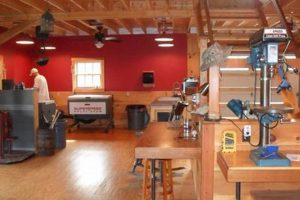
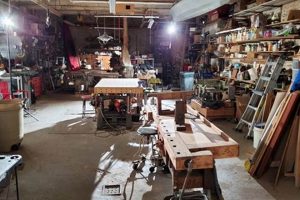
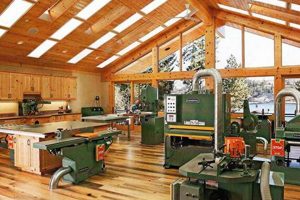
Illumination solutions employing light-emitting diodes, specifically designed for carpentry and related workspaces, offer superior lighting characteristics. These specialized fixtures provide high levels of brightness, excellent color rendering, and energy efficiency, making them well-suited for the intricate tasks performed in woodworking environments. For example, a well-lit workshop using this type of lighting enhances the visibility of fine details during cutting, shaping, and finishing processes.
Adequate and appropriate illumination is crucial for safety, precision, and productivity in woodworking. Historically, incandescent and fluorescent lighting were common choices, but these options often lacked the intensity, color accuracy, and energy efficiency required for optimal performance. Modern diode-based solutions address these shortcomings, reducing eye strain, minimizing shadows, improving the accuracy of color matching, and lowering energy costs, thereby contributing to a safer and more cost-effective workspace.
The subsequent discussion will explore key considerations for selecting suitable illumination systems for woodworking environments. Topics include lumen output, color temperature, CRI (Color Rendering Index), fixture types, placement strategies, and regulatory compliance, all of which play a vital role in creating an ideal and productive woodworking space.
Illumination Selection Guidance
The following provides guidance to ensure optimal lighting within woodworking environments.
Tip 1: Prioritize Sufficient Lumen Output: Determine the necessary lumen output based on the shop’s square footage and task complexity. Higher lumen values are essential for intricate tasks requiring detailed visibility.
Tip 2: Select Appropriate Color Temperature: Opt for a color temperature within the 4000K to 5000K range. This “cool white” provides optimal clarity and reduces eye strain during extended work periods.
Tip 3: Maximize Color Rendering Index (CRI): Aim for a CRI of 85 or higher. A high CRI ensures accurate color representation, crucial for staining, finishing, and matching wood tones.
Tip 4: Choose Durable and Enclosed Fixtures: Select fixtures designed to withstand the dust and debris inherent in woodworking environments. Enclosed fixtures protect internal components and prolong lifespan.
Tip 5: Strategically Position Lighting Fixtures: Implement a multi-point lighting scheme, incorporating overhead lighting, task lighting, and supplementary lighting to minimize shadows and provide uniform illumination.
Tip 6: Consider Dimmable Options: Implement dimmable features allowing for adjustable brightness levels, accommodating varying task requirements and ambient lighting conditions.
Tip 7: Ensure Compliance with Safety Standards: Verify that all fixtures are appropriately rated for the intended environment and comply with relevant electrical codes and safety regulations.
Implementing these measures yields a safer, more productive, and visually comfortable woodworking workspace.
The concluding section will provide a concise overview and closing remarks.
1. Brightness (Lumens)

In the context of illumination solutions for carpentry and related workspaces, the luminous flux, measured in lumens, represents a critical performance parameter. Insufficient luminous flux directly impairs visibility, thereby increasing the risk of errors and accidents while reducing overall productivity. Conversely, excessive luminous flux can induce glare and eye strain, negatively impacting comfort and performance. The selection of adequate lumen output is, therefore, integral to the effectiveness of any illumination strategy for such environments.
Optimal lumen output is determined by multiple factors, including the shop’s dimensions, the surface reflectance of the walls and equipment, and the nature of the tasks performed. For instance, tasks involving fine detail work, such as carving or intricate joinery, necessitate higher lumen levels compared to general assembly work. As a real-world illustration, a workbench dedicated to detailed carving would require substantially more illumination than the surrounding general workspace. Furthermore, the placement and type of fixtures influence the perceived brightness; diffused lighting distributes lumens more evenly than concentrated spotlights.
Consequently, achieving optimal illumination in carpentry environments necessitates a balanced approach. A thorough evaluation of the workspace and task requirements is essential for selecting light-emitting diode fixtures with appropriate lumen output. This careful selection ensures that the illumination system effectively supports precision work, reduces the risk of errors and accidents, and promotes a comfortable and productive working environment. The consideration of lumen output represents a foundational element in establishing an effective and appropriate lighting solution.
2. Color Accuracy (CRI)

Color Accuracy, quantified by the Color Rendering Index (CRI), is a critical attribute in illumination systems designed for woodworking environments. CRI measures a light source’s ability to accurately render the colors of objects compared to a natural light source. In woodworking, where material selection, finishing, and matching are paramount, a high CRI value is essential. A low CRI can distort perceived colors, leading to incorrect material choices, mismatched finishes, and ultimately, compromised project quality. Therefore, the integration of a light-emitting diode system exhibiting a high CRI directly correlates with enhanced accuracy and precision in woodworking tasks. For instance, accurately matching a stain to a specific wood tone is fundamentally dependent on the light source faithfully rendering the colors.
The selection of light-emitting diodes boasting a CRI of 85 or higher is a practical imperative for woodworking shops. This selection ensures that the color of wood, stains, paints, and finishes are viewed under conditions that approximate natural daylight, mitigating the risk of errors arising from color distortion. Furthermore, a high CRI can improve worker efficiency by reducing eye strain and minimizing the need for repeated color checks under different lighting conditions. An illustrative example would be the application of multiple coats of varnish; a low CRI light source could obscure subtle variations, leading to uneven or inadequate coverage. This issue could lead to rework and wasted resources.
In summary, the correlation between Color Accuracy (CRI) and effective lighting for woodworking environments is undeniable. Investing in illumination systems with high CRI values provides a tangible return through improved accuracy, reduced errors, and enhanced efficiency in woodworking processes. Challenges remain in educating woodworking professionals about the importance of CRI and the specific performance characteristics of different light sources; however, understanding this parameter is crucial for achieving optimal results in woodworking endeavors. The deliberate focus on CRI is a vital element in establishing an efficient and productive woodworking workshop.
3. Energy Efficiency

Energy efficiency is a paramount consideration in the selection of optimal illumination for woodworking shops. The operational costs associated with lighting represent a significant overhead for many businesses; therefore, reducing energy consumption without compromising illumination quality presents a compelling economic and environmental imperative. The superior energy efficiency of light-emitting diodes directly contributes to reduced operating expenses and a decreased carbon footprint.
- Reduced Electricity Consumption
Light-emitting diodes consume significantly less electricity compared to traditional incandescent or fluorescent lighting systems for the same level of luminous output. This reduction in energy consumption translates directly into lower electricity bills for woodworking shops, resulting in substantial cost savings over the lifespan of the lighting system. As an example, replacing a 400-watt metal halide fixture with a 150-watt light-emitting diode fixture can result in energy savings of over 60%. These savings are cumulative and become increasingly significant in larger workshops with numerous lighting fixtures.
- Extended Lifespan
Light-emitting diodes possess a significantly longer operational lifespan compared to conventional lighting technologies. This extended lifespan minimizes the frequency of replacements, thereby reducing maintenance costs and downtime associated with replacing burnt-out bulbs or fixtures. The longer lifespan translates directly into reduced labor costs and fewer interruptions to woodworking operations. In contrast to the frequent replacements required by traditional lighting, light-emitting diode fixtures can operate for tens of thousands of hours, offering a substantial economic advantage.
- Lower Heat Generation
Light-emitting diodes generate significantly less heat compared to incandescent or fluorescent lights. This reduced heat generation results in a lower demand for air conditioning in climate-controlled woodworking shops, particularly during warmer months. The decreased reliance on air conditioning translates into further energy savings and reduced operating costs. Furthermore, the lower heat output contributes to a more comfortable working environment, potentially improving worker productivity.
- Rebate and Incentive Programs
Many utility companies and government agencies offer rebate and incentive programs for businesses that install energy-efficient light-emitting diode lighting systems. These programs can significantly offset the initial cost of upgrading to light-emitting diode lighting, making it an even more financially attractive option. The availability of these incentives further enhances the economic benefits of adopting energy-efficient light-emitting diode illumination for woodworking shops. Businesses should actively investigate and leverage these programs to maximize their return on investment.
The multifaceted benefits of energy efficiency extend beyond simple cost savings. The environmental advantages associated with reduced energy consumption, coupled with the economic incentives offered through rebate programs, solidify the position of light-emitting diodes as the superior choice for woodworking shop illumination. Considering these factors collectively underscores the importance of prioritizing energy efficiency when selecting lighting systems for woodworking environments, demonstrating a commitment to both financial responsibility and environmental stewardship. The selection of energy-efficient light-emitting diodes represents a strategic investment in the long-term sustainability of woodworking operations.
4. Fixture Durability
In the context of illumination within woodworking workshops, fixture durability constitutes a critical performance parameter directly impacting operational efficiency and safety. The environment inherent to woodworking characterized by airborne particulates, fluctuations in temperature, and potential physical impacts presents a significant challenge to lighting systems. Consequently, the robustness and resilience of a light fixture directly correlates with its longevity and reliability in such demanding conditions. Insufficient durability results in premature failure, necessitating frequent replacements and incurring associated costs in terms of both materials and labor. These interruptions can disrupt workflow and negatively impact productivity. As an illustrative example, a standard, non-sealed fixture is highly susceptible to dust infiltration, which can impede heat dissipation, reduce light output, and ultimately lead to component failure.
The selection of robustly constructed light-emitting diode fixtures, specifically engineered for industrial environments, represents a strategic investment in the long-term viability of a woodworking operation. Features such as impact-resistant housings, sealed enclosures to protect against dust and moisture, and robust mounting mechanisms are essential for ensuring fixture longevity. Materials such as polycarbonate or reinforced aluminum offer superior protection against physical damage compared to standard plastics. The utilization of sealed connectors and wiring also prevents the ingress of contaminants that can corrode electrical connections and compromise performance. Furthermore, fixtures designed with adequate heat sinking capabilities are better equipped to dissipate heat generated by the light-emitting diodes, prolonging their lifespan and maintaining consistent light output over time. This emphasis on construction and engineering translates into reduced maintenance requirements and prolonged operational lifespan. For instance, a properly sealed fixture will maintain its light output and efficiency even after prolonged exposure to sawdust and other airborne contaminants.
In conclusion, fixture durability is not merely a desirable attribute but rather a fundamental requirement for selecting optimal illumination for woodworking environments. By prioritizing robust construction, sealed enclosures, and appropriate materials, woodworking professionals can mitigate the risks associated with premature failure, reduce maintenance costs, and ensure a reliable and consistent lighting system that supports safe and efficient operations. The understanding and application of these durability considerations are essential for creating a long-lasting and productive workspace, directly contributing to the overall success of woodworking endeavors. The integration of durable lighting solutions is a proactive measure that minimizes disruptions and maximizes the return on investment in illumination systems.
5. Strategic Placement
Strategic placement directly impacts the effectiveness of illumination, transforming general lighting into a precision tool within a woodworking shop. The mere selection of adequate fixtures does not guarantee optimal results; the positioning of those fixtures dictates the distribution of light, influencing visibility, reducing shadows, and enhancing overall safety. Improper placement can negate the benefits of even the most advanced light-emitting diode technology, leading to uneven illumination, glare, and ultimately, compromised work quality. Conversely, a carefully planned lighting layout maximizes the potential of the fixtures, creating a well-lit and efficient workspace. For example, central overhead lighting alone often casts shadows from tools and machinery, obscuring details on work surfaces. The addition of task-specific lighting strategically positioned eliminates these shadows, illuminating critical areas and improving accuracy.
Effective placement involves a multifaceted approach that considers various factors, including the dimensions of the shop, the location of machinery, and the nature of the tasks performed. General overhead lighting provides ambient illumination, while supplemental task lighting focuses on specific work areas, such as workbenches, lathes, and saws. Adjustable fixtures allow for fine-tuning the light direction and intensity, accommodating different project requirements. In areas with tall machinery, strategically placed high-bay fixtures ensure uniform illumination and prevent dark spots. Implementing a zonal lighting system, where specific areas can be individually illuminated, allows for targeted illumination based on workflow and task demands, optimizing energy efficiency and reducing unnecessary light exposure in unused sections of the shop. For instance, a finishing area might benefit from side lighting to reveal imperfections in the wood surface.
Strategic placement, therefore, is not merely an ancillary consideration but rather an integral component of an effective woodworking shop lighting system. It transforms light-emitting diode fixtures from simple illumination sources into tools that enhance productivity, improve safety, and elevate the quality of craftsmanship. Challenges remain in educating woodworking professionals on the importance of strategic lighting design, but the benefits derived from a well-planned layout are undeniable. The conscious application of placement principles is essential for realizing the full potential of light-emitting diode technology in woodworking environments, ensuring that the fixtures function not just as sources of light, but as integral parts of a productive and safe workspace.
Frequently Asked Questions
The following addresses common inquiries regarding the selection and implementation of appropriate lighting within woodworking workshops. Emphasis is placed on clarity, accuracy, and the provision of actionable information.
Question 1: What lumen output is recommended for a woodworking shop?
The appropriate lumen output varies based on the shop’s dimensions and the nature of the tasks performed. However, a general guideline is to aim for 70-100 lumens per square foot. Areas dedicated to intricate tasks necessitate higher lumen values, while general workspaces can function effectively with lower levels of illumination.
Question 2: Why is Color Rendering Index (CRI) important in a woodworking shop?
Color Rendering Index (CRI) indicates a light source’s ability to accurately render colors. A high CRI (85 or above) is crucial in woodworking for accurate material selection, stain matching, and finishing. Low CRI values can distort colors, leading to errors and compromised project quality.
Question 3: Are light-emitting diodes suitable for dusty woodworking environments?
Light-emitting diodes are generally suitable, provided the fixtures are designed for industrial environments. Enclosed fixtures protect internal components from dust and moisture, prolonging lifespan and maintaining performance. It is imperative to select fixtures with appropriate Ingress Protection (IP) ratings for dust and water resistance.
Question 4: How should illumination be positioned within a woodworking shop?
A multi-point lighting scheme is recommended. General overhead lighting provides ambient illumination, while task lighting focuses on specific work areas. Adjustable fixtures offer flexibility in directing light. Minimizing shadows and providing uniform illumination across the workspace is the primary objective.
Question 5: What color temperature is ideal for woodworking?
A color temperature within the 4000K to 5000K range is generally recommended. This “cool white” provides optimal clarity and reduces eye strain during extended work periods. Avoid excessively warm or cool color temperatures, as they can distort colors and impact visual comfort.
Question 6: Do light-emitting diode fixtures require special maintenance in a woodworking shop?
While light-emitting diodes require less maintenance than traditional lighting, periodic cleaning is recommended to remove dust and debris. Ensure that fixtures are properly sealed to prevent dust infiltration. Inspect wiring and connections regularly to ensure safe and reliable operation.
The judicious application of these guidelines ensures a safe, productive, and visually comfortable woodworking environment.
The subsequent section presents a conclusion and summarizing remarks.
Conclusion
The preceding discussion has illuminated the critical role of illumination within woodworking environments. The selection and implementation of suitable lighting systems, specifically the best led lights for woodworking shop, directly impacts safety, precision, and overall productivity. Key considerations include lumen output, Color Rendering Index (CRI), energy efficiency, fixture durability, and strategic placement. A comprehensive understanding of these factors is paramount for achieving optimal results.
The information presented is intended to serve as a foundation for informed decision-making in illumination system selection. Continued awareness of technological advancements and adherence to safety guidelines remain essential for maintaining a productive and safe woodworking environment. Prioritizing appropriate illumination is a strategic investment that yields significant returns in terms of enhanced craftsmanship, reduced errors, and improved worker well-being.