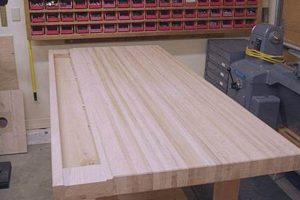
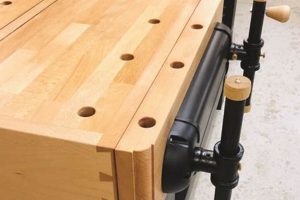
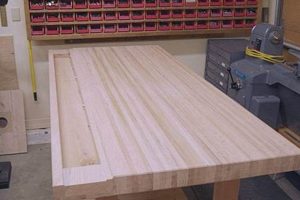
Detailed schematics and instructions originating from or commonly used within England, designed for the construction of a robust workbench, facilitate woodworking tasks. These guides provide dimensions, material lists, and step-by-step procedures to build a traditional or contemporary workbench suitable for various woodworking projects. For instance, a joiner might utilize such a guide to create a sturdy surface for assembling furniture components.
The availability of well-structured building instructions is crucial for achieving precise and functional outcomes in woodworking. Utilizing these documents offers several advantages, including minimizing material waste, ensuring structural integrity, and adhering to established woodworking practices. Historically, the development of formalized woodworking guides has contributed to the standardization and dissemination of woodworking techniques, enabling greater accessibility and consistency in craftsmanship.
The subsequent sections will delve into the critical aspects of selecting appropriate guides, examining essential workbench features, and exploring variations in designs, providing insights relevant to both novice and experienced woodworkers seeking to construct a dependable workspace.
Essential Considerations for Workbench Construction
The following recommendations aim to optimize the process of building a woodworking bench, emphasizing structural integrity and functional design.
Tip 1: Material Selection: Choose hardwoods such as beech, maple, or oak for the bench’s frame and top. These woods provide the necessary density and stability to withstand the rigors of woodworking. Softwoods are generally unsuitable for primary structural components.
Tip 2: Joint Integrity: Employ robust joinery techniques like mortise-and-tenon, dovetail, or through-tenon joints to connect the bench’s components. Secure joints are paramount for long-term stability and resistance to racking forces.
Tip 3: Bench Height Determination: Establish the appropriate bench height by measuring from the floor to the crease of the wrist while standing. Adjust the plans accordingly to ensure an ergonomic and comfortable working posture. A bench that is too high or too low can lead to fatigue and reduced precision.
Tip 4: Vise Placement and Selection: Integrate at least one vise, and preferably two, into the workbench design. Consider a face vise for general clamping and a tail vise or wagon vise for securing longer workpieces. The vise must be robust and capable of applying significant clamping pressure.
Tip 5: Dog Hole Integration: Incorporate dog holes into the benchtop to accommodate bench dogs and other workholding accessories. Accurately spaced and aligned dog holes provide versatile workholding options.
Tip 6: Flattening the Benchtop: Upon completion of the bench construction, meticulously flatten the benchtop using hand planes or a power planer followed by hand planing. A flat and level surface is critical for accurate woodworking operations.
Tip 7: Finish Application: Apply a durable finish, such as oil-based varnish or a blend of oil and wax, to protect the bench from moisture and wear. The finish should not impede the ability to easily clean the surface.
Adherence to these guidelines will contribute to the creation of a durable and functional woodworking bench, capable of withstanding the demands of various woodworking projects.
These considerations provide a solid foundation for undertaking a successful workbench building project, ensuring a valuable addition to any workshop.
1. Benchtop Thickness

Benchtop thickness is a critical parameter detailed within woodworking workbench construction guides. The dimension directly influences the workbench’s stability, mass, and ability to dampen vibrations during woodworking operations. These guides typically provide specific recommendations for benchtop thickness based on the intended use and the overall design of the workbench.
- Vibration Dampening
Increased benchtop thickness contributes directly to improved vibration dampening. A thicker benchtop absorbs more energy from impacts and tool use, resulting in a more stable and predictable working surface. Examples include hand planing operations where reduced vibration leads to more accurate and consistent results. This characteristic is critical for precision woodworking.
- Structural Rigidity
Thickness correlates directly with structural rigidity. A thicker benchtop is less prone to deflection under load, which is essential when clamping large workpieces or applying significant force during tasks such as sawing or chiseling. An example is using a thick workbench top to flatten a large table top; it will ensure even pressure distribution and prevent warping.
- Weight and Stability
A thicker benchtop inherently adds weight to the overall workbench, contributing to increased stability. This is particularly important for workbenches used with hand tools, where the user often applies significant lateral force. A heavy bench resists movement and ensures that the applied force is directed to the workpiece. A practical illustration can be found when mortising; a lighter bench would move, whilst a solid, thicker bench will remain steadfast.
- Hardware Integration
The benchtop thickness influences the selection and installation of hardware, such as vises and holdfasts. Thicker tabletops provide more material for secure mounting and allow for larger and more robust hardware. An example is the use of a leg vise. The thicker the benchtop, the more stable the vise becomes, improving overall workholding ability.
Therefore, in guides derived from the English tradition, proper attention to benchtop thickness is seen as vital for ensuring a stable, accurate, and durable woodworking platform, directly impacting the quality and efficiency of woodworking processes.
2. Joinery methods

The effectiveness of woodworking bench designs is fundamentally intertwined with the joinery methods employed during construction. These methods dictate the structural integrity and longevity of the workbench, directly influencing its ability to withstand the forces exerted during woodworking operations. Guides for constructing such benches originating from the English tradition often emphasize the use of specific joinery techniques known for their strength and durability. The selection of appropriate joinery thus becomes a critical component of these construction instructions.
For example, mortise-and-tenon joints, renowned for their resistance to racking forces, are frequently advocated for connecting the legs to the benchtop and stretchers. Dovetail joints may be recommended for securing the aprons to the benchtop, providing exceptional resistance to tear-out and shear stresses. The precise execution of these joints, as detailed in the guides, is essential for achieving a rigid and stable workbench platform. Failure to accurately execute the prescribed joinery can lead to instability, reduced load-bearing capacity, and premature failure of the bench.
In summary, the connection between joinery methods and woodworking bench guides is causal. The chosen techniques determine the bench’s structural integrity, which in turn dictates its usability and lifespan. Proficiency in these techniques, coupled with adherence to the detailed instructions provided, is paramount for constructing a reliable and durable woodworking bench according to the intended design. Selecting the right hardwoods will make it more reliable during the joining process.
3. Vise integration

Vise integration represents a fundamental component of functional woodworking bench designs. Construction guides, particularly those derived from the English tradition, invariably incorporate specific provisions for the inclusion and effective utilization of one or more vises. The absence of suitable work-holding mechanisms renders a bench significantly less effective for a wide range of woodworking tasks. Vise selection, placement, and mounting methods are critical considerations detailed within these designs. For instance, a traditional English-style bench design might feature a face vise mounted flush with the front edge of the benchtop and a tail vise integrated into the opposite end, providing versatile clamping options for various workpiece dimensions.
The specific type of vise integrated into the design directly influences the range of operations that can be performed effectively on the workbench. A robust face vise, for example, facilitates edge jointing, mortising, and dovetailing operations by securely holding workpieces in a vertical orientation. Similarly, a tail vise, often used in conjunction with bench dogs, allows for the clamping of long boards for planing or edge work. The guides typically provide instructions on how to properly mortise for the vise chop, how to create dead-straight lead screws, and how to install the vise hardware. Adherence to these guidelines is crucial for ensuring the vise functions smoothly and provides adequate clamping pressure.
Successful vise integration requires careful planning and precise execution. The woodworking construction guides provide detailed specifications for vise dimensions, mounting hardware, and reinforcement strategies. The placement of the vise must be considered in relation to the overall bench design and the intended workflow. Proper installation ensures the vise operates smoothly and securely, maximizing the bench’s utility. Furthermore, the integration may influence the choice of hardwoods that are most ideal for building a bench, as they need to be capable of withstanding sustained pressures. Overall, the English woodworking bench guides place considerable emphasis on the precise and robust incorporation of vises, reflecting the critical role of effective workholding in traditional woodworking practices.
4. Dog hole patterns

The layout of dog holes is an integral element within comprehensive woodworking bench designs. These patterns, meticulously detailed in comprehensive plans, serve as a critical component for versatile workholding. The presence and precise arrangement of these apertures directly influence the user’s capacity to secure workpieces of varying sizes and shapes during diverse woodworking operations. Without strategically placed dog holes, a woodworking bench’s utility is significantly diminished, restricting the application of essential techniques. Examples include planing wide boards, constructing mortise-and-tenon joints, or performing complex joinery, all of which benefit substantially from secure and adaptable workholding solutions. Therefore, the arrangement of dog holes, including their spacing, diameter, and alignment, is carefully prescribed within the workbench designs to maximize functionality.
The practical significance of understanding these patterns becomes apparent when considering the iterative nature of woodworking projects. Adjustments and modifications are often required, demanding a flexible workholding system. Dog holes, in conjunction with bench dogs and other accessories, provide a rapid and adaptable means of securing workpieces at different angles and orientations. Furthermore, the consistent spacing of dog holes facilitates the use of specialized jigs and fixtures, streamlining repetitive tasks and enhancing precision. As an example, consider the construction of a series of identical drawers; a well-designed dog hole pattern allows for the creation of a jig that precisely positions each drawer component for assembly.
In summary, the careful consideration and implementation of dog hole patterns represent a key determinant of a woodworking bench’s effectiveness. The specific designs offer standardized layouts and recommendations for patterns that enhance workholding capabilities. Challenges in implementing these patterns arise when deviating from the prescribed specifications or failing to account for the intended applications. These arrangements are pivotal to achieving efficiency and accuracy in a broad spectrum of woodworking tasks, affirming their essential role within the design and implementation of high-functioning workbenches.
5. Leg stability

Leg stability is a paramount consideration within comprehensive documents used to build a woodworking bench. The structural integrity of the legs directly influences the workbench’s overall stability and resistance to movement during woodworking operations. Insufficient leg stability compromises the accuracy and efficiency of tasks, particularly those involving hand tools, where significant force is often applied. As a consequence, these guides invariably dedicate substantial attention to leg design, construction techniques, and reinforcement strategies to ensure a rigid and unwavering base. For example, designs frequently prescribe specific leg dimensions, the use of robust joinery such as mortise-and-tenon joints to connect legs to the benchtop and stretchers, and the incorporation of stretchers to triangulate and stiffen the leg assembly.
The practical consequences of inadequate leg stability are readily observable in the workshop. A workbench with wobbly or flexible legs transmits vibrations, making precise hand planing or chiseling operations challenging. Furthermore, movement of the bench during sawing or hammering can compromise accuracy and increase the risk of injury. English woodworking bench designs often address these potential issues through a combination of factors, including the selection of dense hardwoods for leg construction, the use of diagonally braced stretchers to resist racking forces, and the incorporation of a substantial base that spreads the load evenly across the floor. Failure to adequately address leg stability can negate the benefits of other design features, such as a thick benchtop or well-integrated vises.
In summary, leg stability is not merely a secondary consideration but a fundamental requirement for a functional woodworking bench. Documents derived from English woodworking traditions prioritize leg construction as a means of ensuring a stable and predictable platform for woodworking activities. The detailed specifications and construction techniques outlined in these guides reflect a commitment to building workbenches that withstand the demands of rigorous use, promoting accuracy, efficiency, and safety in the workshop. Any deviations from the recommended leg design or construction methods risk compromising the workbench’s stability and ultimately undermining its usefulness.
6. Apron design

Apron design, within the framework of English woodworking bench layouts, exerts a considerable influence on overall workbench stability and functionality. It encompasses the structural elements connecting the benchtop to the leg assembly, contributing significantly to rigidity and providing additional utility through integrated features.
- Structural Reinforcement
The primary function of the apron is to reinforce the connection between the benchtop and legs, mitigating racking and deformation under load. Designs originating from the English tradition often specify aprons constructed from thick, dimensionally stable hardwoods, secured to both the benchtop and legs using robust joinery techniques such as mortise-and-tenon joints. This approach enhances the workbench’s resistance to twisting forces, ensuring a stable working platform even when subjected to heavy or unevenly distributed loads. A practical example can be found when hand planing wide boards; a well-designed apron prevents the bench from flexing, allowing for consistent and accurate cuts.
- Vise Integration Support
The apron can serve as a critical support structure for vise installations. Certain vise designs, particularly those involving substantial clamping forces, benefit from direct anchoring to the apron. This arrangement distributes the clamping load across a larger area, reducing stress on the benchtop and legs. Specific designs might include reinforced apron sections or strategically placed mounting points to accommodate the vise hardware. For instance, a leg vise benefits greatly from an apron that is joined to the leg with a mortise and tenon joint, and provides further support with a tenon joined into the bottom of the benchtop.
- Tool Storage Considerations
Apron design also influences the potential for integrated tool storage. Certain designs incorporate drawers or open shelves within the apron structure, providing convenient access to frequently used tools. This can improve workflow efficiency and reduce clutter on the benchtop. Examples range from simple open shelves for storing hand planes to more elaborate drawer systems for organizing smaller tools and accessories. For example, the guide may also suggest adding wooden dividers inside the drawer, so that tools don’t roll around inside.
- Design Aesthetics and Tradition
Beyond functional considerations, apron design contributes to the overall aesthetic character of the workbench and often reflects historical woodworking traditions. English workbench designs often feature specific apron profiles, joinery details, and decorative elements that evoke a sense of craftsmanship and heritage. These aesthetic choices can be as important as the overall build, and also can be dictated by the amount of skill the builder has.
In conclusion, apron design constitutes a critical aspect of English woodworking bench structure. From structural reinforcement and vise support to tool storage and aesthetic considerations, the apron contributes significantly to the overall functionality, durability, and visual appeal of the workbench. These considerations are essential for any woodworker seeking to construct a high-quality, functional, and historically informed workbench based on designs originating from the English tradition.
7. Material sourcing

Material sourcing constitutes a critical dependency within the execution of designs for woodworking benches, particularly those adhering to the English tradition. Construction guides, whether historical or contemporary, presuppose the availability of specific wood species and dimensions to achieve the intended structural integrity and aesthetic qualities. The plans typically specify hardwoods like beech, oak, or maple for the benchtop, legs, and stretchers, emphasizing their inherent strength, stability, and resistance to wear. A deviation from these material recommendations introduces risks that may compromise the workbench’s performance and longevity. For instance, substituting a softwood for a hardwood in the benchtop construction can lead to excessive deflection under load and premature wear, undermining the effectiveness of the entire structure. The effectiveness of joinery depends on this aspect. Therefore, sourcing materials effectively becomes an essential component of workbench construction.
The practical implications of material selection extend beyond structural considerations to encompass economic and environmental factors. Sourcing locally available hardwoods can significantly reduce material costs and minimize the environmental impact associated with transportation. However, local availability is often contingent upon regional variations in forestry practices and market demand. As such, the woodworking plans may include alternative material suggestions or guidance on adapting the design to accommodate locally available resources. A real-life example might involve a woodworker in a region where maple is scarce opting to use locally sourced birch as a substitute, adapting the joinery dimensions and reinforcement strategies to account for the birch’s slightly lower density. For certain aspects, sourcing metals for vices are essential.
In summary, material sourcing is inextricably linked to the successful implementation of any woodworking bench design. Precise material selection is often included in the documentation for building a bench, impacting every aspect of functionality, and potentially the economic and environmental impact. Careful consideration of material options, local availability, and design adaptations is essential for ensuring the creation of a durable and effective woodworking platform. Without appropriate materials, there is a risk of failure. The importance of documentation for English-style builds cannot be understated.
Frequently Asked Questions
The following addresses common inquiries regarding the selection, interpretation, and implementation of detailed instructions for building woodworking benches, particularly those originating from traditional English designs.
Question 1: What hardwood species are most suitable for constructing a woodworking bench according to traditional English guides?
Traditionally, hardwoods such as beech, oak, and maple are favored. These species exhibit a combination of strength, stability, and resistance to wear, essential for withstanding the stresses associated with woodworking operations. The documentation for these builds will often specify the selection.
Question 2: How critical is adherence to the dimensions specified in documents when building a woodworking bench?
Adherence to specified dimensions is crucial for maintaining the structural integrity and functionality of the workbench. Deviations from the prescribed measurements can compromise stability, workholding effectiveness, and overall performance. Proper bench height should be considered for optimal ergonomics.
Question 3: What joinery techniques are typically recommended for constructing a robust workbench frame?
Mortise-and-tenon joints are generally preferred for connecting the legs to the benchtop and stretchers, providing exceptional strength and resistance to racking forces. Dovetail joints may be used for securing aprons or other structural components, enhancing overall rigidity.
Question 4: How should vises be integrated into the workbench design to maximize workholding versatility?
A face vise mounted flush with the front edge of the benchtop and a tail vise integrated into the opposite end offer a versatile combination for securing various workpiece dimensions. Vise placement should be carefully considered to accommodate common woodworking tasks.
Question 5: Why are dog holes incorporated into workbench designs, and what considerations govern their placement?
Dog holes, in conjunction with bench dogs, provide a flexible means of securing workpieces at different angles and orientations. Their spacing and alignment are carefully planned to accommodate a variety of clamping configurations and specialized jigs.
Question 6: How should the workbench surface be prepared to ensure accurate woodworking operations?
The benchtop should be meticulously flattened using hand planes or a power planer, followed by hand planing, to create a level and consistent working surface. This process is essential for achieving precise and accurate woodworking results.
Understanding these key considerations is essential for successfully interpreting woodworking documentation and constructing a functional and durable workbench.
The subsequent discussion will explore specific workbench modifications and customization options to suit individual woodworking needs and preferences.
Conclusion
The preceding exploration of documents associated with robust woodworking workspaces has illuminated critical aspects for constructing a durable and functional platform. Topics encompassed material selection, joinery techniques, vise integration, dog hole patterns, leg stability, apron design, and material sourcing. These factors collectively determine the workbench’s capacity to withstand the demands of rigorous woodworking tasks and foster precision in craftsmanship.
Diligent adherence to established building instructions represents a foundational element for achieving a workspace conducive to both traditional and contemporary woodworking practices. Continued refinement of these instructionals and an unwavering commitment to quality construction materials will serve to perpetuate a legacy of excellence in woodworking for generations to come.
![Build A Roman Woodworking Bench [DIY Guide] | Step-by-Step Guides, Tools & Inspiration to Build Beautiful Wooden Decor on a Budget](https://woodfromhome.com/wp-content/uploads/2026/05/th-207-300x200.jpg "Build A Roman Woodworking Bench [DIY Guide] Step-by-Step Guides, Tools & Inspiration to Build Beautiful Wooden Decor on a Budget")