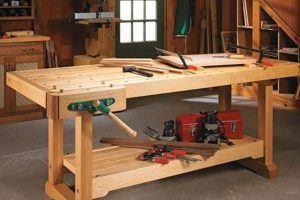
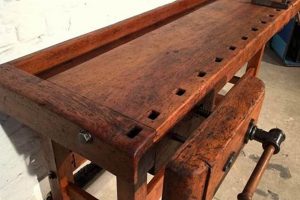
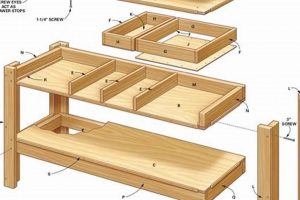
Hardwood surfaces crafted from Acer saccharum are frequently utilized as the primary work area in woodworking environments. These robust platforms provide a stable and durable foundation for a range of tasks, from intricate joinery to the assembly of larger projects. For instance, a craftsman might employ such a surface to precisely cut dovetails or to securely clamp components during glue-up.
The selection of this specific material for workbench construction stems from its exceptional density and resistance to wear. This characteristic enables the surface to withstand significant impact and pressure without sustaining substantial damage. Furthermore, the relative stability of this wood minimizes warping and movement over time, contributing to the longevity and accuracy of the workbench. Historically, this type of surface has been favored by artisans and tradespeople for its reliability and capacity to enhance the quality of their work.
The following sections will delve into the specific properties that make this material a preferred choice, examine various construction techniques employed in creating these surfaces, and provide guidance on proper maintenance to ensure optimal performance and longevity.
Tips for Maple Woodworking Bench Surfaces
The following guidelines outline recommended practices for maximizing the performance and extending the lifespan of surfaces made from Acer saccharum used in woodworking.
Tip 1: Apply a Protective Finish. A durable finish, such as oil-based polyurethane or a blend of oil and wax, should be applied to seal the wood and protect against moisture absorption and staining. Multiple coats are recommended for optimal protection.
Tip 2: Flatten the Surface Regularly. Over time, even the most stable surface can develop minor imperfections. Employing hand planes or a router sled to periodically flatten the surface ensures consistent and accurate work.
Tip 3: Use Bench Cookies or Pads. When clamping or performing impact-related tasks, place bench cookies or pads between the workpiece and the surface. This distributes pressure and prevents dents or scratches.
Tip 4: Clean Spills Promptly. Liquids, especially solvents and adhesives, should be cleaned immediately to prevent absorption and potential damage. Use a clean cloth and appropriate cleaning solutions.
Tip 5: Avoid Extreme Temperature Fluctuations. Significant changes in temperature and humidity can cause the wood to expand and contract, potentially leading to warping or cracking. Maintain a stable environment in the workspace.
Tip 6: Tighten Vise Hardware Periodically. Ensure that all vise hardware is securely fastened to prevent movement and maintain clamping accuracy. Regularly inspect and tighten bolts and screws as needed.
Tip 7: Consider a Dead Blow Hammer. When assembling projects on the surface, a dead blow hammer minimizes impact and reduces the risk of marring the wood. It delivers force without bouncing, providing controlled strikes.
Adhering to these practices will help maintain the integrity and functionality of the surface, ensuring it remains a reliable and effective tool for woodworking projects for years to come.
The final section will address common questions and concerns regarding the care and maintenance of these surfaces.
1. Hardness and Durability

Hardness and durability are critical attributes in the context of work surfaces crafted from Acer saccharum. These characteristics directly influence the workbench’s capacity to withstand the rigors of woodworking tasks and maintain its structural integrity over extended periods. The wood’s inherent resistance to indentation and abrasion dictates its suitability for heavy use.
- Janka Hardness Rating
The Janka hardness test measures the force required to embed a steel ball into a piece of wood. Acer saccharum exhibits a high Janka rating, indicating its superior resistance to denting and scratching compared to softer woods. This property is crucial for a workbench top, which is frequently subjected to impact from tools, workpieces, and clamping forces. Higher hardness translates to reduced wear and tear over time.
- Resistance to Abrasion
Woodworking tasks often involve abrasive materials such as sandpaper, files, and chisels. A durable surface resists abrasion, preventing the formation of grooves and imperfections that can compromise the flatness and accuracy of the work area. Surfaces constructed from Acer saccharum retain their smoothness and integrity despite repeated exposure to abrasive forces, ensuring consistent work quality.
- Impact Resistance
Workbenches are often used for tasks that involve hammering, chiseling, and other impact-related activities. High-impact resistance prevents the surface from splitting or cracking under sudden force. This property is particularly important for supporting heavy workpieces and absorbing vibrations, contributing to a safer and more efficient working environment. Acer saccharum’s density and fiber structure provide significant impact resistance.
- Long-Term Stability
The combination of hardness and durability contributes to the long-term stability of a workbench surface. A surface resistant to wear and damage maintains its flatness and structural integrity over many years, minimizing the need for frequent repairs or replacements. This longevity represents a significant cost-saving factor for woodworkers and ensures a reliable working platform for future projects.
In summary, the hardness and durability of Acer saccharum are integral to its suitability as a material for woodworking bench tops. These properties ensure the surface can withstand the demanding conditions of a workshop environment, maintain its precision, and provide a reliable platform for woodworking projects for years to come.
2. Surface Stability

Surface stability, concerning work surfaces fabricated from Acer saccharum, refers to the material’s capacity to maintain its dimensional integrity and flatness under varying environmental conditions and mechanical stresses. This characteristic is paramount for precision woodworking, where even minor deviations can compromise the accuracy of joinery and assembly.
- Moisture Resistance and Dimensional Change
Acer saccharum, while a dense hardwood, is still susceptible to moisture absorption and desorption, which can induce dimensional changes. The stability of the surface is contingent upon the wood’s ability to resist warping, cupping, or twisting in response to humidity fluctuations. Kiln-drying the wood to a low moisture content before construction, followed by the application of a moisture-resistant finish, can significantly enhance stability.
- Wood Grain Orientation
The orientation of the wood grain during the construction of the surface plays a crucial role in its stability. Quarter-sawn or rift-sawn lumber, with grain patterns oriented perpendicular to the surface, exhibits greater stability compared to flat-sawn lumber. This orientation minimizes tangential expansion and contraction, reducing the likelihood of warping. Proper grain selection and orientation are essential for maintaining a flat and true work surface.
- Lamination Techniques
Laminating multiple layers of Acer saccharum together enhances stability by distributing stress and counteracting wood movement. The grain direction of each layer is typically alternated to further minimize warping. This technique creates a composite structure that is more resistant to dimensional changes than a single solid piece of wood. Lamination is a common practice in the construction of high-quality workbench tops.
- Support Structure and Base Design
The stability of the support structure beneath the surface directly impacts the overall stability of the workbench. A rigid and well-designed base prevents sagging and twisting, ensuring that the surface remains flat and level. The base should be constructed from stable materials and properly connected to the top to provide adequate support. Regular inspection and maintenance of the base are essential for maintaining surface stability.
These interconnected factors collectively determine the stability of surfaces crafted from Acer saccharum. Maintaining a stable work surface is essential for achieving accurate and consistent results in woodworking projects. Proper material selection, construction techniques, and environmental control contribute to the longevity and reliability of these surfaces.
3. Dimensional Accuracy

Dimensional accuracy is a critical attribute of woodworking bench tops constructed from Acer saccharum. It directly influences the precision and quality of woodworking projects undertaken on the surface. The ability of the bench top to maintain consistent dimensions and a flat, true plane provides a reliable reference point for measuring, cutting, and assembling workpieces. Any deviation from dimensional accuracy can introduce errors that accumulate throughout the project, leading to misaligned joinery, inaccurate cuts, and overall compromised results. The selection and preparation of material, coupled with sound construction techniques, are fundamental to achieving and preserving dimensional accuracy.
The influence of a dimensionally accurate surface is evident in various woodworking applications. Consider the construction of a dovetailed drawer. If the surface is not perfectly flat, clamping the drawer parts for glue-up will introduce stresses that distort the assembly, resulting in gaps or uneven alignment. Similarly, when using the bench top as a reference for planing stock to a specific thickness, any inconsistencies in the surface will translate into inaccuracies in the workpiece. Maintaining dimensional accuracy necessitates employing techniques such as laminating multiple layers of wood with alternating grain directions to minimize warping and using a stable base to prevent sagging. Regular flattening of the surface with hand planes or power tools further ensures consistent dimensional accuracy over time.
In conclusion, the dimensional accuracy of Acer saccharum work surfaces directly affects the fidelity of finished woodworking pieces. Its attainment requires careful material selection, skilled fabrication, and conscientious maintenance. The consequence of neglecting this aspect is project imprecision. Thus, a dimensionally accurate surface is not merely a desirable feature but a functional necessity for precision craftsmanship.
4. Vibration Dampening
Vibration dampening, in the context of woodworking benches incorporating surfaces crafted from Acer saccharum, refers to the ability of the bench to mitigate the transmission of oscillatory forces generated during various woodworking operations. This characteristic is significant for enhancing both the precision of work and the comfort of the woodworker.
- Material Density and Mass
The density and mass of Acer saccharum contribute directly to its vibration-dampening capabilities. Denser materials possess a greater inertia, resisting acceleration and deceleration caused by vibrational forces. A heavier workbench top absorbs more energy, reducing the amplitude of vibrations transmitted to the work surface and surrounding environment. This is critical when performing tasks requiring precision, such as carving or intricate joinery.
- Internal Damping Properties
Beyond density, the internal damping properties of Acer saccharum influence how effectively it dissipates vibrational energy. Internal damping refers to the material’s capacity to convert mechanical energy into heat due to internal friction. Wood, as a viscoelastic material, exhibits inherent damping characteristics. The specific cellular structure of Acer saccharum, while hard, allows for some energy dissipation, minimizing the propagation of vibrations.
- Joint Construction and Rigidity
The method of joining the Acer saccharum top to the bench’s base significantly affects vibration dampening. Rigid, well-fitted joints maximize the transfer of vibrational energy from the top to the base, allowing the entire structure to contribute to energy dissipation. Conversely, loose or poorly constructed joints can amplify vibrations by creating resonant frequencies. Dovetail joints, mortise and tenon joints, and robust bolting are common techniques for ensuring joint rigidity.
- Bench Mass and Footing
The overall mass of the workbench, including the base and any internal bracing, further enhances vibration dampening. A heavier bench is less susceptible to movement caused by vibrations. Moreover, the type of footing used whether rubber pads, levelers, or direct contact with the floor influences the transmission of vibrations to the surrounding environment. Vibration-dampening feet can further isolate the bench and reduce noise levels.
In summary, effective vibration dampening in woodworking benches featuring surfaces of Acer saccharum is a multifaceted property influenced by the material’s inherent characteristics, the bench’s structural design, and its interface with the surrounding environment. A workbench that effectively dampens vibrations provides a more stable and controlled working platform, ultimately contributing to improved precision and reduced fatigue for the woodworker.
5. Finish Compatibility
The selection of a compatible finish for surfaces constructed from Acer saccharum is a critical consideration in woodworking. The interaction between the chosen finish and the wood’s properties dictates not only the aesthetic outcome but also the long-term performance and protection of the bench top. Understanding the nuances of this interaction is essential for achieving a durable, functional, and visually appealing work surface.
- Oil-Based Finishes and Absorption Rates
Acer saccharum, while dense, possesses a cellular structure that allows for the absorption of oil-based finishes. These finishes, such as linseed oil or tung oil, penetrate the wood fibers, providing protection from within. However, excessive absorption can lead to a sticky or uncured surface. Careful application and wiping away excess finish are crucial to achieving a durable and non-tacky result. An example of successful application is a hand-rubbed oil finish that enhances the wood’s natural grain while providing a measure of water resistance.
- Water-Based Finishes and Grain Raising
Water-based finishes offer an alternative to oil-based products, providing a durable protective layer with lower VOC emissions. However, the application of water-based finishes to Acer saccharum can raise the grain, resulting in a rough surface. Proper surface preparation, including sanding to a fine grit and pre-raising the grain with water before final sanding, is necessary to minimize this effect. The use of a sanding sealer can further mitigate grain raising, ensuring a smooth and even finish.
- Polyurethane Finishes and Durability
Polyurethane finishes, available in both oil-based and water-based formulations, offer excellent durability and resistance to scratches, chemicals, and moisture. These finishes form a hard, protective film on the surface of the Acer saccharum bench top, providing long-lasting protection against the rigors of a woodworking environment. However, polyurethane finishes can obscure the natural grain and color of the wood to some extent. Selecting a satin or matte sheen can help minimize this effect while still providing superior protection.
- Wax Finishes and Maintenance
Wax finishes, such as beeswax or carnauba wax, provide a natural and low-luster protective layer. These finishes are easy to apply and maintain but offer less protection against moisture and chemicals compared to polyurethane. Wax finishes are often used as a topcoat over oil-based finishes to enhance their water resistance and provide a smooth, tactile surface. Regular reapplication of wax is necessary to maintain the protective properties of the finish.
The choice of finish for surfaces crafted from Acer saccharum is a critical decision that balances aesthetics, durability, and ease of maintenance. Understanding the interaction between different finish types and the wood’s properties allows woodworkers to select the most appropriate finish for their specific needs and preferences, ensuring a long-lasting and functional work surface.
6. Workholding Options

Effective workholding is paramount in woodworking, and the design of a workbench surface fabricated from Acer saccharum must accommodate a variety of methods for securing workpieces. The integration of appropriate workholding features enhances the versatility and efficiency of the workbench.
- Dog Holes and Bench Dogs
Dog holes, typically round or rectangular apertures spaced regularly across the surface, allow for the use of bench dogs. These dogs, often made of metal or wood, act as stops against which workpieces can be clamped or positioned. The precision and consistent spacing of dog holes are critical for accurate and repeatable setups. An example of their application is in edge-jointing boards where dogs, combined with a vise, secure the board for planing.
- Vises (Face, Tail, and Leg Vises)
Vises are essential for clamping workpieces securely to the surface. Face vises, mounted on the front of the bench, provide clamping force parallel to the user. Tail vises, integrated into the end of the bench, utilize a sliding jaw and dog holes to clamp long workpieces. Leg vises offer substantial clamping power and are advantageous for tasks requiring heavy force, such as chopping mortises. The selection and installation of appropriate vises are crucial for a functional workbench.
- Clamping Tracks and T-Tracks
Clamping tracks or T-tracks, recessed into the surface, provide versatile attachment points for clamps and jigs. These tracks allow for the secure positioning of clamping devices at any point along their length. An advantage of this system is its adaptability to various workpiece shapes and sizes. This feature is particularly useful for assembling complex projects or securing irregularly shaped components.
- Surface Texture and Friction
While not a direct workholding device, the surface texture of the Acer saccharum top contributes to workpiece stability. A smooth, flat surface provides a consistent contact area, minimizing slippage. Some woodworkers prefer a slightly roughened surface to increase friction, particularly when working with hand tools. The appropriate surface texture enhances control and reduces the likelihood of workpiece movement during critical operations.
These workholding options, when effectively integrated into a surface constructed from Acer saccharum, provide a comprehensive system for securing workpieces of various shapes and sizes. The careful consideration and implementation of these features transform the bench from a mere surface into a versatile and indispensable tool for woodworking.
Frequently Asked Questions
The following addresses common inquiries concerning work surfaces crafted from Acer saccharum used in woodworking applications. These questions aim to provide clarity on the properties, maintenance, and suitability of this material for workbench construction.
Question 1: What is the typical lifespan of maple woodworking bench tops?
The lifespan of a workbench surface constructed from Acer saccharum depends on several factors, including the quality of the wood, the construction techniques employed, the intensity of use, and the level of maintenance provided. With proper care, such a surface can last for several decades, often exceeding the lifespan of other workbench materials.
Question 2: How does the hardness of maple compare to other common workbench materials?
Acer saccharum possesses a Janka hardness rating that is generally higher than that of softwoods like pine or fir, making it more resistant to dents and scratches. It falls within the range of other hardwoods commonly used for workbenches, such as beech or birch. This hardness contributes to its durability and suitability for woodworking applications.
Question 3: What is the best method for flattening maple woodworking bench tops?
Flattening can be accomplished using both hand tools and power tools. Hand planing, using a jointer plane and a smoothing plane, is a traditional method for achieving a flat and true surface. Alternatively, a router sled can be used to remove material quickly and efficiently. The choice of method depends on the individual’s skill level, available tools, and desired level of precision.
Question 4: How should spills and stains be addressed on maple woodworking bench tops?
Prompt cleaning is essential to prevent permanent staining. Liquids should be wiped up immediately with a clean cloth. For stubborn stains, a mild abrasive cleaner or a solution of water and vinegar can be used. Harsh chemicals or solvents should be avoided, as they can damage the finish and the wood itself.
Question 5: Is it necessary to apply a finish to maple woodworking bench tops?
While not strictly necessary, applying a finish is highly recommended to protect the wood from moisture, stains, and wear. A finish can also enhance the aesthetic appeal of the surface. Options include oil-based finishes, water-based finishes, and wax finishes, each offering different levels of protection and maintenance requirements.
Question 6: What is the best way to prevent warping in maple woodworking bench tops?
Preventing warping involves several strategies, including selecting kiln-dried lumber, laminating multiple layers of wood with alternating grain directions, applying a moisture-resistant finish, and maintaining a stable environment in the workspace. Proper storage of the lumber before construction is also crucial. These measures minimize the wood’s susceptibility to moisture-induced dimensional changes.
These questions and answers provide a foundation for understanding the properties and maintenance of work surfaces constructed from Acer saccharum. Further research and consultation with experienced woodworkers can provide more specific guidance tailored to individual needs and circumstances.
The subsequent section will examine the economic factors associated with choosing this specific material for workbench construction.
Conclusion
This exploration has detailed the multifaceted considerations surrounding Acer saccharum as a material choice for work surfaces. From hardness and dimensional stability to finish compatibility and workholding options, this analysis underscores the importance of informed decision-making in workbench construction. The longevity and precision afforded by a well-crafted and maintained Acer saccharum surface represent a significant investment in woodworking capabilities.
Ultimately, the suitability of maple woodworking bench tops hinges on a balance of factors, including the intended use, the working environment, and the commitment to proper maintenance. The data presented herein serves as a framework for assessing the value and applicability of this material in diverse woodworking contexts. The continued refinement of construction and maintenance techniques promises to further enhance the performance and lifespan of these essential tools.